
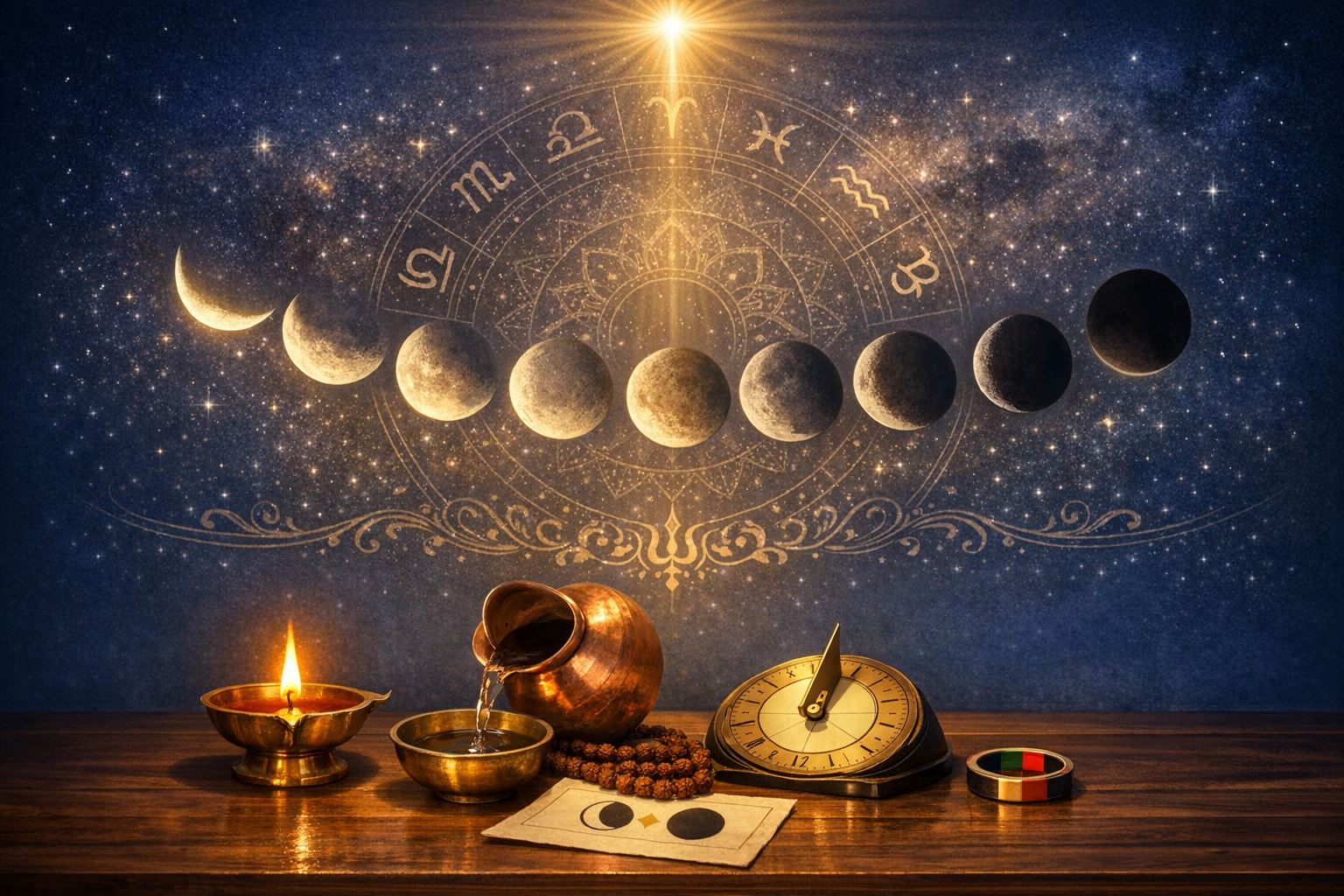
On Sunday, June 14, 2026, the Hindu Panchang records Krishna Paksha Chaturdashithe fourteenth lunar day in the waning fortnightuntil 11:14 AM. From that moment, Amavasya (the no-moon tithi) begins and, per the source, continues until 8:45; because the unit after “8:45” is not specified, corroboration with a reliable local panchang or temple almanac is recommended. As with all tithi transitions, minor differences can occur by region, time zone, and computational method (Drik versus traditional Surya Siddhanta), so practitioners in locations outside India should adjust to local sunrise and lunar timings.
In the Hindu calendar, a tithi is defined by the longitudinal separation between the Moon and the Sun, measured in 12-degree intervals. Krishna Paksha denotes the waning half of the lunar month, culminating in Amavasya, which is traditionally oriented toward inward practices, silence, charity, and remembrance of ancestors (pitṛ-tarpaṇa), while steering clear of inaugurating major worldly ventures. Chaturdashi in the waning phase is classically associated with austerity and focused worship, especially of Shiva, whereas Amavasya emphasizes cleansing rites, dāna, japa, and contemplation.
Because this day shifts from Krishna Paksha Chaturdashi in the forenoon to Amavasya thereafter, its practical use divides into two parts. Before 11:14 AM, the tithi favors tapas, Shiva-oriented worship, and remedial observances. After 11:14 AM, Amavasya predominates, and many traditions encourage quiet sādhanā, tarpaṇa for ancestors where appropriate, and works of service or charity. Across dharmic households, a balanced approach is to avoid beginning high-stakes secular commitments under Amavasya while embracing spiritual inventories, atonement, and reflection.
Shubh Muhurat selection on such a day benefits from a nuanced approach. When immediate action is necessary, the midday Abhijit Muhuratdefined around local solar noon for approximately 48 minutesoffers a widely acknowledged window for urgency, though it remains subordinate to the sanctity and mood of the governing tithi. For purely spiritual activities, practitioners often prioritize sattvic hours (Brahma Muhurta before sunrise, or calm evening hours) and ensure alignment with the day’s tithi tenor: restrained, prayerful, and inward-looking during Amavasya.
To refine timing further, traditional filters such as Rahu Kaal, Yamaganda, and Gulika Kalam are applied. These segments are computed by dividing the daylight interval (sunrise to sunset) into eight equal parts and mapping weekday-specific segments to each doṣa. For Sunday, Rahu Kaal occupies the eighth segment of daylight, Yamaganda the fourth, and Gulika Kalam the seventh; practitioners should derive exact local spans by first determining the precise local sunrise and sunset. Avoiding these intervals for auspicious initiations enhances the quality of the chosen muhurta.
The Abhijit Muhurat is centered on local solar noon (not merely clock noon), with an effective span of roughly 24 minutes before and after that point. Because solar noon varies slightly by longitude and the equation of time, it is best calculated using a trusted panchang or astronomical utility for the precise location. On a tithi that transitions into Amavasya, Abhijit can still be used for necessary undertakings; however, the day’s spiritual texture generally counsels simplicity, humility, and introspective works over celebratory commencements.
Nakshatra and Rashi add additional layers of granularity to any Panchang-based decision. The Nakshatra describes the Moon’s stellar mansion and informs the qualitative tone of the day, while the Chandra Rashi (Moon sign) refines how emotions and decisions may flow. As Nakshatra and Rashi shift with the Moon’s motion, their precise identification for June 14, 2026 depends on local time and the computational standard consulted. Accordingly, cross-verification with a region-specific Panchang is prudent, especially when planning life events or samskāras that require a high degree of precision.
Because calendars in the Indian cultural sphere are regionalized, month naming and observance emphases can differ (e.g., Jyeṣṭha, Adhik Jyeṣṭha, Aani in Tamil tradition). The same astronomical instant can carry slightly different community customs, and this pluralism is a strength of the broader dharmic ecosystem. Responsible practice emphasizes both fidelity to astronomical reality and respect for local guidancetemple schedules, family paramparā, and the counsel of learned pandits, bhikkhus, sadhus, or granthis as relevant to one’s lineage and place.
Dharmic unity naturally flowers around lunar observances such as Amavasya. Many Buddhist communities align their discipline cycles to lunar phases; Jaina traditions emphasize pratikraman and heightened ahiṃsā during sensitive tithis; Sikh homes may prefer reflective simran and ardas while following the Nanakshahi calendar for gurpurabs. This shared attentiveness to time as a vehicle for ethical living and inner cultivation affirms a common civilizational grammar that celebrates compassion, truth-seeking, and service.
A practical routine for this day might begin with dawn meditation, mantra japa, or scriptural reflection during Brahma Muhurta, followed by light worship during Krishna Paksha Chaturdashi hours for steadiness and clarity. After the Amavasya transition, families often keep the home atmosphere serene, perform pitṛ-tarpaṇa where customary, and dedicate time or resources to charitable causes. Even simple actsmindful silence, a vow of kindness, or supporting community kitchenscarry special potency under the new moon’s contemplative canopy.
Because the source indicates Amavasya extends “till 8:45” without specifying the unit, those scheduling rites that are sensitive to tithi endings (e.g., darśa-related offerings) should confirm the terminal time with a dependable regional Panchang. When in doubt, prioritize sunrise-based determinations, verify using more than one almanac where possible, and keep the day’s core intentpurification, remembrance, and renewalat the forefront.
In summary, June 14, 2026 interweaves a Krishna Paksha Chaturdashi morning with an Amavasya-dominated remainder, inviting a calm, service-oriented, and introspective rhythm. Attention to Abhijit Muhurat for necessities, mindful avoidance of Sunday’s Rahu Kaal, and sensitive alignment with Nakshatra and Rashi yield both practical order and spiritual depth. The Panchang remains, above all, a compass for ethical timingone that unites the many streams of the dharmic family in a shared pursuit of wisdom and well-being.
Inspired by this post on Hindu Blog.
