
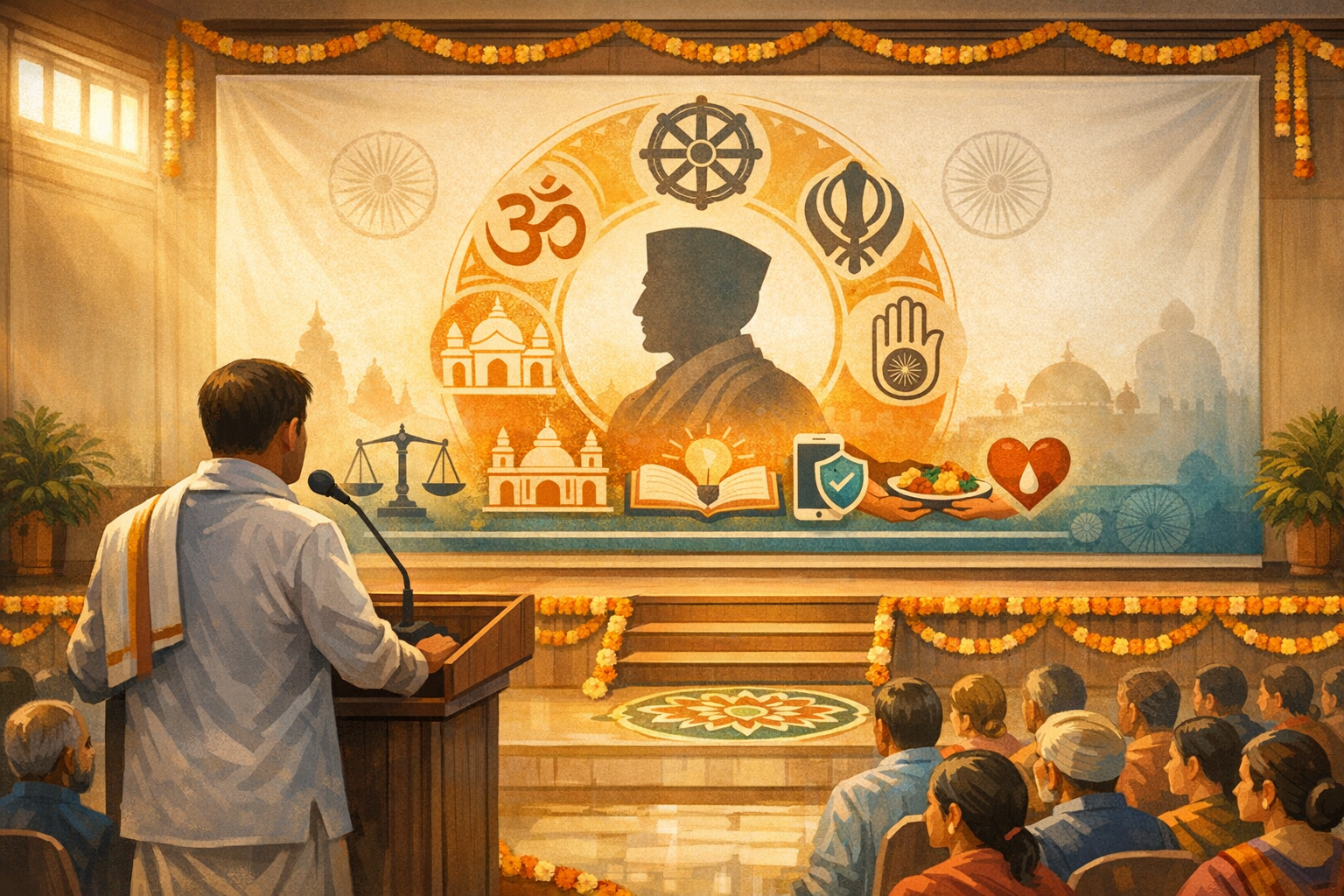
At a Hindu Ekta Sabha held in Nipani (Belagavi, Karnataka), speakers called for deeper Hindu unity, safeguarding of civilizational values, and fresh inspiration from Swatantryaveer Savarkar’s thought to address contemporary social and cultural challenges. In remarks that framed the gathering, Pramod Muthalik stated that “Savarkar’s ideology remains an enduring inspiration for Hindu society,” setting the tone for a discussion on constructive, lawful, and community-centric pathways to solidarity.
Within the forum’s emphasis on unity, the call extended to the broader family of Dharmic traditionsHinduism, Buddhism, Jainism, and Sikhismrecognizing shared ethical foundations such as dharma, karuna, ahimsa, and seva. Participants described unity not as uniformity but as cooperation around constitutional rights, cultural heritage, and mutual respect across sampradāyas and panthas, reflecting the longstanding ethos of Sanatana Dharma that welcomes diversity under a common civilizational canopy.
A brief analytical lens on Savarkar’s intellectual corpus helps situate the invocation of his name at Nipani. In Hindutva: Who Is a Hindu? and other writings, Savarkar articulated Hindutva primarily as a cultural-civilizational identity anchored in a shared history, sacred geography, and social memory, rather than as a narrow theological or ritual prescription. He coupled this with a modernist and rationalist spiritadvocating scientific temper, caste-transcending social reform (including temple access and inter-dining), and civic disciplineideas that many see as relevant to strengthening community cohesion today.
Interpreted through a contemporary, constitutional lens, the forum’s call to “protect values” was framed as a commitment to lawful pluralism, women’s dignity, inclusion of marginalized communities, ethical public conduct, and the preservation of temples, monasteries, gurudwaras, and sacred sites. The emphasis remained on civic responsibility and self-restraint, consistent with the Dharmic insight that inner order and outer order must reinforce each other for society to flourish.
Speakers and attendees identified a cluster of present-day challenges: erosion of cultural literacy among youth; neglect or encroachment affecting heritage spaces; polarizing misinformation on social media; episodic law-and-order flashpoints around festivals; and a general deficit of cross-community trust. Many participants, drawing on local experiences in Belagavi district and beyond, underscored that these are solvable through patient institution-building and community-led collaboration rather than reactive posturing.
Consistent with that diagnosis, an actionable, multi-pronged approach was discussed in the spirit of Savarkar’s emphasis on organization and civic discipline. First, community education can be strengthened through locally-adapted modules on Indian civilizational ethics, comparative study of Dharmic philosophies, and primary-source reading circles that cultivate intellectual humility and evidence-based debate. Second, heritage stewardship can be scaled by documenting temple and gurudwara assets, training volunteers in basic conservation protocols, and building partnerships with municipal authorities for transparent upkeep.
Third, legal literacy and rights-based engagement can help communities work confidently within the rule of lawcovering procedures for event permissions, noise and safety compliance, heritage regulation, and grievance redress. Fourth, digital civility initiativespeer-led fact-checking groups, rumor reporting channels, and training in responsible content sharingcan pre-empt online provocation and blunt the spread of incendiary narratives that undermine harmony. Finally, a renewed emphasis on sevablood donation drives, disaster response training, food security initiatives such as annadānam and langarcan transform unity from rhetoric into daily, measurable service.
Testimonials shared at the Sabha offered a human face to these priorities. Volunteers from youth mandals, mahila groups, and local trusts described how inter-dharma service projectshospital aid desks, exam mentoring for first-generation learners, and neighborhood cleanliness campaignslower social barriers and create a vocabulary of trust that politics alone cannot produce. These lived experiences illustrated a principle recognizable across Dharmic traditions: sustained, non-transactional service dissolves suspicion and builds durable social capital.
In translating inspiration into outcomes, a constitutional guardrail was repeatedly affirmed: unity efforts must eschew hate speech, vigilantism, and coercion, and remain anchored in lawful methods, dialogue, and peaceful mobilization. That restraint is not a retreat but a strategyaligning community energy with institutions that protect fundamental rights (Articles 25–28) while ensuring that public order and mutual dignity are maintained for all.
For accountability, participants proposed simple metrics to track progress over the next year: the number of schools and colleges hosting civilizational literacy workshops; heritage sites covered by volunteer audits; documented cases of successful mediation around festivals; growth in multi-community seva projects; and reductions in misinformation incidents through local digital civility teams. Such indicators, while modest, create a feedback loop between intention, action, and impact.
Viewed synthetically, the Nipani Hindu Ekta Sabha’s message drew on Swatantryaveer Savarkar’s organizational ethos and rational reformism while channeling the inclusive spirit of the Dharmic family. The proposed pathway is neither majoritarian nor sectarian; it is civic: cultivate knowledge, serve locally, steward heritage, comply with the law, and practice digital and social responsibility. In that convergence of principle and practice lies a credible route to Hindu Unity that invites Buddhists, Jains, and Sikhs as natural partners in a shared quest for cultural renewal and societal well-being.
By placing Savarkar’s call for disciplined organization alongside the Dharmic emphasis on compassion and self-mastery, the Sabha reframed inspiration as a public ethic: unity as service, strength as responsibility, and heritage as a commons to be preserved for future generations. If pursued with patience and integrity, this ethic can help communities navigate the pressures of rapid change while deepening the plural, resilient foundations of Sanatana Dharma.
Inspired by this post on Hindu Jagruti Samiti.
