
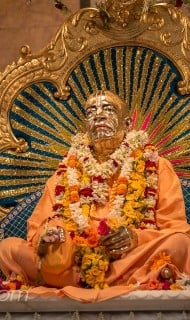
During a temple discourse attended by hundreds, Srila Prabhupada paused mid-sentence, closed his eyes, and the entire assembly entered a profound stillness. According to the eyewitness account of Srutakirti das, even a pin-drop felt audible, breath became delicate, and attention settled around His Divine Grace’s inward absorption. The collective atmosphere shifted from speech to silence, from listening to contemplative presence.
After a time, he resumed speaking, softly and with characteristic modesty: “I do not do that very often,” Srila Prabhupada said. The brief acknowledgment framed the episode not as spectacle but as an unplanned overflow of bhakti, received by the audience with reverence rather than curiosity.
Within the analytical vocabulary of Gaudiya Vaishnavism, the moment coheres with stambha (stunned stillness) and, to a degree, svara-bheda (subtle modulation of voice)two among the classical ecstatic symptoms (sattvika-bhavas) that may arise in a realized bhakti-yogi. The rarity and brevity of such manifestations, coupled with humility, align with the tradition’s emphasis on authenticity over exhibition.
Texts such as Rupa Goswami’s Bhakti-rasamrta-sindhu and the Caitanya-caritamrta outline eight primary sattvika-bhavas: asru (tears), vepathu (trembling), romañca (horripilation), svara-bheda (voice faltering), vaivarnya (pallor), stambha (stunned stillness), sveda (sweating), and pralaya (fainting). Arising involuntarily when devotion concentrates on Krishna with purity, they are understood as intensifiers of realized feeling, secondary to the steady current of service and love.
From the standpoint of Gaudiya rasa theory, devotional realization integrates vibhava (stimuli such as Krishna-katha), anubhava (expressive signs), vyabhicari-bhavas (transitory emotions), and the abiding sthayi-bhava that matures into rasa. The involuntary sattvika-bhavas appear when the sthayi-bhava becomes predominant; their value is diagnostic rather than performative, indicating inner absorption rather than inviting emulation.
That Srila Prabhupada offered a gentle, almost apologetic remark underscores Vaishnava etiquette: genuine realization seeks concealment rather than display. The Bhagavad Gita’s ethic of amanitvam (humility) serves as foundation and safeguard so that mystical states never eclipse sadhana, seva, or shastra. In this light, the event is best read as pedagogical gracean unintended lesson in the primacy of inner devotion.
The collective responsehushed breath, heightened attention, and a sense of elevationillustrates how a guru’s inner absorption can entrain a community into deeper remembrance (smarana). Contemporary studies on group chanting and meditation associate such moments with reduced stress markers and increased social bonding; in devotional settings, that physiological coherence can function as a vessel for shared kirtan consciousness and focused bhakti-yoga.
Hagiographical sources recount that Sri Caitanya Mahaprabhu sometimes manifested heightened bhava during kirtan, and close associates carefully preserved decorum around those moments. Biographical narratives from the early ISKCON period similarly note rare, unpremeditated instances around Srila Prabhupada, consistently presented with restraint and framed by scriptural norms that emphasize humility, service, and steadiness.
Comparable dynamics appear across the dharmic family and foster unity rather than competition among traditions. In Buddhism, samadhi can be accompanied by pīti and sukha; in Jainism, samayika cultivates extraordinary steadiness and inwardness; in Sikh tradition, sustained Naam Simran evokes anand. Each path honors transformative experience while centering discipline, ethics, and humilityshared principles that anchor inter-dharmic harmony.
Pedagogically, a pause of this kind operates as a meta-teaching: discursive instruction momentarily yields so that śabda (sacred sound) opens into anubhava (direct apprehension). For a community trained in hearing and chanting, the teacher’s silence becomes a form of kirtan, turning attention inward to the Name and outward to communal reverence.
Within ISKCON and the wider Hare Krishna Movement, such moments are situated inside a disciplined program of bhakti-yoga: Nama-sankirtana, scriptural study (śravaṇa), japa of the Hare Krishna maha-mantra, and service in the guru–shishya parampara. The intended lesson remains clear: ecstatic symptoms are not spiritual goals; unalloyed service to Krishna is. This perspective preserves both theological clarity and experiential authenticity.
Practically, when a teacher enters deep absorption, devotees maintain silence, steady the breath, continue mental japa, and avoid distraction or documentation. Reverence protects the sanctity of the moment and helps the assembly internalize the instruction beyond words, strengthening personal practice while sustaining communal unity across dharmic pathways.
Viewed as a case study, the event described by Srutakirti das illuminates how authentic ecstatic symptoms function pedagogically: they recalibrate attention, elevate collective devotion, and affirm that the essence of bhakti is realized inwardly yet shared communally. Read through scripture and lived traditionand appreciated alongside cognate experiences in Buddhism, Jainism, and Sikhismit offers a unifying window into how dharmic spirituality transforms both individual hearts and whole communities.
Inspired by this post on Dandavats.
