
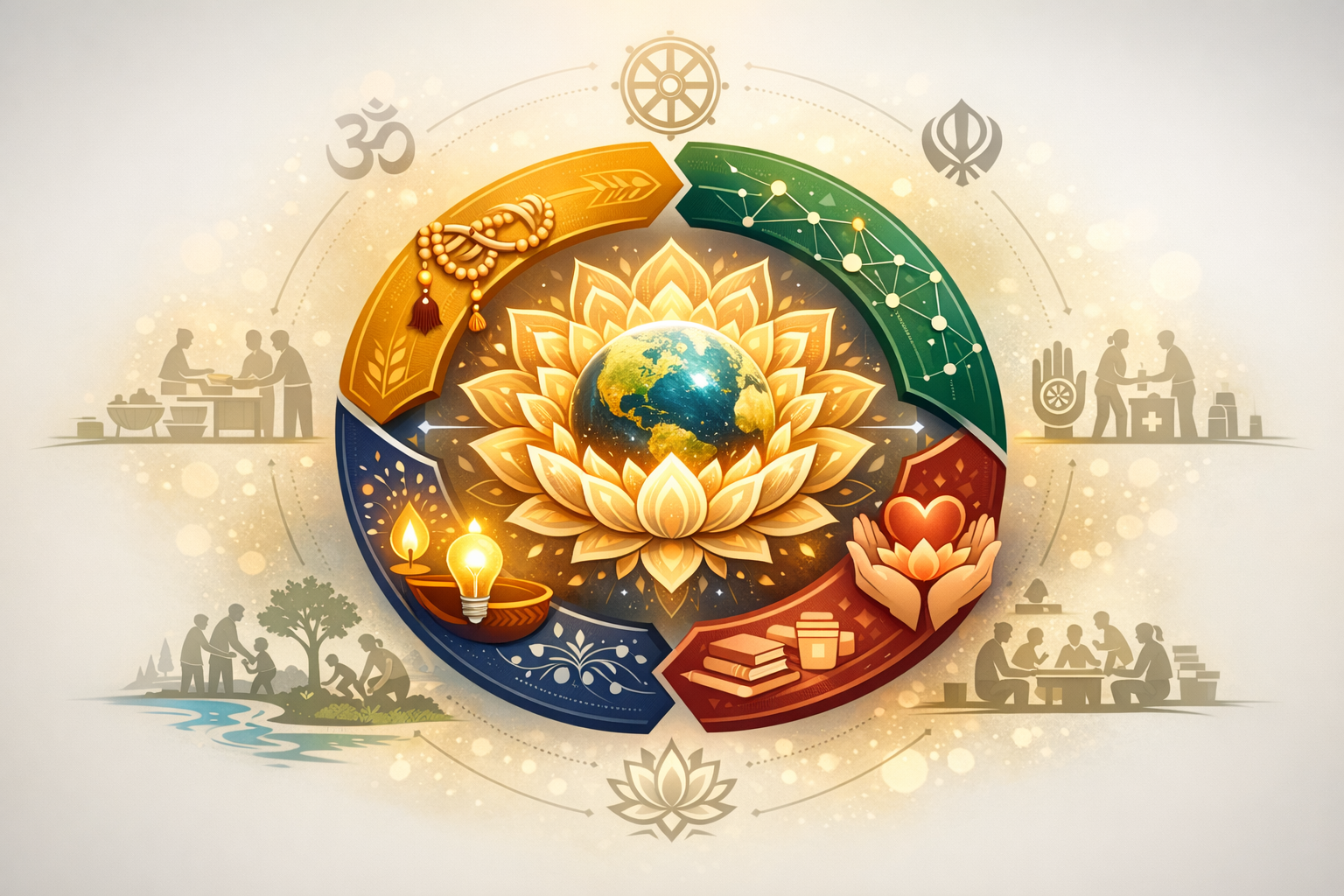
The Big Four C’sCommitment, Connectivity, Compassion, and Creativityoffer a rigorous, values-anchored framework for strengthening communities and organizations grounded in Dharma. Rooted in the ethos of Vasudhaiva Kutumbakam, this approach views Hinduism, Buddhism, Jainism, and Sikhism as complementary traditions aligned toward human flourishing, ethical conduct, and service. By integrating these four capacities, communities cultivate unity in spiritual diversity while building robust systems that scale with integrity and care.
Across Dharmic traditions, these C’s are not abstract virtues but operational competencies. Commitment translates Shraddha and Tapas into dependable follow-through; Connectivity extends Satsang and Sangha into resilient networks; Compassion harmonizes Ahimsa, Karuna, Daya, and Seva into protective, healing cultures; and Creativity channels the spirit of nava-vidha innovation into service-oriented breakthroughs. Their synergy enables a community to remain principled under pressure, collaborative across difference, humane in conflict, and inventive in uncertainty.
Commitment benefits from a generous default: assume good intent and honor the person’s devotion. Publicly questioning someone’s sincerity often fragments trust. Instead, address gaps privately and constructively, upholding Ahimsa in words and actions. This stance respects the inner Shraddha that motivates volunteers, monastics, and professionals alike, while creating psychological safety for honest course correction.
Technically, commitment becomes reliable through explicit agreements and transparent review. Clear charters, RACI matrices for role clarity, and OKRs aligned to Dharma-aligned outcomes prevent diffusion of responsibility. Service-Level Expectations (SLEs) rather than punitive “SLAs” suit volunteer ecosystems, emphasizing mutual respect over enforcement. A quarterly “Commitment Reliability Index” can be computed from planned-versus-actual delivery, re-commit rates, and on-time task closure, correlated with survey-based trust measures to ensure that execution does not erode goodwill.
Consistent practice (nairantarya abhyase) operationalizes commitment. Micro-rituals help: begin meetings with one minute of breath awareness to center intent; end with explicit re-commitment statements; schedule weekly ten-minute retrospectives focused on what to start, stop, and sustain. Such rhythms translate Tapas into stable habit, preventing overextension and burnout while sustaining Seva.
Connectivity strengthens the social fabric by weaving bonding ties (depth within a group) and bridging ties (links across groups). Dharmic culture has long recognized this through Satsang, Sangha, and inter-math or inter-sampradaya dialogue. Network science provides useful diagnostics: track degree centrality to identify isolated members, bridging centrality to highlight connectors across Hindu, Buddhist, Jain, and Sikh circles, and clustering coefficients to assess cohesion. Healthy ecosystems display both dense clusters for support and strong bridges for cross-pollination.
In practice, connectivity thrives through layered infrastructure: small circles for intimacy, mid-size working groups for delivery, and open assemblies for shared celebration and learning. Digital platforms should enable discoverability without surveillance, favoring consent-based directories, curated knowledge bases, and opt-in updates. A quarterly “Sangha Exchange” that rotates hosting among traditions, coupled with joint Seva sprintssuch as langar optimization, tree-planting, or river clean-upscreates lived interdependence and visible unity.
Compassion anchors ethical culture. Across Dharmic lineages, compassion manifests as Maitri and Karuna (Buddhism), Ahimsa and Daya (Jainism and Hinduism), and Seva and Sarbat da Bhala (Sikh tradition). Operationally, compassion is cognitive (accurate appraisal), affective (empathic resonance), and behavioral (skillful, boundaried help). Cultures that lead with compassion reduce fear-driven errors, increase learning velocity, and keep accountability human-centered.
Compassion becomes actionable with structured methods. Nonviolent Communication (observations, feelings, needs, requests) offers a shared grammar for difficult conversations. Psychological First Aid and trauma-informed practices reduce harm during crises. Confidential feedback channels protect dignity. Measurement can include the Professional Quality of Life (ProQOL) scale for compassion satisfaction and burnout, coupled with incident response reviews that assess not just outcomes but also the kindness and clarity of processes.
Creativity sustains relevance without severing roots. Within Dharmic frames, creativity honors Parampara even as it adapts. The 4P modelPerson, Process, Press (environment), Productcan be contextualized: cultivate sattva for clarity, harness rajas for generative energy, and design processes that respect tradition while welcoming experiment. Design Thinking’s Double Diamond (discover, define, develop, deliver), TRIZ for systematic invention, and safe-to-fail pilots minimize risk while encouraging insight.
To keep innovation humane and pragmatic, establish light-weight governance: idea intake portals, fortnightly triage reviews, time-boxed pilots, explicit sunset criteria, and “story of change” narratives connecting each experiment to Dharma-aligned purpose. Metrics such as Idea Flow Rate, Time-to-Pilot, Pilot-to-Adoption Ratio, and Diversity of Origin (representation across Hindu, Buddhist, Jain, Sikh contributors and genders/ages) ensure that creativity remains inclusive and impact-oriented.
Integration matters as much as excellence in any single C. A practical architecture is a “C-Loop”: Commitment provides dependable cadence; Connectivity widens access and reduces silos; Compassion preserves dignity and safety; Creativity translates insights into better services. Quarterly balanced scorecards can track leading indicators (participation rate, bridge ties, idea velocity) and lagging indicators (program outcomes, retention, well-being), preventing one C from crowding out the others.
A 90-day roadmap helps communities start strong. In days 0–30, clarify shared purpose, define 4–6 OKRs, map stakeholders across the four Dharmic traditions, and agree on communication norms. In days 31–60, pilot two Compassion protocols, launch a Sangha Exchange event, and run a micro-innovation sprint targeting an urgent Seva need. In days 61–90, review the Commitment Reliability Index, publish a connectivity heat map, scale successful pilots, and refine governance with input from all traditions to strengthen unity in spiritual diversity.
Consider a relatable example from a gurdwara langar and a temple annadanam team collaborating with a Buddhist community kitchen and a Jain Seva group. Commitment appears as reliable rosters and food safety compliance; Connectivity emerges through shared procurement and logistics channels; Compassion informs dietary inclusivity and dignified service; Creativity yields a zero-waste redesign with compostables and dynamic meal forecasting. This integrated approach lowers costs, reduces waste, and deepens trust.
During a regional festival, a multi-tradition volunteer corps can coordinate crowd flow, first aid, and eco-stewardship. Commitments are explicit and time-bounded; connectivity tools align schedules across monasteries and mathas; compassion shapes protocols for lost-and-found children and elder support; creativity introduces real-time heat maps and hydration stations crafted from upcycled materials. The event remains devotional and safe, with measurable environmental gains.
A knowledge-sharing initiative offers another illustration. A joint library network linking Hindu Vedanta texts, Buddhist Abhidharma, Jain Agamas, and Sikh Gurbani enables cross-referencing by themes such as Ahimsa, Karuna, and Dharma. Commitments ensure cataloging quality; connectivity links archives and study circles; compassion frames respectful interpretation; creativity provides multilingual, mobile-first access. Learners experience unity without erasure of distinct voices.
There are risks and anti-patterns. Assuming commitment without resourcing leads to overload; relying on connectivity without curation creates noise; offering compassion without boundaries enables dysfunction; celebrating creativity without stewardship invites mission drift. Risk controls include capacity planning, curated forums, restorative practices with clear consequences, and an ethics review that checks each innovation against Dharma-aligned purpose and community consent.
Ethical guardrails reinforce the blog’s objective of unity among Hinduism, Buddhism, Jainism, and Sikhism. The framework explicitly rejects competitive proselytism and zero-sum rhetoric. It advances Religious Tolerance, Interfaith Dialogue, and Spiritual acceptance, insisting that each path retain its authenticity while participating in shared Seva and learning. In this way, unity in spiritual diversity becomes practical, measurable, and emotionally resonant.
When the Big Four C’s operate together, communities become both compassionate and capable, both faithful and future-ready. Commitment builds trust, connectivity sustains collaboration, compassion protects dignity, and creativity renews relevance. Grounded in Dharma and guided by Vasudhaiva Kutumbakam, this integrated model equips Dharmic communities to serve boldly, learn continuously, and flourish together.
Inspired by this post on Hindu Pad.
