
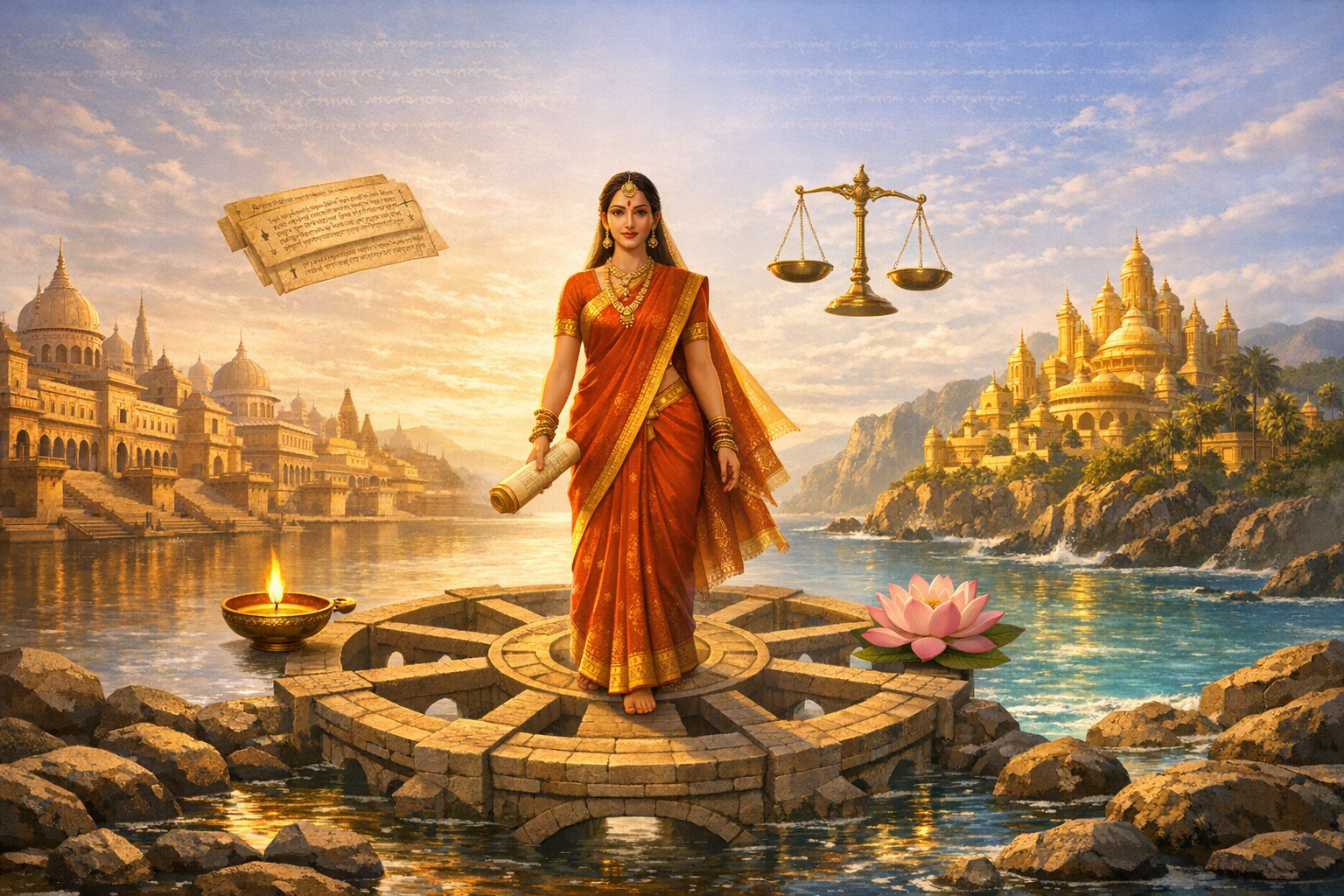
The Ramayana has long served as a civilizational mirror, reflecting both aspirational ideals and complex social realities. Among its many debates, a persistent modern claim suggests that “Asuras did not believe in widowhood,” implying that Ravana’s Lanka normalized widow remarriage while Ayodhya did not. An evidence-based reading shows a more nuanced picture: the epic’s narratives are ethically layered, the terms “asura” and “rākṣasa” are not identical, and the Valmiki Ramayana does not legislate widowhood or remarriage in explicit legal terms for either society. What emerges instead is a broader Dharmic discourseacross epic literature and Dharmashastrawhere widowhood and remarriage (punarvivāha) were handled contextually rather than monolithically.
Any responsible discussion must therefore separate three strands: the Ramayana as a narrative text (especially the Valmiki recension), the plural legal-discursive tradition of the Dharmashastras, and regional or later retellings that add political and social motifs. This separation avoids anachronism and honors the Dharmic principle that dharma is dynamic and attentive to deśa-kāla-pātra (place, time, and person).
The Valmiki Ramayana’s Sundara Kanda and Yuddha Kanda portray Lanka as wealthy, architecturally advanced, and socially vibrant, with powerful female voices such as Mandodari and the rakshasis around Sita. These depictions emphasize a sophisticated urban polity rather than a homogenous “demonic” culture. While the text shows women speaking candidlyeven admonishing kingsit does not, in the critical edition, offer an explicit legal code on widowhood or remarriage in Lanka.
Ayodhya, for its part, is framed as a dharmic exemplar through Rama’s commitment to rājadharma. The trials surrounding Sitaagni-parīkṣā and later separation due to public rumorare presented as extraordinary moments of kingly burden, not as universal social ordinances about widowhood or remarriage. Read closely, these episodes are moral crucibles within governance, not blanket social legislation.
Across the epic, Mandodari’s counsel to Ravana demonstrates a capacity for sharp ethical reasoning within Lanka’s courtly culture. Some later vernacular and regional traditions contend that, after Ravana’s death, Mandodari became the queen alongside the newly crowned Vibhishana, sometimes described as remarriage to stabilize political order. The Valmiki Ramayana’s critical edition is silent on this, focusing instead on coronation and closure. The existence of such variants nonetheless signals that premodern storytellers could imagine and authorize pragmatic, compassionate solutions around royal succession and female status.
In other words, while it is inaccurate to claim that the Valmiki text explicitly codifies an “anti-widowhood” law in Lanka, a comparative reading across Dharmic sources shows that widowhood and remarriage were never a single, fixed rule in ancient India. Rather, they were treated as questions of social ethics and prudence, governed by a plurality of norms.
The Dharmashastra corpus is central to that plurality. Texts such as the Nārada Smṛti and Parāśara Smṛti provide conditional allowances for punarvivāha when a husband is missing, has abandoned family obligations, or is incapacitated. These are not marginal opinions; they reflect a jurisprudential concern to reduce harm, minimize social disorder, and prioritize women’s welfare when marriage’s foundational aimsartha, dharma, and kāma in rightful balancecannot be met.
The Nārada Smṛti in particular canvasses cases of desertion and neglect, proposing remedies that include remarriage in specified circumstances. The spirit of these provisions is restorative rather than punitive: property, guardianship, and consent are coordinated to protect vulnerable parties and to ensure social continuity.
The Parāśara Smṛti, often cited for its yuga-dharma sensitivity, articulates more accommodative rules for Kali Yuga, precisely on the logic that law must respond to degraded capacities and increased social risk. In doing so, it normalizes pragmatic recourse, including remarriage, where strict adherence to earlier norms would intensify suffering or produce injustice.
The Arthaśāstra of Kauṭilya adds a statecraft lens. It attends closely to marital breakdown, abandonment, and economic protection, recognizing female property (strīdhana) and specifying relief when household stability collapses. While not a religious manual, its legal realism complements Dharmashastra in curbing harm, maintaining order, and aligning remedies with lokasaṅgrahathe welfare and cohesion of society.
By contrast, Manusmṛti’s often-quoted ideal of lifelong widow chastity is not the entire Dharmic legal field; it is one influential voice among many. Even within Manusmṛti, exceptions, regional custom (ācāra), and practical considerations complicate a rigid reading. Taken together, the smritis illustrate deliberation, not dogma.
Earlier Vedic and epic references to niyoga (procreation by a designated kinsman when the husband is deceased or incapable) further demonstrate that the tradition’s primary concern was household continuity and social protection rather than the sacralization of bereavement. Over time, niyoga receded, and in some regions remarriage arose as a clearer, more dignified path to restore a woman’s social and economic agency.
Marriage typologies in Dharmashastrafor instance, rākṣasa vivāha and gandharva vivāhado not endorse violence or abduction as ethical ideals but do recognize that a wide variety of unions existed and required legal acknowledgment. This admits a normative pluralism in which communities negotiated marriage, agency, and legitimacy in diverse ways.
Anthropological and historical records echo this textual plurality. Across regions and jātis, practices around widowhood ranged from immediate remarriage to ritualized celibacy, often influenced by local economies, inheritance patterns, and kinship structures. Even within a single linguistic region, customary law (deśācāra) could diverge sharply between groups.
From a pan-Dharmic perspective, Buddhism and Jainism reinforce the primacy of compassion (karuṇā) and non-harm (ahiṁsā) in social ethics. While these traditions chiefly elaborate monastic disciplines, their lay codes and historical communities negotiated marriage and widowhood with emphasis on reducing suffering and sustaining honest livelihoods.
Within the Sikh tradition, reform against harmful customs was explicit. The Gurus denounced practices that degraded women; Sikh history remembers strong advocacy against sati and narrow interdictions around widowhood. The community ethos around Anand Karaj and social equality aligns with the broader Dharmic current that values dignity, consent, and mutual responsibility in family life.
Colonial codification disrupted this indigenous plurality by compressing “Hindu law” into a narrow textual canon, disproportionately privileging Manusmṛti in early Anglo-Hindu jurisprudence. Nineteenth-century reformers such as Ishwar Chandra Vidyasagar campaigned for legal recognition of practices already accepted in many communities, culminating in the Hindu Widows’ Remarriage Act of 1856. That statute should be seen not as a foreign imposition but as a legal acknowledgment of existing Indian debates and compassionate norms.
Returning to Lanka and Ayodhya with this wider lens, the apparent contrast becomes less about a moral binary and more about two narrative laboratories for testing dharma. Lanka dramatizes the perils of unrestrained desire and powerbut it also exhibits capable queens, eloquent counselors, and a cosmopolitan court. Ayodhya dramatizes the austerity of rājadharmayet its ethical horizon includes the suffering of innocents, the demands of public trust, and the high cost of leadership.
In several later retellings where Mandodari is said to unite with Vibhishana after Ravana’s death, the motif functions as political healing and social restoration. Whether understood as ceremonial recognition or remarriage, such narratives argue that the stability of the kingdom and the dignity of the queen both matter. They thereby resonate with Dharmashastra’s central aim: to repair households, protect dependents, and sustain the common good.
The emotional core of this question is not abstract. Imagine the loneliness of a young widow in an ancient port-cityits harbors full of ships, its markets alive with voiceswho must still navigate the private silence of loss. Dharmic ethics, in its best moments, refuses to turn that silence into a life sentence. It asks instead how society can hold sorrow without foreclosing hope, allowing pathwaysremarriage, economic independence, learning, or spiritual pursuitsuited to her deśa-kāla-pātra.
Accordingly, a unifying Dharmic vision across Hindu, Buddhist, Jain, and Sikh traditions centers karuṇā, ācāra informed by reason, and the reduction of duḥkha. When read in this spirit, the Ramayana does not divide communities into “civilized” and “demonic”; it invites readers to transcend reactive binaries and to cultivate wise judgment (viveka) responsive to circumstance.
This clarifies why the assertion “Asuras did not believe in widowhood” oversimplifies the record. The Valmiki Ramayana does not promulgate such a categorical rule; later narratives that suggest royal remarriage in Lanka do so to reaffirm order and compassion. In parallel, the Dharmashastras display a rich spectrumsometimes cautionary, often accommodativeconsistently aiming to protect those most at risk.
For contemporary Dharmic society, the practical takeaway is straightforward. Ethical reading requires distinguishing narrative exempla from legal injunctions, respecting multiple sources of normativity, and foregrounding the person whose welfare is at stake. When those commitments align, the tradition’s diverse voices cohere around a common promise: grief must not eclipse dignity, and law must serve life.
In sum, Lanka and Ayodhya do not stand as opposites in a civilizational contest but as complementary theaters for contemplating dharma’s demands. When set alongside Nārada Smṛti, Parāśara Smṛti, and the Arthaśāstraand remembered in conversation with Buddhist, Jain, and Sikh insightsthe Ramayana points beyond polemic to a unifying ethic: uphold agency, minimize harm, and choose the course that best preserves both truth and compassion.
Inspired by this post on Hindu Blog.
