
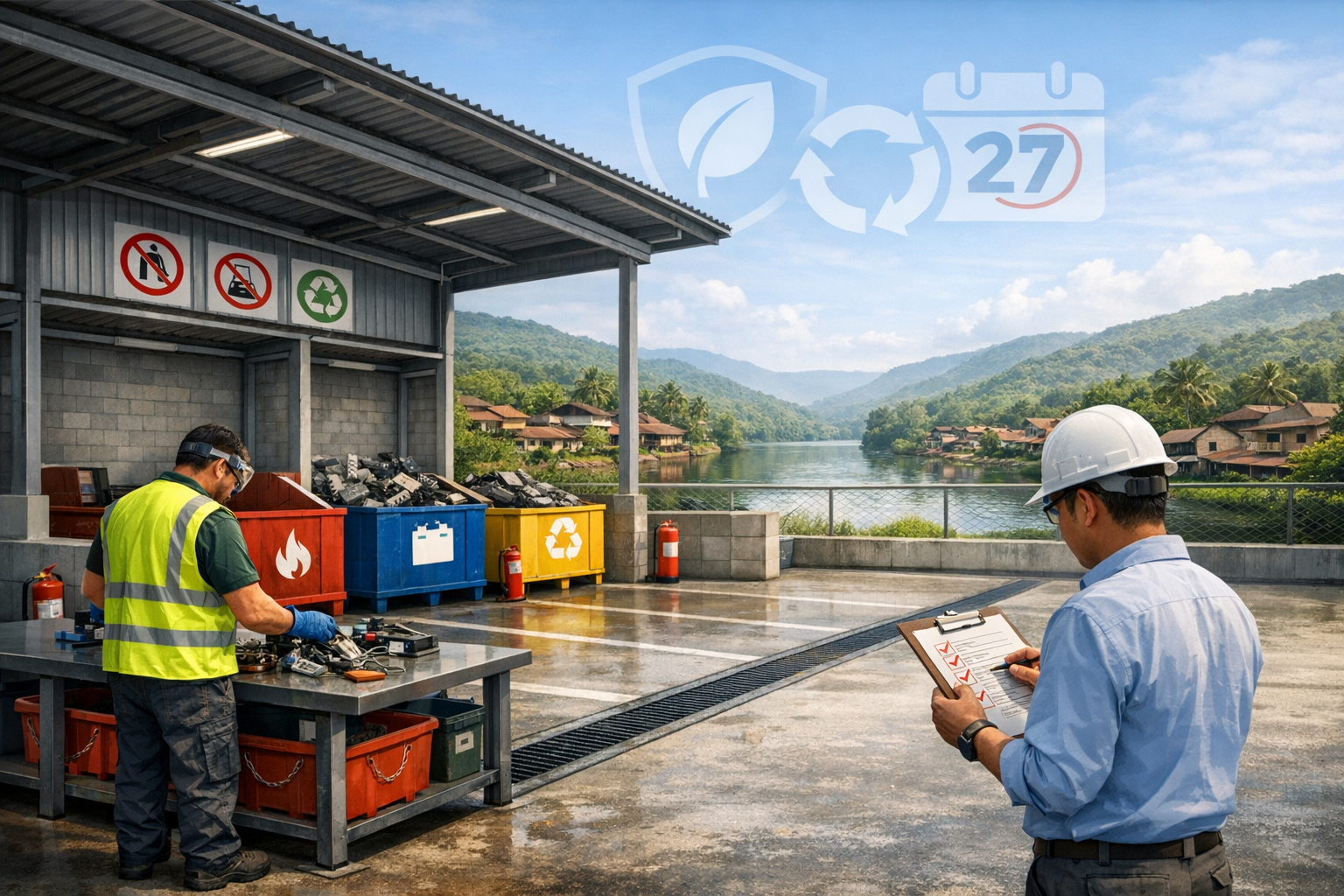
Illegal scrap operations are reportedly on the rise in Chiplun, and the trend is drawing urgent attention because of its implications for environmental safety, public health, and community well-being. The Hindu Rashtra Samanvay Samiti has publicly warned of agitation if strict action is not taken by 27 April 2026, signaling a clear deadline and an intensifying civic demand for accountability. The situation, however, presents more than a law-and-order challenge; it is a systemic governance and sustainability question that requires coordinated action from local authorities, state regulators, and the recycling industry to transition from informal, unsafe practices to compliant, safe, and livelihood-protective recycling.
Chiplun’s geography amplifies the risks. Situated in Maharashtra’s Konkan belt along the Vashishti river, the city has experienced severe monsoon flooding in recent years, notably in 2021. When unlicensed scrap yards operate on permeable soil, in flood-prone localities, or near drains and riverbanks, leaked oils, acids, solvents, and heavy metals can be mobilized during monsoons and dispersed into surface water and groundwater. This is not only an ecological risk but also a direct public health concern for families relying on local water sources and for those living or working downwind and downstream of such sites.
Hazards associated with illegal scrap yards are well understood. Open burning of wires and plastics emits dioxins and furans; uncontrolled dismantling of electronics releases lead, cadmium, and brominated flame retardants; and mishandling of batteries can leak corrosive electrolytes and heavy metals. The storage of pressurized cylinders, fuels, and solvents near ignition sources substantially raises fire and explosion risks, while unsegregated heaps obstruct evacuation routes and complicate firefighting. Chronic noise, dust, and sharp-metal injuries add to the burden, and informal, unregulated work arrangements often mean minimal personal protective equipment, inadequate ventilation, and poor emergency preparedness.
Against this backdrop, India’s regulatory architecture already provides a comprehensive framework that, if enforced and supported, can resolve much of the current risk without destroying livelihoods. The Environmental (Protection) Act, 1986 is the umbrella statute under which specific rules operate: the Hazardous and Other Wastes (Management and Transboundary Movement) Rules, 2016 for hazardous waste; the E-Waste (Management) Rules, 2022 for electronics recycling under Extended Producer Responsibility (EPR); the Battery Waste Management Rules, 2022 for batteries; and the Solid Waste Management Rules, 2016 for municipal handling and segregation. Complementing these are the Plastic Waste Management Rules, 2016 (as amended), Maharashtra Pollution Control Board (MPCB) consents to establish and operate, the National Building Code of India (fire and life safety), local zoning and fire no-objection certificates (NOC), and the Ministry of Road Transport and Highways’ Registered Vehicle Scrapping Facility (RVSF) Guidelines, 2021 for end-of-life vehicles.
Within this framework, “illegal” operations typically mean one or more of the following: operating without MPCB consent; carrying out activities in non-conforming or encroached zones; lacking mandated fire safety measures; open burning or acid leaching; handling e-waste or batteries without registration on the Central Pollution Control Board (CPCB) EPR portal; mixing hazardous and non-hazardous fractions; and disposing of residues in drains, open plots, or waterbodies. Each of these violations is preventable through due process, better siting, and basic engineering controls, underscoring that most hazards arise not from the activity of recycling itself but from operating outside the law and best practice.
Equally important, scrap collection and recycling are vital to a functional circular economy. Informal scrap networks recover significant volumes of metals, plastics, and paper that would otherwise go to landfill or leak into the environment. The policy imperative, therefore, is not a blanket crackdown but a just transition: formalize legitimate livelihoods while eliminating dangerous, non-compliant practices. Done well, this approach protects workers, shields neighborhoods from fires and toxins, and increases material recovery yields for India’s manufacturing sector.
In practical terms, strict action should be outcome-oriented, science-based, and proportionate. Authorities can begin with a citywide inventory of scrap-related establishments, geo-tagging each site and classifying it by risk (low, medium, high) based on location, materials handled, and current controls. High-risk sites in floodplains, cramped residential lanes, or adjacent to schools and hospitals should receive priority inspections and, where necessary, immediate stop-work orders with safe-closure protocols. Medium- and low-risk sites can be given a time-bound compliance pathway with technical guidance and access to authorized recyclers under EPR frameworks.
An effective transition plan for Chiplun before 27 April 2026 would reasonably include the following elements articulated as administrative steps rather than slogans. First, establish a joint task force comprising the municipal council, MPCB, fire services, police, and revenue departments to coordinate inspections, notices, and closures. Second, publish a simple compliance checklist aligned to MPCB consent conditions, the E-Waste and Battery Rules, and fire safety codes, translated into local language, to remove ambiguity for small operators. Third, create a one-stop help desk for legal registrations, consents, and EPR onboarding to reduce transaction costs. Fourth, designate or upgrade a material recovery facility (MRF) or an industrial cluster with impermeable flooring, bunds, stormwater management, and 24/7 surveillance, where compliant dismantling can be consolidated away from dense residential zones.
Fifth, connect informal collectors with CPCB-registered recyclers through aggregator contracts, ensuring traceability and fair compensation while eliminating incentives for burning, acid leaching, or dumping. Sixth, provide access to microcredit and equipment grants conditioned on safety upgradesroofed storage, spill kits, oil–water separators, fire extinguishers, and signageso that compliance is economically feasible. Seventh, announce a graded penalty regimewarnings, fines, seizure of hazardous materials, and prosecution for repeat or egregious offenseswhile guaranteeing due process and the right to be heard. Eighth, maintain a public dashboard with ward-level inspection counts, violations found, closures ordered, and materials safely recovered to anchor transparency and trust.
Technical minimum standards for any authorized scrap or dismantling operation are well-established internationally and readily applicable. Impermeable, sloped floors prevent infiltration; covered work areas minimize rain ingress; bunded and labeled storage segregates acids, bases, oils, and batteries; and oil–water separators intercept contaminated stormwater. Fire and life safety necessitate unobstructed accessways, appropriate extinguishers for Class A/B/C fires, cylinder storage protocols, spark control, and emergency lighting. Operational controlsno open flames, no open burning, no acid leaching, and strict prohibitions on discharging effluentsare non-negotiable and enforceable through routine inspections.
Worker safety must be central to any compliance plan. Basic personal protective equipment (PPE) such as cut-resistant gloves, goggles, masks for dust and fumes, and steel-toe footwear reduce injuries substantially. Ventilation or fume extraction where soldering or cutting occurs, noise control for shredders and cutters, and clearly marked evacuation routes with assembly points provide further protection. Training moduleshazard recognition, safe handling of batteries and capacitors, cylinder valve safety, first aid, and spill responsebuild a culture where safety is a daily practice, not a paperwork formality.
Chiplun’s monsoon profile calls for additional precautions. Pre-monsoon de-risking should include draining and safely evacuating oils from drums and machinery, relocating hazardous stockpiles to higher ground within covered, bunded areas, clearing drain inlets near scrap clusters, and pre-positioning spill booms and absorbents. A seasonal moratorium on high-risk dismantling practices in flood-prone pockets can further reduce contamination incidents during peak rainfall, while periodic drills with the fire service ensure readiness for waterlogged access conditions.
Community participation improves both compliance and fairness. Residents can document visible risksopen burning, smoke plumes, nocturnal operations, obstructed fire lanesand submit complaints through the municipal portal or designated helplines, enabling authorities to prioritize hotspots without vigilante action. Schools and neighborhood associations can host awareness sessions on segregating household e-waste and channeling it to CPCB-registered collection centers, shrinking the supply that feeds unsafe yards. Public postings of authorized facilities and pickup days reduce confusion and dilute the market for illegal handlers.
Shared dharmic values offer a constructive ethical lens for engagement and reform. Principles such as Ahimsa (non-violence), Seva (selfless service), and Aparigraha (non-hoarding) resonate across Hinduism, Buddhism, Jainism, and Sikhism, and they translate into concrete civic duties: do not harm neighbors through pollution or fire hazards; serve the community by handling materials safely; and avoid practices that externalize costs onto vulnerable families or future generations. In this spirit, broad-based, peaceful civic engagementinterfaith clean-up drives, safety education, and support for compliant livelihoodspromotes unity while advancing environmental stewardship.
Governance credibility depends on visibility and consistency. Clear, time-stamped notices; photographs of violations; documented hearings; and reasoned orders minimize perceptions of arbitrariness. Third-party environmental audits for large sites, random verification checks for smaller ones, and mandatory insurance for facilities storing flammables create aligned incentives. Above all, a zero-tolerance stance on open burning and acid leachingpaired with accessible compliance pathwayssends an unambiguous signal that Chiplun’s safety and environment are not negotiable.
By 27 April 2026, outcomes should be measurable. A comprehensive registry of scrap-related establishments; elimination of open burning; closure or relocation of high-risk yards; onboarding of collectors to CPCB/MPCB-compliant value chains; and a functioning, monitored dismantling cluster with stormwater controls constitute a realistic, auditable set of goals. Fire incident rates, neighborhood air quality readings near prior hotspots, and complaint resolution times can serve as transparent indicators for the public to track progress.
Handled with proportionality, technical rigor, and compassion, Chiplun can convert a combustible flashpoint into a model of circular economy governance. The call for “strict action” should be read as a mandate to protect families, safeguard rivers, and uphold the lawwhile preserving honest livelihoods through formalization and safety upgrades. This balanced path honors shared dharmic values, reduces the likelihood of confrontation, and leaves a safer, cleaner, and more resilient city for everyone.
Inspired by this post on Hindu Jagruti Samiti.
