
Amavasya Tharpanam Sankalpam Mantras for April 2026 gain special relevance as the new moon spans 16–17 April 2026 across India. In Tamil Nadu this observance aligns with Chithirai Amavasya; in Kerala it is Mesha Maasa Amavasya; in Telugu, Kannada, Marathi, and Gujarati calendars it is Chaitra Amavasya; and in the North Indian (Hindi) purnimanta tradition it is Vaishakh Amavasya. Because the amavasya tithi stretches over two consecutive civil dates, householders generally follow the canonical rule of performing Amavasya Tharpanam on the day when the tithi prevails during the local midday (aparahna), with final choice guided by one’s regional panchang and family parampara.
Calendrically, these dates fall after Ugadi/Puthandu in 2026 and therefore belong to Parabhava Nāma Samvatsaram within the Śālīvāhana Śaka 1948 year. The solar context is Uttarayana and Vasantha ṛtu. Regional month names differ because some traditions follow solar months (e.g., Chithirai/Mesha/Medam) while others follow lunar months using either the amanta (e.g., Chaitra) or purnimanta (e.g., Vaishakh) reckoning. This diversity illustrates the remarkable coherence of the Hindu calendar systems: nomenclature differs, but the underlying amavasya moment is astronomically the same everywhere.
Amavasya Tharpanam (also written Tarpanam or Tarpana) is a monthly act of gratitude offered to forebears (pitṛs). Dharmaśāstra literature upholds this rite as a vital thread in the fabric of family and society, expressing remembrance, gratitude, and the transgenerational transmission of blessings. The spirit of honoring lineage, teachers, and departed loved ones resonates across dharmic traditions; practices of remembrance and transfer of merit (puṇyānumodana) emphasize shared values of gratitude, continuity, and compassion.
Astronomically, amavasya occurs when the Moon conjoins the Sun (synodic new moon). Ritual manuals advise that Amavasya Tharpanam be performed when the amavasya tithi is operative during aparahna (around local midday). Where this is impractical, householders may follow their family tradition for morning performance after snāna, or at a time designated by one’s guru/ācārya. Because the tithi spans both 16 and 17 April 2026 in many regions, the local panchang should be consulted for exact tithi start–end times and the recommended window for tharpanam.
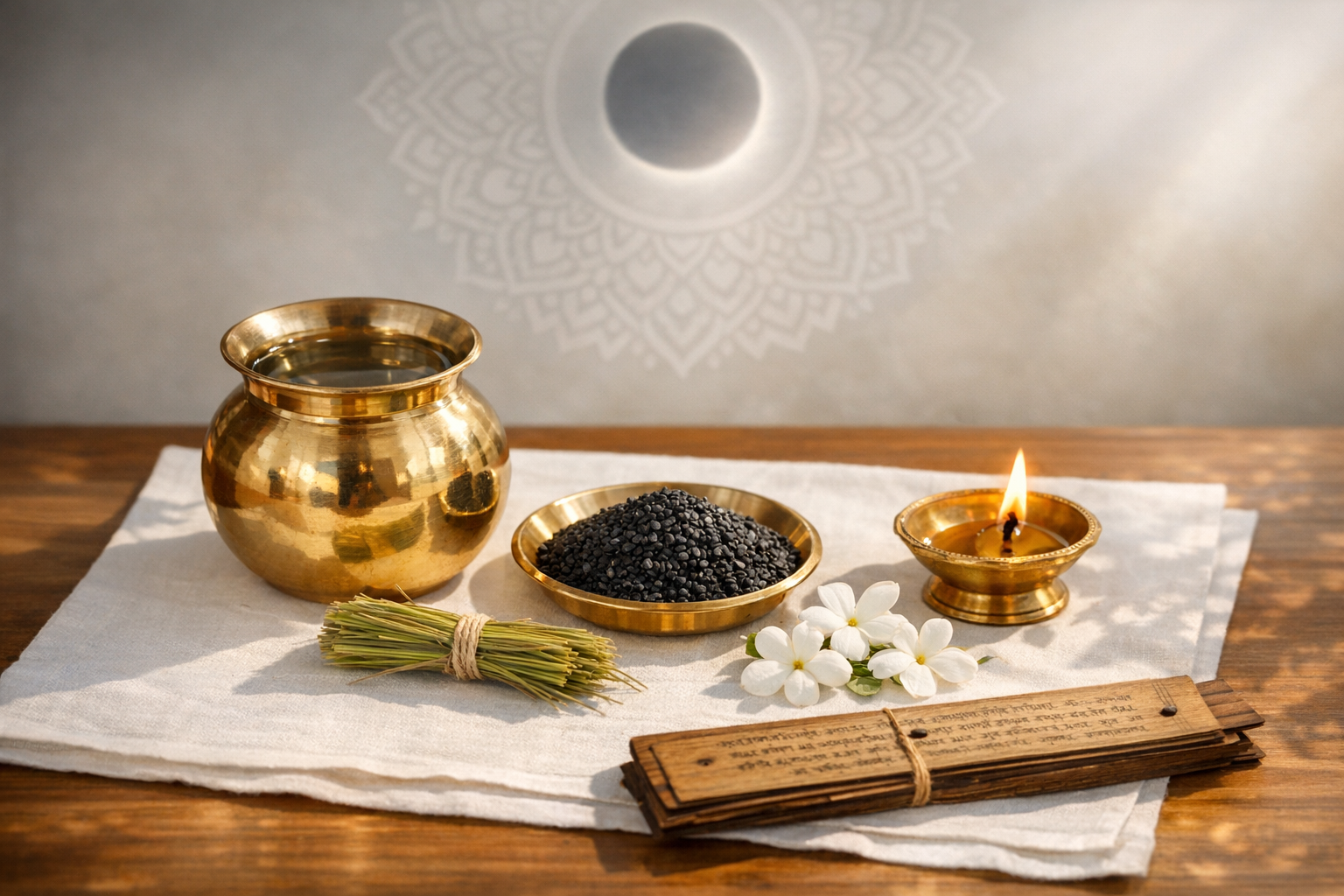
Core preparations include a clean, quiet space; darbha (kuśa grass); black sesame (tila); a copper or brass vessel for water; a plate or shallow bowl for offerings; and a seat oriented for south-facing observance (the pitṛ-diśā). Those wearing the sacred thread adopt apavīta (right shoulder to left) for pitṛ-kārya. Many observe light fasting or simple sāttvika food before the rite, remain mindful and composed (manas-śuddhi), and maintain an attitude of reverence and gratitude throughout.
The structure of Sankalpam (the formal statement of resolve) anchors the act in time and space. It records the samvatsara, ayana, ṛtu, māsa, pakṣa, tithi, weekday (vāsara), and purpose of the rite. For April 2026, reference to Parabhava Nāma Samvatsaram is appropriate. Month names vary by regional tradition on this date: “Mesha-māse” for the solar reckoning (Tamil Nadu, Kerala), “Chaitra-māse” for amanta lunar reckoning (Telugu, Kannada, Marathi, Gujarati), and “Vaiśākha-māse” for purnimanta reckoning (North India).
Below are concise, pan-Indian Sankalpam templates. Practitioners may add detailed cosmological clauses (e.g., “jambū-dvīpe, bhārata-varṣe…”) or personal details (deśa, nagara, gotra, nāma) according to paramparā. Replace the bracketed portions as relevant to region, weekday, and time of day.
“śrī govinda govinda govinda | parābhava-nāma-saṁvatsare uttarāyaṇe vasanta-ṛtau [māse] kṛṣṇa-pakṣe amāvāsyāyāṁ [vāsare] [kāle] mama upātta-samasta-durita-kṣaya-dvāra śrī-parameśvara-prītyarthaṁ amāvāsyā-pitṛ-tarpaṇaṁ kariṣye.”
Regional month name substitutions for this Sankalpam: for Tamil Nadu (Chithirai Amavasya, solar): “mesha-māse (chittirai māse)”; for Kerala (Mesha Māsa Amavasya): “mesha-māse (medam)”; for Telugu, Kannada, Marathi, Gujarati (Chaitra Amavasya): “chaitra-māse”; for North Indian purnimanta (Vaishakh Amavasya): “vaiśākha-māse.” For Thursday, use “guru-vāsare”; for Friday, use “śukra-vāsare.” If performed around midday, “madhyāhna-kāle” is apt; otherwise “prātaḥ-kāle” or “sāyaṁ-kāle” may be used per tradition.
For those who prefer a fuller Sankalpam that also records era and cycle, the following form may be adopted and customized with place and lineage details: “śrī govinda govinda govinda | śrī-śālīvāhana-śake 1948 parābhava-nāma-saṁvatsare uttarāyaṇe vasanta-ṛtau [māse] kṛṣṇa-pakṣe amāvāsyāyāṁ [vāsare] [kāle] mama upātta-samasta-durita-kṣaya-dvāra śrī-parameśvara-prītyarthaṁ amāvāsyā pitṛ-tarpaṇaṁ kariṣye.”
The Pitṛ Tarpanam sequence emphasizes sincerity over complexity. Water mixed with black sesame (tila) is offered with both palms shaped as a conduit, facing south. Many traditions recite simple, potent offering-mantras three times for each group of forebears, inserting gotra and names when known. A widely used form is as follows:
“om pitr̥bhyaḥ svadhā namaḥ, tarpayāmi.” “om pitāmahbhyaḥ svadhā namaḥ, tarpayāmi.” “om prapitāmahbhyaḥ svadhā namaḥ, tarpayāmi.” “om mātṛbhyaḥ svadhā namaḥ, tarpayāmi.” “om mātāmahbhyaḥ svadhā namaḥ, tarpayāmi.” “om pramātāmahbhyaḥ svadhā namaḥ, tarpayāmi.”
Some households add expanded sequences for sapinda and samanodaka ancestors or include devatā and ṛṣi tarpaṇa in the morning nitya routine while reserving amavasya specifically for pitṛ-tarpaṇa. After offerings, kṣamā-yācanā (seeking forgiveness) is expressed in one’s own words or through brief verses, and the rite is concluded with quiet remembrance and a resolve to uphold dharma within the family.
Timings for 16–17 April 2026 vary by longitude and local sunrise. The amavasya tithi runs across both dates in many regions, hence the emphasis on the aparahna criterion. In practice, those in Tamil Nadu observing Chithirai Amavasya and those in Kerala observing Mesha Māsa Amavasya will likely find an auspicious midday window on one of the two dates; similarly, those following amanta (Chaitra Amavasya) or purnimanta (Vaishakh Amavasya) traditions can align with their panchang’s aparahna recommendation. Where uncertainty persists, householders typically prioritize the day in which amavasya prevails during local midday and defer to family tradition or guidance from one’s guru.
Materials and method, summarized for clarity: adopt a clean seat facing south; wear the sacred thread in apavīta for pitṛ-kārya; prepare tilodaka (water with black sesame) in a copper or brass vessel; place darbha appropriately; and maintain uninterrupted mental focus (ekāgratā). The offerings are made with humility, invoking “svadhā” and the names/gotra of ancestors if known. Excess ritualization is unnecessary; sincerity, recollection, and gratitude are the essence.
Common questions arise about travel, apartment living, or environmental constraints. The rite may be performed indoors using a plate or bowl dedicated for offerings; flowing water is not obligatory. Waste is minimized by using small quantities of water and tila, and pure intent takes precedence over scale. The spirit of the actremembrance, gratitude, and continuityremains intact wherever the householder may be.
A brief theological note highlights the unifying motif across dharmic paths: honoring those who came before strengthens ethical life, nurtures social harmony, and cultivates inner steadiness. Whether expressed through Tarpanam, quiet prayers of gratitude, or dedicating merit to departed loved ones, the shared commitment is to live responsibly and compassionately. Amavasya thus becomes a luminous pause in the lunar cycle, inviting reflection on lineage, duty, and the gentle power of remembrance.
In April 2026, observing Amavasya Tharpanam with the above Sankalpam mantras and method offers a disciplined, meaningful way to align with cosmic time, honor the family line, and embrace the unity of diverse calendar traditions that converge on a single, sacred intention.
Inspired by this post on Hindu Pad.
