
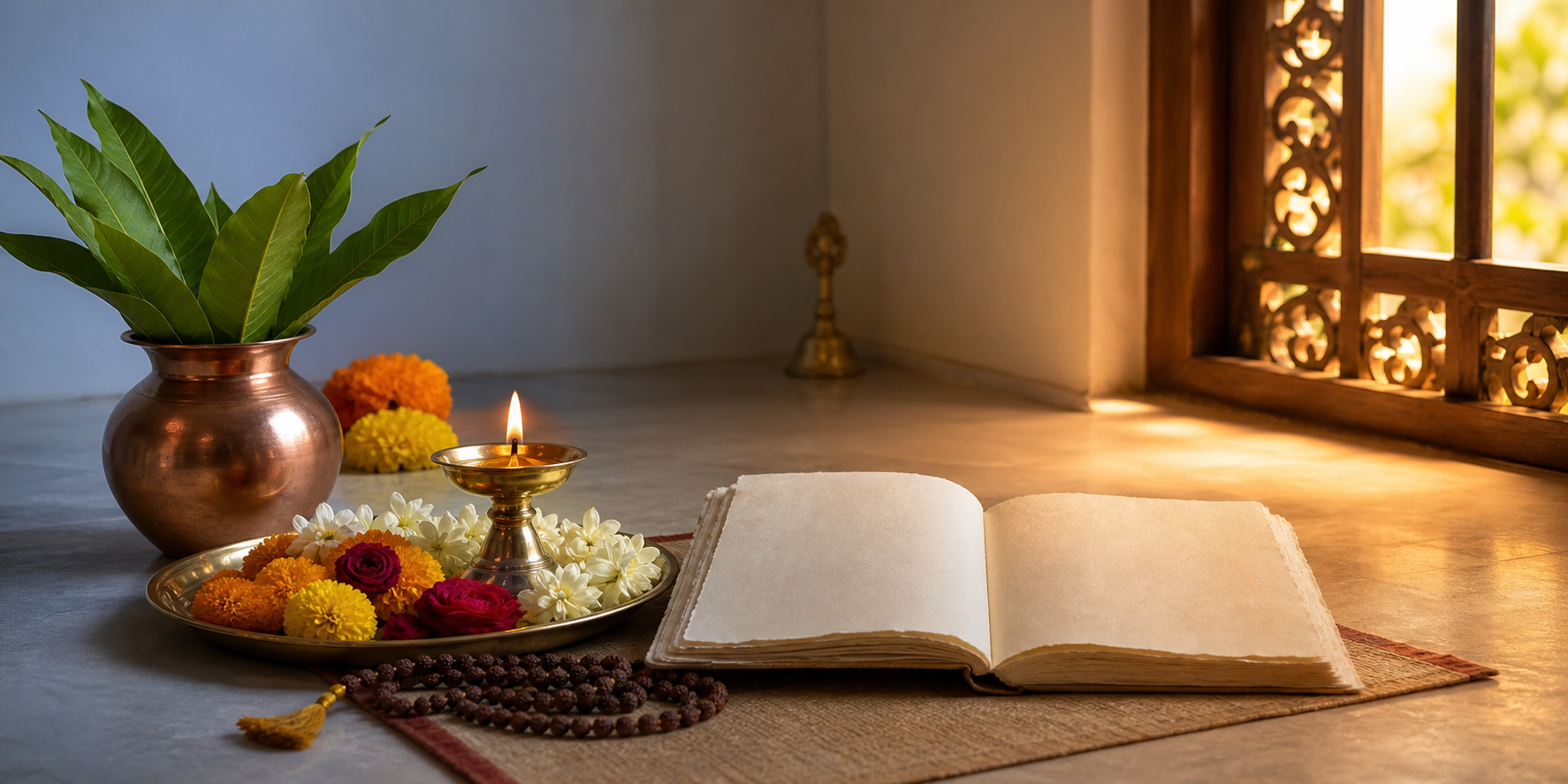
If you’re arranging puja, beginning a sadhana, or choosing a time for an important undertaking on April 18, the main decision is whether to act before or after the afternoon Tithi change. That choice matters more than trying to label the entire civil date with a single lunar day.
For most Indian locations, the practical outline is clear: Shukla Paksha Pratipada prevails until about 3:13 PM, after which Shukla Paksha Dwitiya begins. Use that time as a planning marker, then confirm the exact boundary for your city before any time-sensitive sankalpa or rite.
April 18 at a glance
| Period | Prevailing Tithi | Practical ritual use |
|---|---|---|
| At local sunrise | Shukla Paksha Pratipada | Use Pratipada for the day’s sankalpa when your vrata or household custom follows the sunrise Tithi. |
| From sunrise until about 3:13 PM in most Indian regions | Shukla Paksha Pratipada | Begin study, japa, a spiritual journal, altar renewal, or another constructive commitment. |
| After about 3:13 PM | Shukla Paksha Dwitiya | Strengthen what you began, organize the next steps, repeat the mantra practice, or complete the second stage of a rite. |
Pratipada is the first lunar day of the waxing fortnight. Its ritual symbolism favors inception, renewal, and the first movement of an intention. Dwitiya is the second lunar day. Its symbolism is better suited to continuity, reinforcement, and orderly development. The day’s transition therefore offers a natural sequence: establish the intention first, then give it structure.
The 3:13 PM boundary is not a universal clock time. Longitude, latitude, time zone, and the local astronomical calculation can shift the displayed time. Even Indian cities may differ by several minutes. If you live outside India, do not copy 3:13 PM into your local schedule or rely on an informal time-zone conversion; use a Panchang calculated for your location.
Turn the Tithi change into a two-stage observance
- Verify the local day before fixing a clock time. Enter the city, date, and correct time zone in a reliable Panchang. Record local sunrise, the end of Pratipada, and any Rahu Kalam, Yamaganda, or Gulika periods that affect your plan. For a formal muhurta, also record Nakshatra, Yoga, Karana, and the Moon’s Rashi.
- Make the morning sankalpa under Pratipada. If your observance uses the Tithi at sunrise, state the intention after local sunrise according to your family or sampradaya procedure. A short Ganesha or Lakshmi puja, the first round of a new japa commitment, the opening page of a study ledger, or a refreshed home altar all fit the day’s initiating character.
- Complete the first meaningful action before the transition. Do not let the observance stop at a verbal resolution. Read the first passage, perform the first mala, clean and relight the altar, or write the first concrete step. Pratipada is most useful when the beginning is visible and specific.
- Use Dwitiya for reinforcement after the local change. Return to the practice, organize the material you began, schedule the next session, document the procedure, or perform the second portion of a multi-stage observance. The aim is not to begin a competing intention but to stabilize the first one.
If you can perform only one devotional act, a morning observance remains coherent because Pratipada is present at sunrise. If your activity can be divided, however, the two-stage pattern makes good ritual and practical sense: initiation before the transition, consolidation afterward.
Keep the scale proportionate to the purpose. A household practice may need only a clean space, a diya, a short prayer, and an honest commitment. A formal ceremony with a prescribed muhurta needs the fuller local Panchang and the rules of the relevant tradition. The Tithi alone cannot settle every ceremonial question.
Calculate auspicious and caution periods locally
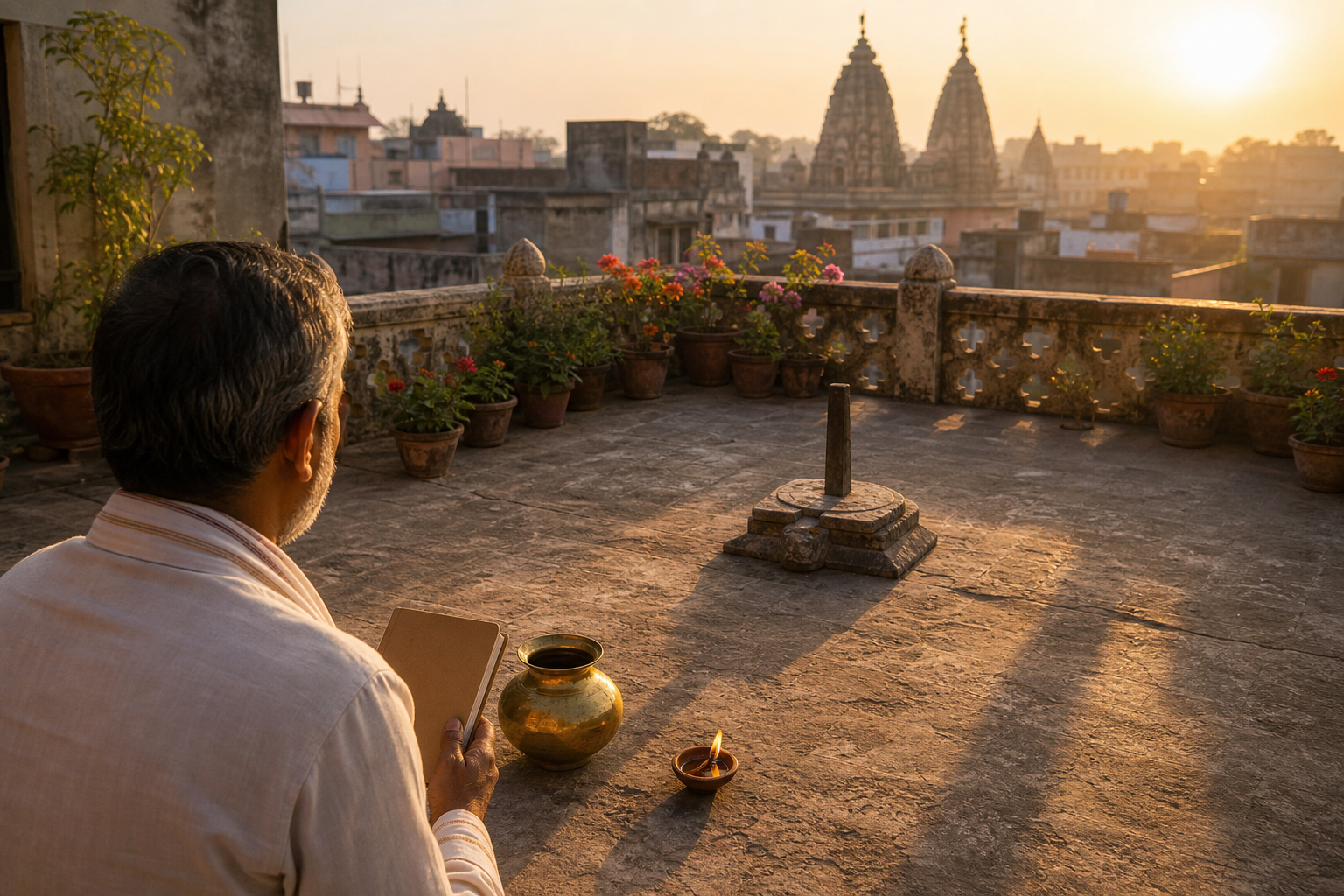
Generic tables often assign the same clock hours to Rahu Kalam across every season and city. That is only an approximation. These caution periods are based on proportional sections of the daylight interval, so their boundaries move when sunrise and sunset move.
- Find the correct local sunrise and sunset for April 18.
- Subtract sunrise from sunset to obtain the daylight duration.
- Divide that duration into eight equal segments.
- For Saturday, Rahu Kalam occupies the second segment of that daylight octet.
- Use locally calculated entries for Yamaganda and Gulika rather than guessing their positions from the weekday alone.
In formula form, if sunrise is S, sunset is E, and one daylight segment is L = (E – S) / 8, Saturday’s Rahu Kalam runs from S + L to S + 2L. This explains why a printed fixed-hour chart can drift away from the actual local interval.
Abhijit Muhurta is centered around local solar noon and is traditionally treated as a balanced period for success-oriented work. Local solar noon is not automatically 12:00 on the civil clock, and the Muhurta’s exact minutes depend on that location’s sunrise-to-sunset span. Look up the city’s calculated window instead of assuming that the whole noon hour qualifies.
Abhijit Muhurta should also not be treated as a substitute for the rest of the Panchang when the undertaking requires careful election. First identify the correct Tithi and local window. Then check whether Rahu Kalam or another caution period affects the proposed time, followed by any Nakshatra, Yoga, Karana, or tradition-specific requirements. For an ordinary daily puja, this should prevent needless anxiety; for a formal rite, it prevents a convenient noon estimate from being mistaken for a complete muhurta.
Read the Panchang without forcing it into midnight

Why a Tithi can change at 3:13 PM
A Tithi is an astronomical relationship, not a fixed block on a civil calendar. Each Tithi covers a 12-degree increase in the angular separation of the Moon and Sun. The Moon’s apparent motion is not perfectly uniform, so the duration varies around an average of approximately 23 hours and 37 minutes.
That mechanism is why Pratipada can continue through the morning and end in mid-afternoon. Midnight does not reset the lunar day. When a calendar labels April 18 as Pratipada while also showing Dwitiya after 3:13 PM, those statements are not contradictory: the label generally reflects the Tithi at sunrise, while the transition time shows when the lunar geometry changes.
What the Tithi cannot tell you by itself
The traditional Panchang has five limbs: Tithi, Vara, Nakshatra, Yoga, and Karana. On April 18, Vara is Saturday and the main Tithi movement is known, but a complete activity selection still needs the other locally calculated limbs.
- Tithi identifies the lunar-day phase and supplies the Pratipada-to-Dwitiya framework.
- Vara identifies the weekday and helps place weekday-based caution periods such as Rahu Kalam.
- Nakshatra adds an activity quality that may be fixed, movable, soft, sharp, or otherwise classified within the chosen system.
- Yoga is calculated from the combined solar and lunar longitudes and further qualifies the day.
- Karana divides the Tithi into half-Tithi units and refines the suitability of a narrower interval.
The Moon’s Rashi provides another layer of interpretation, but it is not interchangeable with Nakshatra or Tithi. These factors change on their own schedules. A calendar entry that gives only the Tithi can support a simple household plan; it cannot establish a fully elected muhurta.
Lunar rhythm also appears across Dharmic communities without making their observances identical. Buddhist Uposatha practice follows important lunar phases; Jain vrata, meditation, and pratikraman are shaped by fortnightly rhythms; and some Sikh households retain cultural awareness of Puranmasi and other lunar markers even though the Nanakshahi calendar is solar in basis. If you are planning an inter-community gathering, acknowledge the shared lunar setting while allowing each tradition to determine its own practice.
Key takeaways for April 18
- Saturday, April 18, 2026 begins at sunrise under Shukla Paksha Pratipada in most Indian regions.
- Pratipada ends at approximately 3:13 PM in most Indian locations; Shukla Paksha Dwitiya follows.
- Use Pratipada for the morning sankalpa and first concrete act of a new spiritual or constructive commitment.
- Use Dwitiya after the transition to reinforce, organize, repeat, or extend what you began.
- Calculate Rahu Kalam from the second of eight equal daylight segments on Saturday; do not copy a fixed clock range without checking local sunrise and sunset.
- Find the exact local Abhijit Muhurta around solar noon, and consult Nakshatra, Yoga, Karana, Rashi, and tradition-specific rules when the rite requires a formal muhurta.
- Outside India, obtain a Panchang generated for your city and time zone rather than treating 3:13 PM as a universal local time.
Before setting the day’s schedule, write down three local values: sunrise, the exact end of Pratipada, and the caution periods you intend to avoid. Then choose one action to begin under Pratipada and one action to strengthen under Dwitiya. That small amount of preparation turns the Panchang from a date label into a usable discipline.