
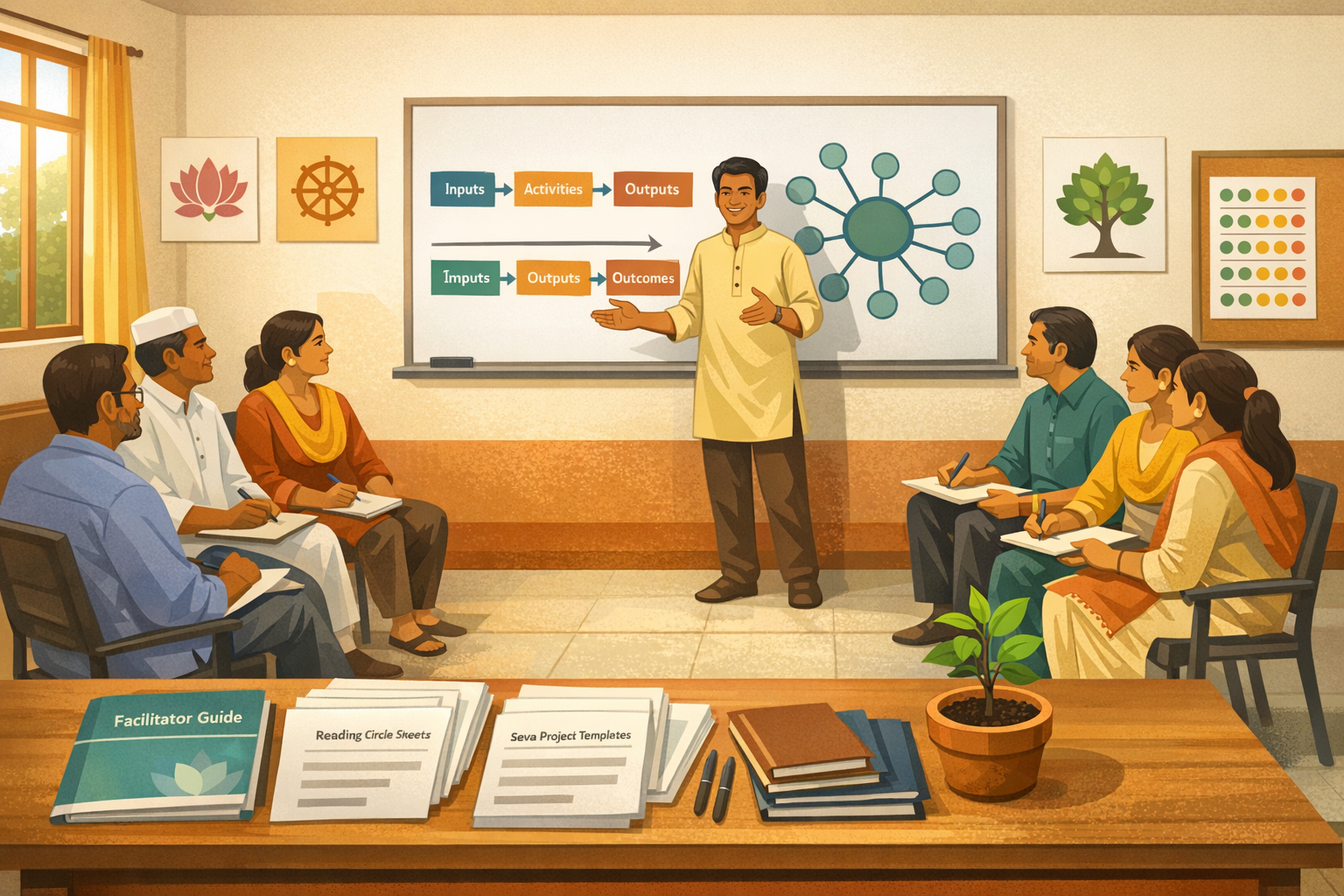
In Jalgaon, a joint conference of Dharmashikshan classes organized by Hindu Janajagruti Samiti (HJS) convened participants from Vikharan village alongside educators and volunteers engaged in community learning. The forum created structured space for peer exchange, practical reflection, and collaborative planning aimed at strengthening values-centered education and extending it to additional villages.
As a community-facing pedagogy, Dharmashikshan advances ethical literacy, character formation, and service-minded citizenship. Framed through a unifying, dharmic perspective that honors the shared civilizational values of Hinduism, Buddhism, Jainism, and Sikhism, it translates principles such as ahimsa, seva, satya, and karuna into everyday practices that reinforce social harmony and local resilience.
Attendees shared field experiences and expressed clear enthusiasm to expand the initiative to other villages. In comparable settings, sustained participation typically grows when classes are predictable, family engagement is encouraged, and instruction aligns with local language and cultural contextconsiderations that offer a pragmatic checklist for scale-up.
From a technical standpoint, the conference outcomes align with a straightforward logic model: inputs (trained volunteers, locally relevant materials, community spaces), activities (weekly classes, discussion circles, seva projects), outputs (regular attendance, completed learning modules, community service hours), and outcomes (improved ethical reasoning, cooperative behaviors, and inter-dharmic understanding). This model supports evidence-informed planning without overcomplicating grassroots delivery.
A robust Dharmashikshan curriculum can be organized around four pillars. First, ethical foundations drawn from dharmic texts and narratives distilled for age-appropriate learning. Second, inter-dharmic appreciation that highlights convergences across Hindu, Buddhist, Jain, and Sikh wisdom on compassion, non-violence, truthful living, and disciplined action. Third, civic and environmental stewardship that links timeless duties to contemporary local needs. Fourth, reflective practicejournaling, satsang-style dialogue, and guidance from mentorsto consolidate learning into habits.
To ensure quality, pedagogy should emphasize dialogue over didacticism, integrate story-based learning with case discussions, and conclude cycles with small seva commitments that make lessons tangible. Simple assessmentsshort reflections, facilitator observations, and community feedbackprovide sufficient evidence of progress while keeping administrative burden low.
Capacity-building is central to scale. A concise training-of-trainers pathway can cover facilitation skills, inclusive classroom norms, safeguarding, conflict-sensitive communication, and basic monitoring methods. Peer observation and quarterly refresher workshops help volunteers exchange practices that work in villages with differing sizes, schedules, and resource constraints.
Local partnerships increase staying power. Temple committees, school management committees, women’s self-help groups, youth clubs, and panchayat representatives can co-host sessions, nominate volunteers, and align Dharmashikshan calendars with festivals and harvest cycles. Clear role definitions and a brief code of conduct sustain trust, transparency, and pluralism.
For expansion beyond Vikharan, a hub-and-spoke approach rooted in Jalgaon can balance ambition with feasibility. A practical pathway includes selecting a small cluster of nearby villages for a 90-day pilot, standardizing starter kits (facilitator guides, reading circles, seva templates), and scheduling monthly peer clinics where facilitators troubleshoot challenges together. Successful pilots can then be replicated in successive cohorts using the same cadence.
Monitoring and evaluation can remain lightweight yet rigorous. Suggested indicators include session regularity, learner retention, completion of service-learning tasks, and observable cooperative behaviors in community settings. Baseline and endline reflective prompts, captured anonymously, can track shifts in ethical reasoning and inter-dharmic understanding without intrusive testing.
Safeguards underpin credibility. Programs should be strictly non-coercive, non-partisan, and welcoming of all who identify with the dharmic civilizational family. Child-protection norms, grievance channels, and data-privacy practices protect participants, while an explicit commitment to unity in spiritual diversity ensures that no single path is imposed over others.
Taken together, the HJS-facilitated conference in Jalgaon illustrates how grassroots energy, practical peer learning, and a clear logic for scale can converge into a replicable model. By grounding Dharmashikshan in shared dharmic values and locally relevant service, communities such as Vikharan can seed confident, compassionate citizenshipand neighboring villages can adopt the same framework with minimal friction.
Inspired by this post on Hindu Jagruti Samiti.
