
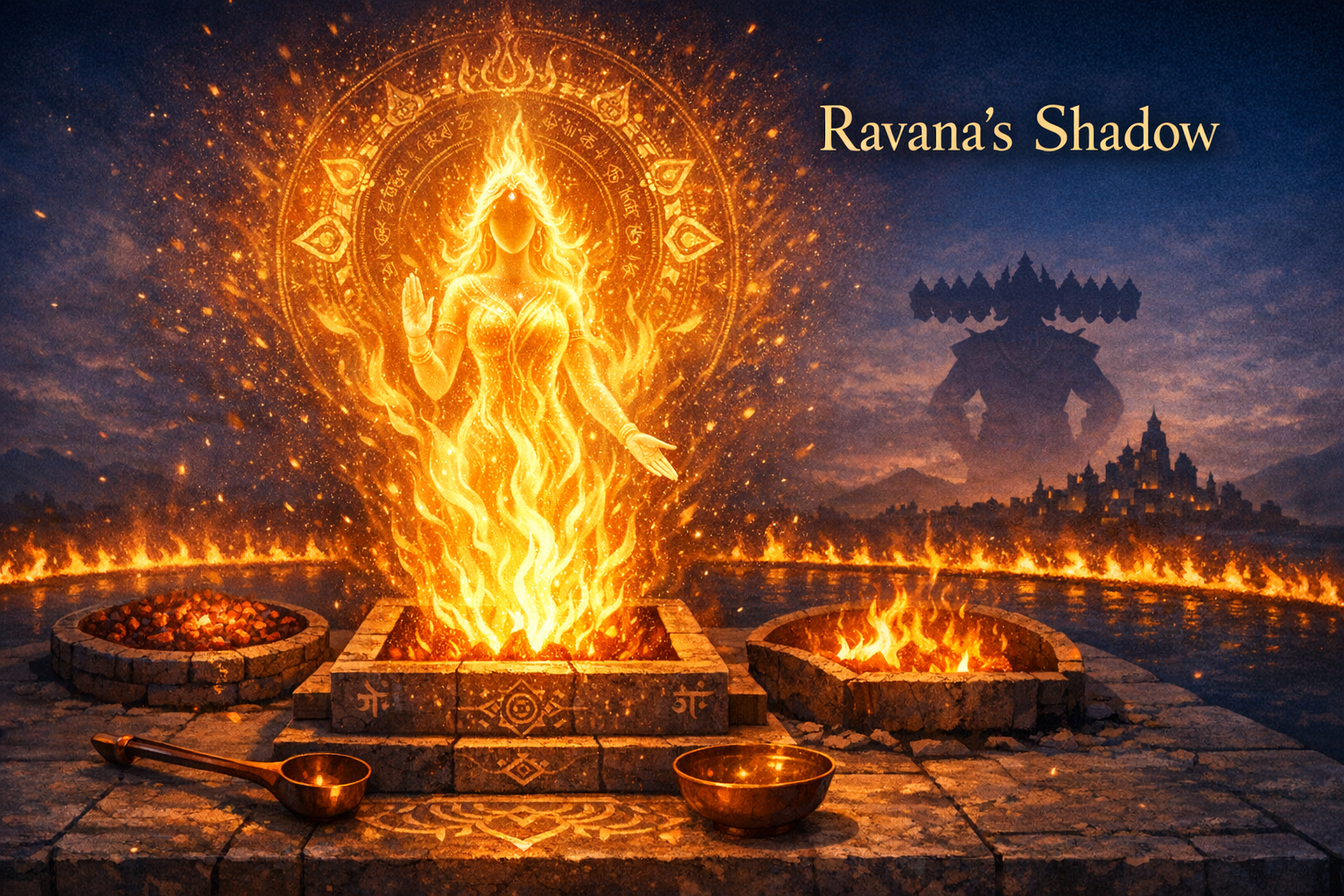
Within the vast interpretive tradition of the Ramayana, the narrative of Swaha’s curse upon Ravana emerges as a compelling lens on dharma, consent, and the sanctity of the sacramental word. While absent from the oldest recensions attributed to Valmiki, this later Ramayana strandcirculating in Puranic and regional tellingsframes Lanka’s eventual immolation as a karmic consequence of the Demon King’s transgressive desire. Read alongside better-attested motifs such as Vedavati’s curse, Nandi’s rebuke, and Nalakuvara’s interdiction, Swaha’s warning deepens a consistent ethical message: adharma, especially where it violates the sacred autonomy of women and ritual purity, summons its own retributionoften, quite literally, through fire.
Swaha, venerated as the consort of Agni, stands at the heart of Vedic ritual ontology. In homa and yajna, “swaha” is the performative utterance that carries the oblation into the transforming medium of fire. It is not merely a closing word but a mantric seal that completes intention, authorizes offering, and mediates between the human and the divine. In this ritual grammar, Swaha personifies purity, legitimacy, and consent: only that which is rightly intended, rightly spoken, and rightly offered can be borne by Agni to the devas.
The ritual architecture behind this personification is technical and exacting. Shrauta praxis maintains three sacrificial firesGarhapatya (domestic), Ahavaniya (offering), and Dakshinagni (southern)with precise liturgical roles. The efficacy of mantras, discussed in Mimamsa as apurva (the unseen potency generated by faithful performance), is actualized at the moment the officiant voices “swaha.” The utterance completes a triad of intention (sankalpa), mantra (vac), and offering (dravya). As Agni is “hotr” of the gods and witness to vows, Swaha is the sanctifying consent that renders action ritually and morally legitimate.
Against this backdrop, the Swaha–Ravana motif gains moral clarity. In later narrative memory, Ravana’s lust does not simply disclose personal failing; it profanes a boundary guarded by the sacred feminine. By affronting the consort of Firewhether through direct impropriety or through the broader pattern of coercive desire seen across his lifeRavana offends the very principle that authorizes any offering to reach the divine. Swaha’s curse, in this reading, is not arbitrary wrath but a juridical pronouncement within a ritual cosmos: a ruler who violates consent and sanctity will meet destruction by the same Fire whose laws he has abused.
This theme resonates with a wider web of Ramayana warnings. Nandi’s curse at Kailasa foretells a simian force undoing Ravana’s pride; Vedavati’s vowafter resisting Ravana’s advancesprefigures an eventual reckoning tied to her rebirth traditions; Nalakuvara’s proscription, following the assault on Rambha, bars further sexual violence by threat of instant ruin. Swaha’s imprecation harmonizes with these strands, converging on a singular ethical vector: adharma rooted in coercion and contempt for the sacred feminine invites catastrophic loss.
In narrative time, the prophecy coheres with the Sundara Kanda’s conflagration of Lanka. When Hanuman’s tail is set alight and he ranges across the city, fire becomes both punitive agent and cosmic teacher. Commentarial traditions frequently note that the homes of the righteous, including that of Vibhishana, are spared, underscoring a jurisprudence of flame: Agni is no blind destroyer but a discerning witness (Agni-sakshi) acting in alignment with dharma. In this light, Swaha’s warning does not merely predict a blaze; it announces a moral audit by the very element that consecrates Vedic rite.
There is, therefore, a profound symmetry at work. The same Fire that legitimizes offerings and seals vows becomes the instrument by which violations of consent and sanctity are exposed and corrected. The lesson is not retributive sensationalism but ethical restoration: power, when severed from restraint and reverence, consumes itself. Ravana’s arc illustrates how kama, unbridled by dharma, degenerates into adharma and pramada (recklessness), dissolving judgment and imperiling the kingdom entrusted to his care.
From a pan-dharmic perspective, the story’s moral grammar aligns with sister traditions of the subcontinent. Buddhism’s pañca-sila proscribe sexual misconduct (kamesu micchacara) and valorize right intention; Jainism elevates ahimsa and brahmacharya, binding desire to self-discipline and non-violation; Sikh ethics, grounded in dignity and equality, repudiate coercion and uphold reverence for women and familial sanctity. Swaha’s curse may be a Hindu narrative detail, yet the principle it enshrinesconsent as sacred, power as accountableis shared across dharmic wisdom.
For readers and practitioners, this integrative view invites reflection on how sacred words shape ethical worlds. In every homa where “swaha” is voiced, a compact is renewed: vows are to be honored, offerings to be pure, relations to be consensual, and power to be service-bound. The Ramayana’s fiery tableau then becomes more than epic spectacle; it becomes a mirror in which communities can examine leadership, gendered agency, and ritual integrity.
A textual-critical note is instructive. The earliest Valmiki strata do not recount Swaha’s curse; its presence in later Puranic and regional retellings illustrates how living traditions expand ethical emphasis through new narrative linkages. This is not variance for its own sake but hermeneutic pedagogy: by tying Lanka’s burning to a sacramental transgression, transmitters of the tradition foreground the indivisibility of ritual correctness and moral conduct. Such developments, common across premodern literature, reflect pedagogy-through-story more than historiography.
Equally important is what the motif avoids: sectarian animus. Rather than indicting a community or exalting partisanship, the narrative targets a vicecoercive lustand protects a valuesacred consent. In doing so, it strengthens a shared civilizational ethic that can be affirmed by Hindus, Buddhists, Jains, and Sikhs alike: the feminine is not merely to be “respected” as an abstract ideal but safeguarded as an inviolable principle grounding family, society, and spiritual life.
Finally, the story suggests a practical takeaway for the present: words and rites have power because they bind communities to truth. If “swaha” is the ritual signature that makes an offering real, then public speech, policy, and leadership similarly require the seals of transparency, consent, and accountability. Where these are honored, fire illuminates; where they are flouted, fire exposes. In the ethical geography of the Ramayana, that is how prophecy becomes pedagogyand how a kingdom’s destiny, for good or ill, is lit.
Inspired by this post on Hindu Blog.
