
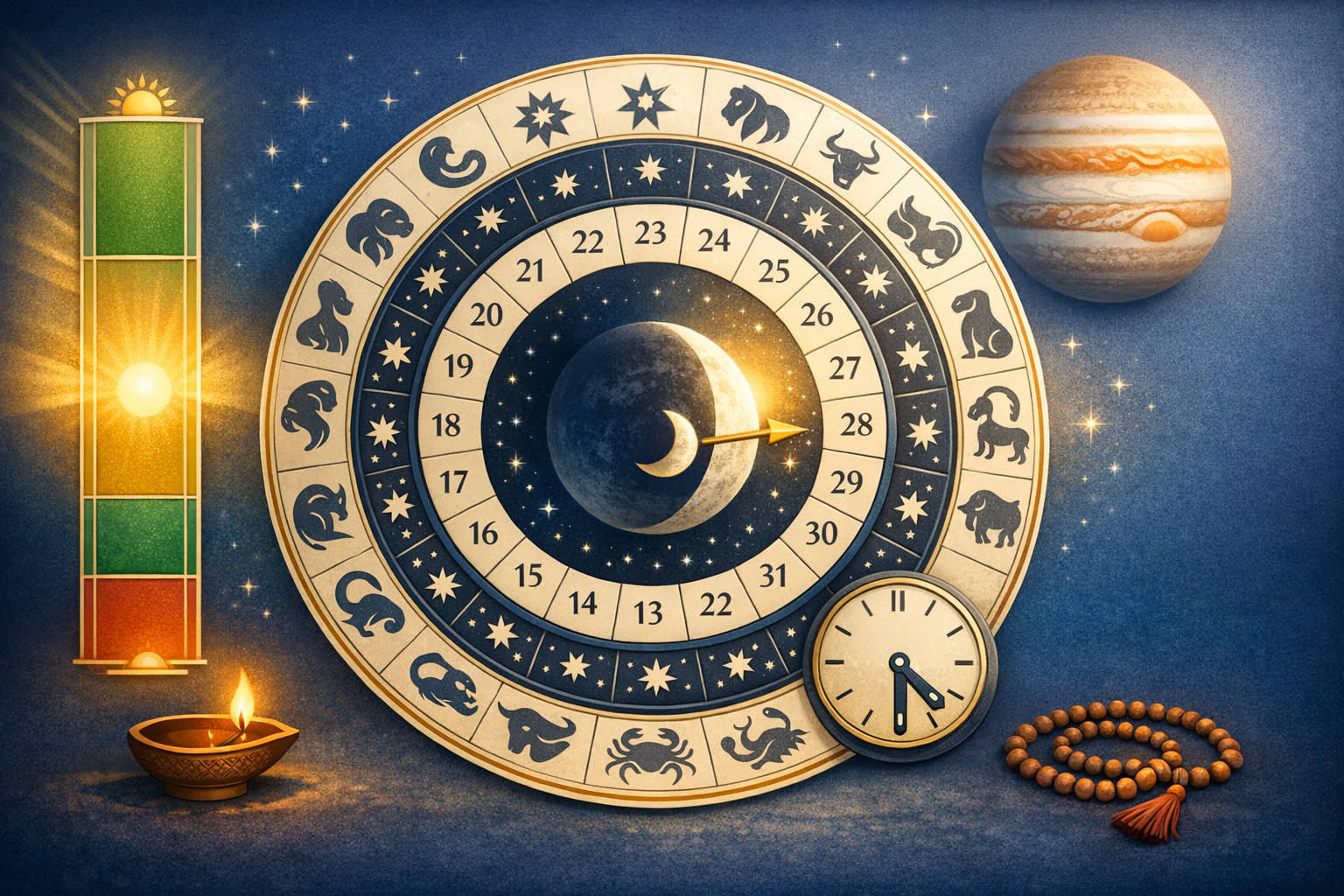
On Thursday, March 5, 2026, the Hindu calendar (Panchang) marks Krishna Paksha Dwitiya, the second lunar day of the waning phase, until 4:28 PM. From that time onward, Krishna Paksha Tritiya prevails. These timings reflect traditional Indian Panchang calculations used in most regions; local observances can shift slightly with longitude, latitude, and chosen ayanamsa.
Krishna Paksha is traditionally associated with inward focus, simplification, and refinement of daily disciplines. The movement from Dwitiya to Tritiya on this date supports routines that prioritize study, reflective japa, restrained diet, and quiet seva. Across dharmic traditionsHindu, Buddhist, Jain, and Sikhthis segment of the lunar month is widely regarded as conducive to contemplation, ethical restraint, and community harmony, underscoring shared values of self-awareness and compassion.
Falling on a Thursday (Guruvara), the day is symbolically aligned with Jupiter (Guru), emphasizing learning, transmission of wisdom, and the teacher–student relationship. Acts that strengthen guidance, mentorship, and ethical leadership are considered especially resonant, and families often choose such days to begin studies, offer “guru-dakshina,” or set collective intentions for education and service.
Technically, a tithi is determined by the relative geocentric ecliptic longitudes of the Moon and the Sun. Each tithi spans 12 degrees of angular separation: Tithi number = floor((Lmoon − Lsun)/12°) + 1. During Krishna Paksha, the Moon–Sun angular distance decreases from 180° after Purnima toward 0° at Amavasya; Dwitiya corresponds to the 12°–24° band, and Tritiya to 24°–36°. Because this astronomical criterion is independent of sunrise or sunset, tithis can begin and end at any clock time, which is why precision matters when planning rites or travel.
Time notations for Panchang are sensitive to computational choices (for example, Lahiri or other ayanamsa) and locality. A best practice is to confirm the tithi end moment with a trusted, region-specific Panchang or temple office if a rite requires exactness. When coordinating across time zones, especially for family events in the diaspora, aligning to the local sunrise, sunset, and lunar ephemerides ensures accuracy and avoids unintended shifts in observance.
Good Time (Shubh Muhurat) selection on a weekday begins with a few universal anchors. Abhijit Muhurat, when used, centers around local solar noon and is often considered suitable for urgent or necessary actions when other windows are unavailable. To approximate it, determine local sunrise and sunset, compute local solar noon (roughly the midpoint), then consult a regional Panchang for its exact span. It is prudent not to conflate civil clock noon with true solar noon; longitude and the equation of time introduce small offsets.
Equally important are the avoidance windows. Rahu Kalam, Yamaganda, and Gulika are computed by dividing the daylight span (sunrise to sunset) into eight equal parts and assigning weekday-specific segments. For Thursday, Rahu Kalam occupies the sixth segment of the day; Yamaganda and Gulika fall in their standard Thursday segments as per local tradition. The exact clock times therefore vary with the date and location because the daylight length changes; one should calculate these segments from that day’s local sunrise and sunset. Initiating major undertakings, signing contracts, or starting journeys is generally deferred outside these intervals.
Choghadiya offers another practical framework, especially common in western and northern India. The daytime and nighttime are each divided into eight “ghadiyas”; among them, Shubh, Labh, and Amrit are broadly favorable, whereas Rog, Kaal, and Udveg are avoided for beginnings. Because the spans depend on that day’s daylight and night length, the recommended method is to compute Choghadiya blocks from local sunrise and sunset and then choose positive blocks that also steer clear of Rahu Kalam and Yamaganda.
Nakshatra and Rashi are core to daily Panchang insights yet necessarily location- and ephemeris-dependent. A Nakshatra covers 13°20′ of the ecliptic, subdivided into four padas of 3°20′ each. Determining the day’s Nakshatra requires the Moon’s sidereal longitude; when the Moon crosses a Nakshatra boundary, the Nakshatra changes and can do so at any time of day. Similarly, the Moon’s Rashi is the 30° segment of the sidereal zodiac it occupies; transitions occur as the Moon crosses sign boundaries. For authoritative results, reference a locale-appropriate Vedic ephemeris using a consistent ayanamsa, such as Lahiri.
In many households, practitioners synchronize routine tasks with these cues to restore a calming rhythm to daily life. Studies and lessons often begin during positive Choghadiya blocks; quiet sadhana intensifies during Krishna Paksha; and family service activities are planned after verifying that they do not coincide with Rahu Kalam or Yamaganda. This method offers both structure and spaciousness, allowing devotion and duty to support one another.
Ritually, Krishna Paksha Dwitiya and Tritiya are well-suited to satvik activities: steady japa, svadhyaya of the Upanishads or the Bhagavad-Gita, simple “anna-daan,” and observances that emphasize ahimsa and maitri. These disciplines resonate across dharmic lineages: Buddhist mindfulness and Uposatha-inspired reflection, Jain vrata practices centering on restraint and compassion, and Sikh teachings on seva and remembrance of the Divine Name reflect convergences in intent that strengthen social harmony and personal clarity.
Calendrical practice varies by region. Many north and east Indian traditions follow the Purnimanta month reckoning, while much of peninsular India uses the Amanta system. The tithi sequence remains the same, but month names can differ around the new- and full-moon transitions. When a festival falls near a boundary, cross-checking with the local tradition prevents date drift and ensures that collective observances remain unified.
For those scheduling ceremonies, two practical steps preserve accuracy without unnecessary complexity. First, confirm the tithi end time for the specific location and ensure the chosen muhurta does not overlap Rahu Kalam, Yamaganda, or Gulika. Second, if Nakshatra or Moon’s Rashi matters for the rite, consult a trusted Panchang or app that clearly states its ayanamsa and time zone handling; consistency across tools prevents small but consequential discrepancies.
The educational value of Panchang use lies as much in its astronomy as in its spirituality. Understanding that a tithi reflects a 12° Moon–Sun separation invites a scientific appreciation of why lunar dates sometimes appear to “cut across” civil days. Recognizing that Nakshatra boundaries are precise celestial arcs illuminates why a Nakshatra can change in mid-afternoon. These insights foster respect for the care with which earlier astronomers structured timekeeping in the Indian knowledge systems.
In summary, Thursday, March 5, 2026, transitions from Krishna Paksha Dwitiya to Tritiya at 4:28 PM in most Indian Panchang traditions. The day’s Guruvara character elevates learning, counsel, and ethical resolve. Favorable periods can be found using Abhijit Muhurat and positive Choghadiya segments, while diligence in avoiding Rahu Kalam and Yamaganda protects new beginnings. When Nakshatra and Rashi are required, rely on a consistent, locale-specific ephemeris. Approached this way, the Panchang becomes a shared compassscientifically grounded, spiritually open, and naturally unifying across the diverse streams of Sanatana Dharma.
Inspired by this post on Hindu Blog.
