

Evidence about everyday life in ancient civilizations often arrives unevenly. Sixth-century B.C.E. Mesopotamia preserves vivid courtroom records, while the contemporaneous Indus-Sarasvati world leaves only tantalizing archaeological traces. The imbalance deepens in the history of Indian philosophy, where textual voices are abundant yet biographical details are scarce. Of the Varanasi logician Raghudeva Bhattacharya, for instance, tradition records only a lineage of learningstudent of Harirama, resident of Varanasi, with translations by Mahādevareminding readers that Indian philosophers prized ideas over personal narratives.
This asymmetry frames a larger question central to Indian intellectual history: how should modernity be understood? Was it, as in parts of Europe, a deliberate rupture with the ancient past? Or did Indian philosophers cultivate a different pathone that reinterpreted ancestral wisdom through new methods of reasoning without discarding continuity? Jonardon Ganeri’s study of Navya-Nyāya, centered on Mithila, Navadwīpa, and Varanasi, argues compellingly for the latter.
The pivotal figure is Raghunātha Śiromaṇi (c. 1475–1545), author of the Padārtha-tattva-nirūpaṇa, whose work predates Francis Bacon and René Descartes by a century. Raghunātha urged “reason and evidence-based critical inquiry” over mere scriptural exegesis, calling for independent thinking and meticulous evaluation of even widely accepted views. In doing so, he helped inaugurate a culture of disciplined analysis that resonated across the dhārmic world. The Navya-Nyāya system soon became the dominant school of logic and epistemology in Sanskrit learning, drawing scholars from Tibet and Nepal; seventeenth-century pandits from Navadwīpa even assisted the Fifth Dalai Lama, exemplifying a shared pursuit of knowledge across Buddhist and Hindu communities.
Modernity in this context emerges not as a clean break but as a bridge. Philosophers developed a new style of commentary that probed hidden meanings, clarified difficult arguments, and, at times, reframed entire texts through innovative conceptual lenses. They trained readers to “think well,” building a layered ontology in which concepts operated from the finest granularity to composite wholes. When classical Sanskrit proved insufficient for ever more intricate logical forms, they crafted a precise technical idiom capable of capturing subtle relationships with extraordinary clarity.
Social and political conditions enabled this intellectual flowering. Many thinkers lived near great centers like Navadwīpa and Varanasi yet remained sufficiently on the fringe to avoid entanglement in courtly demands. Patronage from the Mughal court, the Bengal Sultanate, and local landholders sustained scholastic work, while the Sanskrit philosophical corpus of the era shows little direct Persianate imprint. The result was a robust sampradāya-based ecosystem operating within the norms of śāstra and sustained by pedagogical lineages whose authority derived from rigor, not personality.
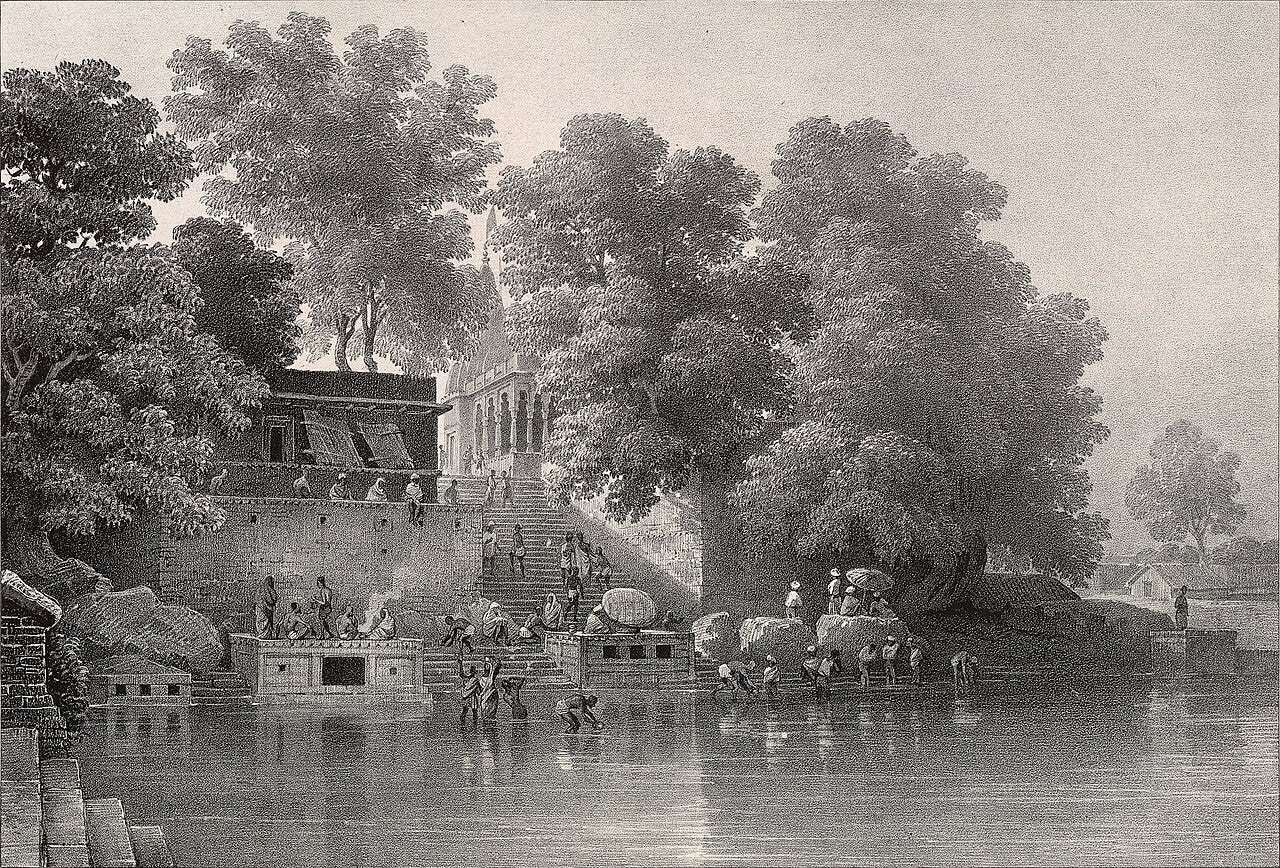
Ganeri emphasizes how this ecosystem was later disrupted under British rule, when traditional institutions were deemed irrelevant and, perhaps, perceived as capable of generating intellectual resistance to colonial authority. Even so, the record of early modern India between 1450 and 1700 reveals a self-confident philosophical culture that integrated critical inquiry with continuityan approach that resonates with readers who have watched debates unfold in monastic courtyards or imagined scholars arguing fine points of logic along the ghats of Varanasi.
This raises a thoughtful challenge: is “modernity” even the right label? Indian darśanas have long embraced rigorous questioning. The Upaniṣads critiqued the ritualism of the Brāhmaṇas even as they preserved the philosophical insights of the Mantras. Buddhism denied a persisting individual self; Nyāya-Vaiśeṣika took it as ultimately real. As Prof. Hiriyanna observed, “we have all the different shades of philosophic theory repeated twice over in India, once in the six systems and again in Buddhism.” In this wider dhārmic frameincluding Jaina traditions of logic and an ethos of plural debateinnovation thrives without the need to erase the past.
The neglect of this intellectual vitality in modern curricula is not confined to philosophy. Parallel achievements in mathematics and astronomy are often overlooked. In Kerala, Nīlakaṇṭha refined planetary models for Mercury and Venus, surpassing both Islamic and European contemporaries. The Kerala school’s development of infinite serieslater associated with Gregory and Leibnizappears in Jyeṣṭhadeva’s Yuktibhāṣā, which presents proofs and derivations that amount to a remarkably complete early text of mathematical analysis. Thanks to scholars such as K.V. Sarma, C.K. Raju, M.D. Srinivas, M.S. Sriram, K. Ramasubramanian, and George Gheverghese Joseph, awareness of these contributions is growing.
Seen together, these histories illuminate a distinctively Indian form of intellectual renewal: bold in method, rooted in tradition, and open to cross-cultural exchange within the dhārmic family. Navya-Nyāya shows that rigorous reasoning and respect for lineage are not opposing forces but mutually reinforcing virtues. For readers seeking unity across Hindu, Buddhist, Jaina, and Sikh heritages, this period offers a shared narrative of inquiryone that affirms continuity, celebrates diversity of thought, and invites renewed confidence in indigenous pathways to knowledge.
Ganeri’s reconstruction of early modern Indian philosophy thus serves as both introduction and invitation. It introduces Navya-Nyāya with historical depth and analytical precision; and it invites a wider reassessment of how modernityunderstood as disciplined, evidence-based inquiryarose in India on its own terms, long before Western influence became decisive. In that light, Raghunātha Śiromaṇi’s legacy appears not as a footnote to European developments but as a luminous chapter in the global story of reason.
Inspired by this post on Varnam.
