

The real test of yoga is not whether you can feel calm for ten minutes. It is what happens in the brief interval between a trigger and your response: whether you notice agitation before it becomes speech, whether attention returns after distraction, and whether you can act without being driven by the first impulse that appears.
If your practice produces a temporary pleasant state but leaves rumination, irritability, or compulsive reaction untouched, you do not necessarily need a harder posture or a more exotic meditation. You need a better sequence: ethical orientation, stable movement, regulated breathing, trained attention, and honest observation of how practice transfers into daily conduct.
The Dharmic aim is not thoughtlessness
Patanjali’s yogas citta-vritti-nirodhah, Yoga Sutra 1.2, is often translated as the restraint or settling of the mind’s fluctuations. That does not require you to attack thought, force the mind into blankness, or judge every distraction as failure. In practical terms, nirodha means that a mental pattern no longer has unrestricted command over attention and action.
This distinction matters. Suppression says, “I must not feel anger.” Regulation notices the heat, breath, muscular tension, story, and urge associated with anger, then creates enough steadiness to choose what serves dharma. The emotion may remain present while its control over conduct weakens.
Yoga Sutra 1.12 gives the working method: abhyasa and vairagya. Abhyasa is steady practice. Vairagya is non-grasping: you practise without demanding that every session deliver serenity, insight, or proof of progress. Practice supplies repetition; non-attachment prevents today’s mental weather from becoming the verdict on the whole path.
This principle appears in distinct forms across Dharmic traditions. Hindu paths integrate Raja Yoga with Karma, Jnana, and Bhakti. Buddhist samatha cultivates stability while vipassana develops insight. Jain samayik, pratikraman, and dhyana join equanimity to ethical examination. Sikh simran and Naam japa gather attention around sacred remembrance. These are not interchangeable techniques stripped of lineage and purpose, but they share an important movement: attention becomes steadier, conduct becomes more deliberate, and self-centred reactivity loses some of its authority.
Key takeaways
- Mental regulation is the capacity to notice a state without automatically obeying it.
- Abhyasa builds the capacity through repetition; vairagya keeps you from grasping at immediate results.
- Posture, breath, attention, ethics, and daily conduct form one system. Treating meditation as an isolated mental trick weakens that system.
- A calmer session is useful, but a wiser response outside the session is the more important measure.
- Neuroscience can describe plausible mechanisms and measurable correlates. It cannot certify spiritual attainment or replace the categories supplied by a living Dharmic tradition.
What contemplative neuroscience can and cannot tell you

“Rewiring the brain” is an attractive phrase, but it should not be treated as magic. Repeated movement, breathing, attention, and behavioural restraint give the nervous system repeated experience of noticing, stabilising, and redirecting. Over time, that learning can make a regulated response more available. No single peaceful session proves that a permanent neural change has occurred.
Contemplative practice is frequently associated with changes in the networks involved in attention, interoception, cognitive control, memory, and self-referential thought. The insula is relevant to awareness of internal bodily signals. The anterior cingulate cortex participates in cognitive control. The hippocampus supports context and memory. Moderated activity in the default mode network is associated with less habitual rumination and stronger present-moment awareness.
These findings are correlates, not a scan of enlightenment. They do not show that every practitioner receives the same benefit, that one brain region contains a spiritual faculty, or that an image of neural activity can settle questions about consciousness. Use neuroscience to understand part of the mechanism, not to reduce prana, citta, karma, or liberation to laboratory vocabulary.
Breath gives you the most immediate point of entry. Slow diaphragmatic breathing at roughly five to six breaths per minute is associated with improved baroreflex sensitivity, vagal influence, and heart-rate variability. In ordinary experience, the useful result is not the ability to recite those mechanisms. It is the ability to recognise rising arousal and use a comfortable respiratory rhythm before speech and behaviour become disorganised.
Asana contributes by improving interoception and proprioception: your ability to sense the body from within and locate it in space. Slow, precise loading gives you information about gripping, imbalance, breath-holding, and unnecessary effort. Patanjali’s sthira-sukham asanam, Yoga Sutra 2.46, offers a practical criterion. Look for stability with ease. If you obtain the external shape by sacrificing breath, joint control, or awareness, the posture is rehearsing strain rather than regulation.
Randomised trials and systematic reviews frequently report improvements in chronic low-back-pain outcomes, sleep, quality of life, blood pressure, and symptoms of anxiety or depression. Effects on anxiety and depressive symptoms are generally described as small to moderate, and adherence and suitable instruction strongly influence results. Early findings involving inflammatory signalling or telomerase remain preliminary. They are not a sound reason to promise disease reversal or turn a spiritual discipline into a catalogue of biomarkers.
For your own practice, use neuroscience to ask better questions. Did the breathing reduce arousal without producing strain? Did movement improve bodily awareness before sitting? Did attention return sooner after distraction? Did the session change how you handled the next difficult interaction? Those observations are more useful than trying to feel your brain changing.
Use the eight limbs as a regulation sequence

Patanjali’s eight limbs are often presented as a ladder. For daily mental regulation, they can also serve as a diagnostic sequence. When meditation is not settling the mind, look earlier in the chain before forcing a longer sit.
- Yama and niyama: Begin by reducing the conflicts that keep the mind rehearsing defence, acquisition, and regret. Ahimsa asks whether your speech and action are adding avoidable harm. Aparigraha asks what you are grasping, hoarding, or trying to control. Ethical discipline is therefore part of mental regulation, not an ornamental preface to the “real” yoga.
- Asana: Establish a body that can remain alert without constant fidgeting or collapse. Use manageable ranges, controlled transitions, and an uninterrupted breath. The aim is not visual performance but a sufficiently steady physical base for attention.
- Pranayama: Regulate respiratory pace and depth without force. Three-part diaphragmatic breathing is a suitable foundation. Nadi shodhana can organise attention around an alternating sequence, while bhramari adds vibration and sound to the exhalation. Breath retention belongs later and should be learned under appropriate supervision.
- Pratyahara: Practise loosening the reflex to follow every sound, sensation, notification, or desire. This is not hostility toward the senses. It is the ability to receive sensory information without allowing every stimulus to issue a command.
- Dharana and dhyana: Give attention one clear home, such as breath, bodily sensation, or mantra. Each noticed distraction becomes an opportunity to return. As continuity develops, repeated returning matures into less interrupted meditation.
- Samadhi: Do not turn integration into a performance score. The practical work is to prepare conditions through ethical clarity, steadiness, breath, sensory discipline, and sustained attention. Grasping at an exalted state merely gives restlessness a spiritual costume.
This sequence tells you what to change. If sitting immediately becomes a struggle with agitation, begin with gentle spinal movement and a stable standing posture. If the body is settled but attention remains scattered, use an uncomplicated breath count or meaningful japa. If meditation feels peaceful but your relationships remain reactive, return to ahimsa, aparigraha, and the conduct surrounding the session.
Mantra is especially useful when verbal thought keeps generating new arguments. Repetition of a meaningful sacred name or sound, such as Om, Ram, or Waheguru, gives speech, breath, and attention a coherent direction. Meaning matters. Japa is not merely noise used to block thought; it places attention in relationship with a sacred value and allows that orientation to accompany work, conversation, and seva.
A six-week practice you can actually sustain
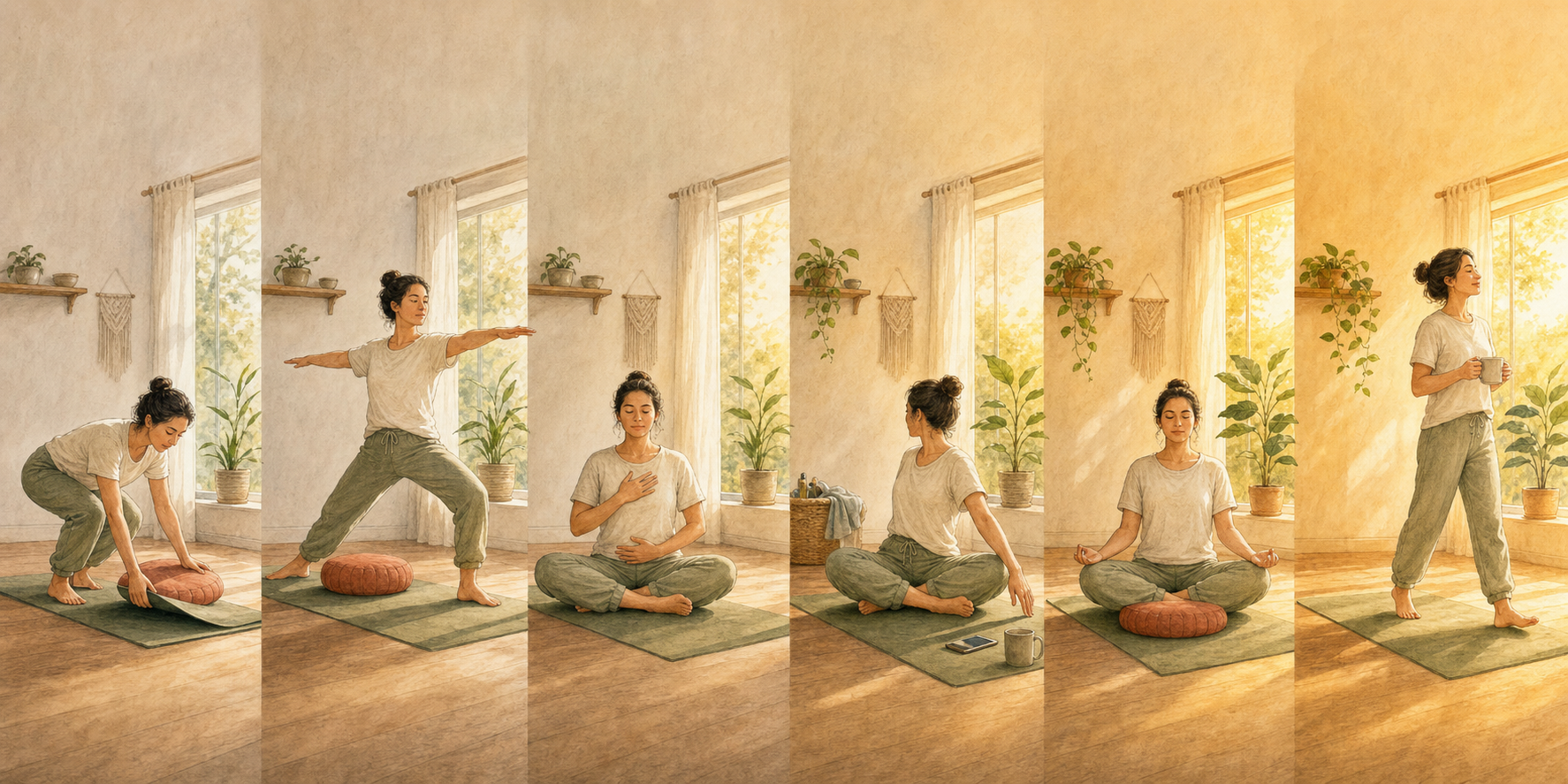
Choose one regular time and keep the basic sequence stable long enough to learn from it. Constantly changing techniques makes it difficult to know whether attention is maturing or merely being entertained by novelty. The following progression adds duration and complexity gradually.
Weeks 1 and 2: establish the foundation
Practise for 20 to 30 minutes. Your task is to connect movement, respiration, and attention without strain.
- Begin with one minute of centring. Name a simple ethical intention, such as carrying less irritation into the next conversation.
- Use three to five minutes of joint mobility, including cat-cow and gentle spinal rotation.
- Practise stable standing in tadasana and add simple balance holds suited to your ability. Keep the gaze quiet and the breath continuous.
- Use five minutes of dirgha, or three-part breathing. Let the abdomen, lower ribs, and upper chest participate without forcing maximum volume.
- Sit for five minutes with breath awareness or silent mantra. When attention wanders, identify the wandering without argument and return.
- Finish with a brief savasana so that the session ends in deliberate downregulation rather than an abrupt return to activity.
Do not judge these weeks by flexibility. Notice whether you can move without rushing, breathe without grabbing for air, and return attention without scolding yourself. Those are the foundational skills.
Weeks 3 and 4: integrate movement and attention
Extend the session to 30 to 40 minutes. Add complexity only while stability and ease remain present.
- Practise three to six unhurried rounds of surya namaskar, allowing roughly five to ten minutes.
- Add hip and shoulder opening appropriate to your current range rather than forcing an ideal shape.
- Practise six to eight cycles of nadi shodhana. Keep the rhythm comfortable and omit retention.
- Increase focused meditation, body scanning, or japa to eight to ten minutes.
- Close with three to five minutes of savasana.
During these weeks, watch transitions. Regulation is often lost while moving from one posture to another, from pranayama to meditation, or from the mat back to the phone. Keep the same quality of attention through each handoff.
Weeks 5 and 6: refine without chasing intensity
Build toward 40 to 50 minutes if the previous duration is sustainable. Longer is not automatically deeper; the extra time should produce greater continuity, not more strain.
- Introduce moderate holds in virabhadrasana variations while maintaining controlled joints and an even breath.
- Add gentle backbending through bhujangasana or supported setu bandha.
- Use bhramari or continue nadi shodhana. Add a retentive breathing pattern only when it is appropriate for you and taught by a qualified instructor.
- Extend meditation or japa to 12 to 15 minutes.
- End with gratitude connected to ethical intent. Ask where ahimsa or aparigraha needs to become visible in the coming day.
On a demanding day, choose emphasis rather than abandoning the structure. A sluggish but stable state may benefit from strength and standing work. An overstimulated state may call for gentle mobility, uncomplicated breathing, japa, and a longer savasana. Keep the core relationship among body, breath, attention, and conduct intact.
If the full session cannot happen, preserve continuity in ordinary transitions. Take three coherent breaths before a meeting, use silent japa while moving between tasks, add a short midday mobility break, or reduce screen light during the evening wind-down. These smaller acts do not replace the full practice, but they prevent regulation from becoming something you attempt only under ideal conditions.
Measure transfer, not performance, and change course safely

A practice journal should be brief enough to use consistently. After each session, record what you practised, how the body and mind felt, and one thing you noticed. Also watch sleep duration and quality, mood, perceived stress, and a simple mobility benchmark relevant to your practice. If you already track heart-rate variability, treat it as a secondary indicator of autonomic balance rather than a spiritual score.
The most revealing evidence appears away from the mat. Notice whether you detect tension earlier, recover from distraction more readily, pause before a harmful reply, listen without preparing a defence, or release an outcome that cannot be controlled. A difficult emotion may still arise. Progress can consist in seeing it sooner and giving it less power over the next action.
Do not use yoga to conceal a worsening health problem. It can support well-being, but it is not a substitute for medical care or psychological treatment. If practice is accompanied by a persistent deterioration in mood, anxiety, sleep, or ordinary functioning, stop trying to solve the problem by intensifying the practice and consult an appropriately qualified health professional.
People with hypertension, cardiovascular concerns, glaucoma, or pregnancy should avoid forceful breath retention and strong inversions unless they have received individual guidance from qualified professionals familiar with their circumstances. Joint pain calls for load management, props, chair-based variations, or individual instruction. Pain and respiratory strain are not evidence that purification is occurring.
Begin with the first 20-to-30-minute foundation session and protect the rhythm for six weeks. Let the question at the end of that period be concrete: not “Did I become perfectly calm?” but “Do I now have more freedom between what arises in the mind and what I choose to do?” That freedom is where mental regulation begins to serve dharma.