
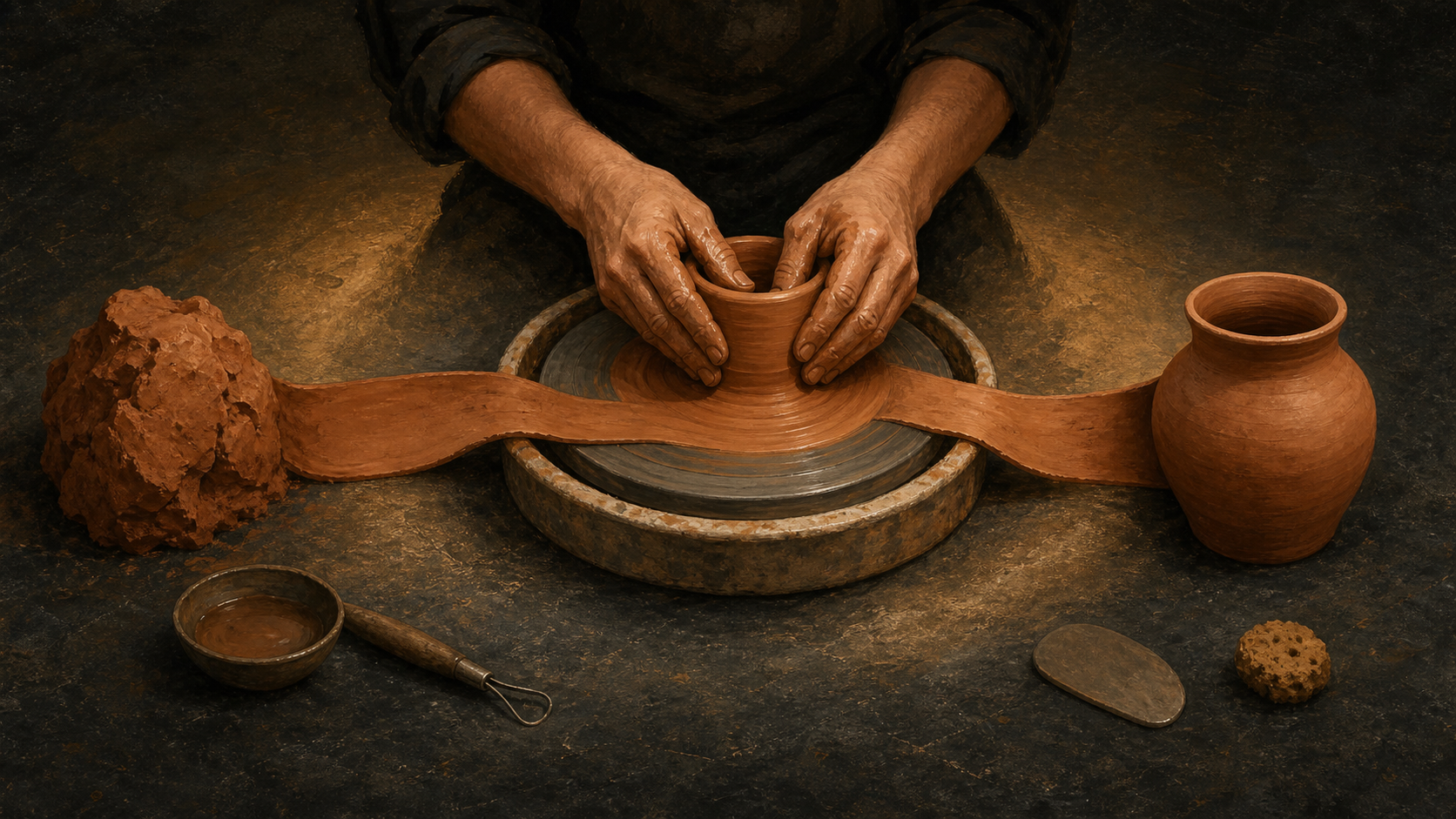
If you are comparing Hindu, Buddhist, Jain, and Sikh accounts of reality, one question will prevent a great deal of confusion: when something comes into being, what, if anything, becomes the new thing? That is the practical doorway into material causation.
The familiar clay-pot example looks simple, but it exposes several different problems at once. Clay supplies the material. A potter shapes it. A pot appears with a new name, form, and use. Separate those roles before you compare traditions, and you will see where their answers genuinely meet—and where a shared vocabulary would hide a real disagreement.
Begin with the effect in front of you
Upādāna-kāraṇa means the material cause: the underlying material from which an effect arises. Clay is the material cause of a pot. Gold is the material cause of a jewel. The potter, by contrast, is an efficient cause—the maker or agency that brings about the particular effect.
Do not let the English word “material” mislead you. The question is not necessarily about modern physical matter or a doctrine of materialism. It is more basic: what stands in the “made from” relation to the effect?
You can test the distinction with any manufactured object. Ask four questions in order:
- What is the effect? Name the particular thing whose arising you are trying to explain.
- What is it made from? This identifies the candidate material cause.
- What produces or organizes it? This identifies the candidate efficient cause.
- What is new? Decide whether the effect adds a new substance, a new arrangement, a new name and form, or only a new appearance.
That final question is where a classroom illustration becomes philosophy. Everyone can point to clay and pot. The disagreement begins when you ask what kind of change occurred and how independently the pot exists from the clay.
The analogy is a diagnostic tool, not a proof. A clay pot does not by itself establish that the cosmos has one material cause, that it requires a maker, or that cosmic creation resembles human manufacture. Use the example to clarify a position, never to smuggle the conclusion into the premises.
Separate four issues that are often collapsed into one
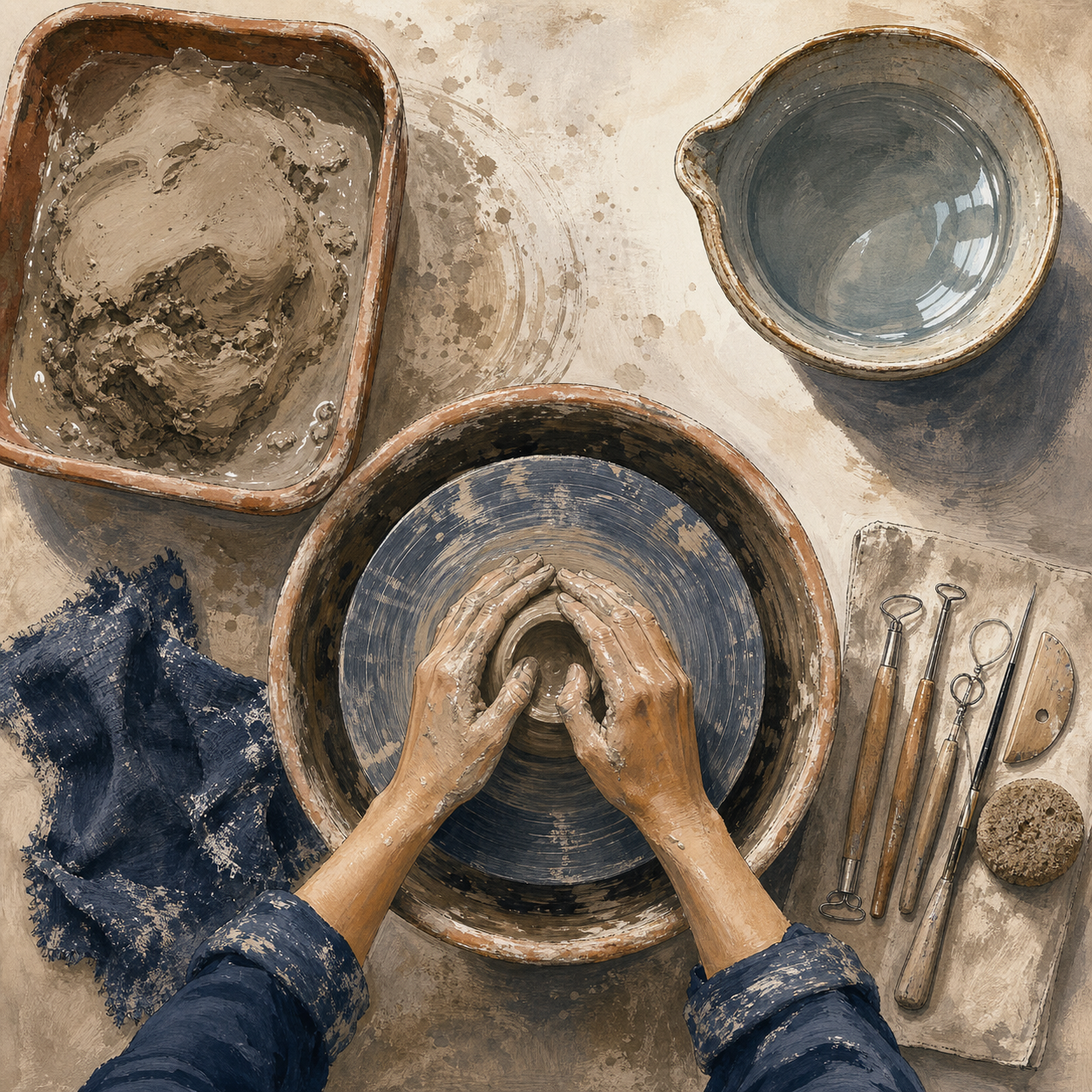
“What caused the world?” sounds like one question. It is usually at least four. A careful comparison keeps them separate until a tradition itself joins them.
- Substratum: Is there something that remains present through the effect, as clay remains present in the pot?
- Transformation: Does the cause actually change into the effect, or does the effect arise as an appearance dependent upon an unchanged reality?
- Agency: Is there a maker, directing intelligence, or other efficient cause? If so, is it distinct from the material?
- Status of the effect: Is the effect a new independent reality, a real modification, a dependent form, or an appearance that cannot stand apart from its ground?
These distinctions stop three common mistakes.
First, dependence is not automatically identity. A pot depends on clay, but you still need an argument before declaring that “pot” and “clay” mean exactly the same thing in every respect.
Second, causation does not automatically imply a permanent underlying substance. An account may explain arising through a network of conditions without accepting an abiding material ground. If you insert such a ground anyway, you have replaced the position rather than understood it.
Third, a maker need not be the material. A potter and clay are distinct in ordinary production. A philosophical system that identifies efficient and material causation is therefore making a substantial claim, not merely using two names for an obvious fact.
Advaita gives the strongest unity claim
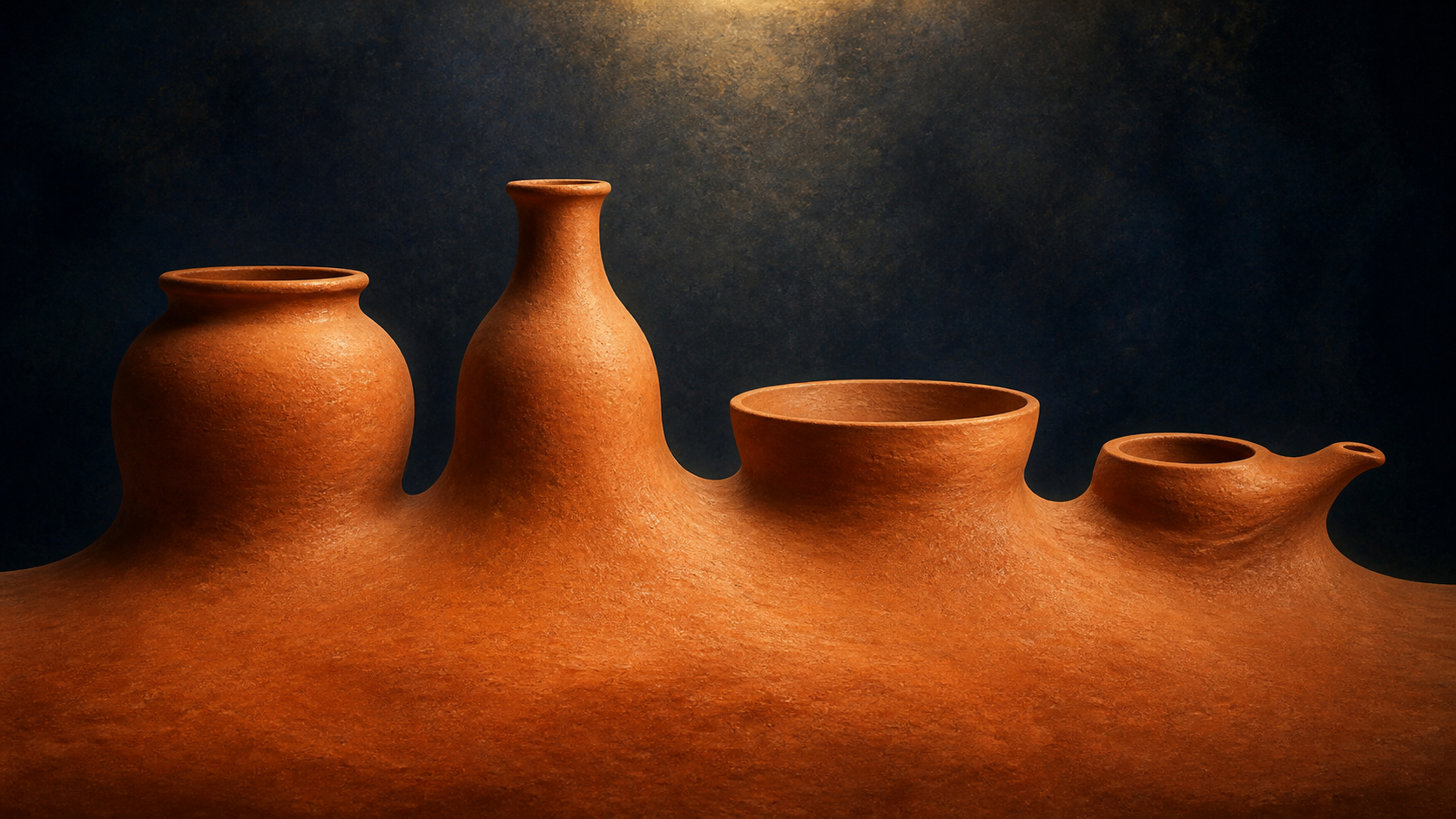
Advaita Vedānta offers a particularly instructive answer because it does not place a divine craftsman outside an independently existing cosmic material. Brahman is described as abhinna-nimitta-upādāna-kāraṇa: the non-different efficient and material cause of the universe.
“Non-different” matters. It means the ultimate ground and the causal agency are not two independent realities cooperating from opposite sides. The cosmos rests upon one reality underlying its many names and forms.
Māyā and vivarta help explain how plurality and transformation appear without requiring Brahman to become one more changing object within the world. This is not well expressed by the casual slogan “nothing exists.” Plurality is not simply deleted. It is understood as dependent upon an all-encompassing ground rather than as a collection of wholly self-standing realities.
Run the four-question test and the structure becomes clear:
- Material cause: Brahman is the ground upon which the universe depends.
- Efficient cause: Brahman is also the causal principle; no second, independent maker is required.
- Mode of change: Māyā and vivarta account for appearance and transformation.
- Status of plurality: Names and forms remain meaningful within experience, but they do not displace the unity on which they rest.
This analysis has a practical consequence. If the world is grounded in the same encompassing reality, the natural response is not contempt for the cosmos. It is reverence toward the world as a manifestation of that ground. The metaphysical claim changes how you regard other beings, the natural world, and embodied life.
Compare Dharmic traditions without turning them all into Advaita
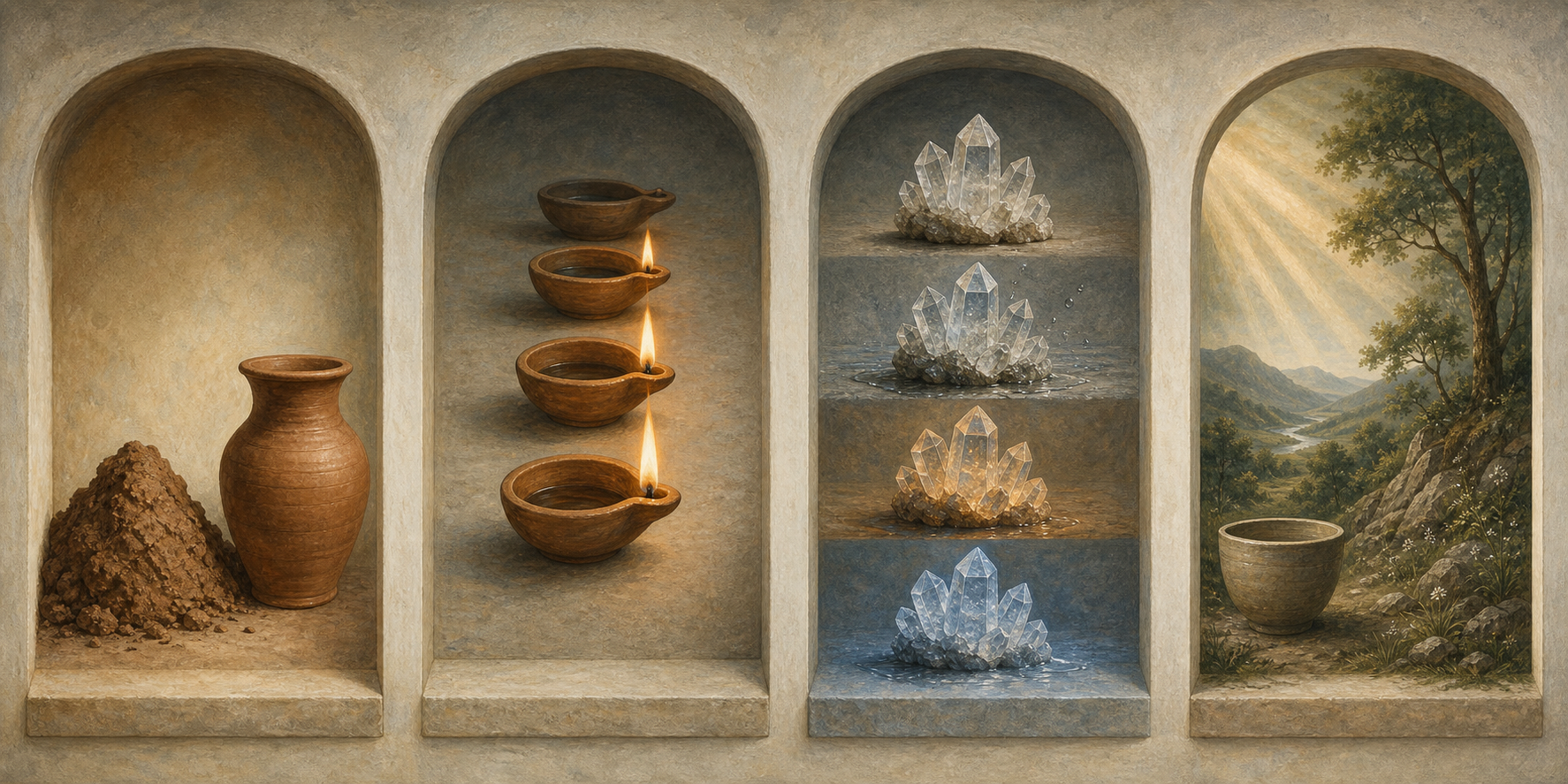
Upādāna-kāraṇa is a valuable comparative lens, but it is not a label to paste over every Dharmic teaching. Hindu darśanas use highly developed causal analysis, while Buddhist, Jain, and Sikh teachings must still be read through their own questions, terminology, and spiritual aims. A shared civilizational conversation does not require a single metaphysical answer.
The safest method is to turn the technical term into a question: “What, if anything, serves as the effect’s underlying material or ground?” Then allow the teaching in front of you to answer in its own vocabulary.
Use the following sequence when you read across traditions:
- Define the effect precisely. “The universe,” “a body,” “a thought,” and “a pot” are not interchangeable effects. A teaching may explain them through different causal relations.
- Preserve the native causal language. Record the actual terms used for substance, condition, agency, dependence, manifestation, or change before translating any of them as “material cause.”
- Ask whether an enduring ground is affirmed. If a passage explains arising through conditions but supplies no persistent substratum, do not manufacture one to complete the clay-pot pattern.
- Keep material and efficient causation separate. Determine whether the teaching distinguishes what an effect comes from and what brings it about. Join the two only when the teaching itself does so.
- Identify the kind of change. Look for the difference between real modification, dependent appearance, reorganization, manifestation, and condition-dependent arising. These are not decorative synonyms.
- Ask what liberation requires you to notice. A causal doctrine matters in Dharmic thought because it can reshape attachment, discernment, responsibility, reverence, or insight—not merely because it completes a metaphysical chart.
This method gives you a legitimate comparison even when the answers differ. You are comparing how traditions handle the same family of problems, not claiming that they secretly teach the same ontology.
It also helps you recognize false agreement. Two teachings may use the same clay analogy while drawing different conclusions about persistence. They may both affirm causation while disagreeing about an underlying substance. They may both speak of unity while assigning very different status to plurality. Similar imagery is an invitation to investigate, not permission to merge doctrines.
Key takeaways
- Upādāna-kāraṇa answers “What is the effect made from or grounded in?” Clay in relation to a pot is the standard model.
- Material cause, efficient cause, mode of transformation, and status of the effect are four distinct questions.
- Advaita Vedānta identifies Brahman as the non-different material and efficient cause, with Māyā and vivarta explaining appearance and transformation.
- Plurality in Advaita is situated within an underlying unity; it is not adequately understood by saying that ordinary existence is simply nothing.
- Across Dharmic traditions, use material causation as a comparative question rather than assuming that every tradition accepts the same substance, agency, or theory of change.
The next time you encounter a creation teaching or a clay-and-pot analogy, write down three phrases before interpreting it: “made from,” “brought about by,” and “dependent upon.” If your answers are different, keep them different. That small discipline will make your reading of Dharmic philosophy more accurate—and far more revealing.
References
