
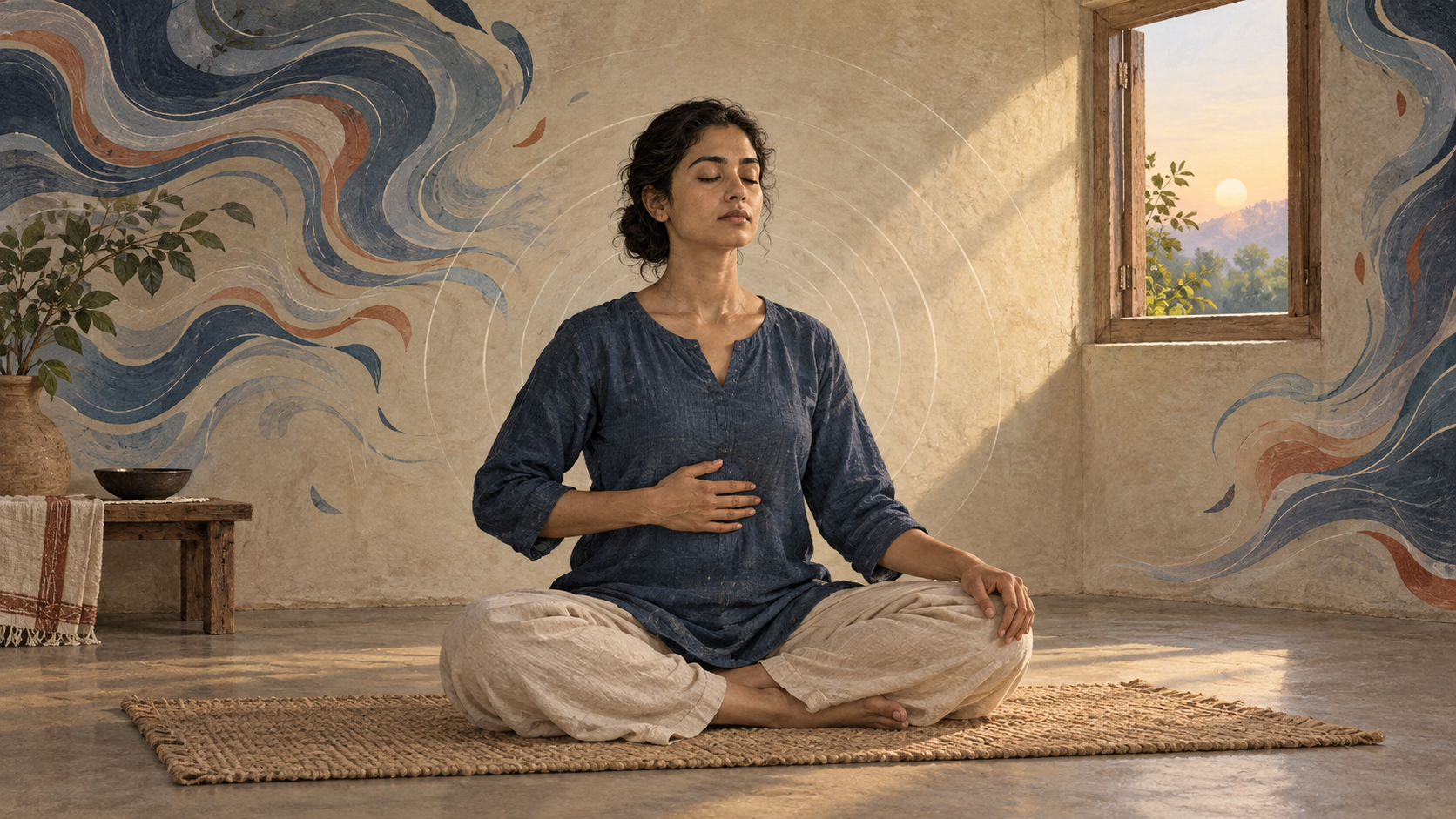
Your mind is racing, your reply is becoming sharper, and every new thought seems to justify immediate action. Trying to argue with each thought can add more thought to an already crowded moment. Your breath offers a quieter point of entry.
Pranayama is not a switch that makes difficult thoughts disappear. It gives you a way to influence the movement that carries them. By noticing and gently regulating the breath, you may create enough inner space to choose your next action instead of being pushed into it.
The breath gives you an early warning the mind often misses

When anger or agitation takes hold, breathing commonly becomes rapid and shallow. When the mind is at ease, the breath tends to become deeper and more relaxed. That connection is easy to overlook because attention usually goes to the apparent cause of the emotion: the insulting remark, the unfinished work, the feared outcome, or the decision that cannot yet be resolved.
Begin by treating the breath as information. Do not immediately try to improve it. First notice what is already happening:
- Does the breath feel hurried, interrupted, or reasonably even?
- Are you pulling air in, pushing it out, or letting it move without much effort?
- Does the exhalation end naturally, or are you cutting it short to speak, type, or continue rehearsing an argument?
- Can you follow a complete breath without correcting it?
This is not a diagnostic test. A particular breathing pattern does not tell you whether your judgment is right or wrong. It tells you that your mind and body may be entering a state in which urgency can masquerade as clarity.
Use that signal before an avoidable action. If your breathing has become strained while you are drafting an angry message, deciding under pressure, or continuing a fruitless dispute, postpone the action long enough to observe the breath. The external problem may remain real. The pause simply helps you meet it with less internal momentum.
It also helps to observe your breathing when you are content. That gives you a personal reference point. You are not trying to manufacture a permanently serene breath; you are learning to recognize the difference between your settled pattern and your agitated one.
Why changing the breath can change the mental field

In the yogic account, breath and prana are closely related but not identical. Breath is the visible, immediately accessible movement. Prana is the life force that sustains bodily functions and supplies energy throughout the organism. Because breath and prana are interdependent, regulating breathing provides an indirect way to regulate pranic movement.
The mind and prana also have different apparent jobs. The mind is connected with thought, perception, and bodha shakti, the capacity of knowing. Prana is connected with movement, action, and kriya shakti, the capacity of doing. Yet the traditional framework traces both to the pancha bhutas, the five elemental bases. It associates the mind with their sattvic aspect and prana with their rajasic aspect.
A useful image is a tree with two branches growing from the same trunk. One branch may move without looking like the other, but movement at the shared base can affect both. In the same way, you do not always have to confront a thought at the level of thought. Working with the breath can alter the pranic movement accompanying the mental state.
This is a yogic map of embodied life, not a claim that prana or the pancha bhutas are anatomical structures. That distinction matters. The map is useful when it guides practice and observation; it becomes confusing when traditional categories are treated as medical diagnoses.
The traditional account further describes five pranic functions:
- Prana is associated with the region above the throat.
- Apana is associated with the region below the navel and the function of excretion.
- Samana occupies the middle region, between the throat and navel, and is associated with digestion.
- Vyana extends throughout the body across the nadis.
- Udana is situated in the sushumna and, within this traditional account, is associated with departure at death.
You do not need to decide which of these is responsible whenever your mood changes. The practical lesson is broader: pranayama concerns the regulation of life movement throughout the embodied person, not merely the intake of more air. Bigger breaths are therefore not automatically better breaths.
A gentle practice for an agitated mind

If your immediate aim is mental regulation, begin with a modest practice that does not involve force or deliberate breath retention. The purpose is to reduce unnecessary effort and recover choice, not to prove how much air you can move.
- Interrupt the reaction. Put down the phone, stop composing the reply, or step back from the conversation if it is safe to do so. Pranayama cannot create a pause if you continue feeding the action at full speed.
- Choose a stable position. Sit or stand in a way that lets your torso remain upright without becoming rigid. Release obvious gripping in the jaw, throat, shoulders, and abdomen.
- Observe the spontaneous breath. Let several natural movements pass without manipulating them. Notice where effort appears and whether the breath is being hurried by the thought stream.
- Make the movement quieter. Reduce pulling and pushing. Let the exhalation finish comfortably, and allow the next inhalation to arrive without dragging in a maximal breath. Do not hold the breath.
- Stay below strain. Ease is the boundary. If you feel an urge to gasp, growing air hunger, dizziness, tingling, chest discomfort, or rising panic, stop regulating the breath and let it return to normal.
- Recheck your capacity to choose. Ask what action is actually required now. You may still need to set a boundary, correct an error, leave the situation, or have a difficult conversation. The test is whether you can choose that action deliberately.
- Practise outside the crisis. Notice and soften the breath during ordinary transitions, such as before beginning work or entering a conversation. Familiarity in calm conditions makes the skill easier to access when agitation appears.
This sequence is intentionally simple. Formal pranayama may use specialised methods, including structured ratios, vigorous breathing, or retention. Those practices require more individual guidance than a general mental-regulation exercise can provide. Learn them from a qualified teacher who can observe your effort and correct it.
If you have a medical condition affected by breathing, a history of fainting, or a pattern in which breathwork provokes panic, consult an appropriate clinician before attempting formal techniques. Persistent or severe breathlessness, chest pain, or fainting needs medical assessment rather than stronger pranayama.
Pranayama can support mental steadiness, but it is not a replacement for psychological or medical care. Persistent distress, inability to function, or thoughts of self-harm call for prompt professional help. If there is immediate danger, contact local emergency or crisis services.
Mental regulation is not thought suppression

The mind plans, predicts, rehearses, defends, and invents. Trying to forbid all of that can turn pranayama into another struggle. Regulation has a more practical aim: a thought may still arise, but it no longer has to command your speech, attention, or conduct.
Judge the practice by what becomes possible after it, not by whether you produce a special feeling. Useful questions include:
- Can you delay a message that does not need to be sent immediately?
- Can you hear another person without preparing your rebuttal during every sentence?
- Can you return attention to the task in front of you?
- Can you name anger, fear, or excitement without automatically obeying it?
- Can you take the necessary action without adding avoidable aggression?
If the breath becomes quieter but the problem remains, that does not mean the practice failed. A settled breath cannot make an unjust situation just, complete neglected work, repair a relationship, or decide an ethical question for you. It can help separate the work of responding from the turbulence surrounding it.
If gentle regulation brings no useful shift, do not keep intensifying the breath in pursuit of control. Change the conditions instead. Leave the argument, reduce stimulation, speak with someone trustworthy, or seek qualified support. Pranayama is one instrument of regulation, not a demand that every difficulty be solved internally.
Approach it as abhyasa, steady practice. Keep a minimal record if you want to test its value in your own life: note the trigger, the quality of the breath, and the action you chose afterward. Over time, look for a change in conduct rather than a dramatic experience.
Key takeaways: use the breath as a decision point
- If your breath becomes hurried while an action can safely wait, pause before acting.
- Observe the existing breath before trying to change it; otherwise force can be mistaken for regulation.
- Make the breath quieter and easier, not merely larger.
- Use the traditional breath-prana-mind relationship as a practical map, not as a substitute for medical diagnosis.
- Measure success by increased freedom in speech, attention, and action, not by the disappearance of every thought.
- Stop when strain, dizziness, air hunger, chest discomfort, or panic appears, and seek appropriate help when symptoms or distress persist.
The next time your mind accelerates, do not begin by wrestling with its entire argument. Notice the breath, remove unnecessary effort, and then decide what deserves your next word or action. That small interval is where pranayama becomes mental regulation rather than an abstract idea.
References
- DharmaRenaissance Blog — Why pranayama can control the mind
