
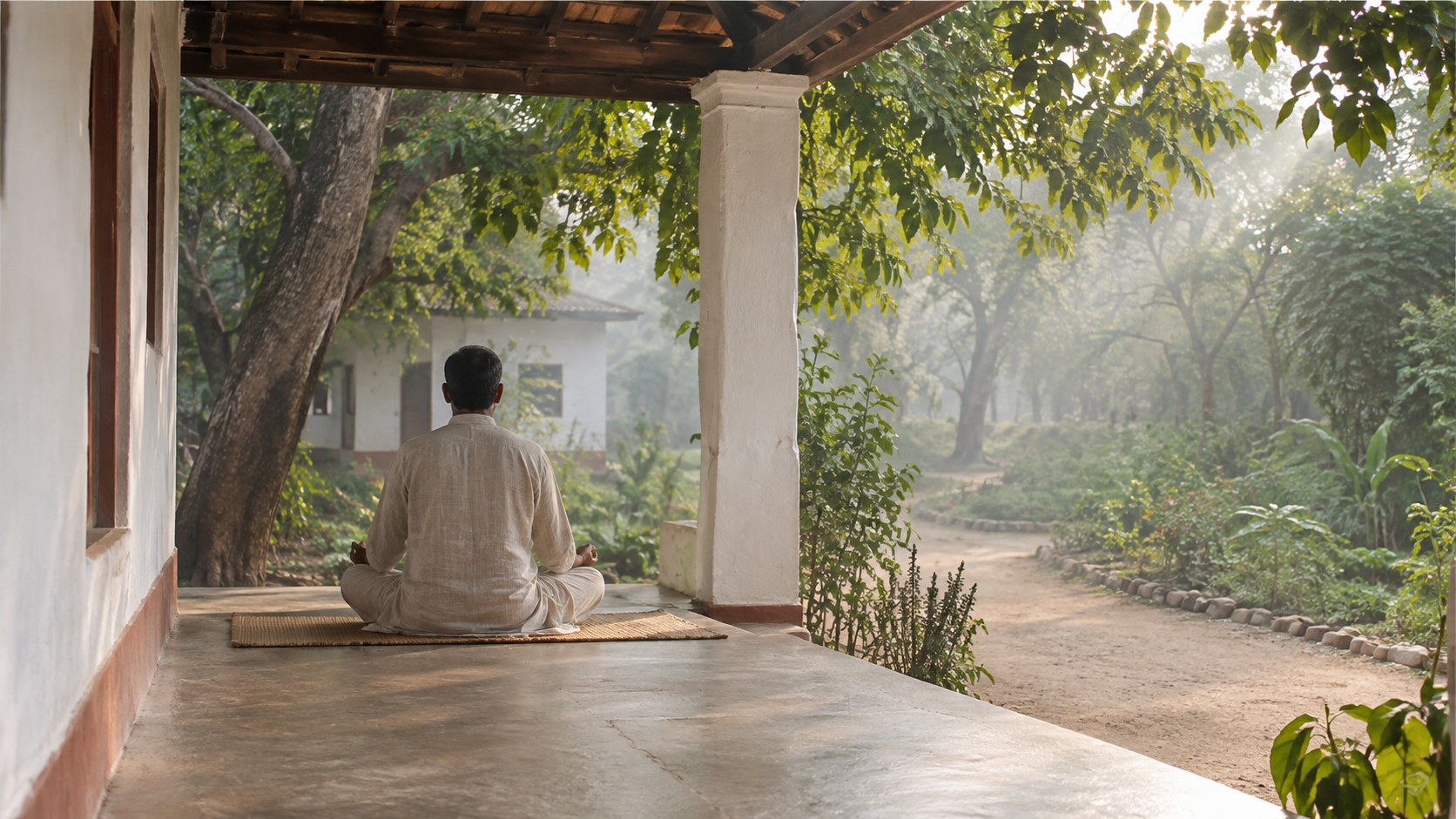
You may be considering Aruni Ashram because ordinary rest no longer feels restorative. A free weekend can stop the work, yet leave the mind carrying the same noise. The practical question is whether a quiet stay can deepen your Kriya Yoga, rather than becoming another trip that briefly changes the scenery.
Aruni offers something increasingly difficult to find: a modest place where trees, simple accommodation and an unhurried rural rhythm reduce the demands on your attention. That setting can support sadhana, but it cannot perform sadhana for you. Go with a clear intention, confirm what guidance is actually available, and decide in advance how you will use the silence.
Decide whether you want escape, instruction or sadhana
These are three different needs. If you mainly need sleep and relief from work, a quiet rural stay may be enough. If you want to learn Kriya Yoga, you need a qualified teacher and clarity about initiation, prerequisites and the method being taught. If you already have an established practice, the retreat can protect the attention that daily life repeatedly fragments.
Write one sentence before you book: “I am going to Aruni so that I can…” Complete it with an observable purpose. “Practise the sequence my teacher gave me without rushing” is useful. “Have a spiritual experience” is not, because it encourages you to judge every quiet hour by whether something unusual happens.
A worthwhile retreat need not produce visions, emotional intensity or an immediate answer to a large life question. A more reliable result is sharper observation. You may notice how quickly you reach for the phone, how often you rehearse conversations, or how difficult it is to sit without turning practice into a performance. Those discoveries are not interruptions to the retreat. They show you where your attention is habitually being spent.
Do not confuse the ashram’s atmosphere with a promise of formal instruction. A guest room containing images connected with Tantra and Lahiri Mahasaya places the visitor within a recognisably contemplative setting, but imagery alone does not establish that a scheduled Kriya course, initiation or individual guidance will be available during your stay. Ask before travelling.
Let silence support Kriya instead of replacing discipline
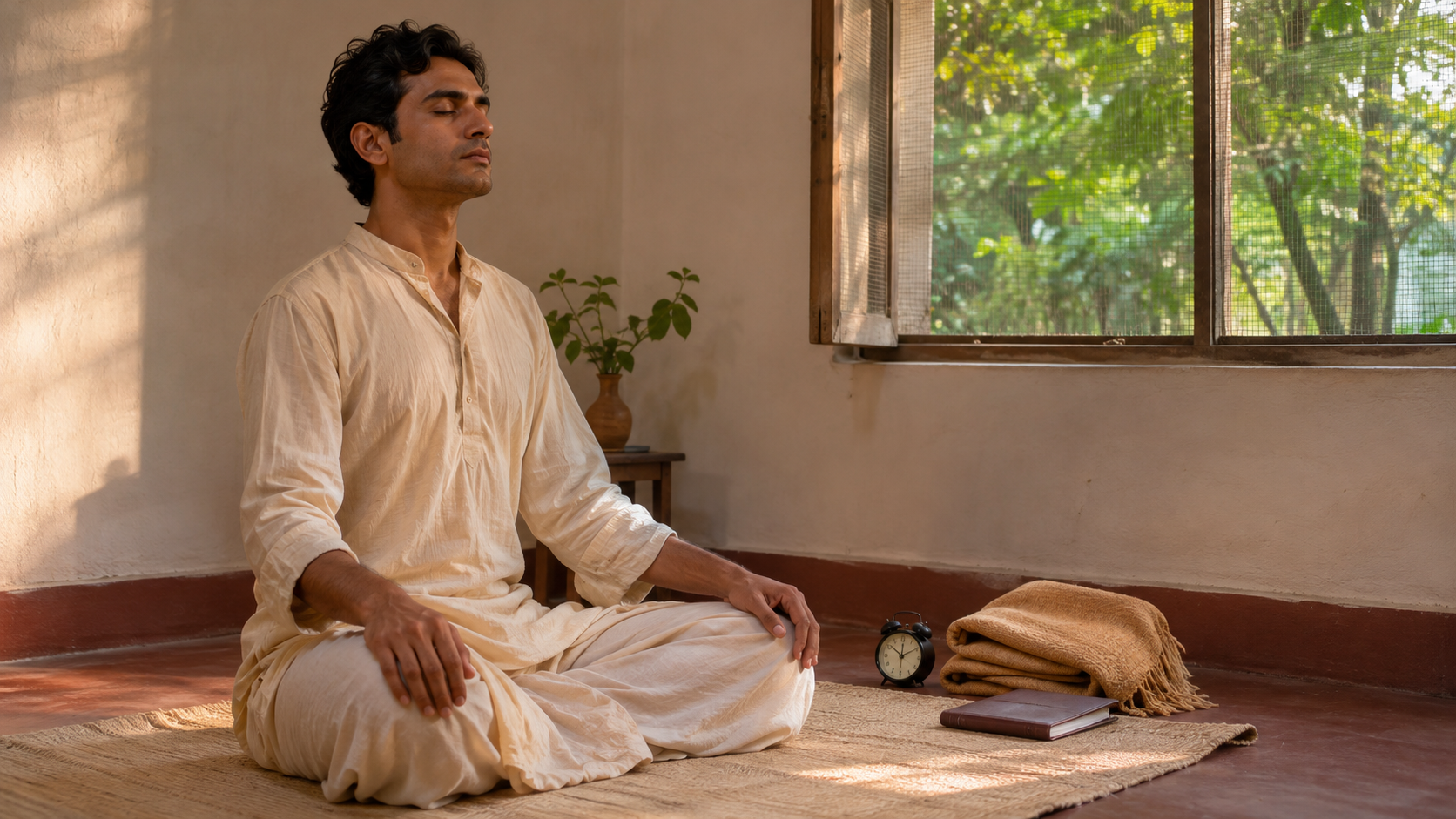
Silence is useful because it removes some of the negotiations surrounding practice. There is less conversation to continue, less media to consume and less pressure to appear occupied. When those inputs recede, the movements of the mind become easier to see. Silence does not necessarily make them disappear.
Contemplative silence is also not the same as refusing ordinary human contact. You can respond courteously to staff, receive a meal and ask a necessary question without converting the day into social activity. The working distinction is simple: speak when speech serves a real need; do not use conversation to escape the discomfort of being inwardly still.
If you have received Kriya instruction from a teacher, retain the sequence and limits you were given. Extra free time is not a reason to multiply repetitions, extend breath retention or combine techniques from unrelated lineages. Intensity can imitate depth while actually making practice restless and self-conscious.
If you have not been instructed, do not reconstruct Kriya from fragments found online or from another visitor’s description. Use the stay for quiet sitting, prayer, japa, scriptural reading or another practice you already understand, and seek proper instruction separately. Breath practices that produce dizziness, distress or unusual physical symptoms should be stopped rather than endured as a spiritual test. Kriya Yoga is not a substitute for medical or psychological care.
A simple retreat rhythm protects the practice without turning the entire day into a timetable:
- Choose a place for practice and keep it free of luggage, food and the phone.
- Begin with the preparation and sequence you already know rather than inventing a more impressive retreat version.
- Remain seated quietly when the formal technique ends. Do not immediately evaluate the session or reach for stimulation.
- Write down only what will help future practice: recurring distractions, avoidable obstacles and a question that genuinely requires your teacher’s guidance.
- Let walking, meals and rest remain simple. They are part of the retreat rhythm, not empty intervals that must be filled.
The aim is continuity. When silence makes a familiar practice clearer, it is doing its work. When silence becomes another achievement to display or endure, it has become a new form of noise.
Work with Aruni’s real conditions, not an imagined retreat
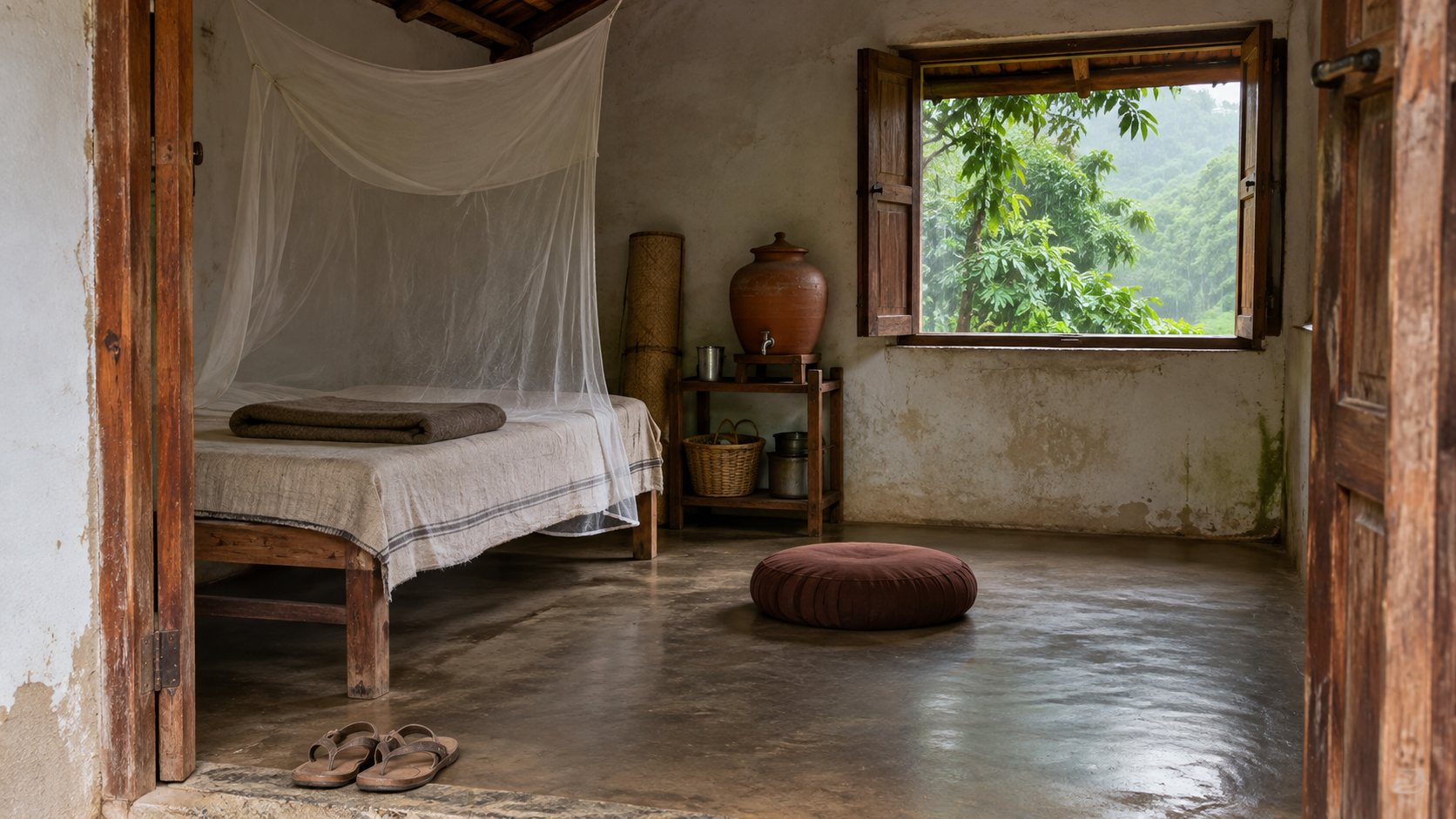
Aruni Ashram is described through modest particulars rather than monumental architecture: trees occupy much of the grounds, a narrow shaded path opens into a courtyard, and a bell can be absorbed by surrounding birdsong. The secluded mud guest room used during a July 2026 stay had a bed, wooden table, chair, cooler, shelf and small windows overlooking trees. An image of Sage Aruni stood outside the door.
That simplicity matters. A room with few competing objects does not automatically make the mind quiet, but it gives distraction less material to work with. Use the table for one chosen text and a notebook, not as a charging station for several devices. Let the chair or one part of the room become your reading place, while your practice place remains associated with stillness. Small physical boundaries reduce the number of decisions you make each time you sit.
Do not arrive expecting soundproof isolation. Ashram silence is living silence: birds, bells, staff, meals and village life remain present. The discipline is not to eliminate every sound but to stop converting each sound into commentary. A bell can be heard without asking what it means for your meditation. Birdsong can pass without becoming either a nuisance or a spiritual symbol.
The human atmosphere matters as much as the room. Attentive listening and unforced hospitality can make silence feel hospitable rather than punitive. Your part is to receive that hospitality without demanding constant attention. An ashram is neither a hotel organised around personal preference nor a stage on which visitors prove their austerity.
Before booking, send three direct questions:
- Is Kriya Yoga instruction or supervised practice available on my dates, who provides it, and are there prerequisites?
- Is silence formally observed, encouraged during particular periods, or left to each guest?
- What accommodation, meals and arrival assistance are included, and what should I arrange independently?
Clear answers let you choose honestly. If no Kriya teaching is scheduled, you can still make a contemplative stay, but you should not arrive expecting an initiation or personalised instruction that was never promised.
Plan the journey and the return as parts of the practice
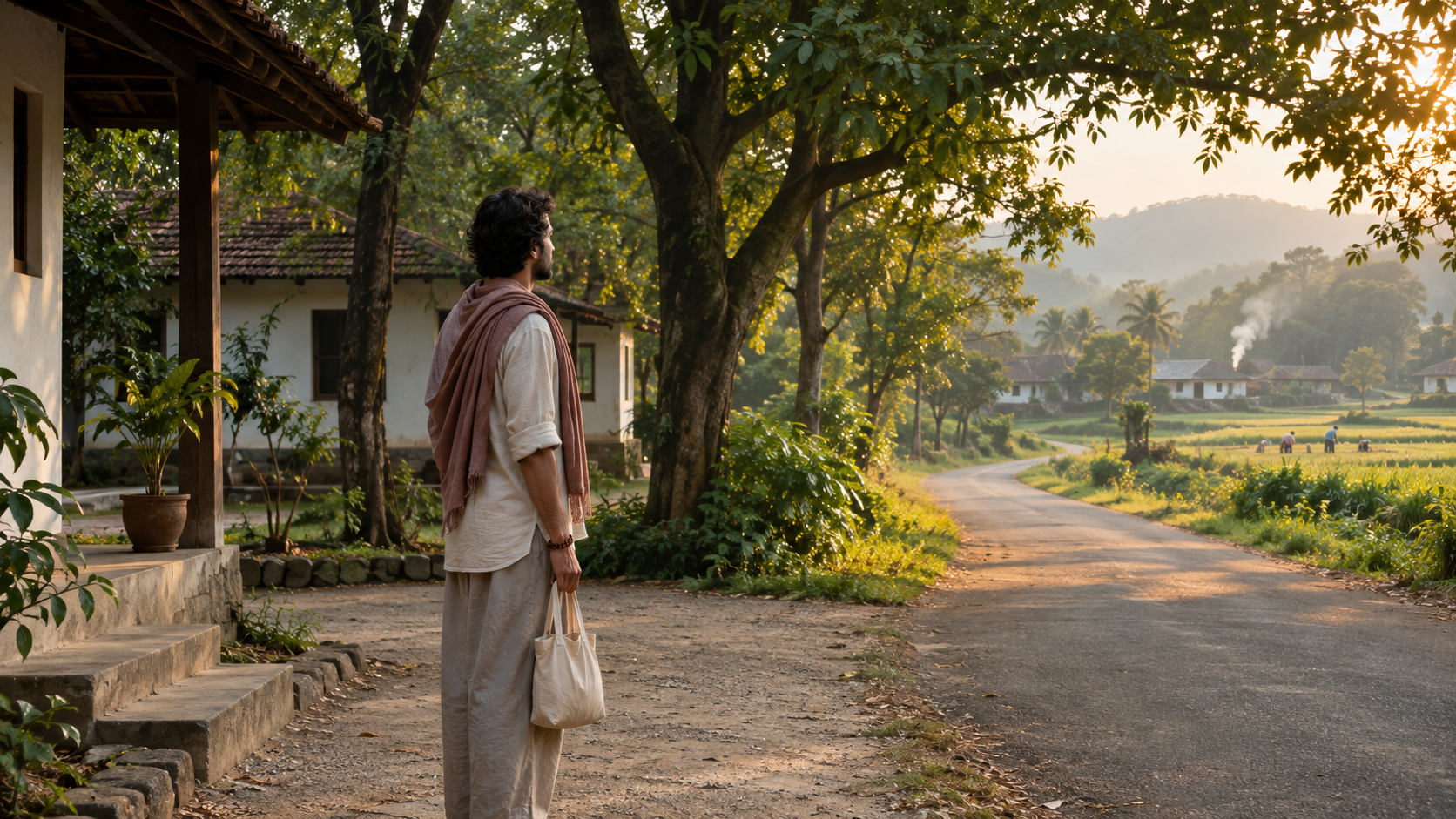
Joydev Kenduli carries its own devotional inheritance. It is associated with Jayadeva and the Gitagovinda, and its winter gathering brings Baul singers, pilgrims, wandering ascetics and visitors together. Outside the festive period, the village shows a quieter, everyday character. Decide whether you want that ordinary rhythm or the energy of a major gathering; they will create very different retreats.
One route used in July 2026 involved the Black Diamond train from Howrah to Durgapur and then a bus towards Joydev Kenduli. The final approach passed through village roads, including an underdeveloped stretch near the ashram. Treat that as orientation, not a permanent timetable. Train schedules, bus connections and road conditions can change, so verify the current route and the last leg with the ashram before departure.
A rural journey will also resist tight sequencing. Traffic may yield to animals, rain may slow the road, and the last connection may not behave like an urban service. Build enough flexibility into the arrival that a delay does not make you carry city impatience straight into the ashram.
The same flexibility applies to the length of your stay. A reservation originally made for two days became a four-day visit. That does not mean every traveller should stay four days. It does show why an inflexible onward plan can work against the purpose of retreat. If your responsibilities permit, avoid placing a high-pressure commitment immediately after your return.
Plan re-entry before you leave home. Decide which part of the retreat can survive an ordinary workday: a fixed place for practice, the phone remaining outside that place, a period of quiet after Kriya, or a notebook used only after the session. Do not try to reproduce the forest in your home. Preserve the condition that proved most helpful.
After you return to a normal work cycle, examine what failed. If the practice disappeared because the phone came back into the room, the problem is environmental. If you kept postponing it, the problem may be the place you gave it in the day. If the technique itself became uncertain, that question belongs with your teacher. Different obstacles require different corrections; another retreat is not automatically the answer.
Key takeaways
- Go to Aruni for a protected setting, not with the expectation that the setting will practise on your behalf.
- Confirm whether Kriya teaching is actually available on your dates and whether initiation or previous instruction is required.
- Define silence through behaviour: limit optional speech, media and reflexive phone use while remaining courteous and responsive to practical needs.
- Keep to the Kriya sequence you were taught. Do not use retreat time to improvise breath ratios, retentions or hybrid techniques.
- Verify transport and accommodation directly, especially the last leg from Durgapur to Joydev Kenduli.
- Choose one condition from the retreat that you can maintain at home; the durable result is continuity, not intensity.
Before you book, send the three practical questions and write your one-sentence purpose. If the answers match what you need, travel lightly, practise only what you understand, and let the ashram’s quiet reveal where your attention actually goes. Bring that knowledge home with you; it is more useful than trying to preserve a temporary mood.
References

Leave a Reply
You must be logged in to post a comment.