

You may encounter an ash-marked ascetic at a Kumbh gathering, beside a roadside sacred fire, in a monastery, or during a festival in Nepal and wonder whether you are looking at a Nathpanthi yogi. Saffron robes won’t answer that question. Neither will matted hair, rudraksha beads, or sacred ash by themselves.
A sound identification comes from reading several signs together: initiation marks, sacred symbols, spoken greetings, Guru lineage, and institutional setting. That method does more than improve accuracy. It helps you meet a living practitioner without reducing a sacred commitment to an exotic costume.
Recognize a constellation of signs, not a costume
Nathpanthis, also called Kanphata Yogis, belong to a Shaiva yogic current traditionally traced through Matsyendranath and Gorakhnath to Shiva as Adinath. Their most characteristic public marker is the initiated ear fitted with a yogi’s kundala. Yet the ear ornament becomes much more reliable when it appears alongside Nath greetings, reverence for Gorakhnath, a Guru-shishya lineage, and affiliation with a matha or akhara.
Key takeaways
- Give the greatest visual weight to initiation. Large kundalas passing through opened outer-ear cartilage are more distinctive than robes, ash, beads, or hair.
- Look for confirmation in speech. Alakh Niranjan, Adesh, invocations of Gorakhnath, and references to a Nath Guru-parampara turn a visual possibility into a stronger identification.
- Treat common Shaiva signs as supporting evidence. Tripundra, bhasma, rudraksha, jata, a kamandalu, or a sacred fire may fit Nath identity, but other ascetic orders use some of them too.
- Let the practitioner name the lineage. Smaller earrings, household life, regional customs, or less standardized dress do not cancel Nath affiliation.
- Do not photograph first and ask later. Recognition should lead to respectful contact, not a claim over someone’s body, ritual, or image.
A useful confidence test has three layers. First, look for the kanphata initiation. Second, listen for Nath vocabulary and Guru affiliation. Third, place the person within a matha, akhara, dhuni, pilgrimage, or regional tradition. If you have only the third layer’s shared visual signs, leave the identification open.
What each sacred symbol communicates

The split ear and kundala
The name Kanphata, meaning split-eared, refers to the initiation known as karna-chedana. The outer cartilage of the ear is opened so that a consecrated kundala can be inserted. These ornaments may be made from horn, wood, stone, or metal. Their importance does not come from size or material value. They function as an initiated mudra: an embodied sign of protection, consecration, and entry into a discipline.
The ear also carries a yogic lesson. Ordinary hearing runs outward toward distraction, praise, argument, and appetite. The initiated ear represents hearing disciplined by sadhana and turned toward the Guru’s instruction and inner awareness. You therefore miss the symbol’s point if you treat it as unusual jewellery.
Even this strongest marker needs care. Some initiated householders and younger renunciants may wear smaller or temporary earrings, while circumstances may make the traditional kundalas less conspicuous. Absence of a dramatic ornament is not proof of absence from the tradition. Conversely, an ornament that merely resembles a Nath kundala does not establish initiation. Ask about lineage rather than inspecting someone’s body.
The supporting vocabulary of ash, beads, hair, and tools
The remaining signs form a visual grammar. Each contributes meaning, but none should be isolated from practice and context.
| Sign | Meaning within Nath life | How you should read it |
|---|---|---|
| Tripundra of bhasma or vibhuti | Three horizontal ash lines, sometimes with a central bindu, recall material transience, the fire of knowledge, and devotion to Shiva. | Strong evidence of a Shaiva setting, but not sufficient evidence of Nath initiation. |
| Rudraksha mala | Worn around the neck or used for japa, the beads support regular mantra practice. | Read them as evidence of discipline, not as a decorative accessory or an exclusive Nath badge. |
| Jata | Matted locks can embody a vow and publicly signal renunciation. | Notice them as part of an ascetic pattern; many non-Nath sadhus also keep jata. |
| Gerua, white, or dark woollen clothing | Simple robes, a kambal, or a kaupin suit austerity and practical monastic life. | Do not make saffron your test. A Nath practitioner may wear white or a dark wrap. |
| Yogadanda | A short staff can provide an elbow rest during seated yogic practices. | It adds weight when it appears with initiation, mantra, and lineage signs. |
| Kamandalu, damru, or chimta | The water vessel and musical or ritual implements belong to a wider Shaiva ascetic vocabulary. | Regard them as contextual clues rather than exclusive identifiers. |
| Dhuni | The maintained sacred fire can organize meditation, ritual, teaching, and communal life around a Nath establishment. | Treat it as sacred space. Do not handle the fire, fuel, ash, or implements without invitation. |
The table also explains why appearance-based certainty fails. A white-clad practitioner can belong to the Nath tradition, while an ochre-clad, ash-covered renunciant may belong elsewhere. The practical question is not whether one symbol is present. It is whether the signs form a coherent Nath pattern.
Let speech, lineage, and place confirm what you see
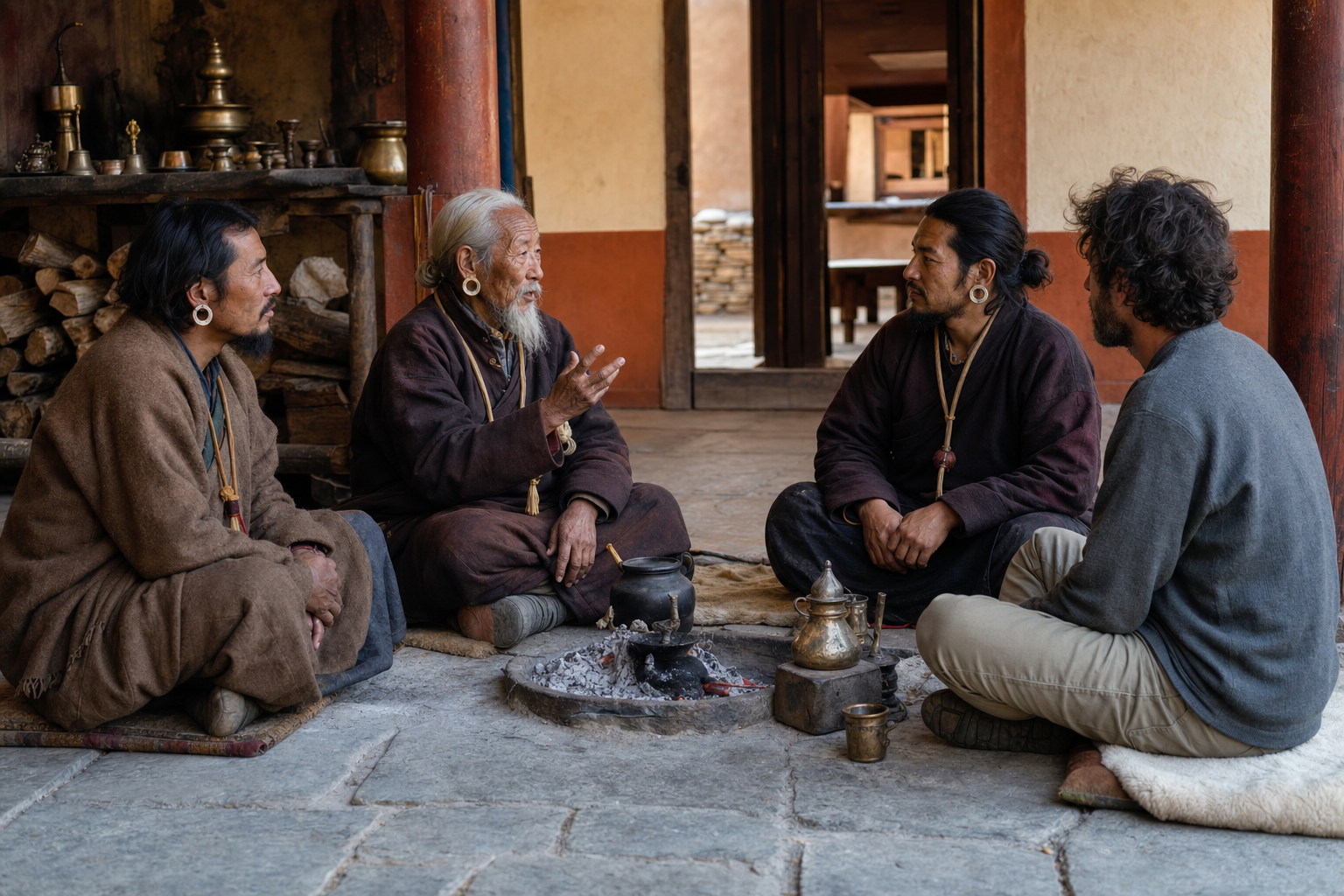
Speech can reveal what clothing leaves ambiguous. Alakh Niranjan invokes the Unseen and Stainless. Adesh acknowledges the Guru’s command and the primacy of transmission. When these expressions accompany invocations of Gorakhnath or references to Adinath, they locate the encounter within a recognizably Nath ritual world.
You don’t need to perform familiarity. If a Nath ascetic greets you with Adesh, returning the greeting respectfully is reasonable. If no such greeting is offered, a simple namaskar is better than trying to impress the person with vocabulary you have just learned.
Place supplies another layer of evidence. Nath life is sustained through mathas and akharas across northern and western Bharat and Nepal. Gorakhnath Math in Gorakhpur is a prominent institutional centre, while devotion to Matsyendranath, also known regionally as Macchindranath or Minanatha, has a long presence in the Kathmandu Valley. Kumbh gatherings and regional yatras bring kundalas, ash, rudraksha, yogic implements, and Nath salutations into a visibly communal setting.
Regional variation is not inconsistency. In Rajasthan and Uttar Pradesh, you may see an austere combination of kundalas, ash, jata, and a dark kambal at roadside akharas or dhunis. In Maharashtra, the memory of Nivruttinath, Guru of Jnaneshwar, links Nath discipline with the devotional world of the Varkari movement. In Nepal, the Rato Macchindranath festival places shared Hindu and Buddhist reverence within a larger civic ritual setting.
Traditional accounts also speak of barah panth, or twelve lineages. Different lineages and regions may emphasize yoga, ritual, pilgrimage, or social engagement in different proportions. This is why a checklist can guide your attention but cannot replace a practitioner’s own account of Guru and panth.
The same caution applies to gender and life stage. Women participate as practitioners, supporters of matha life, and custodians of sacred fires and festivals, but their public insignia may be less standardized. Initiated householders may also look different from full-time renunciants. If you expect every Nathpanthi to resemble a male wandering sadhu with large earrings and matted hair, you will overlook part of the living community.
Do not confuse shared ascetic signs with identical traditions
Several Dharmic ascetic orders share ash, austerity, rudraksha, jata, staffs, water vessels, and Shaiva imagery. The overlap reflects a connected civilizational vocabulary. It does not make all sadhus Nathpanthis.
- Naga sannyasis: Naga ascetics associated with the Dasnami order may appear unclothed in ceremonial processions. They generally do not bear the characteristic split-ear kundalas. Nudity and ash therefore point toward a different institutional setting unless other Nath evidence is present.
- Aghori ascetics: Aghori traditions are associated with transgressive ritual disciplines that differ from ordinary Nath monastic norms. Ash-covered appearance alone is no basis for calling someone an Aghori, and the label should not be used as a synonym for intense-looking Shaiva asceticism.
- Vaishnava bairagis: A vertical tilak signals a Vaishnava orientation more strongly than a Nath one, and Vaishnava bairagis do not ordinarily undergo the kanphata initiation.
Use the distinctions to slow down your judgement. If you see only sacred ash and jata, you have identified ascetic visual culture, not an order. If you see vertical tilak without split-ear ornaments, a Vaishnava affiliation is more plausible. If initiated kundalas, Adesh, Gorakhnath devotion, and a Nath matha converge, your identification rests on much firmer ground.
There is a second mistake to avoid: assuming that external marks are either everything or nothing. Nath teaching does not ask you to worship appearance, but it also does not treat consecrated signs as meaningless. The marks are public commitments whose integrity depends on the inward discipline they represent.
The outer signs point toward an inward yogic discipline

The Nath understanding of the body is neither body worship nor contempt for embodiment. The body becomes a field of disciplined transformation. Asana, pranayama, mudra, bandha, and work with nadi and kundalini belong to a soteriological project: the body is cultivated as a temple and instrument of realization, with Guru and mantra acting as indispensable catalysts.
Works such as the Hatha Yoga Pradipika and Gheranda Samhita, together with later manuals associated with Nath lineages, codify many of these methods. The public symbols make sense inside this framework. The ear recalls inward listening. Ash confronts impermanence and invokes transforming knowledge. Rudraksha supports repeated mantra. Jata and simple clothing declare restraint. The dhuni gives disciplined communal life a sacred centre.
If you practise modern yoga, this changes how you should understand the Nath contribution. Isolating posture or breath from Guru, mantra, ethical restraint, tapas, and the goal of liberation leaves only part of the inheritance. Global yoga owes a substantial debt to Nath-linked systems of embodied practice, but gratitude requires more than borrowing techniques. It requires remembering the spiritual purpose that held the techniques together.
The lineage’s relationships across Dharmic traditions also reward precise reading. Matsyendranath is revered in Hindu and Buddhist settings, especially among Newar communities in Nepal, where Shaiva and Vajrayana worlds have met without becoming indistinguishable. The Sikh tradition’s Siddh Gosht preserves philosophical engagement between Nath yogis and the Sikh Gurus, directing attention toward inner realization rather than outward display. Nath austerity, breath discipline, and self-mastery also resonate with Jain commitments to tapas, ethical restraint, and non-harm.
These encounters express Dharmic kinship without erasing doctrinal difference. You don’t need to claim that Hinduism, Buddhism, Jainism, and Sikhism are the same in order to recognize their history of dialogue. The Nath example offers a better model: loyalty to one’s Guru and chosen path can coexist with respect for other means of spiritual realization.
How to meet or document a Nathpanthi respectfully
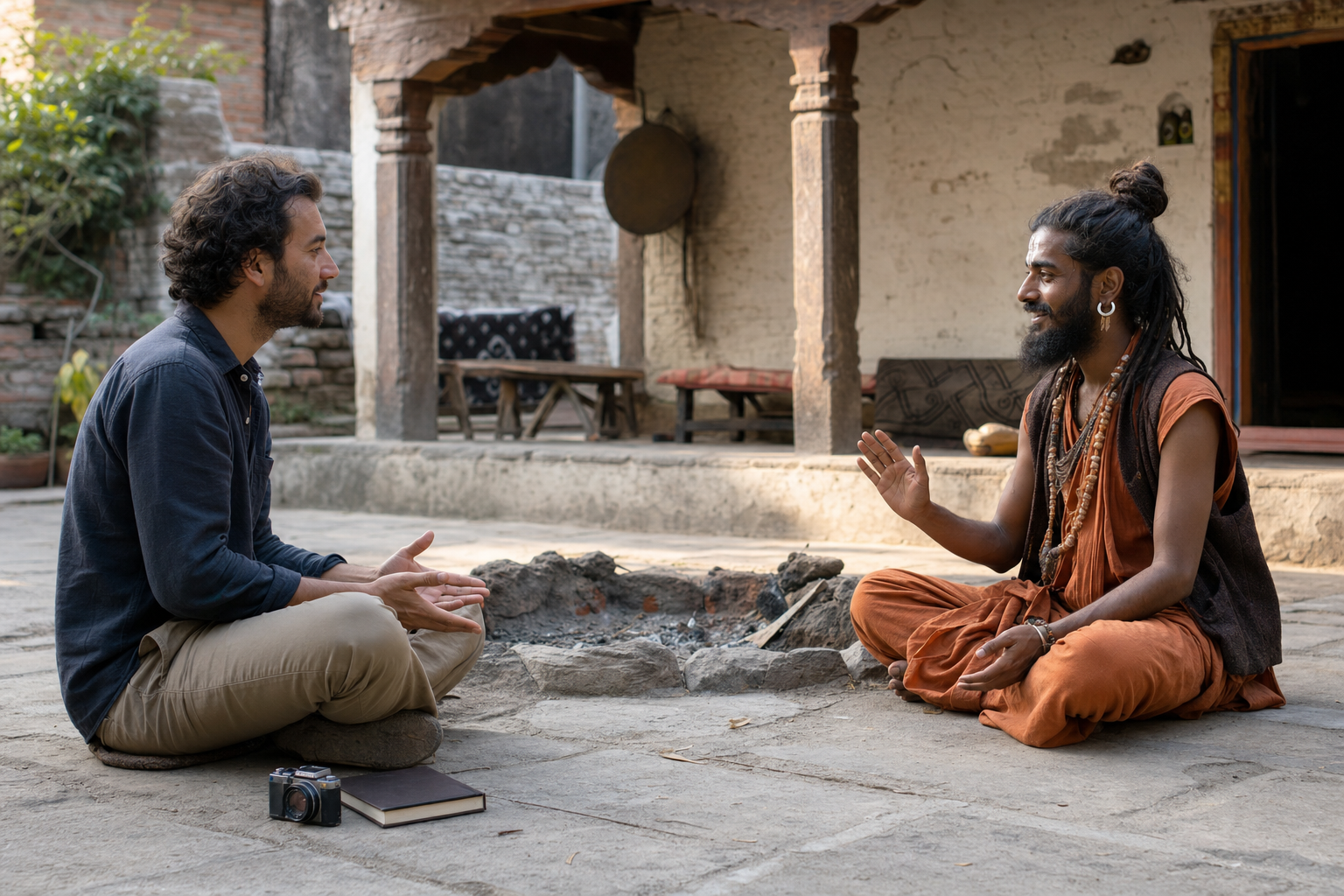
If your interest leads to a conversation, pilgrimage note, photograph, or field record, use a sequence that gives the practitioner control over the encounter.
- Observe the setting before assigning a label. Note whether you are at a Nath matha, an akhara, a dhuni, a Kumbh camp, or a shared regional festival. Context often resolves what clothing cannot.
- Begin with an ordinary respectful greeting. Follow the practitioner’s lead. Use Adesh naturally if it is offered, but do not turn sacred vocabulary into a performance.
- Ask about lineage, not anatomy. A useful question is: May I ask which Guru-parampara or panth this matha follows? That invites self-identification without demanding an explanation of the person’s ears or initiation.
- Request permission before taking a photograph. A public setting does not make a person’s initiated body, worship, or meditation available for unrestricted documentation. Accept a refusal without bargaining.
- Describe only what you can support. If you are writing a caption and have not confirmed affiliation, write Shaiva ascetic wearing tripundra and rudraksha rather than asserting Nathpanthi. Add the lineage only after it has been stated or institutionally established.
- Keep sacred space intact. Do not touch kundalas, malas, the yogadanda, ritual instruments, the dhuni, or its ash without invitation. These are elements of practice, not props for a photograph.
- Let variation remain visible. Record whether the practitioner is a renunciant, householder, woman, festival custodian, or member of a particular regional lineage when that information is voluntarily shared. Do not force every Nath identity into the same visual template.
The next time you encounter someone who may be Nathpanthi, make two passes. First, notice the visible signs without deciding too quickly. Then look for the relational evidence: greeting, Guru, panth, matha, and the person’s own words. If only ash and saffron are present, keep the label open. If initiation, vocabulary, lineage, and setting converge, you can name the tradition with greater confidence.
That small discipline of attention reflects the symbols’ own teaching. Look past display, listen before speaking, and allow identity to come through transmission rather than assumption.
References
