
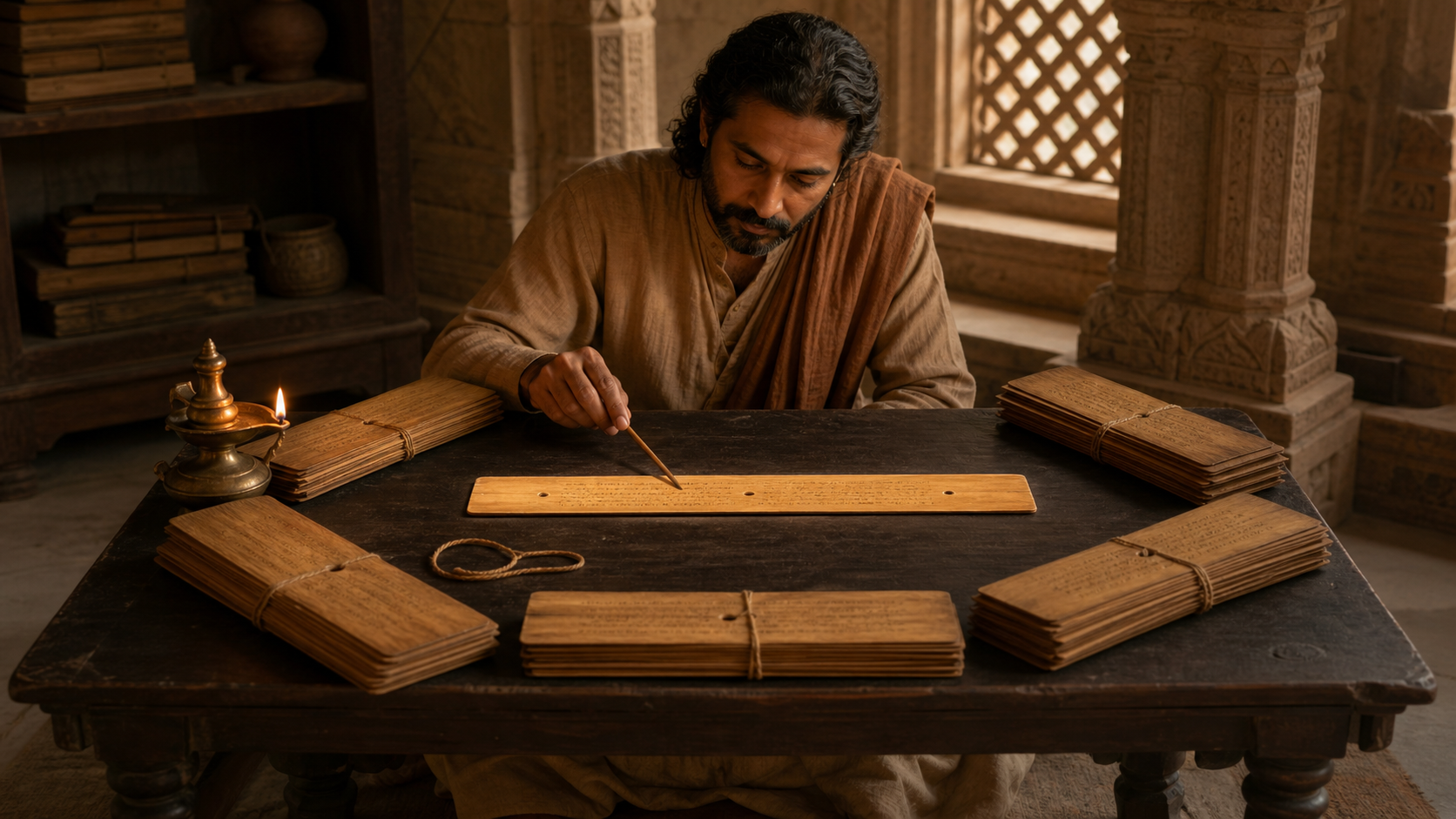
You have a Yogasutra open before you. The aphorism is short enough to remember, yet too compressed to show exactly how its terms, method, and intended result fit together. You want help, but you do not want an explanation that quietly replaces Patanjali with a later system.
That is where Bhoja becomes useful. His approach is valued for staying close to the sutra while making its reasoning easier to follow. If you keep Patanjali’s words, Bhoja’s explanation, and your own application visibly separate, the commentary can deepen both study and practice without blurring their boundaries.
Why Bhoja helps when the sutra is too compressed
A sutra compresses a large thought into very little language. That economy makes it memorable, but it also leaves relationships unstated. A reader may recognize every translated word and still remain unsure about the actual claim: Is Patanjali defining a term, naming a condition, prescribing a discipline, or describing an outcome?
A vritti is meant to unfold the internal sense of such an aphorism. Bhoja’s exposition, known as Bhojavritti or Rajamartandavritti, is especially helpful when you need clarification without losing sight of the terse statement being clarified. The two titles refer to the same commentary, an important practical detail when you search catalogues, editions, or reading lists.
Do not treat the commentary as a substitute for the sutra. Give each reading session three visible layers:
- Sutra: Record only what Patanjali’s wording states.
- Bhoja: Record the definition, connection, or clarification supplied by Bhoja.
- Your question: Record the inference, doubt, or practical implication that arises for you.
This separation prevents a common mistake. After reading a persuasive explanation several times, you may remember the explanation as though it appeared in the aphorism itself. Labelling the three layers lets you appreciate Bhoja’s interpretive work while preserving the authority and distinct form of the Yogasutra.
Use a four-pass reading method

You do not need to cover many sutras in one sitting. One carefully examined passage can teach you more than a page read at speed. For a twenty-minute study period, we recommend the following schedule as a practical method, not as a traditional rule:
- Spend three minutes with the sutra alone. Read it slowly. Circle the central terms and underline any word that appears to connect one idea to another. Write one sentence stating what you think the aphorism is doing, even if you are uncertain.
- Spend eight minutes with Bhoja. Look for the exact point at which his explanation resolves an ambiguity. Does he define a word, identify a relationship, supply a condition, or distinguish the discipline from its result? Mark only what you can locate in his reasoning.
- Spend six minutes paraphrasing. Write two sentences without copying the translation. The first should state the claim. The second should explain why that claim matters within Yoga’s pursuit of ethical steadiness, concentration, or meditative discipline.
- Spend three minutes forming one question. Ask what you would need to understand before moving forward. A precise unresolved question is more useful than a vague impression that the passage is profound.
If the paraphrase remains vague after twenty minutes, stop there. Do not add another sutra merely to complete a quota. Return to the difficult term during the next session and compare how it functions in the immediate context. The delay is productive because it reveals whether the obstacle is vocabulary, logic, or an assumption you brought to the text.
When a passage contains practical direction, convert it into an observation rather than a grand promise. If the issue is concentration, for example, identify what repeatedly interrupts attention during a defined period of practice. If the issue is ethical preparation, identify the conduct the passage asks you to examine. This check does not prove a metaphysical proposition; it tests whether you have understood the practical instruction clearly enough to recognize its relevance.
Mark the moves, not just the meanings
Students often fill their notes with definitions and overlook the movement of an argument. Yet the hinge between two ideas may matter more than either idea in isolation. A simple margin code keeps that movement visible:
- D for definition: Bhoja narrows or clarifies the meaning of a term.
- R for relationship: One state, discipline, obstacle, or outcome is connected to another.
- M for method: The explanation indicates something to cultivate, restrain, sustain, or examine.
- G for goal: The passage indicates what the discipline is intended to accomplish.
- Q for question: A step remains unclear or appears to depend on an unstated premise.
Not every explanation will contain all five moves. That is the point. The code forces you to notice what is actually present instead of completing a familiar Yoga scheme from memory. At the end of a session, try to express the passage as a sequence: term, condition, method, result. Leave any unsupported position blank.
Correct three common reading errors
- Do not attribute every explanation to Patanjali. Prefix your notes with P for the sutra and B for Bhoja. This small habit preserves the difference between an aphorism and its interpretation.
- Do not collect uplifting sentences without their conditions. When a line describes clarity, steadiness, or contemplative attainment, ask what discipline precedes it. An outcome detached from its method becomes inspiration rather than instruction.
- Do not force Bhoja’s biography into every passage. His range can sharpen the questions you ask, but a claim about influence still requires support from the wording before you. Use context to investigate the explanation, not to predetermine it.
Also watch for translation drift. If the same Sanskrit term appears in more than one passage, keep the term beside its English rendering in your notes. You can then see whether an apparent change belongs to the argument or merely to the translator’s choice of vocabulary.
Read the royal and dharmic context with discipline
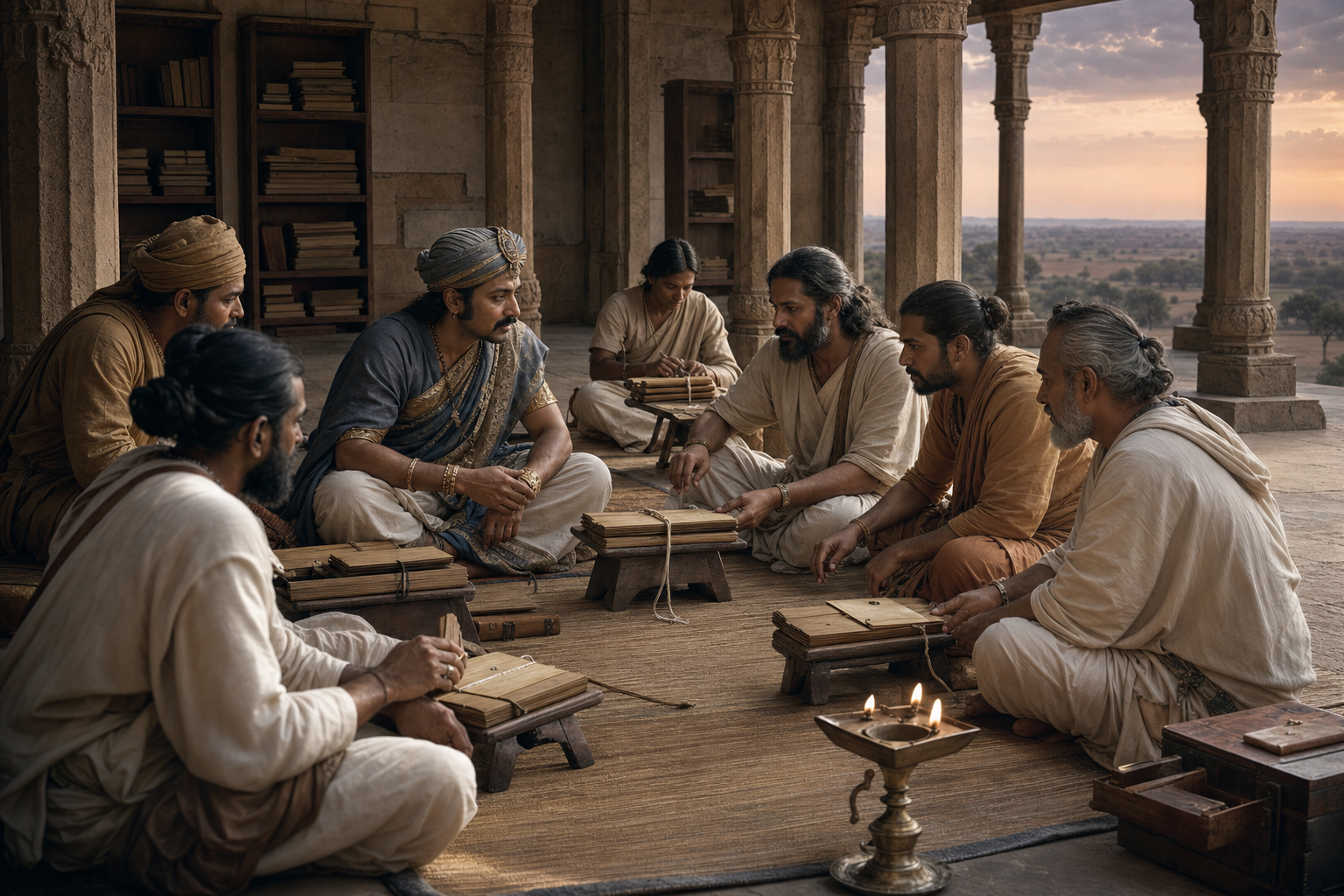
Bhoja ruled Malava from 1018 to 1060 CE, and his learning extended across rhetoric, Ayurveda, architecture, sculpture, warfare, and technology. That breadth matters because it places his engagement with Yoga within a much larger field of Bharatiya knowledge. The commentator was not approaching contemplative discipline as an isolated curiosity.
Royal status, however, does not prove an interpretation. Nor should a list of intellectual interests become permission to discover an Ayurvedic, architectural, or political analogy in every sentence. Evaluate the explanation where it stands. Ask four concrete questions:
- Does Bhoja make the sutra’s central term more exact?
- Does he reveal an order between preparation, discipline, and outcome?
- Does he connect psychological training with an ethical foundation?
- Does the explanation remain recognizably tied to Patanjali’s compact wording?
These questions let you benefit from Bhoja’s systematic intelligence without turning historical context into speculation. They also illuminate something important about Bharat’s intellectual inheritance: serious reflection on the mind could exist beside inquiry into healing, language, art, statecraft, and technical knowledge. You do not have to fragment that inheritance in order to study any part of it rigorously.
Recognize shared dharmic values without erasing differences
Bhoja writes within a Hindu philosophical setting. Readers formed by Buddhist, Jain, or Sikh traditions may nevertheless recognize the importance of disciplined attention, moral steadiness, inner clarity, and compassion. Such recognition creates a sound basis for dharmic conversation, but it does not establish that every tradition defines the self, liberation, knowledge, or contemplative attainment in the same way.
If you are studying in an inter-dharmic group, compare in two stages. First, let each participant name the practical value they recognize in the passage. Second, ask which terms or ultimate claims remain distinctive to the tradition under discussion. Shared discipline can open the conversation; precision about difference keeps it honest.
Key takeaways for your next study session
- Bhojavritti and Rajamartandavritti are two names for Bhoja’s commentary on Patanjali’s Yogasutra.
- Keep the sutra, Bhoja’s explanation, and your own inference in separate parts of your notes.
- Read for definitions, relationships, methods, and goals rather than collecting isolated spiritual phrases.
- Use Bhoja’s broad intellectual background to frame questions, but require the wording to support any proposed connection.
- Notice ethical and contemplative values shared across dharmic traditions without treating their philosophies as interchangeable.
For your next session, choose one sutra and divide a page into three columns labelled Patanjali, Bhoja, and Question. Do not move on until you can state in two plain sentences what Bhoja clarified and which part still requires attention. Repeated patiently, that habit turns commentary from borrowed authority into disciplined understanding.
References
