
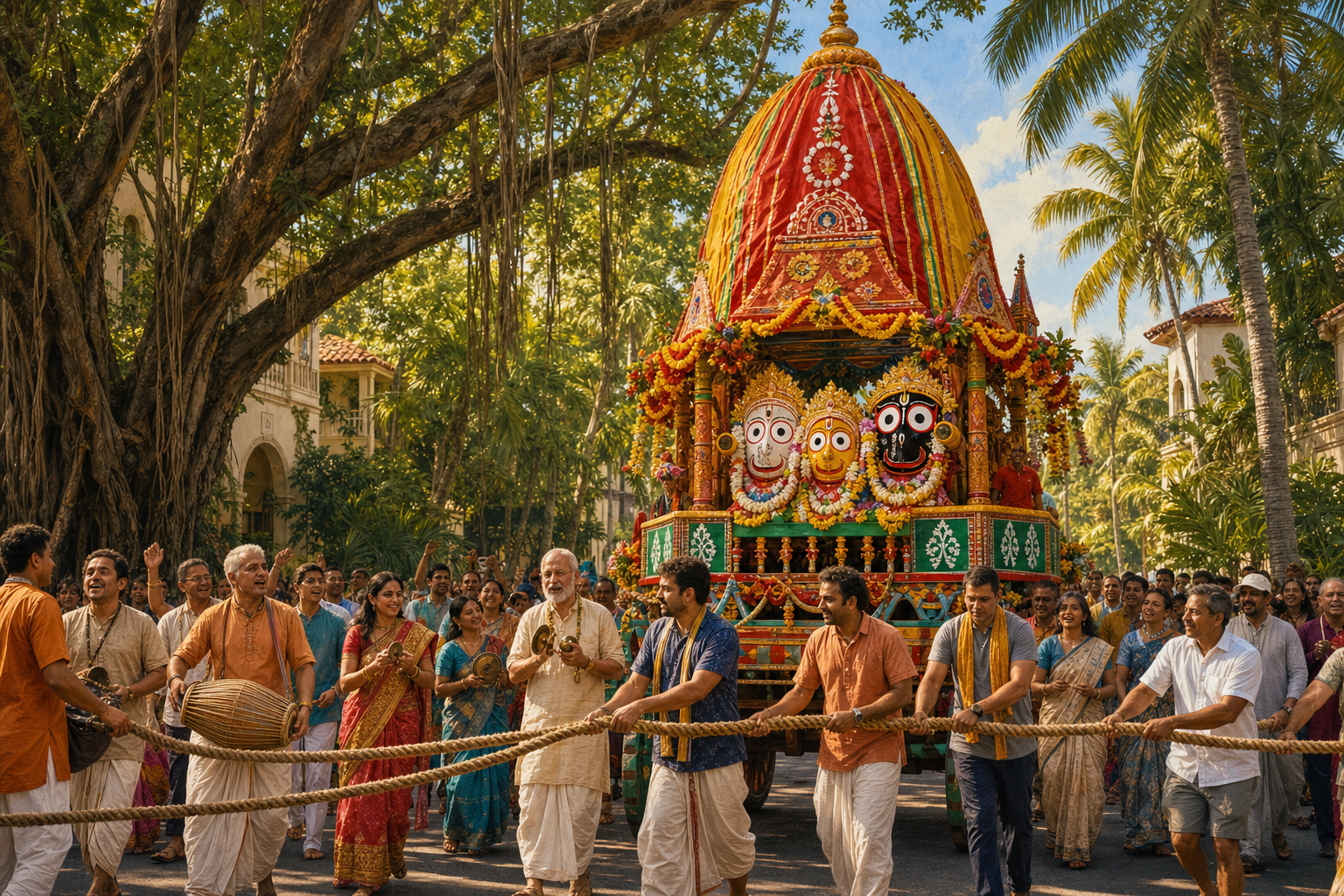
If you saw a towering chariot moving through Coconut Grove at the start of 2026, you may have wondered whether it was a parade float, a Hindu ceremony, or both. The clearest answer is that ISKCON Miami brought a sacred Ratha Yatra procession into one of the neighborhood’s established civic celebrations.
That distinction matters. The chariot was visually striking, but its purpose was not merely to represent Indian culture. It carried the Jagannath tradition into a shared public setting, where you could encounter it without entering a temple or already knowing how to participate.
What Miami actually witnessed in Coconut Grove
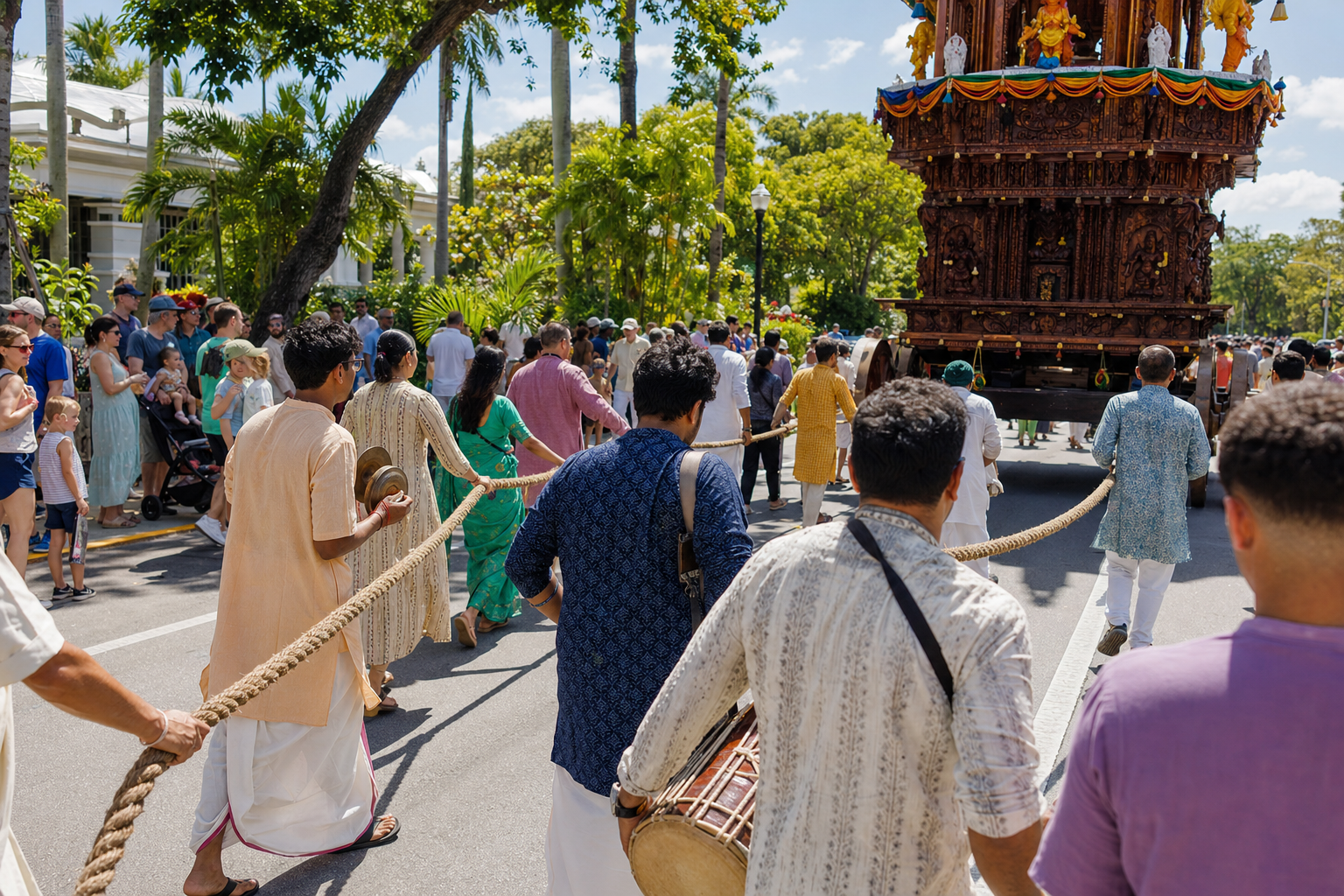
On Sunday, January 4, 2026, ISKCON Miami joined the 41st Annual King Mango Strut Parade for the city’s first Ratha Yatra of the year. This was not a separate festival taking place behind temple walls. The chariot moved through Coconut Grove as part of an existing public procession attended by local residents, families, and visitors.
The large chariot came from Alachua, Florida, through the efforts of Dharmaraja Deva das and Radha Kunda Rani devi. That logistical detail tells you something important about such an event: what looks spontaneous on the street depends on careful transportation, assembly, coordination, and volunteer service before the procession begins.
Devotional chanting and call-and-response accompanied the chariot. Children and families walked alongside it, while people who had come for the wider parade could watch, listen, or take part. The format created several levels of participation. A committed devotee could approach the occasion as worship; a Hindu family could recognize a living tradition from Bharat; and a newcomer could begin simply by hearing the chanting and asking what the chariot represented.
If you are trying to understand the event, do not judge it only by the size of the chariot or the number of people around it. Notice the combination of a moving sacred center, congregational chanting, open access, and volunteer-supported order. Those elements make it a Ratha Yatra rather than a decorative display with Hindu imagery.
Why Ratha Yatra brings Jagannath into the street
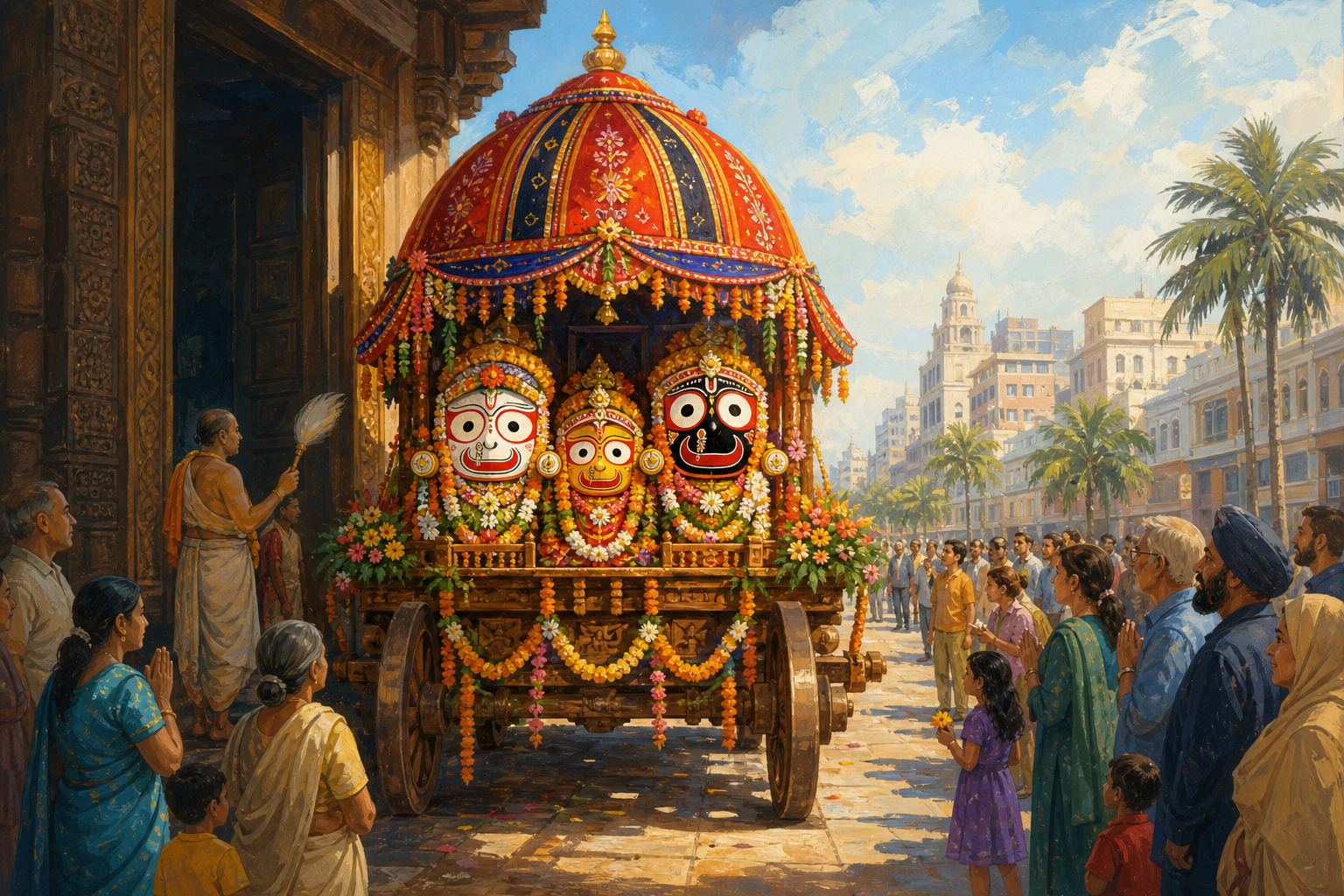
The name gives you the basic form: a ratha is a chariot, and a yatra is a journey or procession. Its deeper meaning lies in the direction of that journey. In the Jagannath tradition, divine grace does not remain confined to an inner sanctum. The sacred presence moves outward so that people in ordinary public life can encounter it.
This is why calling Ratha Yatra an Indian cultural parade is not entirely wrong, but it is incomplete. Music, color, clothing, community participation, and a monumental chariot all carry culture. Yet the center remains devotional. The procession is about Jagannath reaching the public, not simply a community presenting its ethnic heritage to spectators.
The Coconut Grove setting made that outward movement especially visible. A familiar neighborhood parade became a meeting point between a Vaishnava Hindu tradition and Miami’s multicultural civic life. People did not have to cross a religious threshold before encountering the practice. The chariot came to the street they were already standing on.
If you need to explain the event to someone unfamiliar with Hindu traditions, use one clear sentence: Ratha Yatra is a sacred procession in which Jagannath’s chariot moves among the public, inviting people into remembrance, chanting, and fellowship. That description preserves the religious meaning without assuming that every participant shares the same level of belief or knowledge.
How a newcomer can participate respectfully
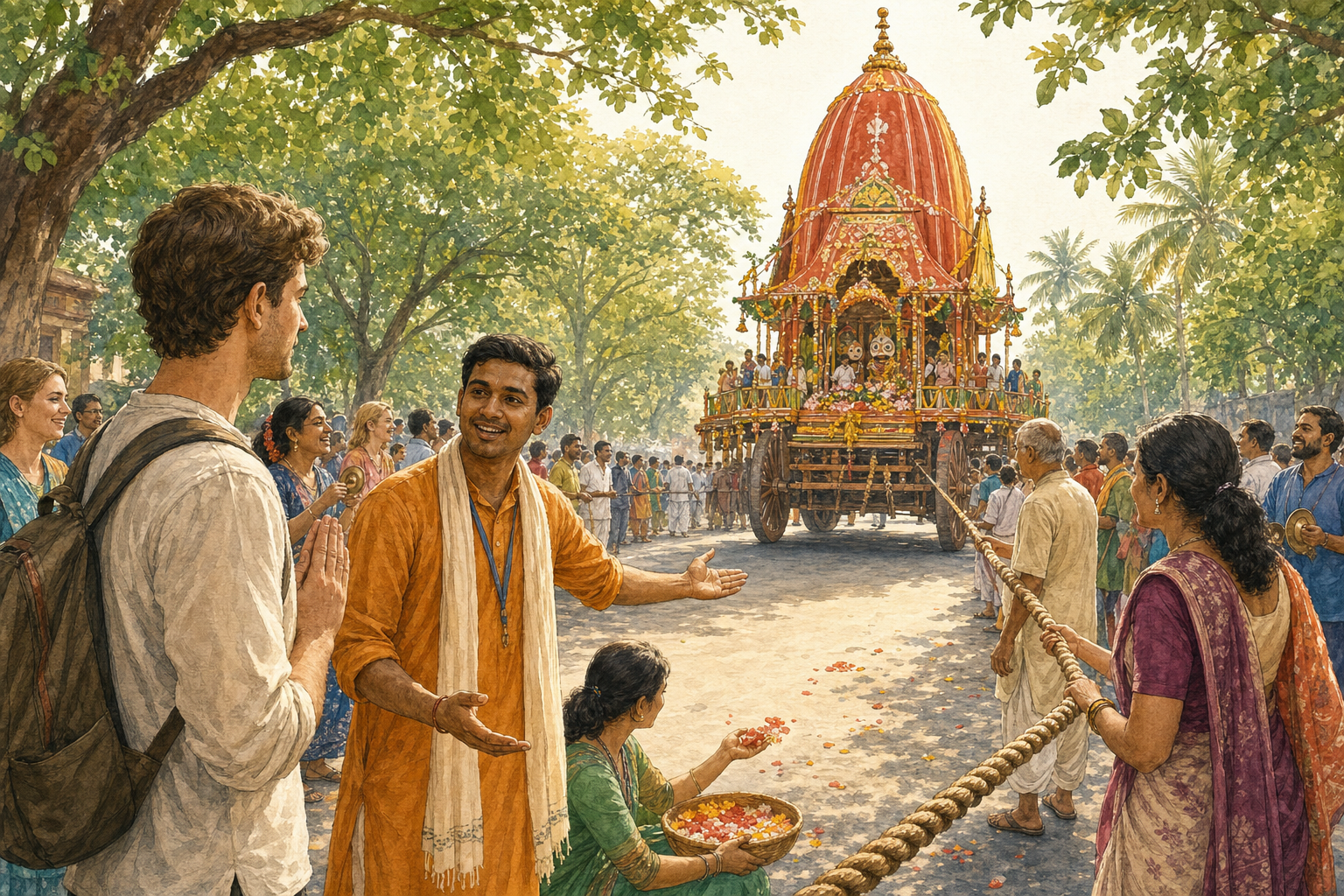
You do not need specialized knowledge to stand near a Ratha Yatra. Openness is part of its public character. Respectful participation, however, begins by recognizing that devotees are engaged in worship even when the setting resembles a conventional street festival.
- Watch before deciding what to do. Spend a moment noticing the chariot’s movement, the chanting pattern, and any directions from volunteers. You will quickly see whether the procession is moving, pausing, or inviting a response.
- Join the chanting at your own comfort level. Call-and-response allows you to listen first and repeat when you are ready. You do not have to imitate a devotional intensity you do not yet understand.
- Keep the route clear. A large moving chariot requires space. Follow volunteer instructions, avoid stepping into its path for a photograph, and keep children close when the procession is turning or moving through a crowded area.
- Ask rather than assume. If you want to know who Jagannath is, why the chariot travels, or what the chanting means, ask a devotee or event volunteer. Treating the chariot as merely an unusual float misses the reason it is there.
- Photograph people with consideration. A public parade naturally attracts cameras, but a close portrait of a worshipper is different from a wide image of the procession. Seek consent when an individual is the subject, and do not interrupt prayer or block the route.
- Accept the welcome without pretending belief. You can listen, walk nearby, respond to the chanting, or learn from the occasion without making a religious declaration. Honest curiosity is more respectful than performing familiarity.
The January 4 procession has already taken place. Do not treat that date, route, or parade arrangement as a standing schedule for future Ratha Yatras. If you hope to attend another Miami event, verify the current announcement from ISKCON Miami or the relevant parade organizer rather than assuming that the same details will repeat.
What this moment asks of Dharmic communities
Public visibility can strengthen a tradition, but visibility alone is not the goal. A chariot can become a memorable spectacle while its meaning remains unclear. The stronger model combines an unmistakable devotional center with enough openness and explanation for a passerby to understand what is being offered.
For organizers, that means treating interpretation as part of seva. A short explanation of Jagannath, visible volunteers who can answer questions, a clearly managed walking route, and patient guidance during the chanting can turn curiosity into genuine understanding. Smooth crowd coordination also protects the atmosphere of worship; people are more able to listen and participate when they are not confused about where to stand or move.
The event also offers a useful lesson for Hindus, Buddhists, Jains, and Sikhs working together in diaspora communities. Compassion, fellowship, service, and peaceful coexistence provide real common ground. They can support cooperation around public celebrations, volunteer work, and cultural education.
Shared ethical ground should not erase the identity of the practice itself. Ratha Yatra belongs to the Jagannath tradition and carries a specifically Hindu devotional meaning. Calling it a generic interfaith ritual would flatten the very heritage being welcomed into public life. Dharmic unity is strongest when communities can support one another without pretending that their histories, theologies, and disciplines are interchangeable.
Coconut Grove showed how that balance can work. ISKCON did not need to hide the chariot’s sacred purpose in order to join a civic parade. Nor did spectators need to become formal practitioners before walking beside it. The procession remained recognizably devotional while offering an accessible point of contact to the wider city.
Key takeaways
- ISKCON Miami’s January 4, 2026 Ratha Yatra appeared within Coconut Grove’s 41st Annual King Mango Strut Parade.
- The chariot was a devotional center rooted in the Jagannath tradition, not simply an Indian-themed parade float.
- Chanting, family participation, and an open public route allowed people to engage at different levels of familiarity and faith.
- A newcomer can participate by listening, following volunteer directions, joining the response when comfortable, and asking sincere questions.
- Future dates and routes should be verified independently; the 2026 arrangement should not be assumed to repeat unchanged.
- Dharmic cooperation works best when shared values support each tradition’s distinct identity rather than replacing it.
When you next encounter a Ratha Yatra, begin with one practical step: ask why Jagannath travels beyond the temple. That question opens the meaning behind the chariot, the chanting, and the welcome. If you help organize such a procession, make the answer easy for every person along the route to find.
References
