
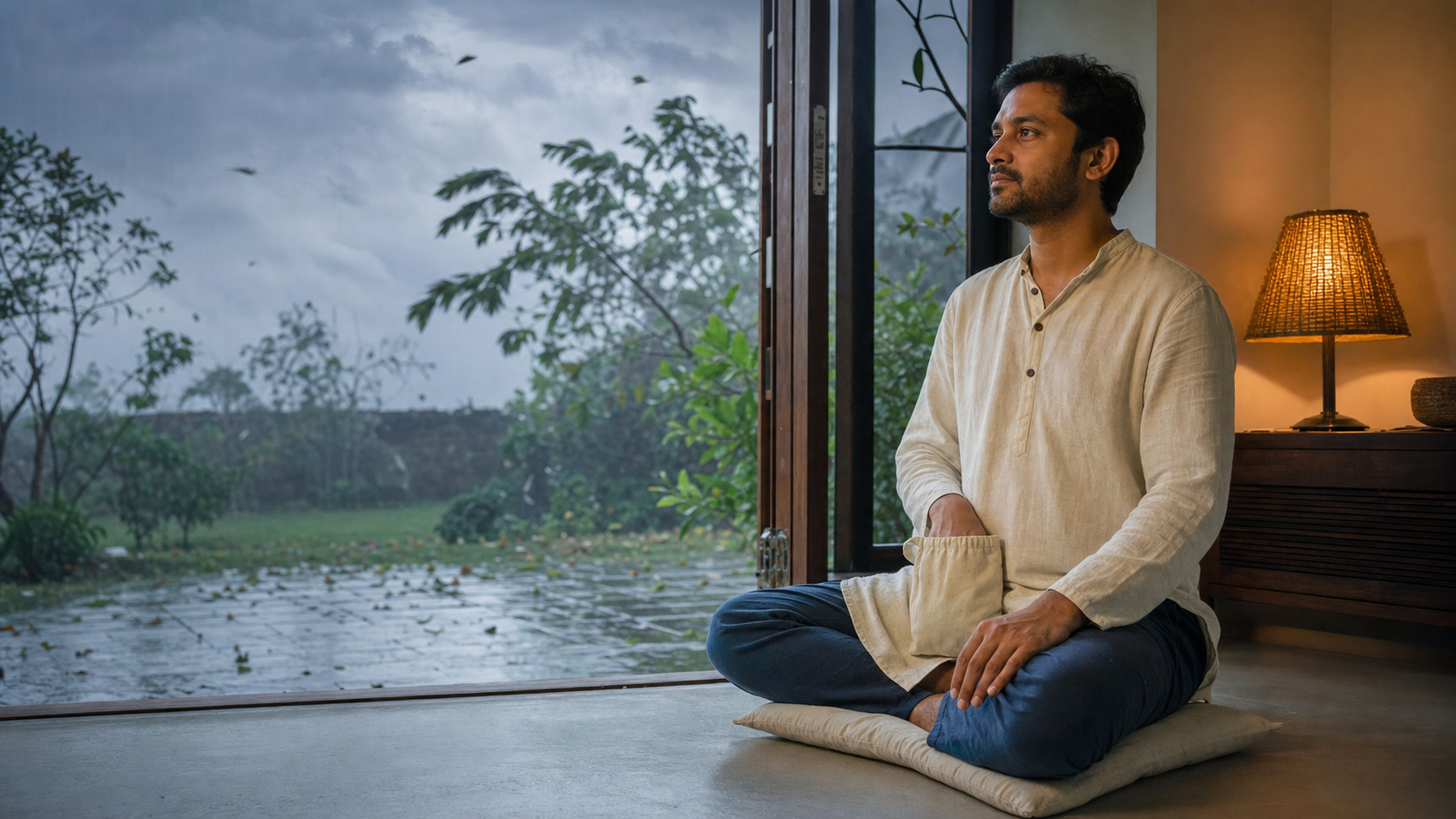
When fear keeps rehearsing the same future, telling yourself to stop worrying rarely works. The mind needs somewhere definite to return. Hare Krishna chanting gives it a sound, a rhythm, a devotional relationship, and a practice you can repeat without waiting for ideal conditions.
The immediate result may be a quieter breath or a less crowded mind. The deeper purpose is abhaya: not a life in which danger and uncertainty vanish, but one in which fear no longer decides how you live. Here is how to practise toward that distinction without exaggerating what chanting can do.
Calm is the beginning; fearlessness is the test

When asked what he experienced while chanting, Srila Prabhupada answered, “I feel no fear.” The precision of that answer matters. He did not merely describe relaxation. He named the spiritual condition of abhaya.
Calm and fearlessness overlap, but they are not identical. Calm is a state: your breathing settles, mental noise recedes, and the body becomes less reactive. Abhaya is an orientation: you remain anchored enough to tell the truth, fulfil a duty, accept uncertainty, or protect another person even when discomfort is still present.
This gives you a better way to judge the practice. Do not ask only, “Did I feel peaceful while chanting?” Also ask:
- Did I recover more cleanly after being unsettled?
- Could I distinguish a real danger from an imagined future?
- Did I take the next responsible action instead of obeying avoidance?
- Was I less harsh toward other people when under pressure?
A pleasant session can be valuable, but sedation is not the goal. If chanting helps you feel peaceful while postponing a necessary conversation, ignoring wrongdoing, or refusing a duty, calm has become a hiding place. Dharmic fearlessness joins inner steadiness to right action.
Why the maha-mantra can steady a frightened mind

The Hare Krishna maha-mantra is a 16-word, 32-syllable pattern:
Hare Krishna Hare Krishna, Krishna Krishna Hare Hare, Hare Rama Hare Rama, Rama Rama Hare Hare.
Its repeated names and balanced phrases give attention a predictable path. When the mind wanders into imagined outcomes, you do not have to debate every thought. You hear the next name and return. That simple act, repeated many times, trains attention not to follow every fearful impulse.
In Gaudiya Vaishnava understanding, this is more than a neutral concentration device. Hare invokes divine energy and grace; Krishna addresses the all-attractive Lord; Rama addresses the reservoir of joy. The mantra is therefore an appeal and an act of remembrance, not a self-directed affirmation that you are invulnerable. Its devotional logic is shelter: your security does not depend on controlling every possible outcome.
The embodied side of the practice supports that devotional movement. Repeated vocalisation tends to regularise breathing, and a relaxed cadence can move respiration toward roughly six breaths per minute, a rate associated with heart-rate variability and parasympathetic activity. Predictable rhythm also reduces the amount of mental work required to choose the next object of attention. In kirtan, call-and-response adds shared rhythm, belonging, and social synchrony.
These physiological explanations can help you understand why repetitive sacred sound often feels settling. They do not prove the Vaishnava theological claim that the divine name acts directly on consciousness. That claim belongs to the bhakti tradition and is verified within the discipline of devotion. You do not need to collapse spiritual meaning into physiology, or use spiritual language to overstate a health effect. The two descriptions answer different questions.
Literal understanding can deepen intention, but it is not required for every initial benefit. A newcomer may first respond to the breathing, cadence, and cooperative music of sankirtana. Gaudiya Vaishnavas also hold that even incidental contact with the holy name can begin purification. That traditional claim should be presented as a conviction of the lineage, while the ordinary calming influence of attentive, rhythmic vocalisation can be noticed directly.
Other Dharmic paths unite sound, remembrance, and ethical formation in their own ways. Sikh Naam Simran turns attention toward the fearless Divine, nirbhau. Buddhist recitation and recollection cultivate awareness, goodwill, and compassion. Jain use of the Namokar Mantra supports equanimity within an ahimsa-centred discipline. These practices share useful human mechanisms, but their names and theological meanings are not interchangeable. Honour the path whose mantra you use rather than treating sacred formulas as equivalent relaxation tracks.
A 12-to-20-minute practice you can sustain
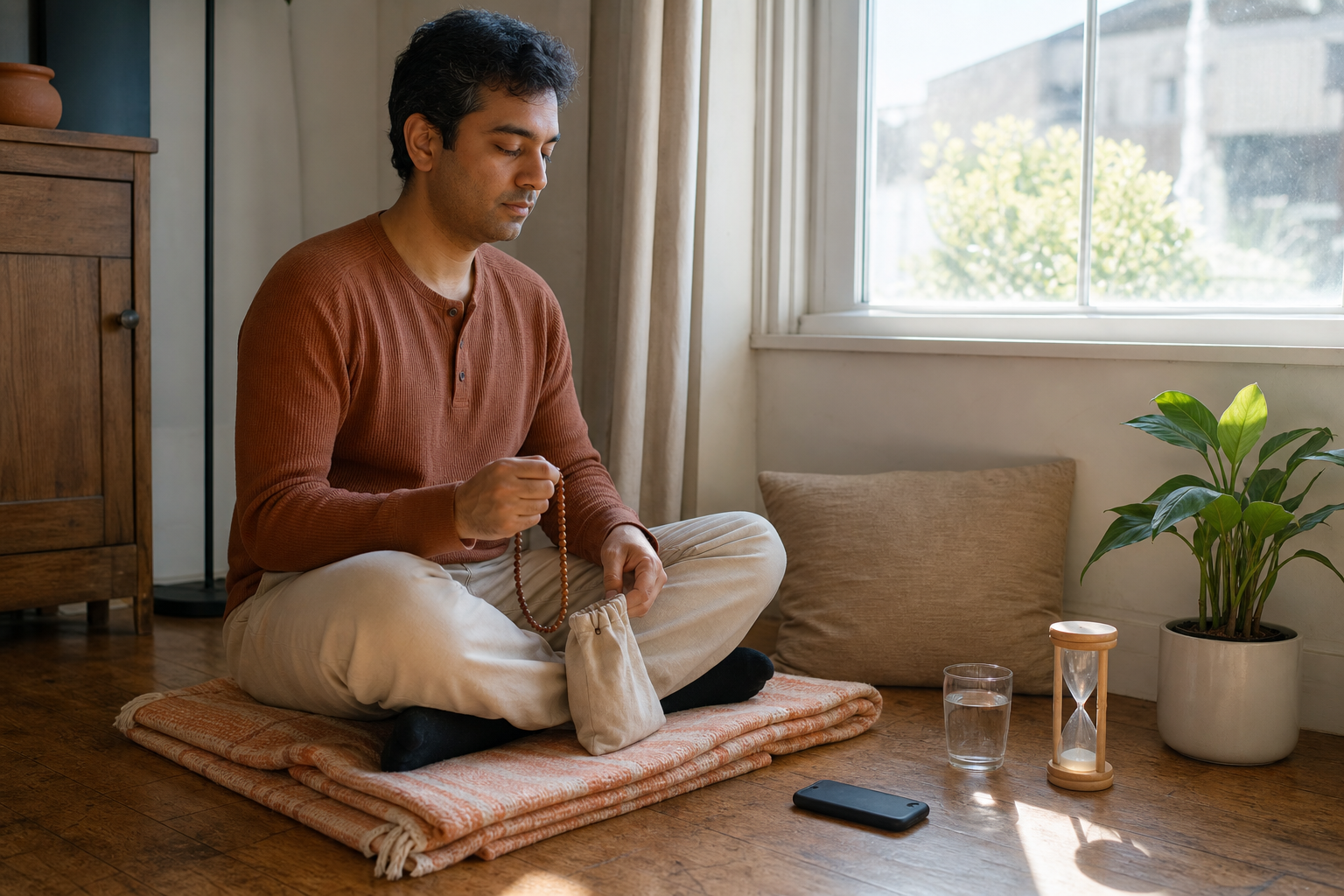
Consistency matters more than producing an intense experience. Begin with a period you can repeat daily rather than making a large promise in a moment of distress.
- Choose a stable cue. Set aside 12 to 20 minutes after an activity that already happens each day. A dependable cue removes the daily argument about when to practise.
- Sit without making the posture into a performance. Keep the spine comfortably upright. Release the jaw and shoulders. The posture should support alertness without strain.
- Notice the breath for about one minute. Let it settle on its own. A gentle exhalation is enough; do not hold the breath or force yourself toward a target rate.
- Chant at a natural pace. Speak loudly enough to hear each name clearly. Let hearing, rather than speed or musical polish, be the centre of attention.
- Return without commentary. When a plan, memory, or fear captures the mind, resume listening at the syllable now being chanted. You do not need to scold yourself or restart the session.
- End with a short silence. Notice the quality of attention before reaching for a screen or moving into the next task. Then identify one responsible action that deserves that steadier attention.
Use japa when you need a personal anchor
A traditional mala has 108 beads. Moving one bead for each complete mantra gives the hands a task and frees the mind from counting. Keep the voice soft but audible if circumstances allow. The important movement is from speaking to hearing, not from one number to another. If your available period ends before a round is complete, do not rush merely to finish the beads.
Restlessness does not mean japa has failed. The repeated return is the training. A distracted session in which you return many times may teach you more about fear’s grip on attention than an unusually effortless session.
Use kirtan when isolation is feeding fear
Kirtan distributes the work of attention across a group. A leader sings a phrase and the gathering responds. Melody, mridanga, kartalas, breath, and listening create a shared rhythm. This can be especially helpful when solitary worry has become self-reinforcing.
You do not need musical expertise. Listen to the call, answer with the group, and let the collective cadence carry you when personal concentration is weak. Responsible public sankirtana should remain an offering of seva: welcoming rather than coercive, mindful of local rules, and careful not to obstruct people who have not chosen to participate.
Match the practice to the kind of fear in front of you

Before a difficult but necessary action
Use the full 12-to-20-minute practice before a conversation, decision, journey, or duty that you have been avoiding. Do not chant in order to guarantee the result you want. Chant to become steady enough to act without deceit, aggression, or paralysis.
At the end, name the next action in concrete terms. “Become fearless” is too vague. “Make the call,” “state the truth without insult,” or “ask for qualified help” gives the steadier mind somewhere ethical to go.
When fear rises suddenly
If you are physically safe, try a one-minute reset. Relax the shoulders, allow a comfortable exhalation, and repeat the mantra softly or internally. If you are walking, let the repetition follow your steps. Your task is not to make the sensation disappear on command. It is to interrupt the automatic chain from sensation to catastrophic thought to impulsive reaction.
If there is an immediate threat, respond to the threat first. Leave the unsafe setting, seek help, or contact the appropriate emergency service. Chanting must never be used to remain in abuse, dismiss a medical emergency, or prove the strength of your faith.
When fear has become a persistent pattern
Keep the daily practice steady and watch what changes outside it. Useful signs include a shorter recovery after stress, less compulsive rehearsal of imagined outcomes, greater willingness to ask for support, and more consistent action in line with dharma. The first change may be modest: fear still appears, but it occupies less of the day and has less authority over your choices.
Persistent panic, trauma-related symptoms, or fear that is disrupting sleep, work, relationships, or basic functioning deserves attention from a qualified mental-health professional. Mantra practice can accompany appropriate care and may offer a devotional anchor within it; it is not a substitute for assessment or treatment.
Also notice the ethical direction of your practice. Genuine abhaya should make you more capable of compassion and responsibility, not more reckless. The fearless person is not someone who cannot detect danger. It is someone who can see danger clearly without surrendering judgement, conscience, or care for others.
Key takeaways
- Calm is a temporary settling of mind and body; abhaya is the capacity to act rightly without being governed by fear.
- The mantra combines a stable acoustic pattern with devotional remembrance of Hare, Krishna, and Rama.
- Begin with 12 to 20 minutes at a repeatable daily cue, chant at a natural pace, and listen to each name instead of chasing speed.
- Choose japa for a quiet tactile anchor and kirtan when shared rhythm and community will help interrupt isolation.
- Measure progress in recovery, judgement, conduct, and willingness to perform necessary duties, not only in pleasant sensations during the session.
- Respond to real danger and seek appropriate professional care when needed; spiritual fearlessness is not denial.
At your next stable daily cue, set aside 12 minutes and chant without demanding a dramatic result. When the session ends, take one safe, dharmic step that fear has been delaying. The mantra begins to form fearlessness when the attention gathered in practice becomes courage in conduct.
References
- Dandavats – Sankirtana as Sound Medicine: How Hare Krishna Chanting Nurtures Inner Calm and Social Harmony
- Dandavats – “I Feel No Fear”: How the Hare Krishna Maha-mantra Builds Abhaya Across Dharmic Paths
