
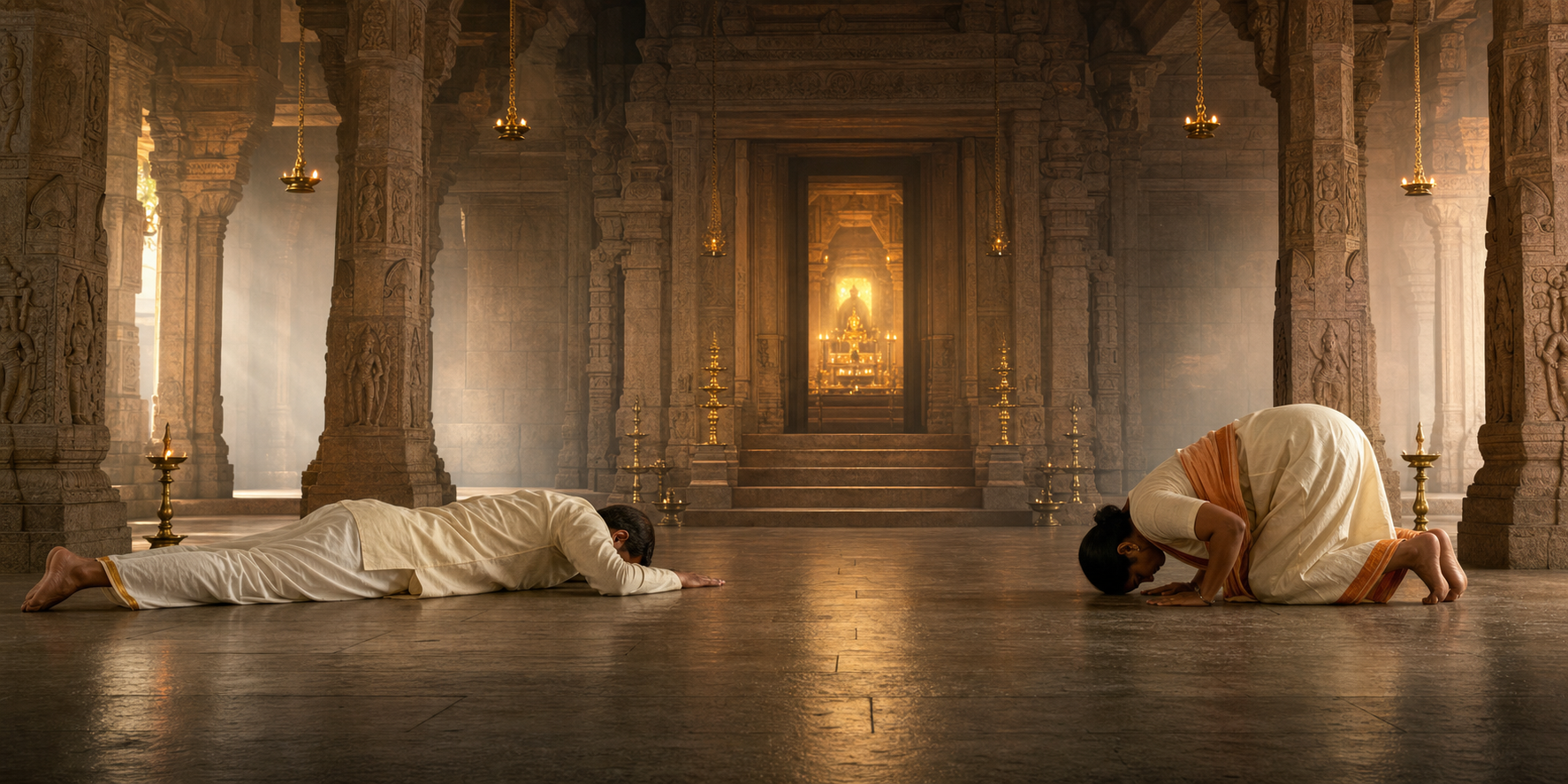
You are standing before the deity, everyone around you begins to bow, and one practical question interrupts the moment: should you make Panchanga Namaskara, lower into Ashtanga Namaskara, or simply remain in Anjali Mudra?
You can answer that without turning devotion into a test of flexibility. Learn the contact points, observe the local tradition, and choose the deepest bow your body can make without pain or disorder. The form matters, but it serves bhava; it does not replace it.
First know which namaskara you are making
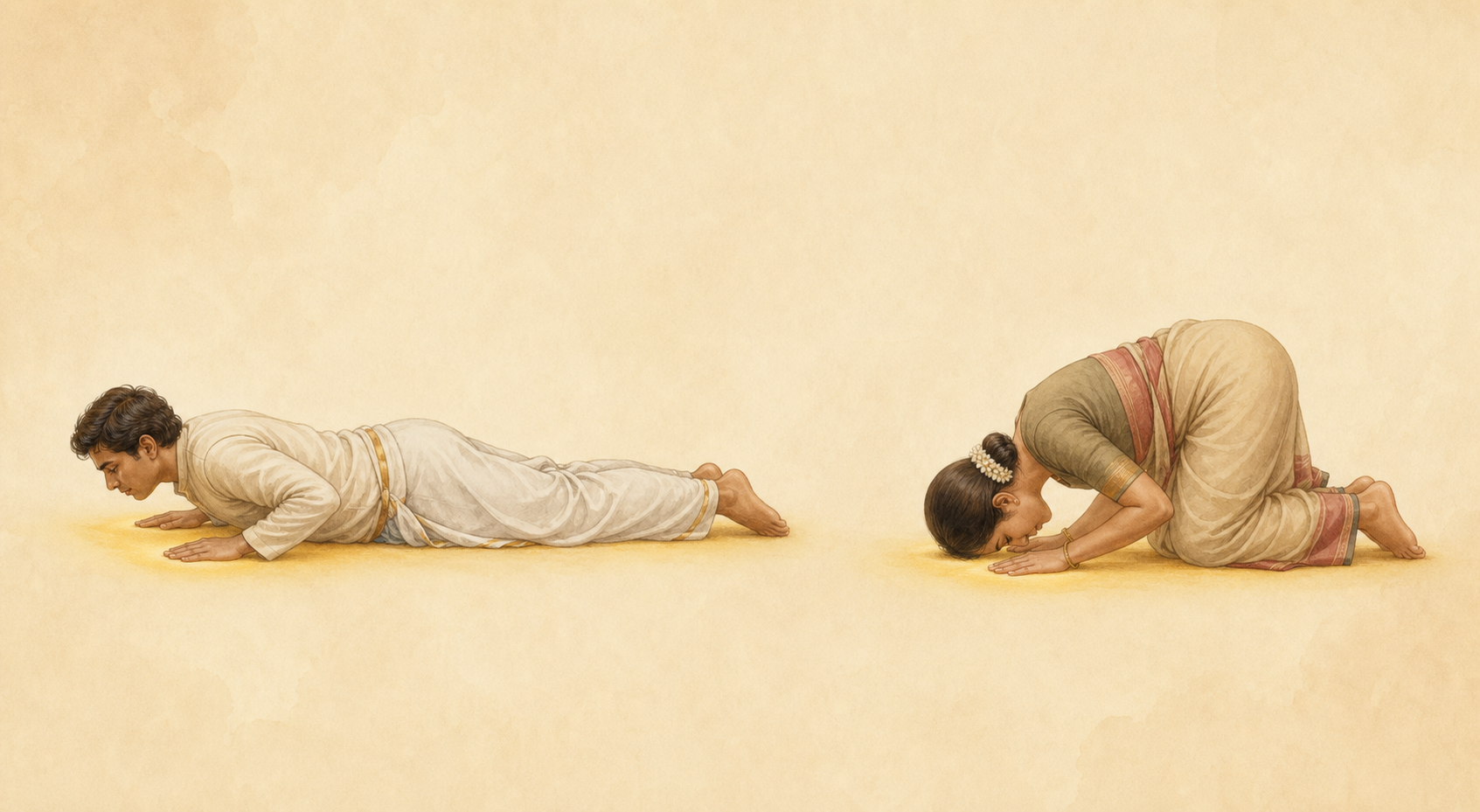
Ashtanga means eight-limbed: ashta is eight and anga is limb or bodily part. Panchanga means five-limbed: pancha is five. Namaskara comes from namas, conveying salutation, reverence, and surrender. The numbers describe the points brought to the ground, not competing ranks of spiritual accomplishment.
| Form | Points of contact | Common use | Physical distinction |
|---|---|---|---|
| Ashtanga Namaskara | Both hands, both knees, both feet or toes, chest, and chin or forehead | Surya Namaskar and full ritual prostration, often called Sashtanga Namaskara | Distributes contact across more of the body and asks more of the wrists, shoulders, knees, neck, and lower back |
| Panchanga Namaskara | Both hands, both knees, and the head or forehead | Temple darshan, home puja, and devotional bowing | Requires less spinal extension but still needs comfortable knees, relaxed shoulders, and a long neck |
The usual eight-point count is two hands, two knees, two feet or toes, the chest, and the chin or forehead. The five-point count is two hands, two knees, and the head or forehead. Regional practice may count or describe these contacts differently, so the physical model is a starting point rather than permission to overrule a temple’s Agama or your family’s parampara.
Ashtanga and Sashtanga are often used interchangeably for an eight-limbed ritual prostration. Context resolves most confusion. In a Surya Namaskar sequence, Ashtanga Namaskara is a transitional yogic position and the chin classically touches the floor. In a devotional prostration, the forehead may be used instead. Ashtanga in this name should also not be equated with Patanjali’s eight-limbed path. Devotees may contemplate a resonance between the two, but they are not the same classification.
The numbers can support contemplation without becoming rigid codes. Eight may call to mind the directions or the offering of the whole person. Five may evoke the pancha-bhutas, pancha-koshas, or the surrender of action and thought through the hands, knees, and head. These are devotional lenses, not one compulsory interpretation that every sampradaya must accept.
A related grammar of embodied humility appears across Dharmic traditions without making their liturgies identical. Buddhist practice includes a five-point bow with the knees, hands, and forehead, while full-length prostrations occur in Tibetan lineages. Jainism’s Pancha-Namokkara venerates five supreme beings. In Sikh practice, matha tek places the forehead before the Guru Granth Sahib in reverence to the Shabad. The shared principle is humility; the theology and ritual context of each act remain distinct.
How to perform both bows without forcing the body
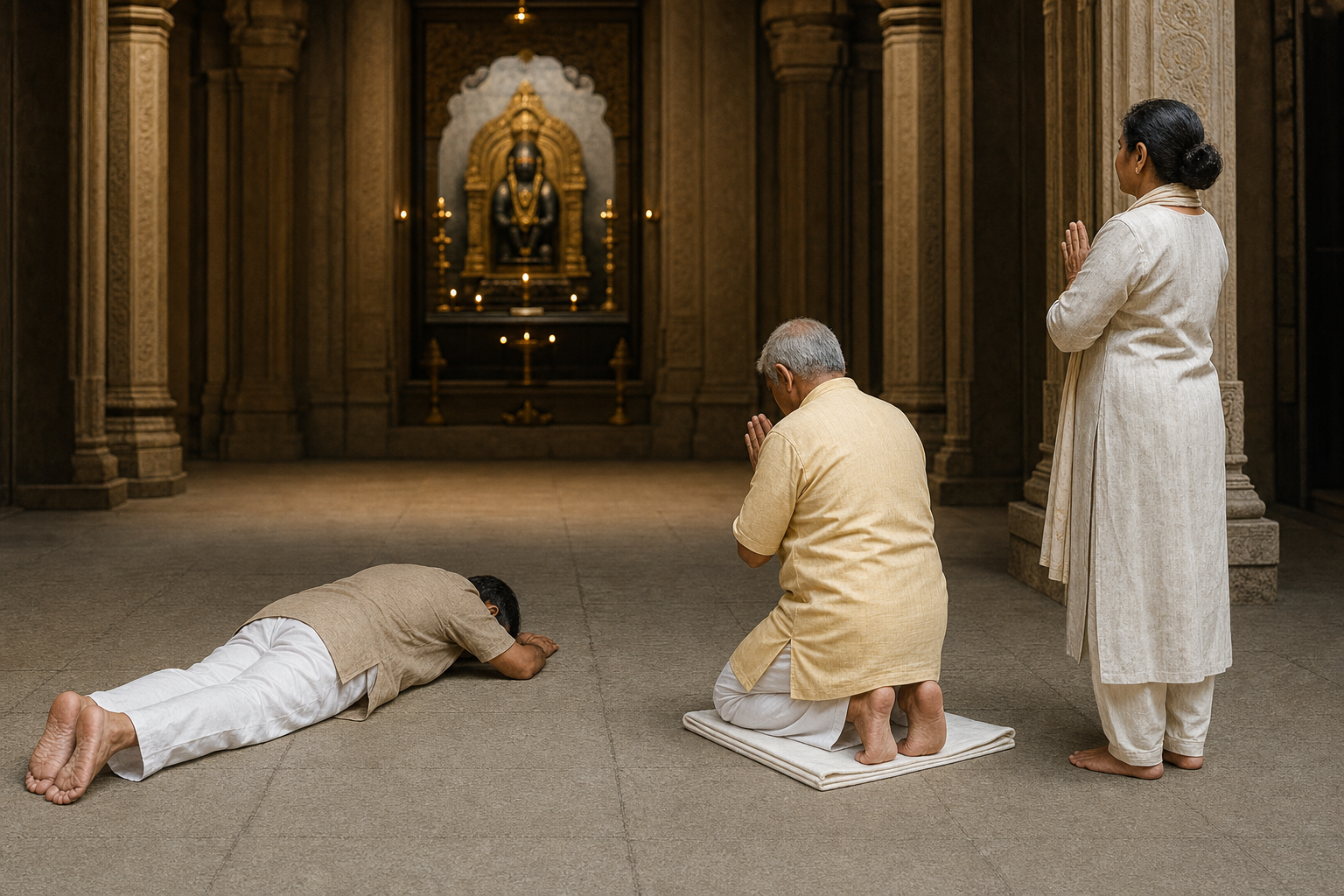
Ashtanga Namaskara, step by step
- Begin from a plank-like or kneeling position with enough clear floor in front of you.
- Exhale as you lower both knees. If the floor is hard, place a folded cloth beneath them before beginning.
- Set the palms beside the chest rather than far ahead. Keep the elbows close to the ribs and the shoulders away from the ears.
- Lower the chest until it makes light contact. Keep the hips slightly elevated and retain a modest natural curve in the lower back instead of collapsing into it.
- In Surya Namaskar, bring the chin down gently. In a ritual form that uses the forehead, lengthen the back of the neck and make light contact without driving the head into the floor.
- Keep the feet or toes in contact, allowing the hands, knees, and feet to share the work. The chest and chin or forehead are points of reverence, not places on which to dump the body’s weight.
- Inhale into the next movement. In a yoga sequence this is often Bhujangasana; in devotional practice, rise slowly and without jerking the neck or shoulders.
The common mistake is to chase all eight contacts by compressing the neck, flaring the elbows, or dropping the lower back. If the position only becomes possible through one of those compensations, stop short and use Panchanga or a non-floor bow. Completing the count is not worth aggravating a joint.
Panchanga Namaskara, step by step
- Come onto both knees with the feet behind you and the torso upright.
- Place both palms on the floor in front of the knees.
- Exhale and incline the torso forward. Keep the shoulders broad and relaxed instead of hunching them around the ears.
- Lower the head or forehead gently to the hands or the floor between them. Do not press the forehead down to prove contact.
- Pause naturally at the bottom. Let the breath remain soft, then inhale as you return upright.
Panchanga reduces the spinal-extension demand of Ashtanga, which can make it more accessible to some elders and people managing lower-back sensitivity. It is not automatically comfortable for everyone: the knees, wrists, and neck still participate. Let actual sensation, not the form’s reputation, tell you whether you need to modify it.
Coordinate breath, mantra, and attention
Use one simple rhythm for either form: exhale while descending, allow a brief natural pause at the lowest point, and inhale while rising. The exhalation supports a calmer descent and can be contemplated as the release of ahankara; the inhalation accompanies uplift. Do not strain to hold the breath.
You may repeat Om or the name of your Ishta quietly as you bow. This keeps the action from becoming mere choreography. Hands offer action, the head offers thought, and the lowered body makes humility concrete. When counting contact points distracts you from the deity, return attention to the mantra and breath.
Modify the bow before discomfort becomes pain
- Knee sensitivity: use a folded cloth beneath the knees. If kneeling remains painful, sit on a chair, keep the feet steady, place the palms on the thighs or in Anjali Mudra, and incline the torso and head.
- Neck limitations: keep the back of the neck long. When forehead contact is unsuitable, make a gentle head bow without touching the floor. People with cervical spondylosis should seek individualized guidance rather than forcing contact.
- Wrist, shoulder, or lower-back pain: do not continue loading the position. Choose the less demanding form or remain seated or standing with Anjali Mudra.
- Pregnancy or abdominal sensitivity: avoid pressure on the lower abdomen. A seated or standing namaskara preserves the devotional act without requiring a floor prostration.
- Injury or medical restriction: use the form permitted by your qualified clinician or physical therapist. Namaskara is a devotional discipline, not a treatment for an injury.
Pain is not a measure of surrender. A stable, attentive inclination of the head is more faithful to the purpose of namaskara than a full prostration performed through strain.
Choose by tradition, capacity, and intention
When both forms are known in your community, use three tests in this order.
- Tradition: What does this temple, sampradaya, or family parampara prescribe here? A local Agamic rule has more relevance inside that temple than a generic instruction learned elsewhere.
- Capacity: Can you enter, maintain, and leave the posture with an easy breath and without pain? If not, modify it before descending.
- Intention: Are you moving through Surya Namaskar, bowing after darshan, beginning japa, or offering pranam during home puja? The same name can describe a yogic transition and a ritual act, but the context changes the details.
That gives you several practical decisions. Use the eight-point form with chin contact when your Surya Namaskar method calls for it and your body can support the transition. Follow your parampara during home puja. In a temple, follow posted directions, the priest’s guidance, or the established conduct of that sacred space. If floor prostration is clearly permitted but no particular form is required, Panchanga is often the less demanding choice.
Some Agamic traditions conventionally prescribe Panchanga for women and Sashtanga for men, particularly in certain South Indian temple settings. That is not a universal Hindu rule. Other temples and lineages differ, and personal capacity also matters. Observe the local practice without turning one region’s convention into a judgment upon every devotee.
If you cannot determine the custom before darshan, Anjali Mudra with a sincere inclination of the head is the prudent option. You can ask a temple attendant afterward and use the prescribed form on your next visit. Uncertainty is a reason to become observant, not to imitate the most elaborate bow you see.
Temple etiquette begins before your knees touch the floor
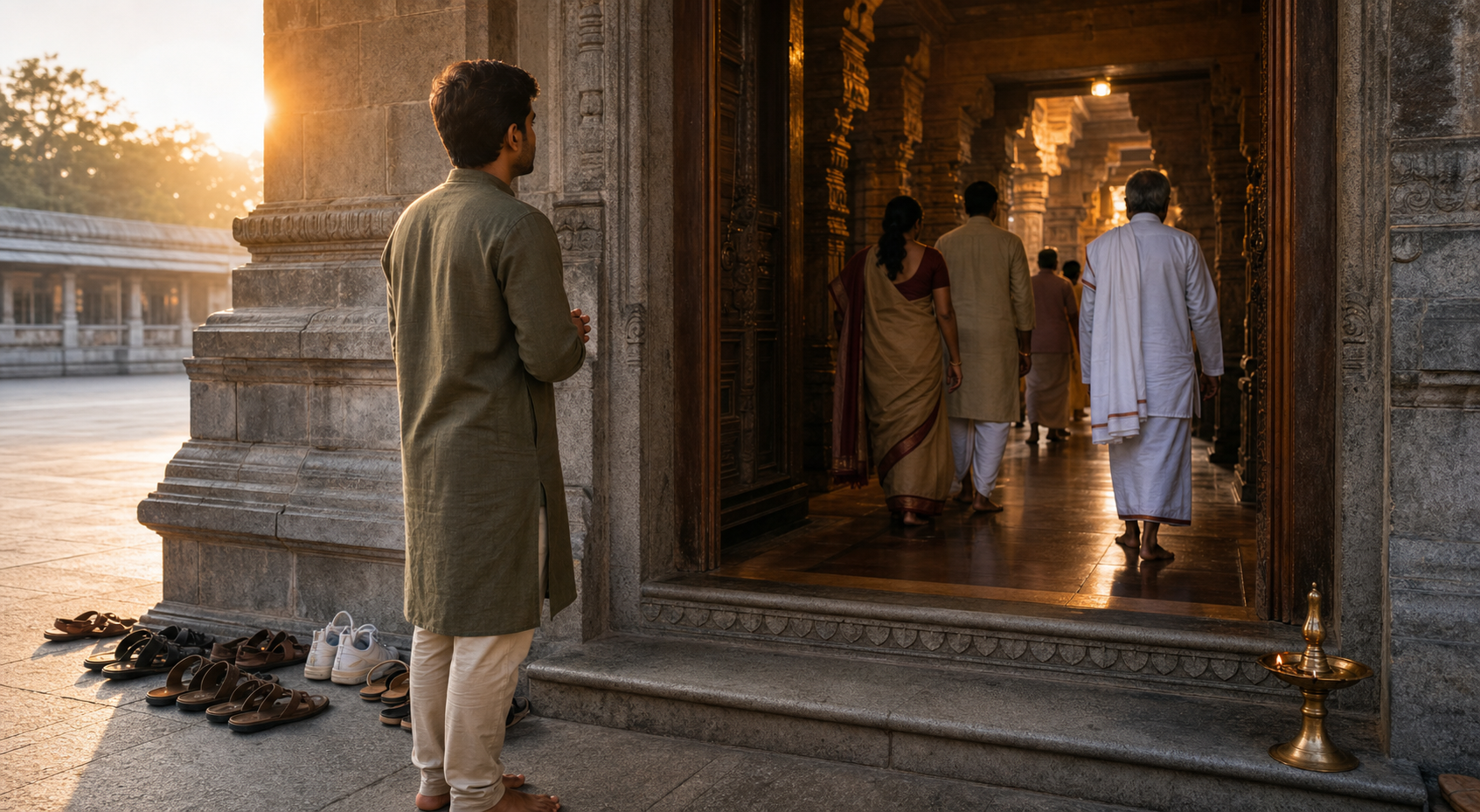
A technically correct bow can still be discourteous when it blocks a doorway, interrupts another devotee’s darshan, or ignores restrictions near the sanctum. Before lowering yourself, notice where prostrations are being made and whether the temple has designated space near the dhvajasthambha or outside the sanctum.
- Remove footwear and wear attire appropriate to the temple.
- Keep entrances, circumambulatory paths, and the direct line of darshan clear.
- Do not assume that a bow permitted in one part of the temple is permitted everywhere.
- Follow local timing. Some traditions bow before or after darshan, after receiving prasada, or at particular moments during an utsava.
- Move unobtrusively. Wait for space instead of beginning a prostration where others must step around you.
- Do not correct another devotee merely because their family or regional form differs from yours.
At home, remove the logistical uncertainty before puja. Clear enough floor space, decide whether you are following Panchanga or Ashtanga, and place any knee support before you begin. Then let one unhurried bow join the physical action to mantra, dhyana, or gratitude. Repetition develops abhyasa only when the movement is sustainable.
The same rule applies in a yoga class. Ask whether Ashtanga Namaskara means the chin-chest-knees transition used in that sequence or a devotional prostration. Do not infer one from the other simply because the name is shared.
Key takeaways
- Ashtanga Namaskara normally uses eight contacts: two hands, two knees, two feet or toes, the chest, and the chin or forehead.
- Panchanga Namaskara normally uses five: two hands, two knees, and the head or forehead.
- Chin contact is classical in the Surya Namaskar transition; ritual practice may use the forehead.
- Sashtanga and Ashtanga can both refer to the eight-limbed ritual bow, depending on local vocabulary.
- Temple Agama and family parampara decide ritual appropriateness; no generic rule overrides the sacred space you have entered.
- Exhale down, pause naturally, and inhale up. Keep contact gentle and modify whenever pain, pregnancy, injury, or limited mobility makes floor prostration unsuitable.
Before your next puja or temple visit, settle three things: the custom of the place, the condition of your body, and the intention of the bow. Then choose one form and perform it without haste. Reverence is visible not in how far you force the body down, but in how completely attention, action, and ahankara are offered.
References
