

You finish meditation with an inner light, a deep calm, or a sudden sense that everything has become clear. The experience may be undeniable. The conclusion you draw from it is not.
If you are wondering whether you touched samadhi, received genuine insight, or merely became absorbed in a passing state, you do not have to choose between blind belief and reflexive dismissal. The yogic response is more disciplined: preserve the experience, suspend the grand interpretation, and test it through viveka, discernment.
The mistake enters between experience and conclusion

In Yoga Sutra I.30, Patanjali places bhranti-darshana among nine antarayas that disturb yogic progress: vyadhi, styana, samsaya, pramada, alasya, avirati, bhranti-darshana, alabdha-bhumikatva, and anavasthitattva. It is a difficult obstacle because it can feel like success. Ordinary doubt announces itself as doubt; false vision often arrives wearing the authority of certainty.
Bhranti-darshana is not the mere fact that an unusual event occurred. A light may appear behind closed eyes. A sound may arise during deep concentration. Devotion may produce intense joy, stillness, or emotional release. The error begins when the mind converts that event into an unsupported verdict: this was samadhi, this proves attainment, this message must be obeyed, or this experience makes further discipline unnecessary.
The same problem occurs without unusual sensory phenomena. You can understand a teaching intellectually and mistake that understanding for realization. You can feel inspired after satsang and assume that a lasting inner transformation has occurred. You can become skilled at explaining non-attachment while remaining deeply attached to being seen as advanced. In each case, something real has happened, but its meaning has been inflated.
| What happened | What you can honestly say | What remains unproven | Useful next action |
|---|---|---|---|
| An inner light or sound appeared | A sensory phenomenon occurred during practice | Its cause, spiritual meaning, or relation to attainment | Note the conditions, release the phenomenon, and return to the practice object |
| A strong calm or uplift arose | Your mental and emotional state changed | That the state was samadhi or produced permanent liberation | Observe whether clarity and ethical steadiness remain after the mood passes |
| A teaching suddenly made sense | You gained a clearer conceptual understanding | That conceptual clarity has become direct realization | Test the understanding in conduct, adversity, and continued sadhana |
| A conviction felt completely certain | The conviction had unusual psychological force | That intensity makes the belief true | Check it against shastra, careful reasoning, observation, and competent guidance |
This distinction also clarifies the relation between viparyaya and bhranti-darshana. Viparyaya names misconception as a form of mental activity, while bhranti-darshana names erroneous seeing as an obstacle that diverts sadhana. A passing misconception can be corrected quickly. It becomes spiritually disruptive when you build identity, practice, or authority upon it.
Avidya, fundamental misapprehension, gives this error its footing. The mind not only misreads an event; it also mistakes the transient for the enduring, interpretation for knowledge, and egoic ownership for realization. That is why a pleasant experience can still feed bondage if you cling to it as proof of who you have become.
Use viveka as a verification process
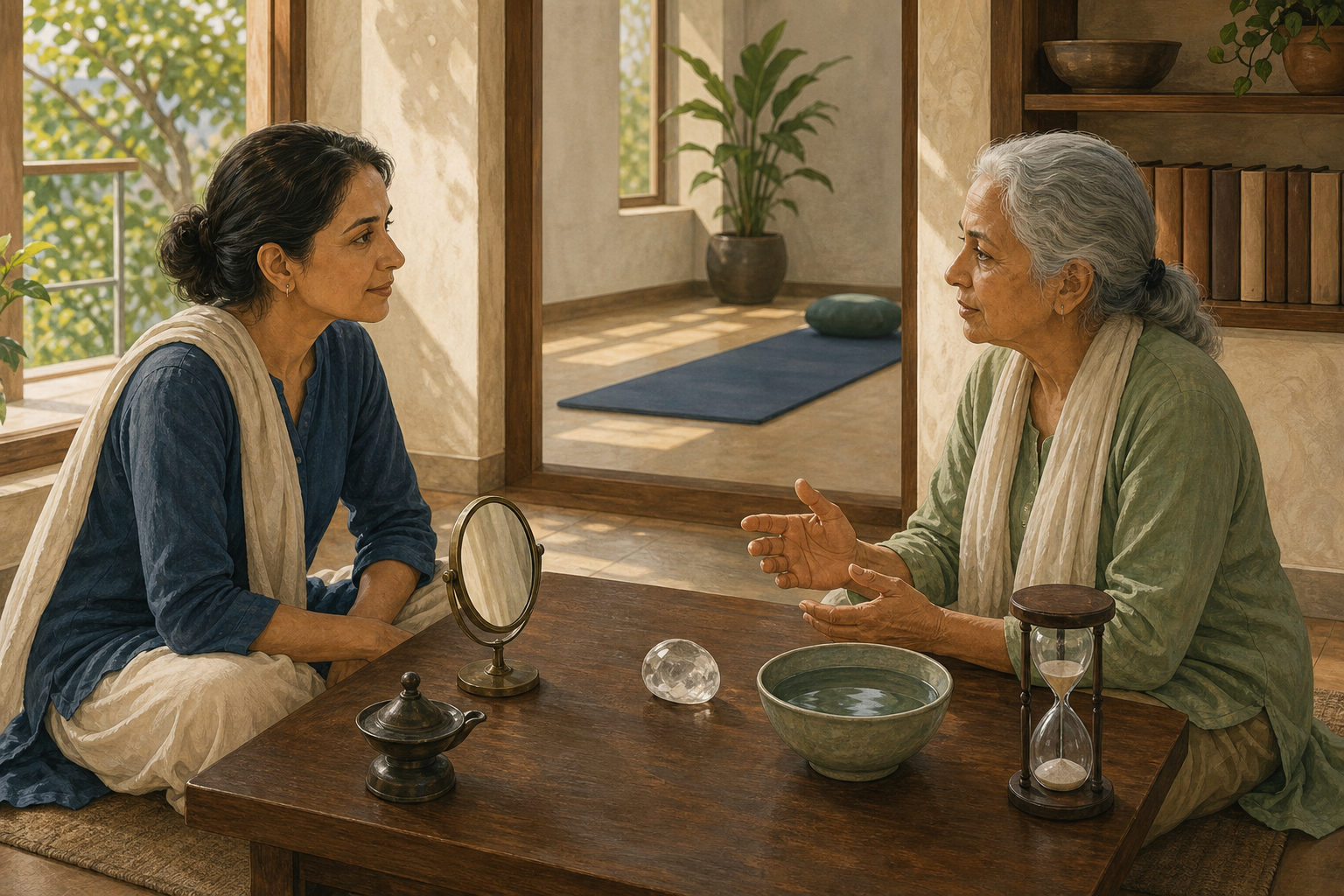
Viveka is not generalized suspicion. It does not require you to deny every subtle experience or distrust your own mind forever. It asks you to separate layers that excitement tends to merge: the event, your interpretation, the evidence for that interpretation, and the effect of believing it.
- Describe the event in low-inference language. Write what you actually noticed: brightness appeared, a sound was perceived, the body felt light, attention became still, or an insight arose. Avoid metaphysical labels at this stage.
- State the interpretation separately. Complete the sentence: I think this means… Once the conclusion is visible as a conclusion, it becomes possible to examine it.
- Ask what pramana supports the claim. Does it rest only on intensity, novelty, desire, or fear? Can it be checked through reliable knowledge, authoritative teaching, continued observation, and a competent guru?
- Look for endurance without demanding repetition. A state may disappear while leaving genuine clarity behind. What matters is not whether you can reproduce the spectacle, but whether understanding and steadiness survive its absence.
- Examine the direction of your conduct. Has the claimed insight made you more truthful, disciplined, compassionate, and open to correction? Or more defensive, self-important, secretive, and impatient with ordinary duties?
- Apply vairagya to the conclusion. Ask whether you can release the claim without feeling that your spiritual identity has been taken away. If you cannot, attachment may already be shaping the interpretation.
This process prevents two opposite errors. Credulity accepts every impression as revelation. Cynicism rejects every subtle event because it cannot be certified immediately. Viveka leaves the event intact while refusing to award it a status it has not earned.
Consultation is most helpful when you bring a precise account rather than a desired verdict. Tell a competent guide what occurred, what you inferred, and why you inferred it. Ask where the conclusion outruns the evidence. Satsang should function as a place of examination, not as an audience recruited to confirm a spiritual self-image.
Shastra also serves discernment best when it corrects your categories. Do not search a text merely for a phrase that resembles your experience. Ask what place the tradition gives that phenomenon, what cautions surround it, and whether the interpretation is consistent with the larger discipline. A familiar word found after the fact is not automatically proof.
The mature aim is viveka-khyati, sustained discriminative clarity. It is less dramatic than a single overwhelming certainty. It is also more dependable because it continues to distinguish the enduring from the passing when the meditation session, emotional atmosphere, and social approval are gone.
Build a practice that catches misperception early
You are less likely to be carried away by an experience when you decide beforehand how you will meet it. A simple protocol protects both openness and steadiness.
Before meditation
Choose the object and method of practice before you sit. Resolve that unusual phenomena will not become new instructions during the session. This matters because novelty can quietly replace the practice you intended to do. The sit then becomes a search for signs rather than training in stable attention.
Bring satya into the intention. You are not sitting to prove that you are advanced, to reproduce yesterday’s pleasure, or to obtain material for a spiritual story. You are sitting to practice honestly. That small correction reduces the pressure to manufacture meaning.
During meditation
When something unusual appears, acknowledge it with the simplest adequate description: light, sound, warmth, image, joy, fear, expansion, or thought. Do not suppress it, follow it, argue with it, or start grading your attainment. Return gently to the chosen object unless your established method directs otherwise.
This is abhyasa and vairagya working together. Abhyasa returns you to the practice. Vairagya prevents the interruption from becoming a possession. Neither requires hostility toward the experience.
After meditation
Use a journal to keep observation and interpretation from blending together. A useful entry has four fields:
- Event: What was directly noticed?
- Interpretation: What meaning did the mind add?
- Verification: What could confirm, revise, or disprove that meaning?
- Consequence: What did believing the interpretation make you want to do?
The consequence field is especially revealing. If an experience makes you want to abandon a sound practice, claim authority, seek admiration, chase stronger phenomena, or neglect ordinary responsibilities, do not treat urgency as validation. Delay the decision. Return to svadhyaya, measured practice, and competent counsel.
Do not intensify breath work, extend a demanding practice, change a mantra, or discard ethical restraints merely to reproduce a transient state. Abhyasa, vairagya, satya, svadhyaya, and Ishvara-pranidhana provide a steadier response. Ishvara-pranidhana is particularly corrective when the ego wants to declare an experience its personal achievement.
If lights, sounds, fear, confusion, or other disturbing experiences persist outside practice, interfere with sleep or daily functioning, or make it hard to distinguish an inner event from the shared environment, do not try to settle the matter only through spiritual interpretation. Pause intensive practice and seek help from a qualified health professional. Yogic discernment should support responsible care, not replace it.
Discernment must produce steadier conduct

Bhranti-darshana rarely remains isolated. When an inflated interpretation fails, samsaya can follow: you begin doubting the path because a claim the path never required proved unreliable. Disappointment can feed alasya. Defending the original claim can become pramada. Chasing one exceptional state after another can end in anavasthitattva, the inability to remain established.
You can often notice this chain in the shape of your practice before you can name its cause:
- You repeatedly redesign your sadhana around the latest experience.
- You spend more energy interpreting meditation than actually meditating.
- You become reluctant to describe a claim precisely because precision would make it testable.
- You treat correction as disrespect rather than assistance.
- You regard ethical discipline and ordinary duty as inferior to inner phenomena.
- You lose motivation when a dramatic state does not return.
The correction is to withdraw the premature claim, not to abandon practice. Return to the established method. Re-establish regularity. Keep the experience in your journal without making it the center of your identity. Let later clarity determine its importance.
A genuine insight does not need false advertising. If it is sound, careful examination will not destroy it. If it is partial, examination can place it in proportion. If it is mistaken, correction prevents one error from reorganizing the rest of your sadhana.
A shared Dharmic discipline without false equivalence
The concern with accurate seeing extends across Dharmic traditions. Buddhism warns against wrong views and the distortions that veil reality. Jainism treats mithyatva, false belief, as a root of bondage. Sikh teachings address haumai and maya through the corrective orientation of gurmat. These concepts belong to distinct paths and should not be collapsed into synonyms. Their practical convergence lies in a shared refusal to treat ego-shaped appearance as liberating knowledge.
This convergence gives you a useful standard when you encounter spiritual claims in conversation or online. Ask whether the teaching distinguishes experience from realization, permits examination, strengthens ethical conduct, and reduces attachment to status. A claim that demands fascination while weakening truthfulness, humility, or compassion has failed an important Dharmic test, however impressive its language may sound.
Key takeaways for clearer seeing
- An experience can be real while your explanation of it is mistaken.
- Emotional uplift is not by itself samadhi, and intellectual understanding is not automatically direct realization.
- Describe what happened before deciding what it means.
- Test interpretations through pramana, shastra, continued observation, ethical consequences, satsang, and competent guidance.
- Use abhyasa to return to practice and vairagya to release the need to possess an experience.
- Judge insight partly by what remains afterward: greater truthfulness, steadiness, humility, compassion, and openness to correction.
- When a dramatic interpretation destabilizes sadhana, retract the claim and restore the practice.
After your next meditation, write two separate sentences: what happened, and what you think it meant. Do not erase the space between them. That space is where yogic discernment begins.
You do not have to make an experience smaller in order to see it clearly. You only have to stop asking it to prove more than it can. Preserve wonder, continue sadhana, and let truth survive examination.
References
