
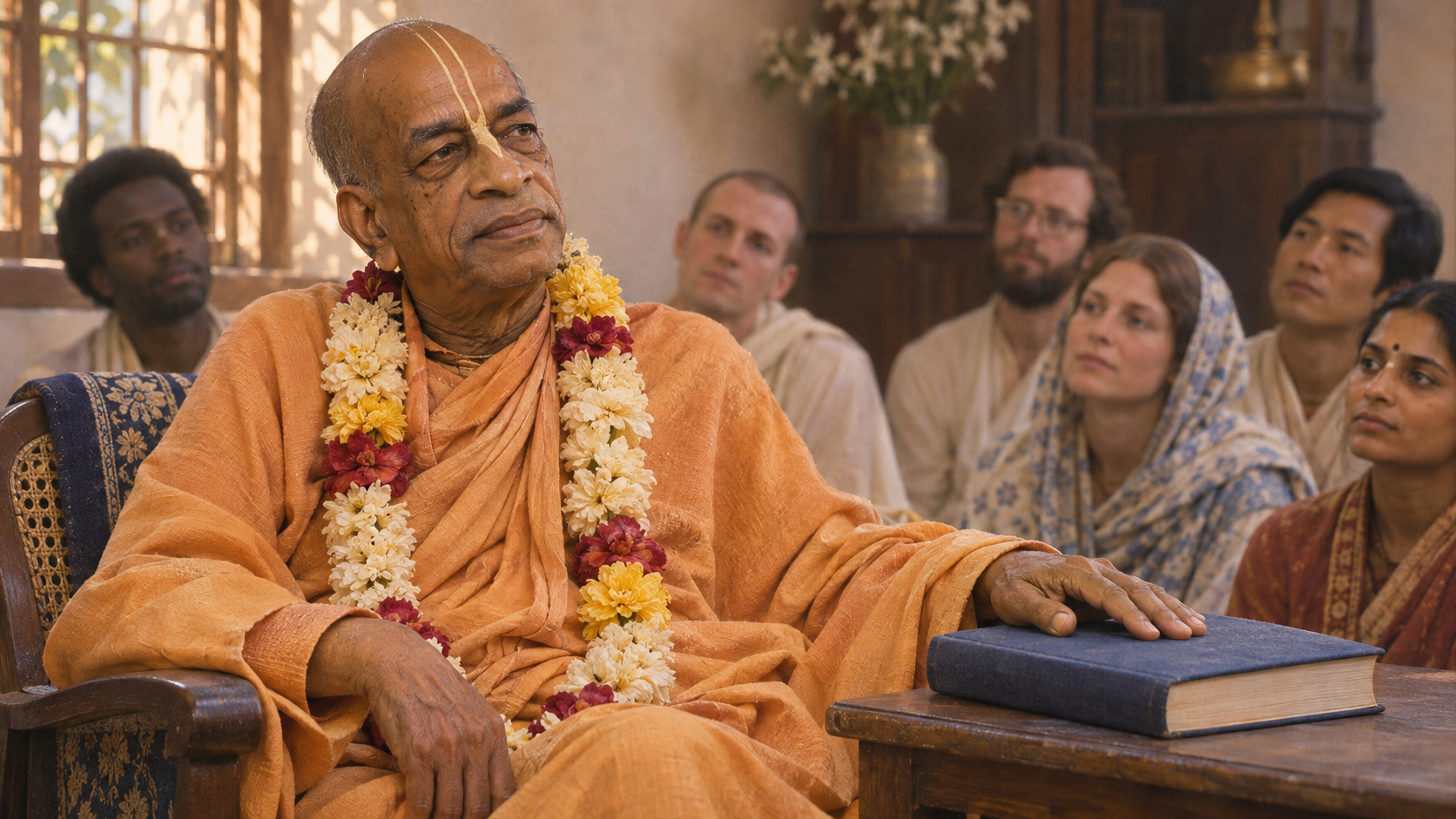
If you know Srila Prabhupada mainly as the revered name printed in a book or spoken at a temple, the natural question isn’t only who he was. It is why a guru who is no longer physically present continues to matter, and how you can approach his legacy without settling for either distant reverence or quick dismissal.
The clearest answer begins with the purpose that governed his life. Srila Prabhupada dedicated himself to spreading Krishna consciousness in service to the mission of Sri Chaitanya Mahaprabhu. His continuing influence is carried through his books, teachings and the worldwide Hare Krishna movement. Those three forms of transmission give you a practical way to understand both the man and the legacy.
A life becomes intelligible when you identify its governing purpose

A chronology can tell you when events occurred. It cannot, by itself, tell you what held a life together. With Srila Prabhupada, the unifying thread is mission: Krishna consciousness was not one interest among many, but the purpose around which his teaching and service were organised.
This is the right starting point whenever you encounter an episode from his life. Don’t ask only whether an action was impressive, difficult or successful. Ask what spiritual end it served. That shift prevents biography from becoming a collection of heroic anecdotes. It lets you see decisions as expressions of a sustained commitment.
- What truth about Krishna consciousness was he trying to communicate?
- What obstacle kept people from hearing, understanding or practising it?
- How did his response turn conviction into teaching, service or community?
These questions also clarify three qualities closely associated with his life: dedication, compassion and unwavering faith. Dedication means remaining answerable to the mission rather than to convenience. Compassion takes the form of making spiritual knowledge available to others. Faith means acting from confidence in the mission even when its reach is not yet visible.
You don’t have to imitate every historical circumstance to learn from that pattern. Identify the principle, then ask what fidelity to it requires in your own place and responsibilities. That is more demanding, and more useful, than copying an outward form without understanding its purpose.
His legacy is carried in books, teachings and a movement

Physical departure changes how disciples and later readers gain access to a teacher, but it does not erase the means by which teaching continues. In Srila Prabhupada’s case, three connected channels matter. Each gives you a different kind of access, and each helps you evaluate the others.
Books provide a stable point of reference
A book allows you to encounter an argument in context. You can slow down, return to a passage and distinguish what the teacher actually says from what someone remembers him saying. This matters especially when a striking sentence circulates by itself. A detached quotation may be accurate as words and misleading as interpretation.
Read a complete section rather than collecting fragments. Write its central claim in your own words, identify the reasoning that supports it, and note the instruction that follows. If you cannot connect the instruction to the claim, you probably haven’t yet understood the passage.
Teachings require attentive interpretation
A teaching is more than a sentence preserved on a page. It includes the distinctions, priorities and purposes that give the sentence meaning. As you study, separate the enduring spiritual principle from the particular situation in which it was expressed. Don’t use that distinction to discard an inconvenient instruction; use it to determine what the instruction was meant to accomplish.
When two statements appear difficult to reconcile, resist the urge to choose the one you prefer. Examine their immediate questions, audiences and aims. Coherence is discovered through context, not manufactured by flattening every statement into a slogan.
The movement makes transmission visible
The worldwide Hare Krishna movement gives social form to the teaching. It is where ideas become habits, relationships, worship, service and shared responsibility. This makes community indispensable to the legacy, but it does not make every action by every participant an infallible expression of Srila Prabhupada.
Your experience with one local community is evidence about that community. It should neither be ignored nor automatically treated as the final verdict on an entire spiritual tradition. In the same way, admiration for a teaching should never require you to excuse conduct that contradicts its professed values. Use dedication, compassion and fidelity to the mission as standards for discernment, not merely as words of praise.
Founder-Acharya is a responsibility, not a ceremonial label

The designation Founder-Acharya joins two roles. A founder stands at a movement’s historical beginning. An acharya is a teacher whose instruction and example establish how a path is to be understood and lived. The first role can be commemorated from a distance; the second continues to make a claim on interpretation and practice.
That distinction explains why remembrance cannot stop at affection. To honour a Founder-Acharya is to keep returning to the mission he established, the teachings he transmitted and the standards of practice he set. A portrait, anniversary or tribute may direct attention toward him, but none can substitute for serious engagement with what he taught.
It also gives you a way to assess later claims made in his name. You need not accept a claim merely because it is delivered with confidence or wrapped in devotional language. Test it with concrete questions:
- Does it keep Krishna consciousness and the mission of Sri Chaitanya at the centre?
- Can it be grounded in Srila Prabhupada’s own books and teachings rather than in hearsay alone?
- Does it clarify devotional practice, or mainly strengthen someone else’s status?
- Does its application encourage dedication and compassion, or does it use authority to avoid accountability?
These questions are not a licence for suspicion toward every teacher or community. They are safeguards against replacing discipleship with passivity. A living tradition needs trust, but durable trust grows through intelligibility, consistency and responsible conduct.
A disciplined way to encounter the legacy for yourself

You do not need to settle every theological or institutional question before beginning. Start with direct contact and proceed in an order that keeps reading, reflection, practice and community connected.
- Choose one coherent work or sustained teaching. Begin with a complete unit of thought, not a compilation of isolated quotations.
- State the main claim in one sentence. Then identify the passage that supports your summary. If you cannot do that, revise the summary.
- Separate description from instruction. Ask what the teaching says is true, what it asks a practitioner to do, and why the action follows from the truth claim.
- Put one clear instruction into practice for a defined period. Choose something genuinely present in the material rather than inventing a more comfortable substitute.
- Observe a practising community. Notice whether the teaching becomes humility, discipline, compassion and service in ordinary conduct.
- Return to the text after practice. Record what became clearer, what remains difficult and which questions now deserve knowledgeable guidance.
This sequence protects you from two common errors. The first is personality devotion without study, in which admiration replaces understanding. The second is armchair judgement, in which you decide what a practice means without seriously reading or attempting it. Neither produces informed conviction.
You may still reach difficult questions. That is not a failure of the process. A serious legacy should generate examination as well as reverence. Bring a precise passage and a precise question to a mature practitioner; a focused question is harder to evade and easier to answer than a general demand to explain everything.
Key takeaways
- Srila Prabhupada’s life is best understood through its governing mission: spreading Krishna consciousness in service to Sri Chaitanya Mahaprabhu.
- His continuing influence operates through three connected forms: books, teachings and the worldwide Hare Krishna movement.
- Founder-Acharya means more than honoured founder; it makes his teaching an ongoing reference point for the movement that follows him.
- Direct reading, careful interpretation, bounded practice and honest observation give you a firmer basis for judgement than either inherited praise or inherited criticism.
Begin with one sustained teaching and one real question. Read it in context, act on what you can clearly understand, and then examine what the practice reveals. That small act of disciplined attention is a more fitting approach to Srila Prabhupada’s legacy than admiration kept permanently at a distance.
References

Leave a Reply
You must be logged in to post a comment.