

If your child’s calendar is full but family life feels spiritually thin, another class, competition or lecture on values will not solve the problem. The first change is closer to home: notice what receives your attention when your child succeeds, fails, becomes angry, loses something or simply sits beside you.
Dharmic mindful parenting makes those ordinary moments the ground of formation. It asks you to combine presence with ethical clarity: less comparison, more truthful attention; less pressure to appear exceptional, more practice in responsibility, compassion, restraint, gratitude and repair.
Replace achievement pressure with better measures of growth
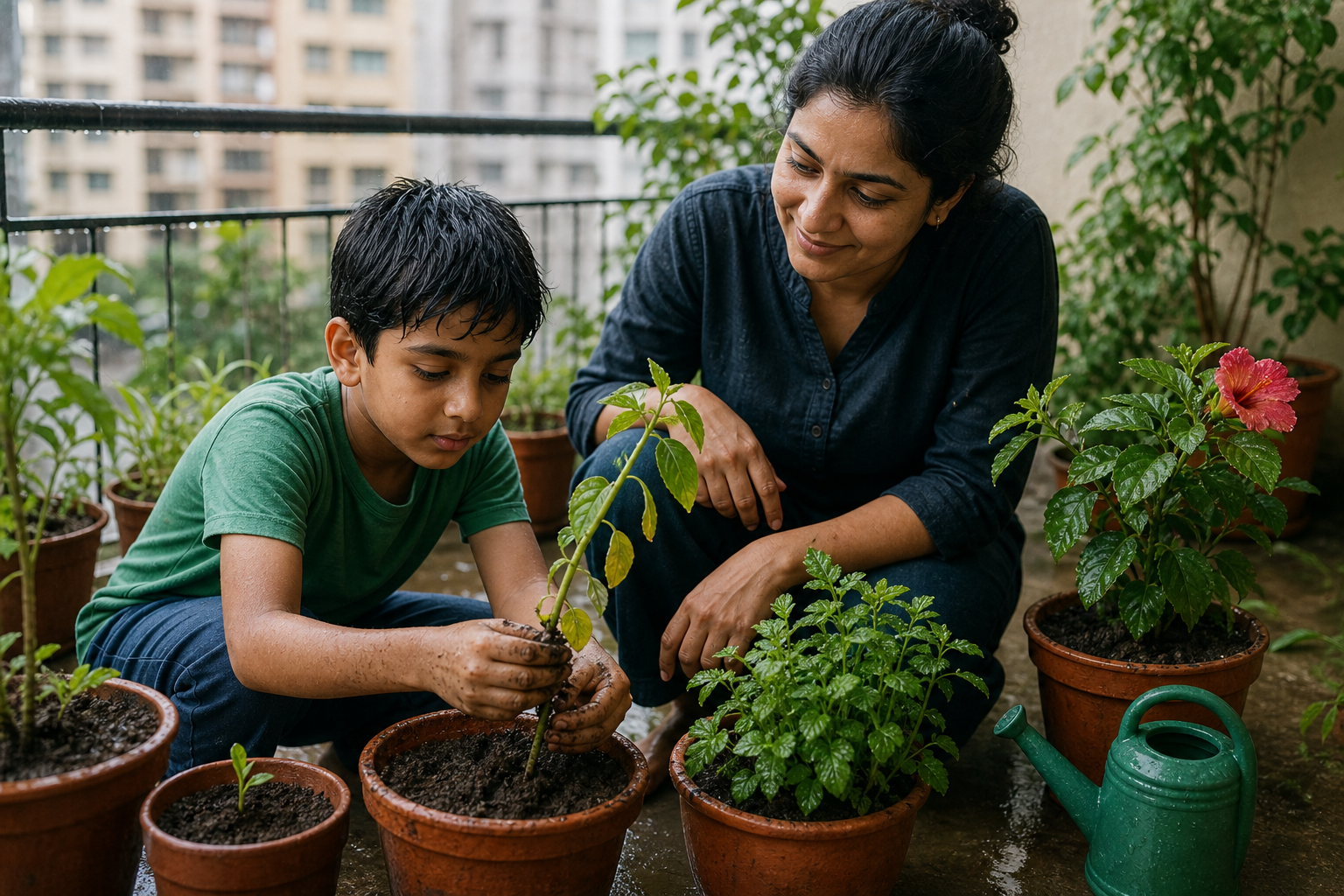
There is nothing undharmic about excellence. A child may study seriously, train hard, create beautiful work and pursue demanding goals. The trouble begins when being extraordinary becomes the price of being worthy. Then a mark is no longer information about learning; it becomes a verdict on the child. A victory is no longer an event; it becomes proof that the family is doing well.
Listen to the questions that dominate your home. They tell your child what deserves attention. If every conversation begins with marks, ranks, selection, speed or comparison, a later sermon about contentment will carry little weight.
- Instead of asking only What mark did you get?, ask What did you understand, and where did you get stuck?
- Instead of Why are you not like that child?, ask What kind of support would help you take the next honest step?
- Instead of Did you win?, ask Did you prepare sincerely, follow the rules and treat people well?
- Instead of rushing to fix disappointment, ask What are you feeling, and what does this situation require from you now?
This is not softer parenting. It is more exact parenting. You are separating ability from character, an outcome from the conduct that produced it, and disappointment from personal worth. Because attention helps frame how a child experiences the world, changing your questions changes what the child learns to notice.
Use the same discipline before adding an activity, purchasing the latest educational advantage or accepting another commitment. Ask:
- Does this serve the child’s real interest, capacity or responsibility, or are we reacting to comparison?
- What ordinary good will it displace: rest, family meals, free play, conversation, worship or unhurried time?
- Can our family sustain it without making everyone resentful?
- If no one else knew about it, would we still believe it was worth doing?
If the answers are unclear, pause. Fear of falling behind creates urgency, but urgency is not the same as dharma. Your task is not to remove challenge. It is to choose challenges that help the child grow without teaching that affection, dignity or belonging must be earned through performance.
Apply this principle to spiritual life too. Japa should not become a streak to display. Seva should not become a photograph. Calmness should not become a demand that the child suppress anger or grief. Dharma becomes distorted when it is used as another ranking system.
Build a family rhythm that children can actually inhabit
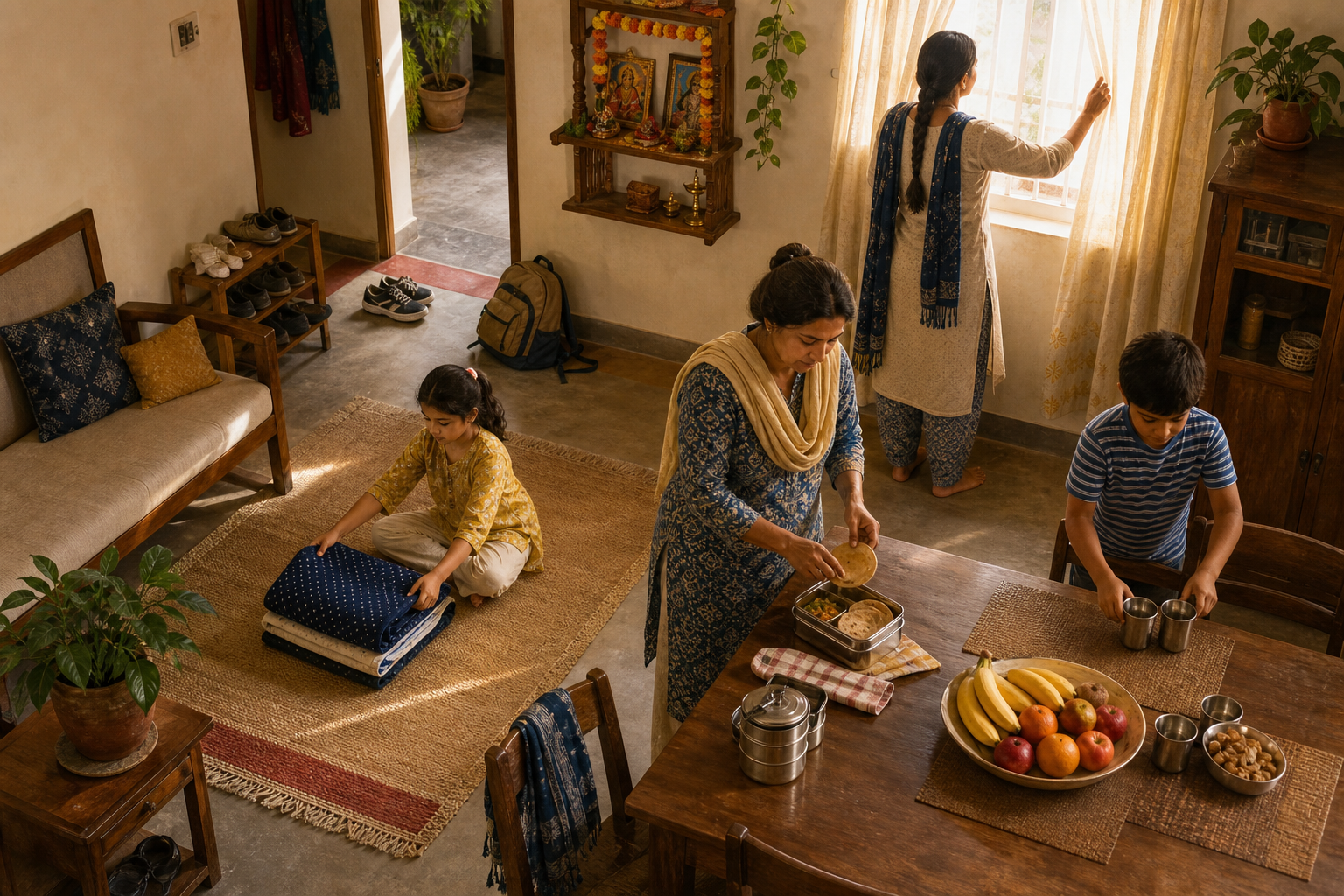
Values that appear only during a festival, crisis or parental lecture remain ideas. Children need to encounter them at recognizable points in the day. You do not need an elaborate domestic curriculum. Choose a small set of practices that belong naturally to your family’s tradition and attach them to routines that already happen.
- On waking: begin with a greeting, pranam, a lamp, a short prayer, japa, simran or quiet breathing, according to your practice. Let the first act be recollection rather than demand.
- Before food: pause long enough to acknowledge the people, land, labor and life involved in the meal. Gratitude becomes concrete when it has an object.
- Before study: settle the body and name an intention such as honest effort, patience or attention. This separates study from panic about results.
- After conflict: return to what happened when everyone can speak without attacking. Name the harm, make repair and decide what should change.
- Before sleep: review the day without conducting a trial. Ask where kindness appeared, where harm occurred and what needs to be repaired.
Do not use every practice in that list. A ritual survives when it is authentic, easy to recognize, connected to an existing transition and open to the child’s participation. If parents repeatedly abandon it, reduce it until the family can keep it without resentment or guilt.
Keep the family’s theological home clear. Hindu practice may emphasize dharma, ahimsa and gratitude in daily action. Buddhist families may cultivate mindfulness and maitri. Jain families may give particular attention to aparigraha and pratikraman. Sikh families may center seva, simran and truthful living. These are related ethical orientations expressed through distinct traditions, not interchangeable labels for a generic spirituality.
Root the child in the language, discipline, stories and community of your own sampradaya or panth. Shared Dharmic values can create respect across traditions without flattening their differences. A family does not need to assemble a spiritual buffet to teach openness.
Participation should mature with the child. A younger child can place a flower, help prepare prasad, join folded hands or sit beside you. An older child can lead a familiar recitation, help plan seva, ask difficult questions and sometimes disagree. Questions are not proof that the practice has failed. They are an opportunity to move from imitation toward understanding.
The strongest test of any ritual is what happens after it. If a family invokes ahimsa and then humiliates a child over a mistake, the humiliation teaches more than the invocation. If adults speak of aparigraha while organizing life around display, the display wins. If seva is praised but household work is treated as beneath certain people, children notice the contradiction. Your conduct interprets the ritual.
Use discipline to teach boundaries, accountability and repair
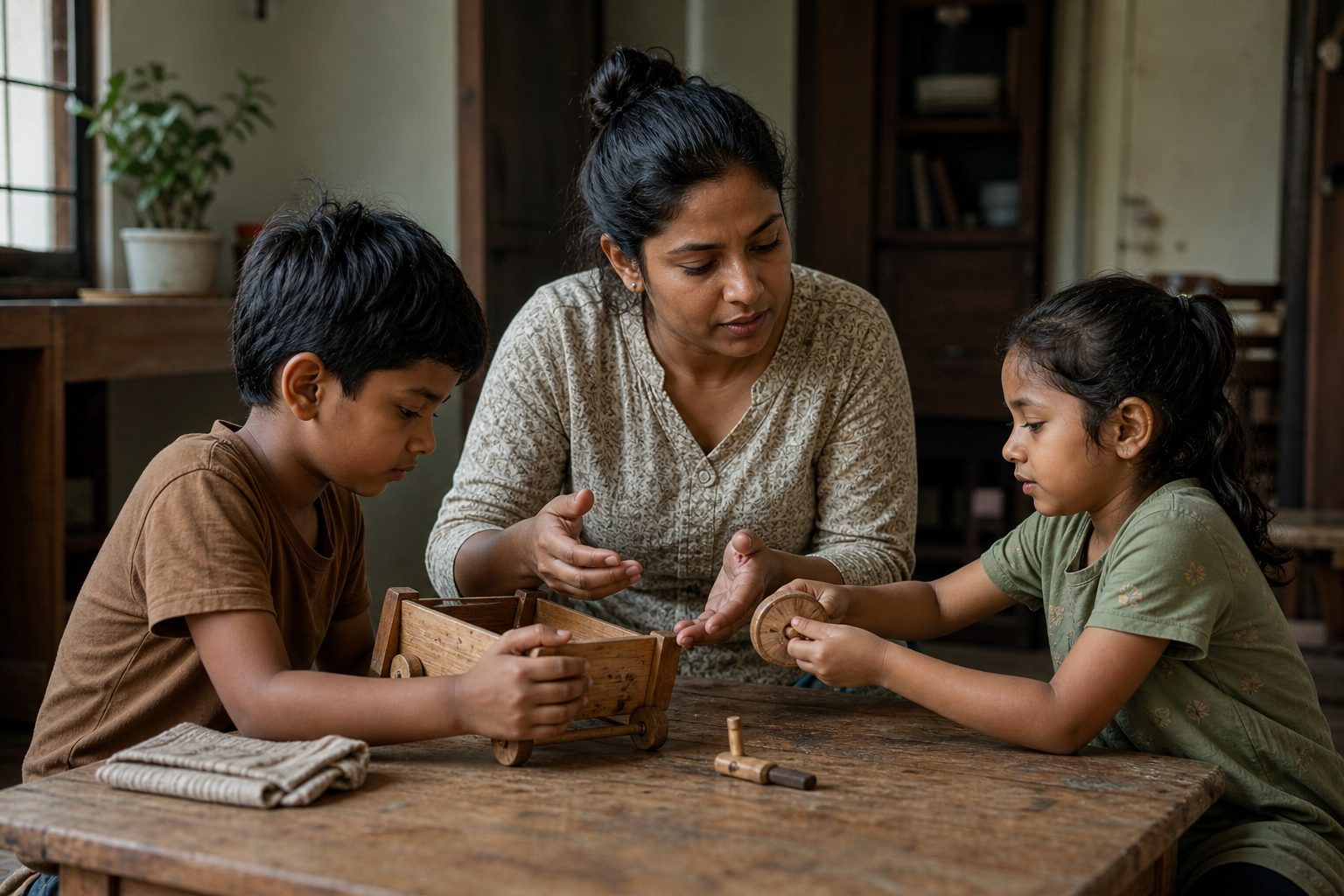
Mindful parenting is sometimes mistaken for endless patience without consequences. That is not mindfulness; it is avoidance. A child needs clear limits because actions affect other people. The Dharmic question is not whether to set a boundary, but whether the boundary is enforced without cruelty, contempt or an attack on the child’s identity.
When something goes wrong, use a consistent sequence:
- Stop immediate harm. If someone is being hit, threatened or placed in danger, separate people and secure safety before attempting reflection.
- Settle your own reaction. Do not turn the child’s mistake into a place to discharge your fear, embarrassment or anger.
- Describe the action. Say what happened without converting behavior into identity. You threw the object is precise; You are a bad child is not.
- State the boundary and connected consequence. The consequence should protect, restore or teach, not merely make the child suffer.
- Hear the child’s account. Understanding a motive does not erase the boundary, but it helps you address the real problem.
- Require repair and then reconnect. Repair may include cleaning, returning, replacing, restating words truthfully, apologizing or making a new plan. Reconnection shows that accountability does not end belonging.
Keep the consequence related to the conduct. When a child throws a toy dangerously, the toy can be put away and the child can help restore the room. When hurtful words are used, the conversation can pause until the child is able to speak without attacking, followed by a sincere repair. When a commitment is neglected, examine what prevented follow-through and decide how the child will meet or renegotiate the responsibility.
Avoid demanding an instant apology simply to end adult discomfort. A forced word can teach performance rather than remorse. First help the child understand what the other person experienced. Then ask what action could make the situation more truthful or just. The aim is not a perfect ceremony of apology; it is the capacity to face harm without hiding from it.
Parents must practice repair as well. A useful parental apology is plain: I shouted at you. That was wrong. The rule still stands, but shouting was not the right way to enforce it. I will pause before speaking next time. Do not add an excuse, demand forgiveness or ask the child to comfort you. Owning your conduct does not dissolve parental authority. It shows what accountable authority looks like.
Shame asks a child to conceal what happened. Accountability asks the child to face it, respond to its consequences and try again. That difference matters because no family avoids anger, failure or misjudgment. A healthy moral culture is revealed not by the absence of mistakes, but by what people do after them.
Let food, grief, affection and seva carry the teaching

Children do not need every meaningful experience converted into a lesson. They need adults who notice what is already present. Seasonal food, a walk, household work, the death of a pet, the touch of a welcomed hand and a shared meal can cultivate attention, emotional literacy, gratitude and connection when they are not rushed past.
- At meals: notice color, smell, texture and season. Name who prepared the food and include the child in serving or cleaning. Gratitude becomes participation rather than a slogan.
- During ordinary walks: let some silence remain. Notice changes in weather, plants, animals, streets or neighbors without turning the walk into a quiz.
- When someone dies: use clear, age-appropriate language, allow tears and make room for remembrance. A prayer, lamp, story or act of service can hold grief without pretending to remove it.
- With affection: offer a hand, embrace or reassuring presence while respecting the child’s bodily boundaries. Warmth is most trustworthy when consent is honored.
- Through household work: give the child real responsibility suited to their capacity. Cleaning, preparing food, caring for belongings and helping relatives teach interdependence when adults do the work alongside them.
- Through seva: choose work that meets an actual need. Let the child see preparation, inconvenience and follow-through, not only the public moment.
Grief deserves particular honesty. Do not rush to distract the child, forbid crying or offer certainty you do not possess. You can say that the loss hurts, that love and sorrow can remain together, and that the family will remember. If grief or anxiety becomes overwhelming, persistently disrupts ordinary functioning or creates a safety concern, seek qualified pediatric or mental-health support. Prayer and ritual may accompany that care; they should not be treated as replacements for it.
Community can deepen these practices. Extended family, teachers, neighbors and religious communities create a wider web of belonging and ethical example. But a village helps only when its authority is used responsibly.
- Invite trusted adults to teach a living practice: a prayer, language, family story, recipe, song, craft, form of service or way of caring for a sacred space.
- Tell relatives which family boundaries are non-negotiable, including boundaries against humiliation, hostile comparison and ridicule about marks, appearance or ability.
- Choose mentors whose ordinary conduct matches the values they teach. Status, age or religious vocabulary alone is not enough.
- Make sure the child can tell you when an interaction feels frightening, coercive or inappropriate. Belonging must not require silent obedience.
- Let the child contribute to the community, not merely perform for it. Carrying, cleaning, preparing, listening and welcoming are forms of participation too.
Leave some family life uncurated. Unhurried meals, playful conversation, quiet travel and time without a measurable outcome are not gaps in development. They are where children discover that relationship does not always require achievement and that the ordinary world is worthy of attention.
Key takeaways: what to change in your home now
- Change the measure: judge growth through honest effort, right conduct, understanding and repair, not comparison alone.
- Change the question: after success or failure, ask what the child noticed, learned, felt and will do next.
- Choose one authentic ritual: attach prayer, gratitude, reflection or remembrance to a transition your family already shares.
- Keep boundaries clear: stop harm, describe conduct precisely, use a connected consequence, require repair and restore connection.
- Do not spiritualize suppression: anger, sadness and disappointment can be named without being allowed to control harmful behavior.
- Teach through ordinary life: let food, chores, affection, loss, play and seva carry values that lectures cannot carry by themselves.
- Use community with discernment: invite trustworthy adults into the child’s formation while protecting the child’s dignity, boundaries and right to speak.
Start at the next ordinary family threshold, not with a grand reform. Pause before a meal, change the first question after a difficult day, or repair the way you handled the last conflict. Keep that practice simple enough to become part of family life. When dharma moves from instruction into repeated conduct, your child no longer has to search for it only in exceptional moments.
References
