
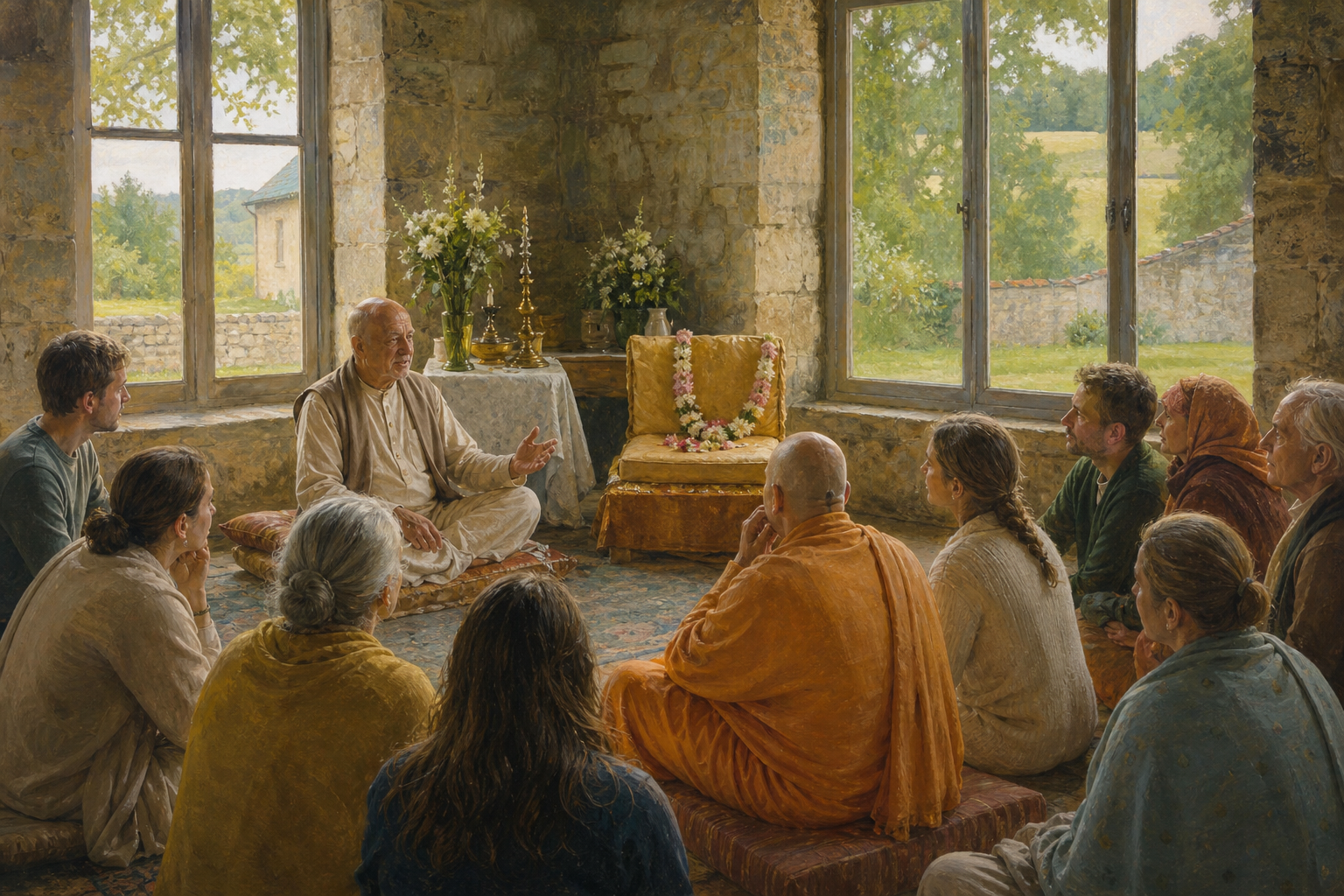
You may come to a remembrance looking for a vivid detail about Srila Prabhupada. The more important question comes after you listen: what should this memory change in the way you hear, practise, serve, or speak?
Yogendra prabhu’s remembrance of Srila Prabhupada in New Mayapura, France, gives you a concrete occasion to ask that question. A devotee’s memory can bring a spiritual teacher close, but it should be received with both affection and discrimination. Treat every recollection as a collectible anecdote and it soon becomes nostalgia. Mine it only for rules and you can miss the relationship that gave the memory its force.
Why the New Mayapura setting matters

New Mayapura places a distinctly Dharmic name in a French setting. That location helps you notice how a tradition travels. It does not travel merely through translated ideas. It travels through sacred names, disciplined practices, relationships between teachers and disciples, shared service, and memories carried by people.
This is especially relevant if you practise outside Bharat. Geography alone neither guarantees nor disqualifies authenticity. Better tests are available. Are the teachings represented accurately? Are unfamiliar terms explained without being emptied of meaning? Is spiritual practice regular rather than decorative? Do people preserve the identity of the teacher and lineage, or reduce everything to generic inspiration?
A community abroad can go wrong in opposite directions. It can preserve cultural forms as museum objects while losing the inner demand of practice. It can also make the tradition so culturally neutral that its actual inheritance disappears. Remembrance offers another path: retain the person, place, vocabulary, and relationship, then ask how the principle should be lived under present conditions.
As you listen, therefore, notice more than the remembered episode. Notice what has crossed borders intact. Pay attention to the forms of address, the understanding of service, the place given to instruction, and the speaker’s sense of responsibility toward memory. Those features show whether transmission remains rooted.
Hear a personal memory at the correct level
A personal recollection is testimony. It tells you what a particular person remembers and how that encounter was understood. It can disclose character through a gesture, correction, choice, or manner of dealing with someone. Yet a remembered episode does not automatically become a universal rule for every devotee in every circumstance.
Keep three layers separate in your notes:
- The remembered event: what the speaker actually recounts. Preserve who remembered it and where the remembrance was given.
- The inferred principle: the quality or lesson you think the memory reveals. Mark this honestly as interpretation rather than putting your conclusion into the speaker’s mouth.
- The confirmed teaching: a principle you can independently trace to Srila Prabhupada’s recorded teachings. This gives an anecdote context without forcing the anecdote to prove more than it can.
This separation protects both faith and accuracy. You do not have to distrust a memory in order to handle it carefully. Carefulness is itself a form of respect. It prevents an affectionate recollection from hardening into a claim that the speaker did not make.
The distinction becomes crucial when you retell the remembrance. Yogendra prabhu remembered that… preserves the chain of testimony. Srila Prabhupada always… turns one recollection into a sweeping assertion. Unless the evidence genuinely supports the second form, use the first.
You should also resist making every detail symbolic. Some details establish atmosphere or relationship; they do not necessarily encode a hidden instruction. Let the speaker’s emphasis guide you. If the central point is not clear, preserve that uncertainty instead of manufacturing certainty for a cleaner devotional story.
Turn reverence into an observable practice

The test of remembrance is not whether it produces a moment of admiration. The practical test is whether it sharpens something you already know you should do. A worthy response is usually modest, specific, and close at hand.
- Write the memory in a concise paraphrase. Include the speaker and setting so that the recollection does not become detached from its origin.
- Name the quality you noticed. Choose a precise word such as attentiveness, courage, discipline, compassion, fidelity, or urgency. Do not choose a quality merely because you expected to find it.
- Identify the point of friction in your own practice. Ask where that quality is presently absent: during mantra meditation, study, service, speech, hospitality, or dealings with other devotees.
- Choose an action you can recognise as completed. Replace a vague intention such as becoming more sincere with a concrete act tied to an existing responsibility.
The action must follow the actual lesson you heard. If a recollection highlights attentive hearing, protect your next scheduled period of hearing from avoidable interruption. If it reveals care for a person, complete a neglected act of service without seeking notice. If it turns on an instruction, read that instruction in context before quoting it. If it exposes steadiness under difficulty, repair a devotional commitment you have been treating as optional.
Avoid dramatic vows made under emotional momentum. The point is not to imitate the outer shape of another person’s relationship with Srila Prabhupada. Your responsibility is to receive the principle honestly and apply it within duties you actually have. An act that can be performed is more valuable than a grand sentiment that evaporates.
Return to your note after acting. You may discover that your first interpretation was shallow, self-serving, or impractical. Revise it. Remembrance becomes formative when it passes through practice and correction, not when it remains untouched in a notebook.
Share the remembrance without turning it into folklore

Devotional memories are vulnerable to a familiar kind of distortion. A careful recollection is retold without its speaker’s name. A paraphrase becomes a quotation. An uncertain detail becomes definite. Separate memories are merged into one smoother story. Repetition then gives the revised version an authority it did not originally possess.
You can interrupt that process with simple habits:
- Keep Yogendra prabhu’s name and New Mayapura attached when you share this remembrance.
- Call a paraphrase a paraphrase. Use quotation marks only when you have checked the exact words.
- Preserve qualifications such as uncertainty, approximation, or second-hand knowledge rather than silently removing them.
- If you share an excerpt, retain enough context for listeners to understand what the speaker was discussing.
- Do not combine separate recollections merely because they express a similar lesson.
- When the memory leads to a doctrinal claim, verify that claim in the teacher’s recorded teachings before presenting it as settled instruction.
These habits do not make remembrance cold or academic. They protect the devotee who spoke, the teacher being remembered, and the future listener who was not present. Accuracy allows affection to travel without becoming folklore.
There is another danger to watch: using proximity as status. A remembrance should deepen service, not create a contest over who stood nearer to a revered teacher. The spiritually useful question is not how close the speaker once was in physical distance. It is what responsibility the remembered encounter now places upon the hearer.
That question also makes the New Mayapura setting more than an attractive backdrop. A memory received in France can remain faithful to its Dharmic roots when listeners preserve its lineage context and translate reverence into practice. Cultural distance then becomes a reason for greater care, not an excuse for dilution.
Key takeaways
- Receive a personal remembrance as testimony: valuable and revealing, but not automatically a universal command.
- Separate the remembered event, your inferred lesson, and any teaching you can independently confirm.
- Turn the lesson into a concrete act within an existing area of practice or service.
- Retain the speaker, setting, qualifications, and distinction between quotation and paraphrase whenever you share the memory.
- Judge the fruit of remembrance by greater fidelity and service, not by emotional intensity or claims of proximity.
Before you move on from this remembrance, write down the principle you believe it carries and the act through which you will test that understanding. Then perform the act before you retell the memory. That is how remembrance remains living service rather than devotional sentiment.
References
