
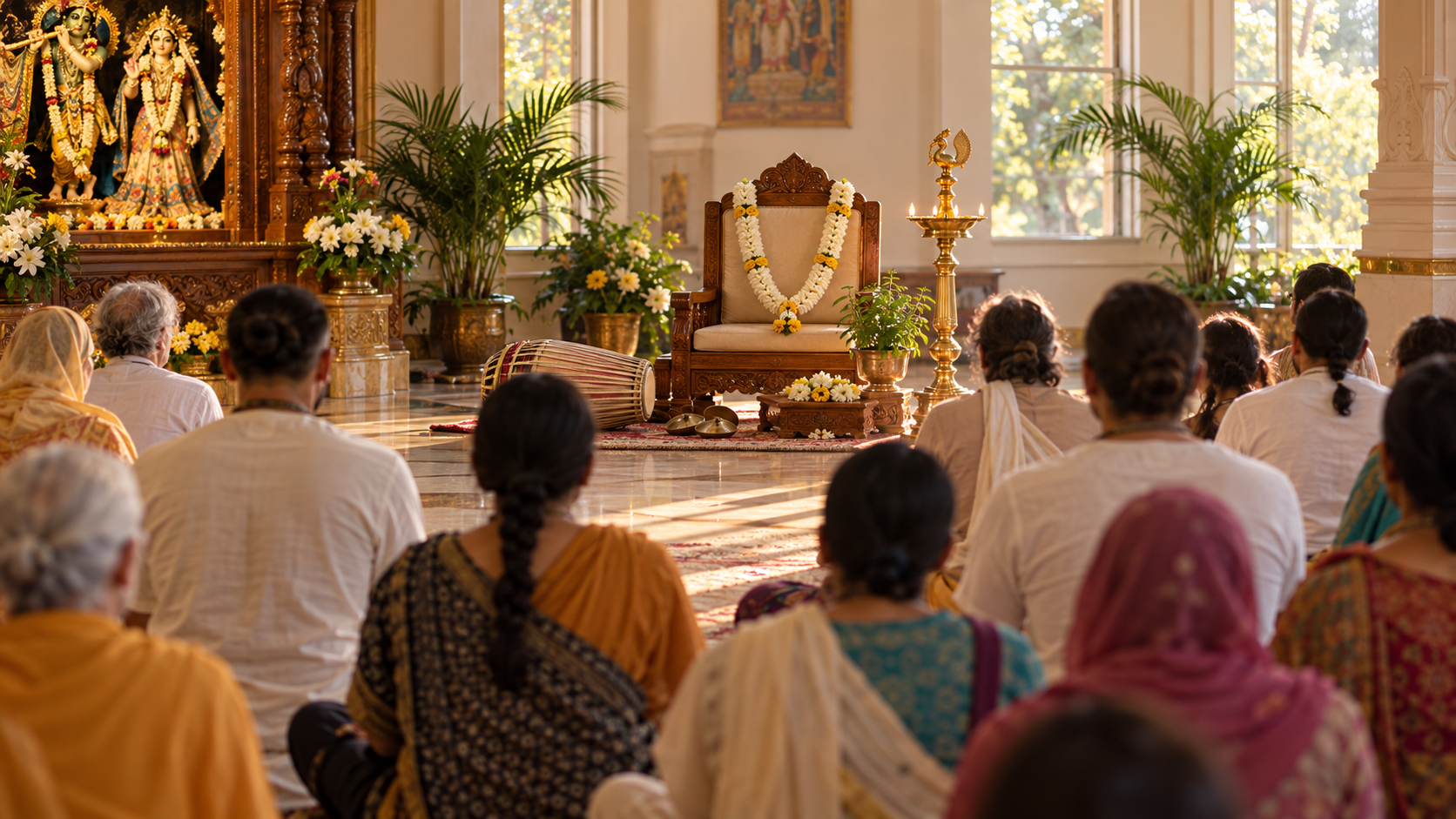
You may come to HG Kripasindhu Prabhu’s remembrance carrying a personal memory, or simply wanting to understand the life being honoured. Both are valid reasons to attend. What matters is that you arrive ready to hear, rather than trying to manufacture a closeness you did not have.
The live celebration of his life from ISKCON Alachua Hare Krishna Temple gives you an opportunity to receive the memories of devotees who knew him. With a little preparation, that hearing can become more than a passing emotional moment. It can clarify which qualities you want to remember and how you will honour them through your own conduct.
Prepare to listen, not merely to watch

A remembrance broadcast can easily become background noise. You open the stream, answer messages, hear fragments of several tributes, and leave with only a general impression. Prevent that by treating the programme as a period of devotional hearing.
- Use the linked broadcast notice to reach the programme instead of depending on a copied or shortened link.
- Confirm the published time and its time zone before the day of the broadcast. Do not assume that a time shared by someone elsewhere is already converted for your location.
- Open the stream early enough to resolve ordinary sound, connection, or device problems before the remembrance begins.
- Silence notifications and choose a place where you can hear complete recollections rather than isolated sentences.
- Divide a page into two headings: “What I heard” and “What I will carry forward.” This keeps testimony separate from your response to it.
If you are watching with family or members of your local community, agree beforehand that conversation will wait until a natural break. A speaker’s account deserves to be heard in full before anyone interprets it.
Listen for a quality, an example, and a duty

General praise tells you that a devotee was loved. A concrete recollection shows you why. As each person speaks, listen for three connected elements: the quality being remembered, the incident that revealed it, and the difference it made to another person.
<!– wp:list {
Leave a Reply
You must be logged in to post a comment.