
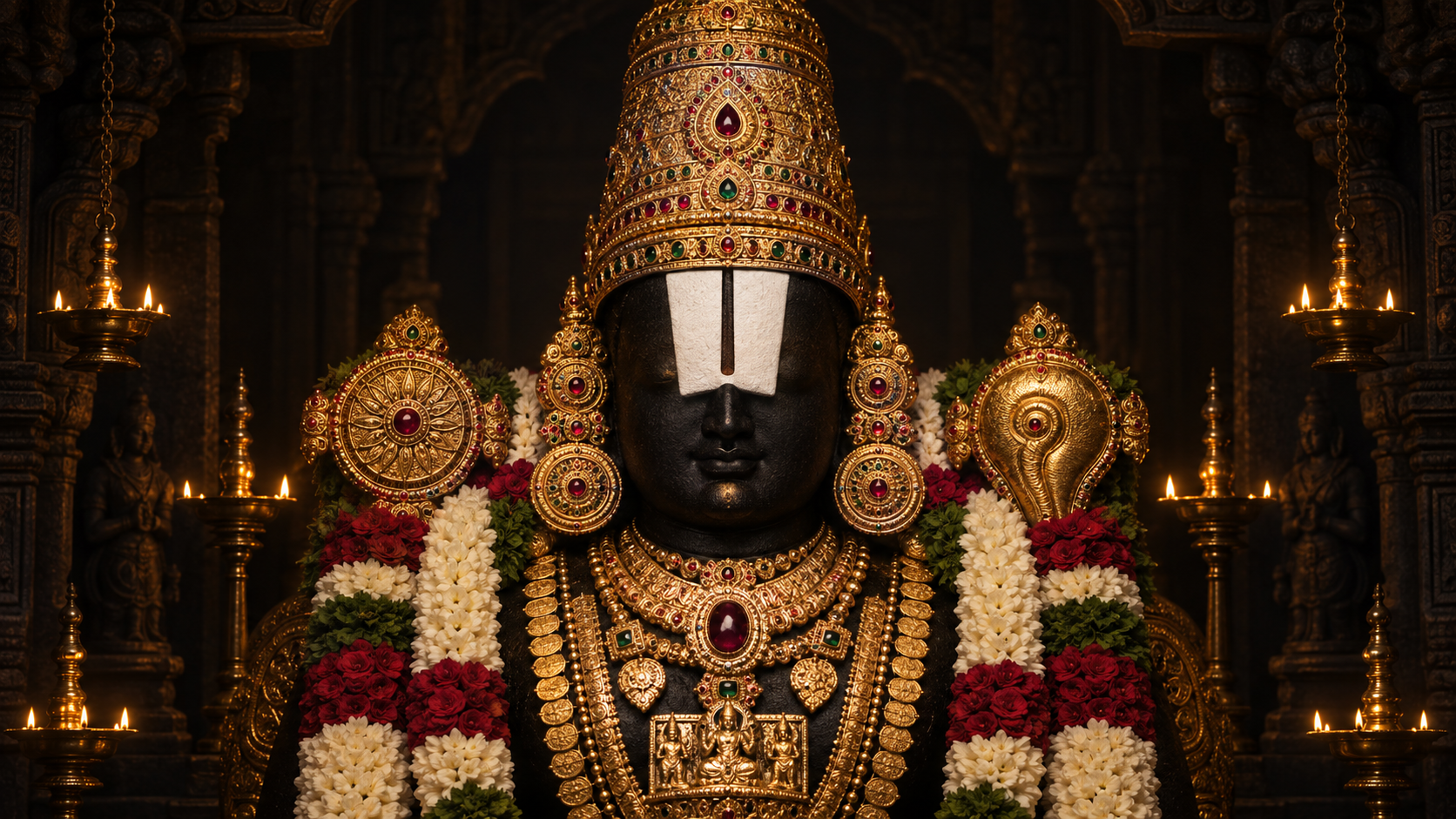
You may wait a long time for a brief darshan of Venkateshwara and then leave with one visual question: why could you not see his eyes clearly? The large namam seems to descend over them, hiding the very feature through which devotees normally expect a deity’s gaze.
The concealment is deliberate, not a flaw in the murti. The direct answer lies in the namam itself; the deeper answer lies in what Vaishnava devotion understands a divine gaze to be. Keeping those two levels distinct will help you appreciate the image without mistaking a devotional interpretation for an anatomical or historical claim.
The namam veils the eyes; it does not close them

Bhagavan Venkateshwara, the presiding deity of the Tirumala Tirupati temple and also lovingly addressed as Balaji or Srinivasa, bears a prominent Vaishnava namam. Its scale and placement are such that the namam partially covers the deity’s eyes. The eyes are therefore better described as veiled or partly concealed, not shut, absent, or completely hidden.
A namam is not ordinary facial decoration. It marks the murti within a Vaishnava devotional world and directs attention toward Bhagavan. Treating it as an accessory misses why its placement matters: what appears to obstruct the gaze is itself a sacred sign.
The common devotional explanation is that Venkateshwara’s direct gaze is extraordinarily powerful. The broad namam moderates that intensity, allowing the devotee to encounter the Lord’s presence as grace rather than as an unmediated force. This is theological language. It expresses how devotees understand divine majesty and compassion; it is not a claim that can be measured as a physical mechanism.
You therefore do not have to choose between calling the namam a visible ritual feature and recognizing a sacred meaning in it. Both can be held together: the mark physically overlaps the eyes, while devotion interprets that overlap as a merciful veiling of divine power.
A concealed gaze does not diminish darshan
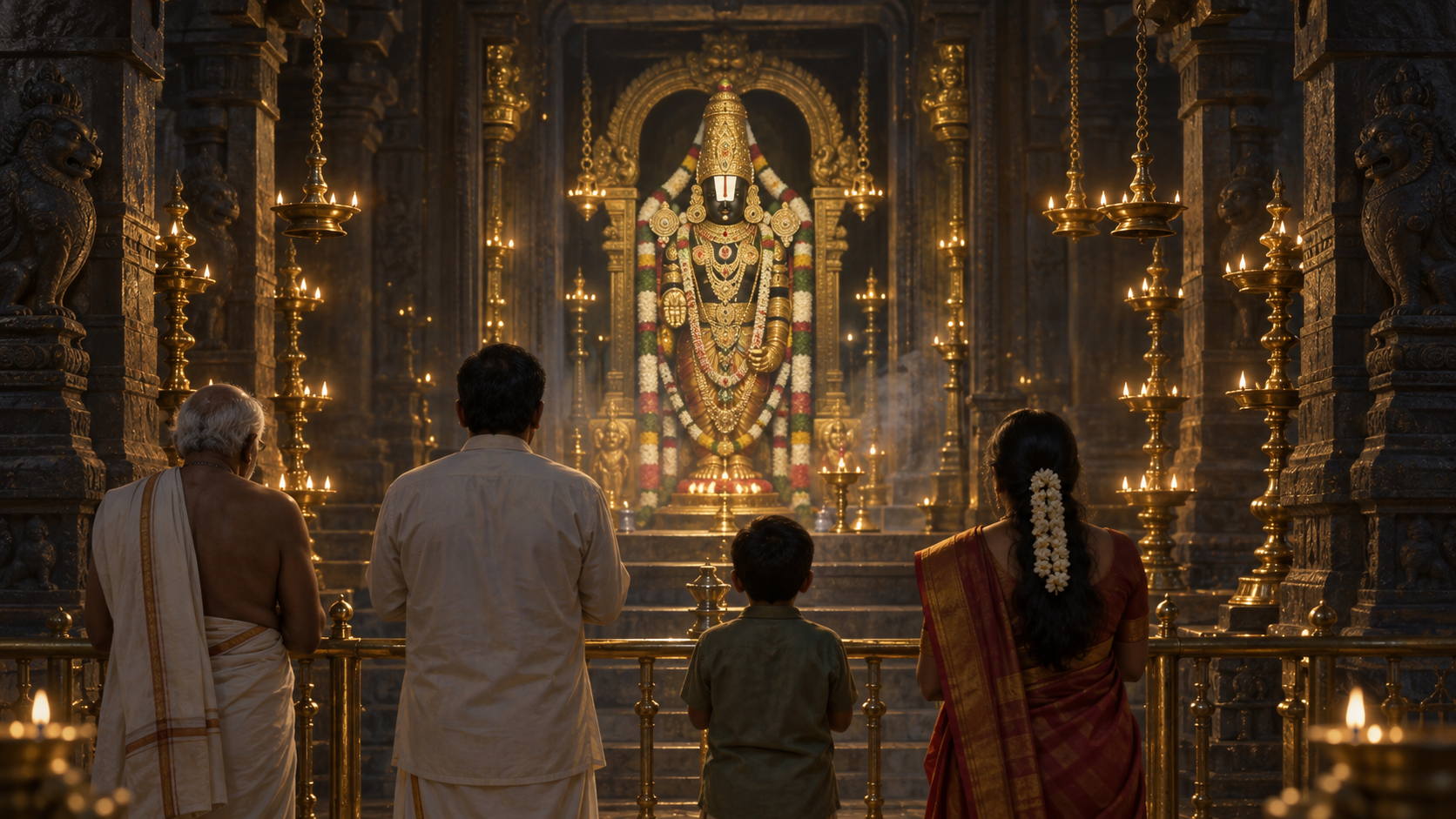
Darshan is more than inspecting a sacred image. You behold the deity, but you also approach with the understanding that Bhagavan beholds you. That reciprocity does not depend on securing ordinary eye contact. If it did, darshan would become a test of viewing angle, distance, lighting, or the number of seconds available to you.
The partly hidden eyes correct that instinct. They remind you that divine awareness is not limited by how much of the murti you can visually examine. You may not see the eyes in full, yet nothing about you is concealed from the Lord.
This changes what you should notice during darshan:
- Presence before detail: Receive the complete form before trying to isolate one facial feature.
- Recognition before possession: The namam helps you recognize whom you have come to worship; you do not need to visually possess every detail of the murti.
- Trust before proof: The concealed gaze asks whether you can accept being seen by Bhagavan without demanding a visible confirmation.
Partial concealment can therefore deepen darshan rather than weaken it. The veil creates restraint. It stops the eye from treating the murti as an object to be decoded and returns the devotee to reverence.
Keep fact, tradition, and personal meaning distinct
Sacred images often gather several explanations around them. A family may emphasize the overwhelming power of the Lord’s eyes. A teacher may speak about compassion moderating majesty. Another devotee may understand the concealment as a lesson in surrender. These meanings can illuminate one another, but they should not be flattened into a single provable event unless a particular liturgical or textual authority is actually identified.
Use three simple tests when you hear an explanation:
- What can you directly observe? A large namam extends across part of the eye area.
- What does the tradition interpret? The veiled gaze represents divine intensity made approachable through grace.
- What is a devotee drawing from it? Concealment may become a lesson in humility, trust, or freedom from the demand to control the encounter.
This distinction protects both faith and accuracy. It prevents the dismissive mistake of calling sacred symbolism mere ornament, and it prevents the opposite mistake of presenting every circulating devotional story as established temple history.
It also corrects three common misreadings. Venkateshwara is not portrayed as blind. The namam does not mean the Lord refuses to see his devotees. And limited visual access to the eyes does not make your darshan spiritually incomplete. The central devotional claim is almost the reverse: Bhagavan’s sight is not limited even when yours is.
How to approach the concealed eyes during darshan
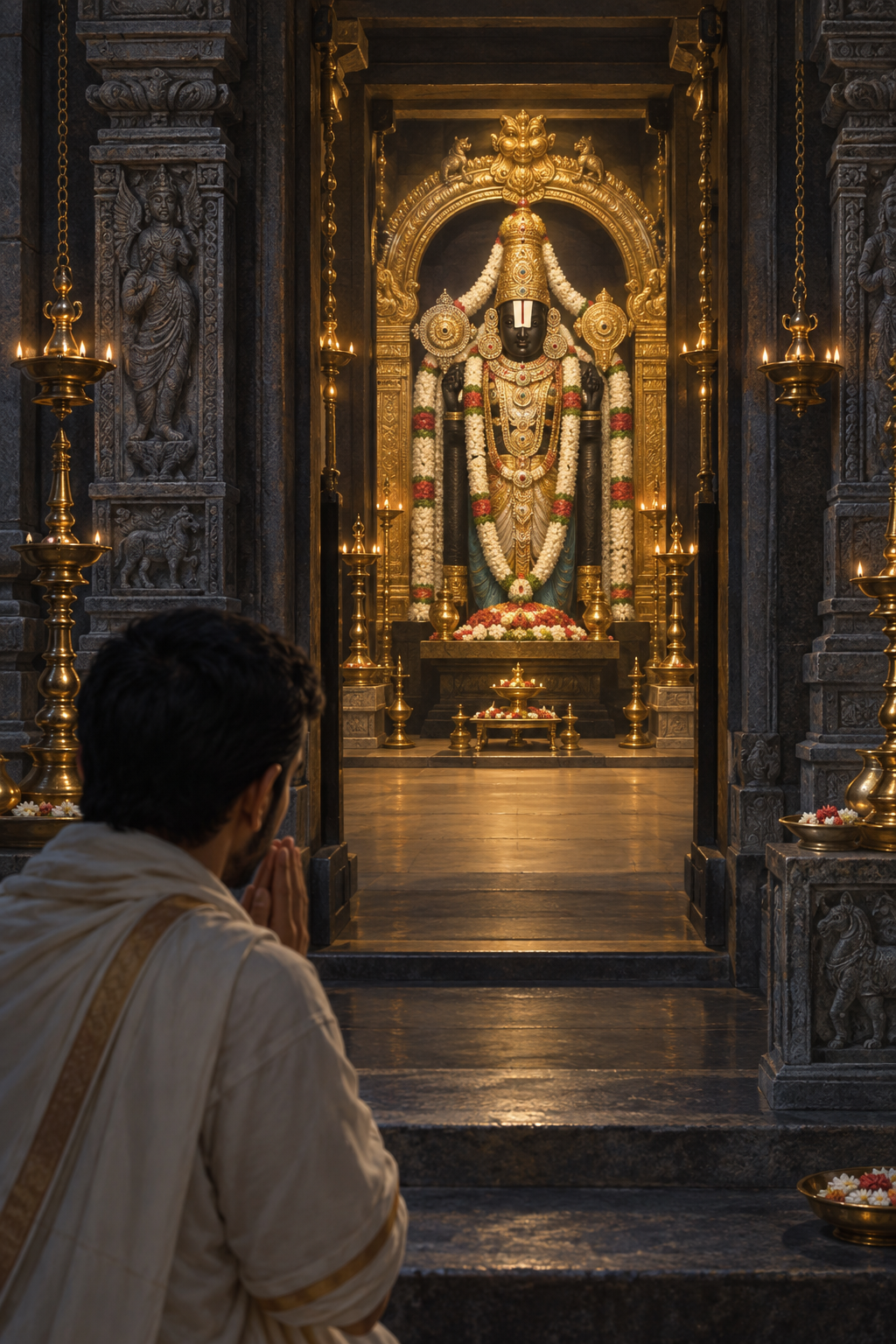
A crowded or brief darshan can tempt you to arrive with a mental checklist: see the eyes, see the ornaments, remember every detail, and somehow complete a prayer at the same time. That effort often turns a sacred encounter into a visual task. A simpler discipline is more useful.
- Choose one intention before you see the murti. Decide what you are placing before Bhagavan: gratitude, a difficulty, repentance, or a request for clarity. One honest intention is easier to hold than a hurried catalogue.
- Receive the whole form first. Do not spend your first moment struggling to locate the eyes. Let the murti register as a complete presence.
- Notice the namam as part of the darshan. Instead of treating it as something blocking what you came to see, recognize it as one of the sacred features through which the form is presented.
- Use one familiar name. Silently address the Lord as Venkateshwara, Srinivasa, or Balaji. A name steadies attention when the external moment is short.
- Carry one question away. Ask yourself: what am I being invited to trust without seeing completely? Let that question shape one decision or action after the visit.
This is a personal attentional practice, not a temple-mandated ritual. Its purpose is to stop frustration about an obscured detail from consuming the darshan you actually receive.
Key takeaways
- Venkateshwara’s eyes are partially concealed by the large Vaishnava namam; they are not represented as completely closed.
- The common devotional understanding is that the namam moderates an exceptionally powerful divine gaze, expressing majesty made approachable through compassion.
- The explanation belongs to sacred interpretation, not to a measurable physical claim.
- Darshan does not require ordinary eye contact. You can understand the concealed gaze as a reminder that Bhagavan sees the devotee fully even when the devotee sees only partially.
- During darshan, attend to the whole murti, hold one intention, repeat one name, and resist turning the encounter into a checklist of visual details.
The next time you stand before Venkateshwara, do not look past the namam in search of a supposedly more complete darshan. Notice the veil itself. Let it move you from trying to capture every detail toward the harder devotional act: standing before Bhagavan without needing to control how he reveals himself.
References
