
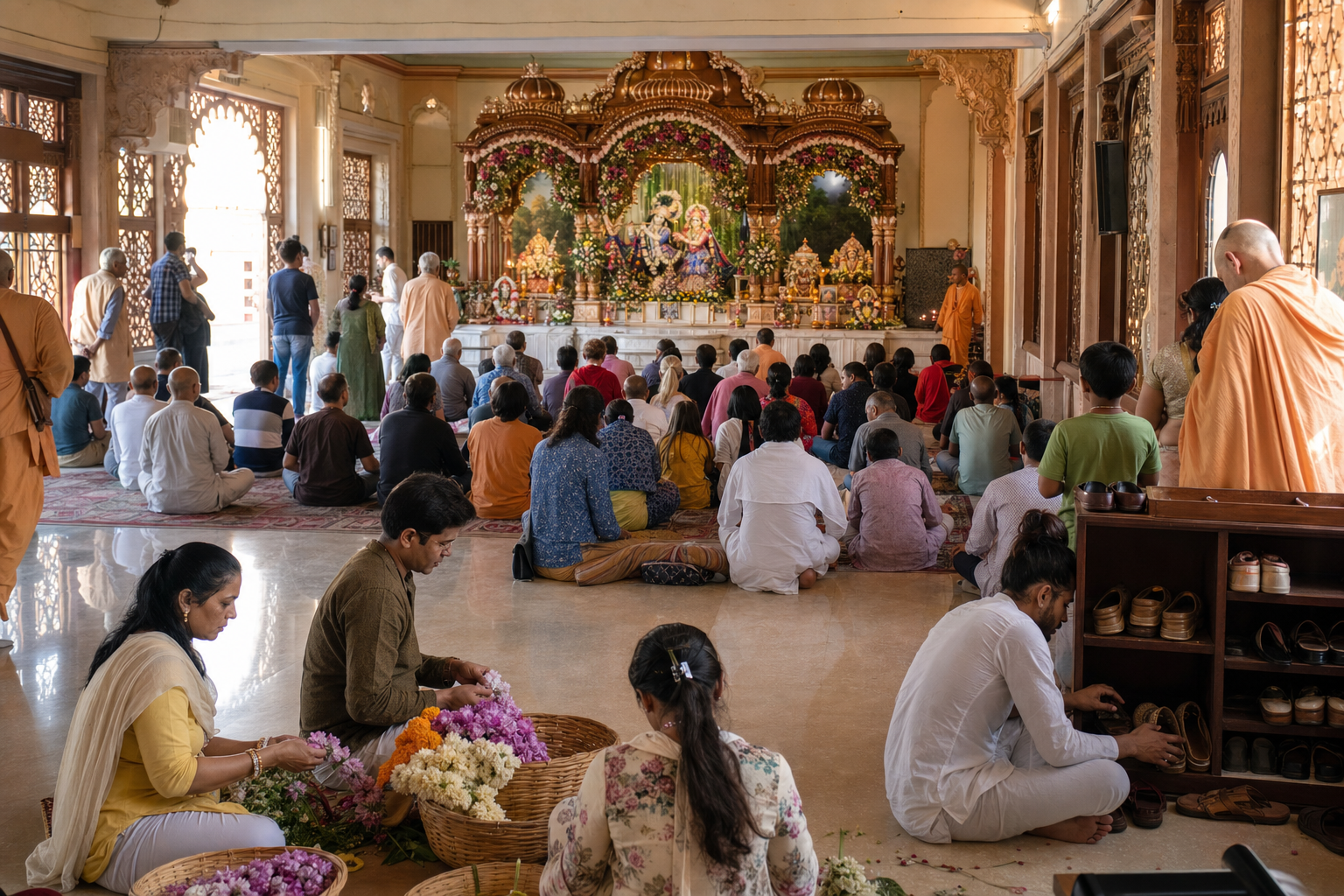
If you are deciding whether to visit an ISKCON temple, take your family, volunteer, or support a new center, do not judge it only by the size of its altar, the beauty of its domes, or the crowd at a festival. Ask a more revealing question: what happens there on an ordinary day?
A serious mandir holds three responsibilities together. It sustains attentive worship, passes a living inheritance to the next generation, and creates unity through hospitality and seva. Once you can see those functions clearly, you can enter the temple with confidence and recognize whether it is becoming a durable center of dharmic life.
Devotion must set the temple’s daily clock
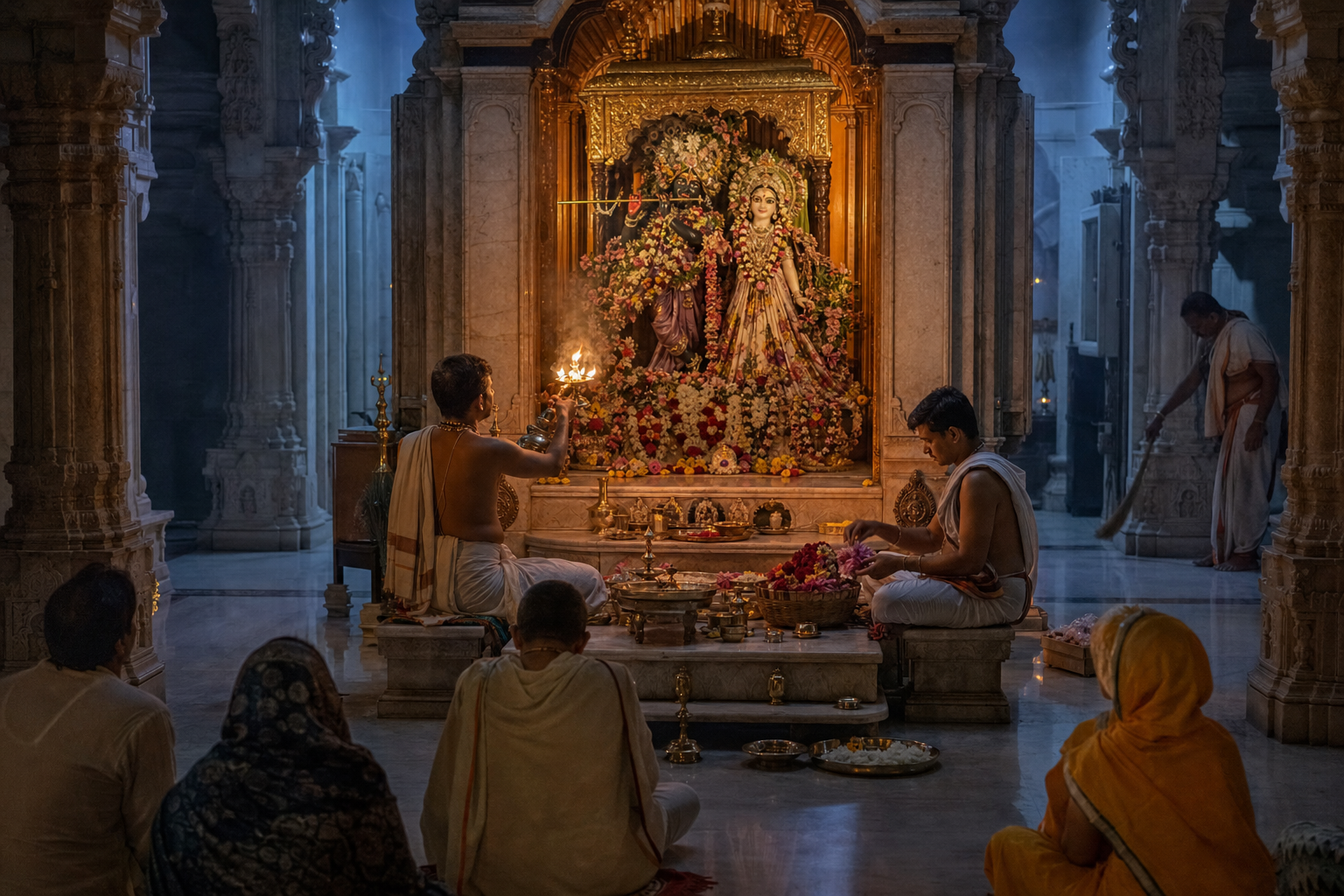
An ISKCON temple is not primarily an auditorium with a sacred image at one end. In Gaudiya Vaishnava practice, a consecrated murti is approached as divine presence. That understanding creates obligations: the Deities are awakened, offered food, dressed, honored through arati, and served according to a regular schedule. Kirtan, japa, cleanliness, cooking, flowers, music, and hospitality are not separate departments loosely gathered under one roof. They are forms of seva organized around remembrance of Krishna.
This is why the installation or relocation of Deities cannot be reduced to moving objects and opening a building. Worship must continue through the transition, and nitya-seva, the recurring cycle of daily service, must be established in the new sacred space. The January 30 to February 1, 2026 inauguration of Sri Sri Radha Madhava Mandir in Taguig City joined the Deities’ move to a permanent home with a continuous 24-hour kirtan. The public ribbon-cutting made the center visible to the city, but the unbroken chanting expressed the temple’s inner purpose.
That distinction matters whenever you evaluate a temple project. A civic ceremony can help neighbors, officials, and local institutions understand that a mandir belongs in the public landscape. It cannot replace consecration, daily worship, or trained service. Sacred continuity and civic recognition can reinforce one another, but they perform different tasks.
Kirtan makes this devotional center unusually accessible. You do not need an academic command of Sanskrit or prior ritual training to listen and respond to the maha-mantra. Melody, rhythm, mantra, and congregational participation draw attention away from private distraction and toward shared remembrance. At an extended kirtan, leadership may rotate while the congregation maintains the response. Variation in tempo and musical phrasing can sustain attention, but the measure of the practice is remembrance, not performance.
When you attend, notice four ordinary signs of devotional seriousness:
- The announced arati, offering, and kirtan schedule is treated as a commitment, not a suggestion.
- Volunteers understand that work in the kitchen, entrance, classroom, and shrine is connected to seva.
- The atmosphere supports attention even when no major guest or festival crowd is present.
- Newcomers are helped to participate without turning the worship into a spectacle for them.
A grand opening shows what a community hopes to become. The ordinary worship schedule shows whether that hope has acquired discipline.
Heritage survives when people learn how to carry it
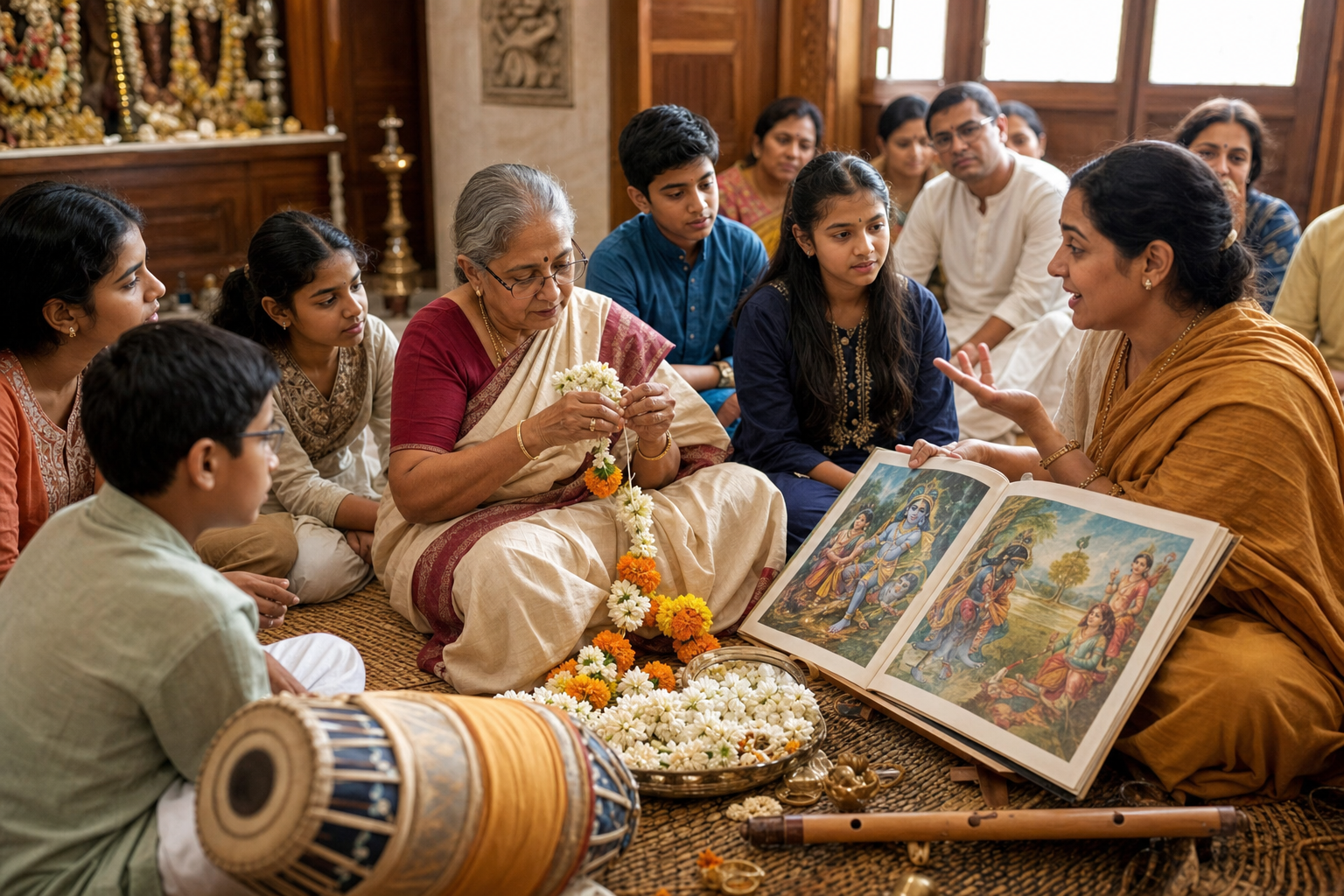
Heritage is sometimes mistaken for an impressive structure, an old manuscript, or a festival costume. Those things can carry memory, but a tradition remains alive only when people know what to do with them. In a functioning temple, children hear sacred names pronounced carefully, adults study the reasoning behind a practice, cooks learn the discipline of preparing offerings, musicians inherit kirtan forms, and families begin to understand the calendar of sacred time.
ISKCON has worked in this institutional form since its establishment by A. C. Bhaktivedanta Swami Prabhupada in 1966. Its temples connect congregational chanting with scriptural study, prasadam distribution, devotional arts, and organized service. That combination is especially consequential in the diaspora. A family may preserve a few rituals at home, but a permanent mandir can provide teachers, peers, vocabulary, festivals, and recurring responsibilities that one household cannot sustain alone.
Mayapur shows how this transmission can operate at civilizational scale. Located in the sacred landscape associated with Chaitanya Mahaprabhu and near Nabadwip’s historic culture of scholarship, ISKCON’s international center at Sridham Mayapur brings pilgrimage, worship, teaching, community service, and heritage interpretation into one ecosystem. The setting matters because Gaudiya Vaishnavism did not emerge as devotional emotion without intellectual depth. Its inheritance includes disciplined theology, scriptural commentary, philosophical inquiry, sacred geography, music, and communal practice.
The Temple of the Vedic Planetarium adds another layer to that work. Its planned cosmic chandelier, inspired by the cosmography of the Fifth Canto of the Srimad-Bhagavatam, is intended to make a scriptural vision of cosmic order visible at architectural scale. This should invite serious inquiry rather than a forced claim that every traditional cosmological category is simply identical to a modern scientific model. A heritage institution serves the public best when it explains its own sources clearly, distinguishes interpretation from demonstration, and allows faith and curiosity to meet without making either superficial.
Architecture also teaches through movement. A shrine focuses attention; a congregational hall enables shared worship; classrooms support explanation; a prasadam area turns offering into hospitality; and paths for circumambulation give embodied form to reverence. In a riverine pilgrimage environment such as Mayapur, durable construction, hydrology-sensitive planning, safe circulation, and long-term maintenance are not merely technical concerns. Caring for the setting is part of caring for the sacred institution.
If you are choosing a temple program for your children, evaluating a heritage initiative, or considering where to volunteer, look beyond the number of performances on the calendar. Ask:
- Can students explain why a practice is performed, or are they only taught to reproduce its outer form?
- Are Sanskrit terms translated and pronounced with care?
- Does teaching distinguish scripture, theology, established practice, and local custom?
- Is Gaudiya Vaishnava thought, including acintya-bheda-abheda, presented as a coherent tradition rather than a collection of slogans?
- Can young people move from attending programs to accepting meaningful, supervised responsibility?
- Can a newcomer ask a basic question without being embarrassed or pressured?
A child who can perform a ritual has learned a valuable skill. A child who can explain its meaning, locate it within a tradition, and serve others through it has begun to inherit a civilization.
Dharmic unity does not require theological sameness
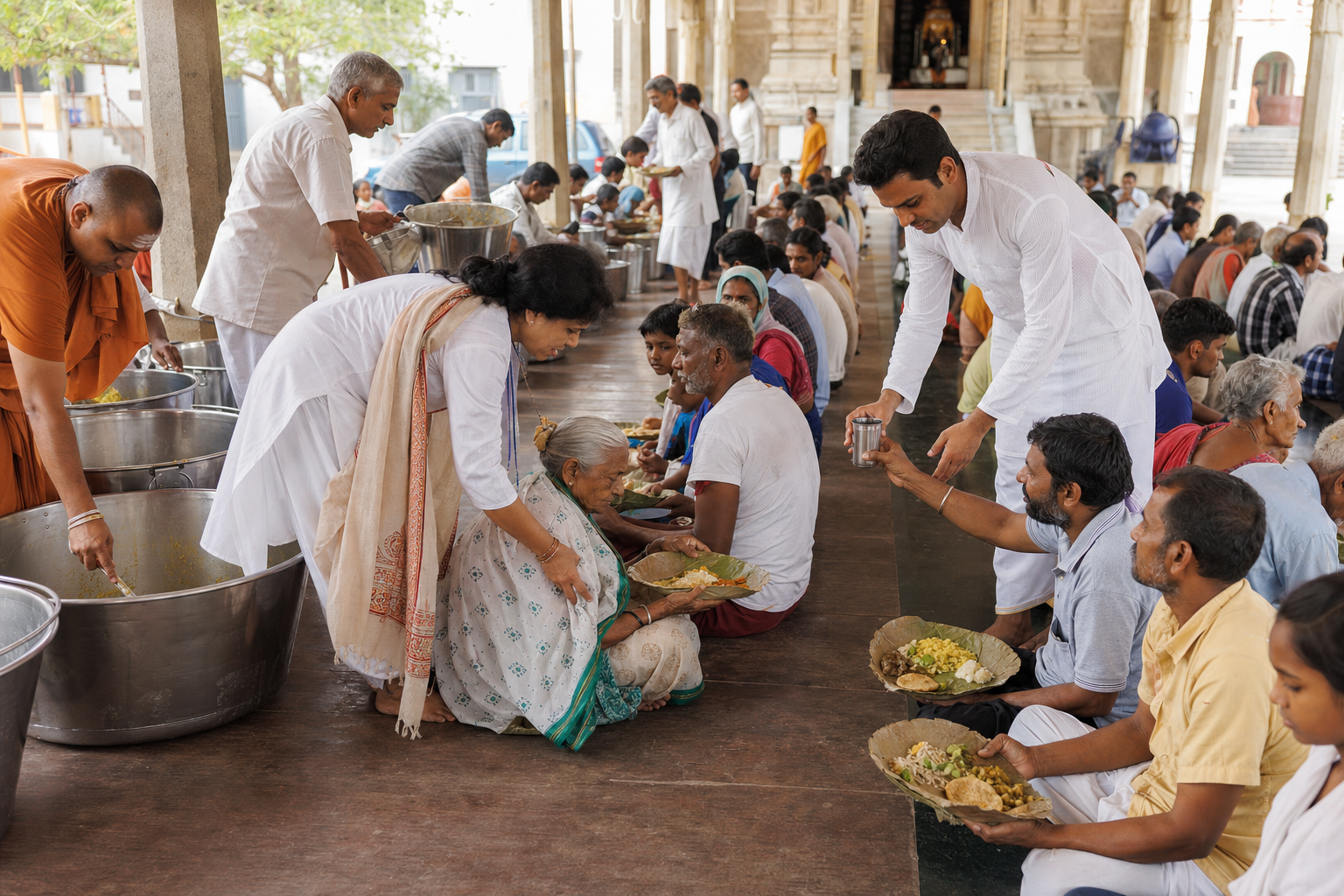
ISKCON temples can contribute to unity because they offer a recognizable language of disciplined practice: chanting, self-restraint, vegetarian food, study, devotion, and seva. Several of those forms resonate beyond Gaudiya Vaishnavism. Sikh tradition gives sacred music a central place through shabad kirtan. Chant and disciplined meditation appear throughout Buddhist communities. Jain practice gives rigorous expression to ahimsa and aparigraha. Hindu traditions share many terms while interpreting them through different lineages and philosophies.
Those affinities are real, but they do not make the traditions interchangeable. Vaishnava nama-sankirtana, Sikh shabad kirtan, Buddhist recitation, and Jain liturgy arise from distinct teachings, authorities, and understandings of liberation. Unity becomes credible when each community can speak in its own voice while recognizing shared commitments such as compassion, ethical discipline, self-cultivation, hospitality, and service.
This is particularly important in places where Hindu traditions are not well understood. A permanent mandir in predominantly Christian Metro Manila gives neighbors an opportunity to encounter Hindu life directly rather than through stereotype. Kirtan, prasadam, public festivals, classes, and respectful conversation make the tradition visible in forms that people can actually experience. The temple does not need to conceal its theology to be welcoming, and a guest does not need to adopt that theology to behave respectfully.
Public recognition can help establish that confidence. The civic opening in Taguig and Amit Shah’s visit to Mayapur show two different ways a temple enters public consciousness. Yet political attention, celebrity presence, or official praise should never become the test of spiritual worth. A temple earns trust over time through reliable worship, responsible governance, teaching, service, and the way it treats an unknown visitor when no camera is present.
If you are arranging an interfaith or inter-dharmic visit, keep the program concrete. Begin with the host tradition’s own account of its worship. Let visitors describe related practices in their own traditions rather than having someone else collapse them into one category. Explain which parts of the ritual are open to observation or participation. End with a specific act of hospitality or service. The goal is neither debate nor a declaration that all paths say the same thing. It is accurate understanding joined to neighborly conduct.
How to visit an ISKCON temple with confidence
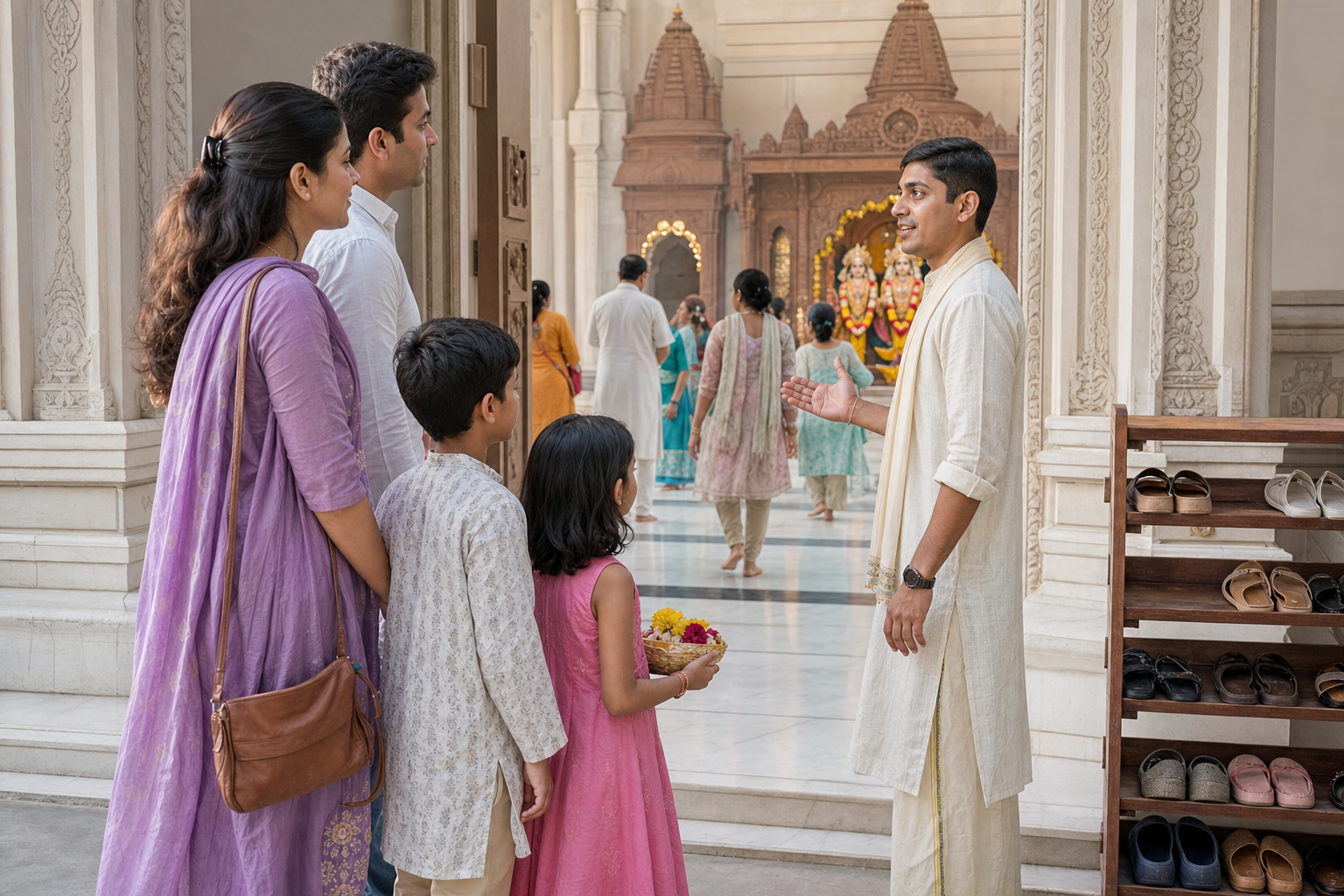
You do not need to master temple protocol before entering. A few deliberate choices will let you participate without treating the mandir as either an exotic attraction or a private club.
- Check the local schedule. Find the listed time for arati, kirtan, a class, or prasadam. A festival visit shows the community at full intensity; an ordinary-day visit reveals its regular rhythm. If you are deciding whether to become involved, experience both.
- Dress and enter respectfully. Wear modest clothing and remove your shoes where directed. Temple layouts vary, so follow signs or ask a volunteer rather than assuming every room has the same rules.
- Observe before copying. Watch how the congregation responds during arati, offerings, and movement around the shrine. You can stand or sit where directed, listen carefully, and ask about an unfamiliar gesture later. Respect does not require pretending to understand something you have just encountered.
- Join kirtan simply. Listen for the leader’s phrase and repeat with the congregation. You do not need to sing loudly. If instruments are present, use them only when invited or when you know the local practice; rhythm that serves the chant is different from percussion that competes with it.
- Receive prasadam as sacred hospitality. Prasadam is food first offered to Krishna and then shared. Accept only what you can eat, avoid waste, and ask about ingredients if you have an allergy or dietary constraint. Its significance is devotional even when distribution also meets a social need.
- Ask one practical question. Speak with a volunteer about the daily worship schedule, an introductory class, children’s education, or a regular seva opportunity. A specific question is more likely to lead to a meaningful next step than a general request to know everything about ISKCON.
Photography deserves particular care. Many temples restrict it near the inner shrine or during worship. Do not infer permission from another visitor’s phone. Ask first, and put the device away when the congregation is being called to attention. The fact that a ceremony is public does not make every sacred moment raw material for personal content.
If you are bringing a school, interfaith delegation, older relatives, or anyone with mobility needs, contact the local center in advance. Ask about accessible entrances, seating, language, photography, the length of the program, and where prasadam will be served. Accessibility features and programming differ by location, so local confirmation is more reliable than assumptions based on another ISKCON temple.
Keep three distinctions in mind during the visit. Open participation does not mean every theological claim has been set aside. Warm hospitality does not turn worship into entertainment. Monumental architecture does not by itself prove institutional health. These distinctions will help you appreciate what is offered without idealizing what you have not yet examined.
How to decide whether a temple has earned your support
A mandir may need donations, professional expertise, volunteer hours, teaching support, maintenance work, or help serving prasadam. Before making a substantial commitment, look at the center as a year-round institution. Festival enthusiasm is valuable, but your support will strengthen whatever habits are present after the festival ends.
- Worship is consistent. Daily seva does not depend entirely on one charismatic person, and trained devotees can maintain the schedule through ordinary disruptions.
- Teaching has depth and entry points. There is serious study for committed practitioners as well as clear orientation for people who do not yet know the vocabulary.
- Children and young adults have a path to responsibility. Youth are not used only as performers. They can learn music, philosophy, language, cooking, hospitality, administration, and supervised service.
- Governance is understandable. Trustees or responsible leaders provide fiduciary oversight, volunteer roles are clear, and concerns have a channel through which they can be addressed. Sacred purpose does not remove the need for accountability.
- Hospitality protects the sacred atmosphere. First-time guests receive guidance, while worshippers are not continually displaced by the needs of visitors, cameras, or public events.
- Service reaches beyond the building. Prasadam distribution, education, arts, and community relationships make devotion socially legible without reducing the temple to a secular service provider.
- Growth respects place. Large centers plan for safe circulation, maintenance, water, local ecology, and the effect of pilgrimage on residents and livelihoods. Ambitious construction carries a corresponding duty of stewardship.
If you are a donor, ask which recurring service your contribution will sustain and who is accountable for it. If you are a volunteer, ask what training the role requires and how often you are expected to serve. If you are a parent, observe whether teaching produces understanding as well as enthusiasm. If you are an organizer, test the welcome through the eyes of someone who does not know when to remove shoes, where to sit, or what prasadam means.
The economic life surrounding a pilgrimage center also deserves attention. Transport workers, farmers, cooks, artisans, publishers, and local hospitality providers may all participate in the ecosystem. That activity can sustain livelihoods and traditional skills, but size alone does not guarantee healthy development. Transparent management, respect for local communities, and responsible care for land and water determine whether expansion serves the wider dharmic purpose.
Key takeaways
- Judge a temple by its ordinary cycle of worship, not only by architecture or festival attendance.
- Look for heritage that is explained, practiced, and entrusted to the next generation.
- Welcome unity through shared ethical practice without pretending that Dharmic traditions are theologically identical.
- On a first visit, check the schedule, observe before copying, join kirtan simply, and ask before taking photographs.
- Before donating or volunteering, ask what recurring service you will strengthen, what training it requires, and who is accountable.
On your next visit, choose one ordinary service rather than waiting only for a major festival. Stay through a complete part of the temple’s rhythm, whether that is arati, kirtan, a class, or prasadam. Then ask one question about learning and one about seva. A living mandir becomes a center of unity when visitors stop being spectators and begin to participate with understanding.
References
- Dandavats – Taguig City’s Sri Sri Radha Madhava Mandir Opens: 24-Hour Kirtan, Devotion, and Unity
- Dandavats – Amit Shah’s Reverent Visit to ISKCON Mayapur: Honoring TOVP, Heritage, and Dharmic Unity
