
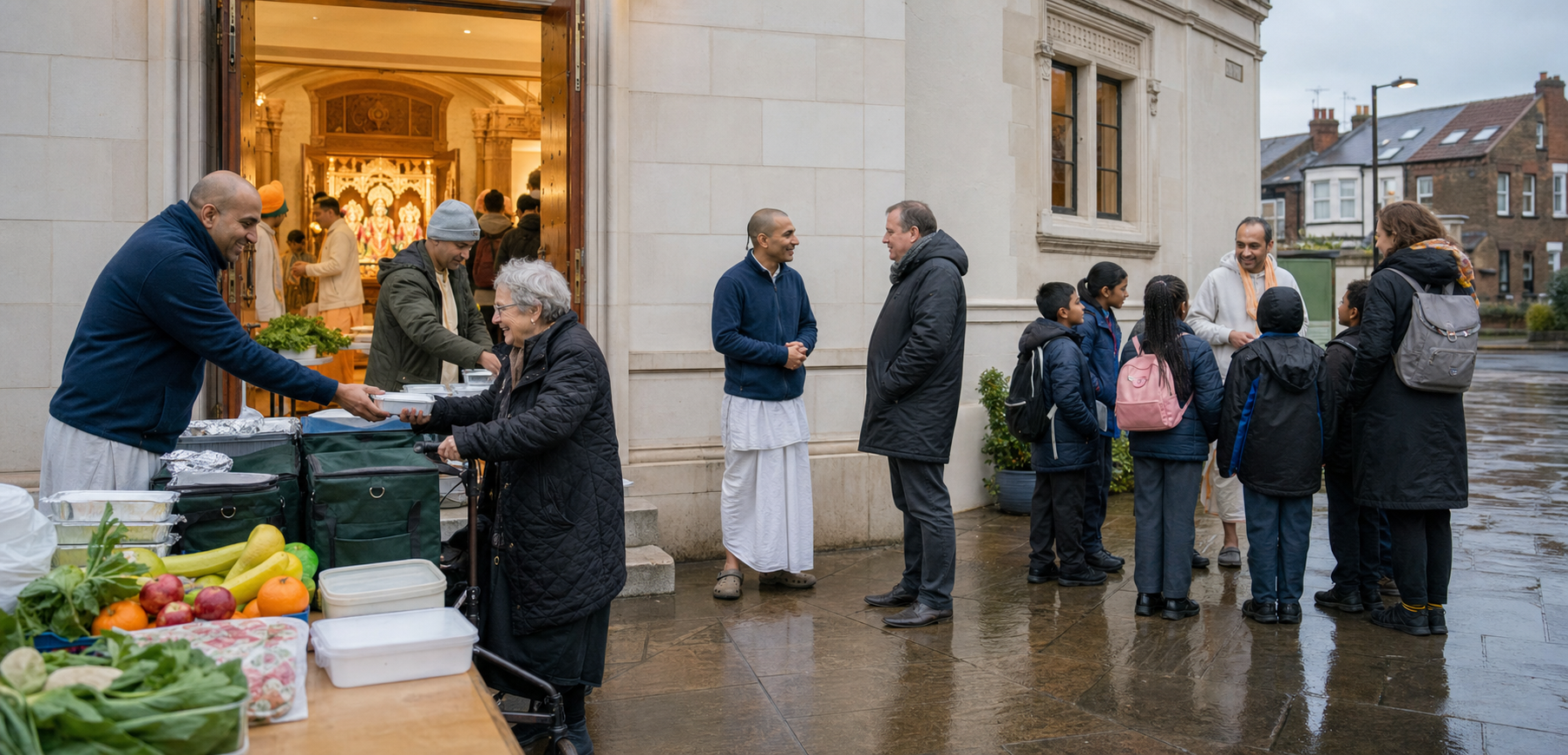
You may be deciding whether to volunteer at an ISKCON temple, support a renovation, bring a school group, invite a councillor, or work with the temple on a local need. The useful question is not simply whether the temple holds popular events. It is whether devotion has been turned into dependable public capacity.
Two British examples show what that looks like from different directions. ISKCON Leicester is using a demanding community fundraiser to connect heritage, family formation and seva. Bhaktivedanta Manor has used a major religious festival to connect unapologetic Krishna-bhakti with civic hospitality. Together, these patterns give you a practical way to judge when a temple is becoming a durable community and civic institution.
A civic institution is built through repeatable service
Calling a temple a civic institution does not turn it into an arm of the state, a generic cultural centre or a venue whose Hindu identity must be softened for outsiders. It means that the temple has become a dependable part of local life: it preserves memory, forms volunteers, welcomes the public, sustains relationships and can organise people around a shared responsibility.
The distinction matters. A crowded festival is an event. A trained hospitality team that can welcome first-time visitors at successive festivals is institutional capacity. A successful appeal pays for a project. A congregation that learns how to govern the project, protect volunteers, involve young people and report what happened is building an institution.
For an ISKCON temple, the civic role should arise from its devotional life rather than compete with it. Kirtan develops congregational participation. Prasadam makes hospitality tangible. Scriptural study gives ethical language to duty and service. Deity worship creates habits of care, regularity and responsibility. When those habits travel beyond the shrine room, the temple can offer its neighbourhood something deeper than occasional entertainment.
This also creates a natural meeting point across the wider dharmic family. Seva in Hindu and Sikh life, karuna in Buddhist practice, ahimsa and aparigraha in Jain ethics, and sarbat da bhala in Sikh teaching are not interchangeable doctrines. They retain their own theological settings. Yet they can support practical cooperation in heritage protection, hospitality, food service, youth formation and care for the common good. The right model is unity in action without pretending that every tradition is the same.
When you evaluate a temple’s civic role, therefore, ask three questions. What practice is repeated? Who is being formed to carry it forward? What public good remains after the individual event is over? Clear answers matter more than the size of a guest list.
Leicester: heritage work that also builds people
In Leicester, 22 participants, primarily fathers and sons and joined by the temple’s Head Pujari, set 24 April 2026 for a National Three Peaks Challenge in support of ISKCON Leicester’s renovation. That combination is significant. The building is the immediate object of the appeal, but the work also brings generations, temple leadership and lay families into a common discipline.
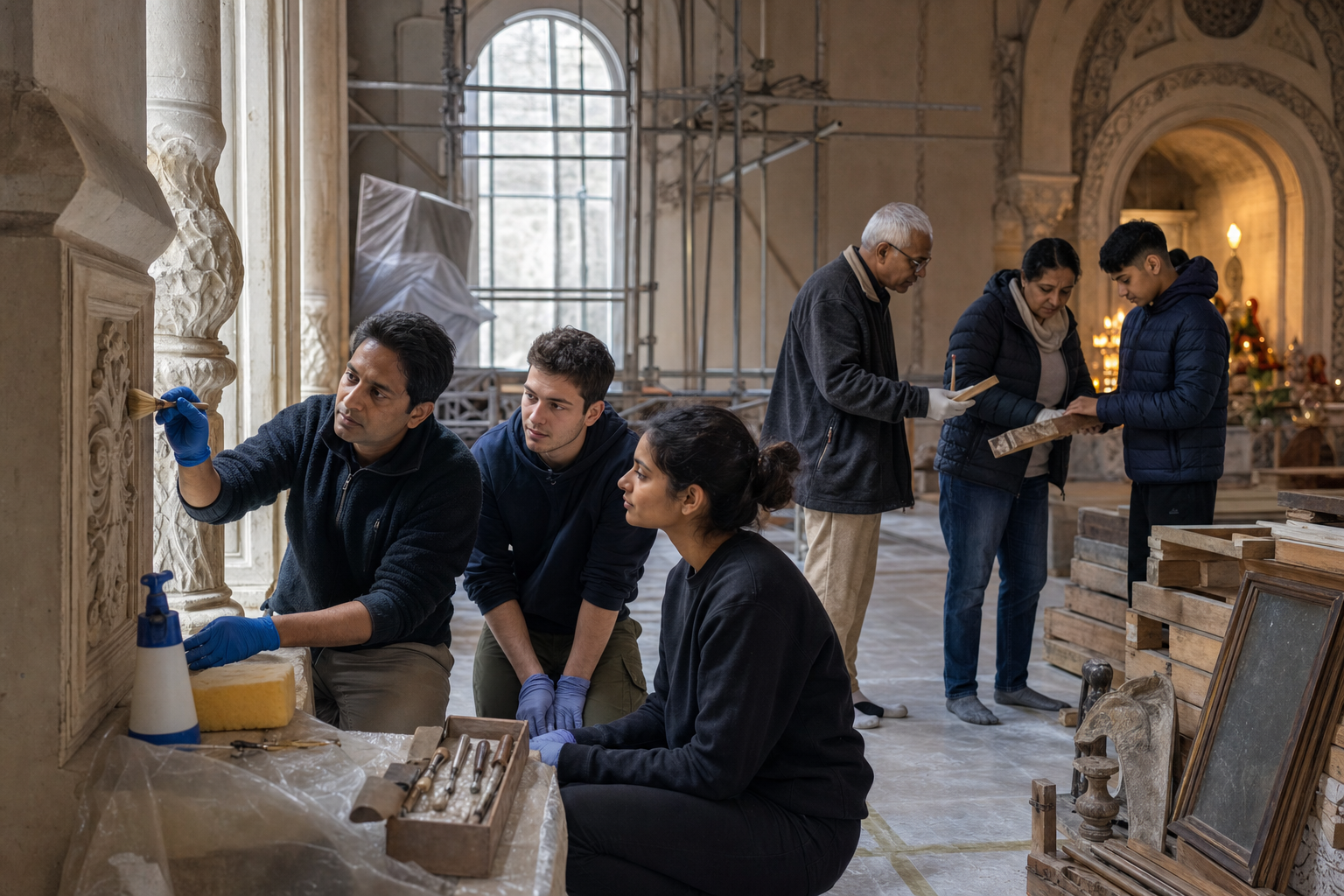
A heritage project becomes civic when people understand what the building enables. Renovation does not merely protect bricks, decorative features or a recognisable local facade. It gives living practices – kirtan, scriptural learning, prasadam, worship and intergenerational teaching – a stable home. The tangible and intangible forms of heritage depend on one another: a building without a living community becomes a shell, while a community without durable space struggles to transmit memory and practice.
The choice of fundraiser also matters. The standard Three Peaks route links Ben Nevis in Scotland, Scafell Pike in England and Snowdon/Yr Wyddfa in Wales. It commonly involves 23 to 26 miles of mountain walking, more than 3,000 metres of combined ascent and roughly 10 hours of road travel, with many teams targeting an overall window of about 24 hours. This is not a symbolic stroll. It demands preparation, role clarity, trust and the ability to stop when conditions make the original target unsafe.
That last point is part of the civic meaning. Seva does not justify careless risk. A responsible plan needs experienced mountain leads, pre-assigned navigator and sweep roles, maps and compasses as well as GPS, reliable check-ins, and drivers who do not also walk the mountain stages. Late-April conditions can still leave snow and ice on the upper slopes of Ben Nevis. A stopwatch must never outrank the safety of walkers, drivers or mountain rescuers.
Environmental conduct counts as well. Staying on durable paths, taking all waste away, using facilities during transfers and respecting residents during night arrivals show whether the team understands stewardship beyond its own fundraising objective. A temple earns public trust partly through the way its members behave in shared places.
If you are planning or assessing a similar heritage fundraiser, look for the following sequence:
- Name the living heritage. Explain which recurring forms of worship, education, music, food culture or family life the building makes possible.
- Give participants real responsibility. Youth involvement should include preparation, navigation, communication, hospitality or documentation, not merely attendance beside adults.
- Publish the safety structure. Identify leaders, drivers, check-in procedures, equipment requirements and the conditions that will trigger a delay, route change or withdrawal.
- Connect the effort to the public realm. Invite neighbours and other dharmic communities to support appropriate roles, but make the purpose and devotional identity of the project clear.
- Record the outcome. Separate what was planned from what was completed, then document funds raised, renovation milestones, volunteer learning and logistical problems that should change the next project.
A scheduled challenge is evidence of mobilisation, not proof of completion. The institutional value becomes visible when organisers report what happened, protect the lessons and use the new relationships again. That is how a fundraiser stops being a one-off feat and becomes part of the temple’s civic memory.
Bhaktivedanta Manor: devotion as a public doorway
Bhaktivedanta Manor demonstrates a second route into civic life: making a major devotional festival intelligible and welcoming to people who do not already know how to enter it. At its public Rama Navami celebration, three local Mayors and Miatta Fahnbulleh MP, Parliamentary Under-Secretary of State with the brief for Devolution and Faith, were among the civic and community guests.
The presence of public figures is meaningful because it recognises the temple as part of Britain’s visible religious and cultural life. But a photograph with a Mayor is not, by itself, civic achievement. The deeper test is whether the encounter helps public institutions, neighbours and families understand the community well enough to build a continuing relationship.
That relationship should begin with the festival as it actually is. Rama Navami at an ISKCON temple is not a vaguely spiritual open day. Its devotional centre includes kirtan, Ramayana readings, abhishekam for Sri Rama, Sita, Lakshmana and Hanuman, darshan and prasadam. These practices allow visitors to encounter Hindu life through sound, ritual, narrative, food and shared presence. Removing the sacred content would remove the very thing that makes the invitation worthwhile.
Accessibility does not require theological dilution. It requires interpretation. A first-time visitor may not know why shoes are removed, when photography is appropriate, what abhishekam signifies, how to move through a darshan queue or whether prasadam is offered to everyone. A short orientation can prevent uncertainty from becoming distance. It also allows regular worshippers to participate without repeatedly having to repair avoidable misunderstandings.
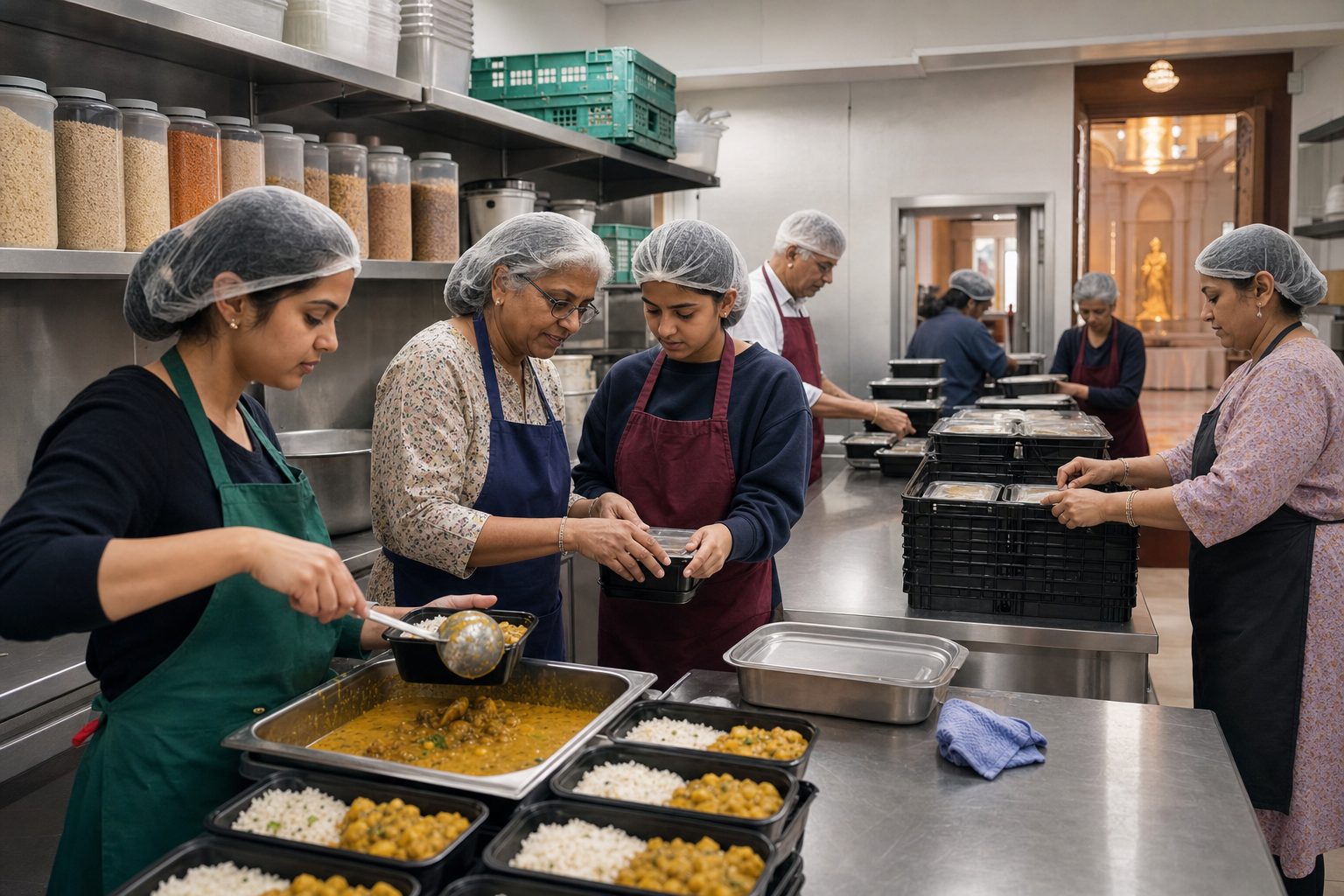
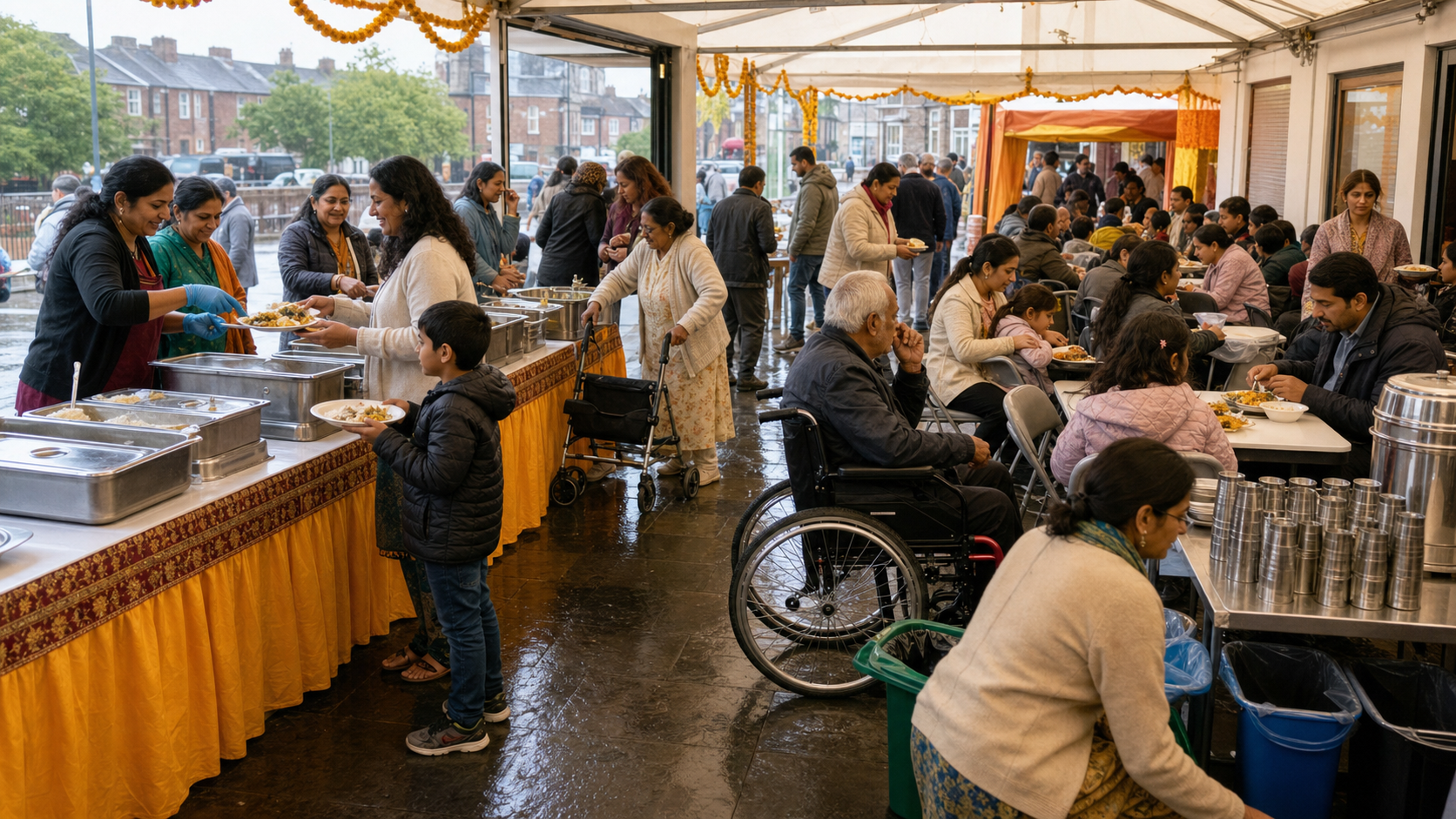
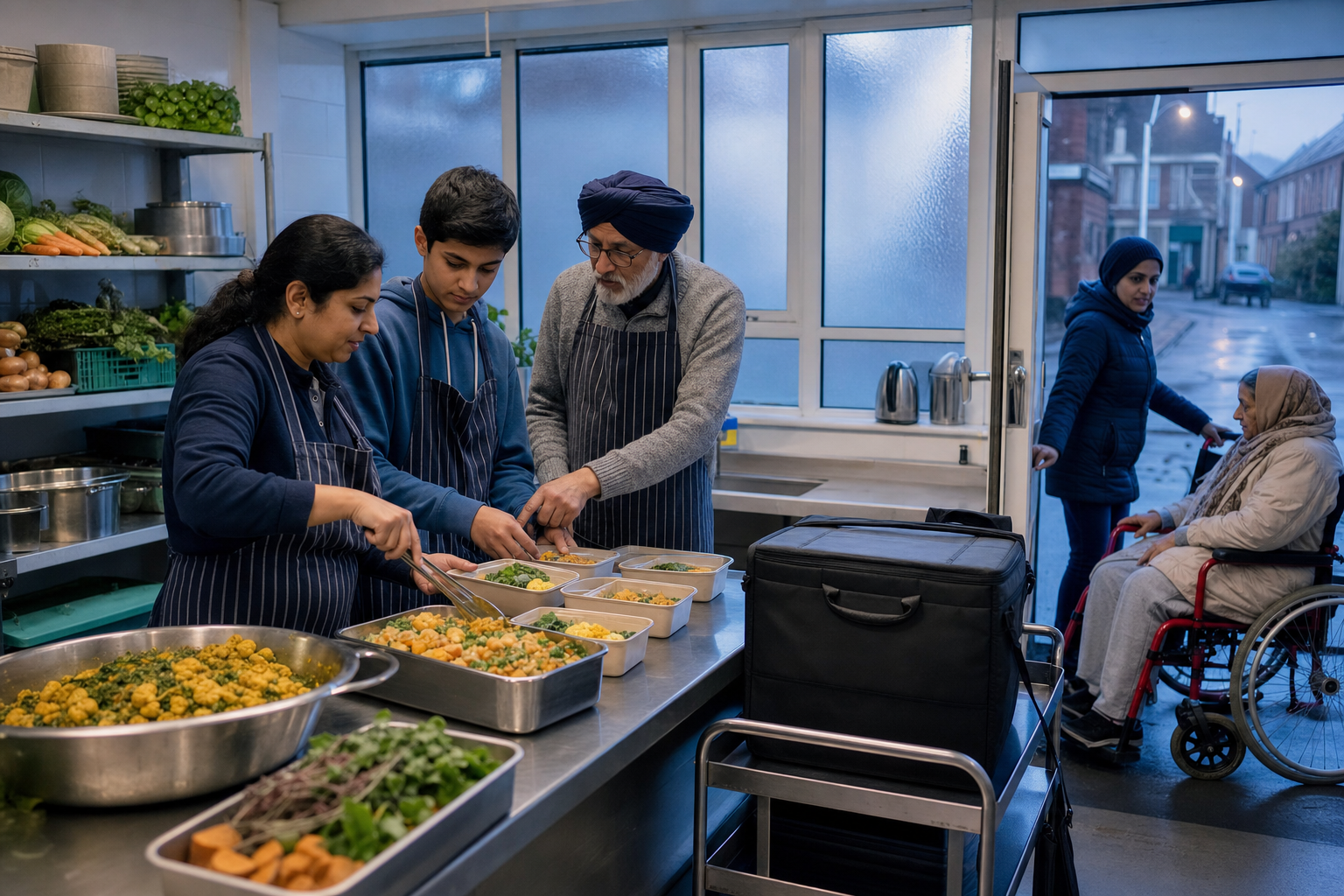
The practical work is easy to underestimate because, when done well, it almost disappears. Clear wayfinding, trained volunteer stewards, multilingual communication where useful, considerate queue management, family-friendly provision and an orderly prasadam service turn welcome from a sentiment into an operating system. Step-free access and seating for elders determine who can participate. A quiet area can make the event more manageable for visitors who find a dense crowd or continuous sound overwhelming.
If you organise a public festival, map the visitor’s journey before writing the dignitary list. Begin with the invitation: explain what the festival commemorates, what guests will see, how they should prepare and whom they can approach with questions. At the entrance, give responsibility to identifiable hosts. Inside, make the ritual sequence and queue direction visible. At prasadam, explain the devotional character of the food rather than treating it as ordinary catering. After the festival, ask visitors what remained unclear and give civic partners a named contact for the next conversation.
That final contact is crucial. Civic trust grows through repeated, low-friction relationships. A council officer, school leader, interfaith representative or neighbouring congregation should not have to begin again with a generic inbox every time. A functioning communications team acts as a bridge between the temple’s internal devotional rhythms and the different timelines of public institutions.
Evaluation need not become bureaucratic. Record the information that will improve the next decision: attendance, volunteer hours, youth and school participation, representation from other communities, accessibility problems, surplus-food handling and recurring visitor questions. Combine those records with short qualitative feedback. Footfall tells you scale; questions and follow-up requests tell you whether understanding and trust actually grew.
Judge institutional depth, not the size of the crowd
A temple can have a full calendar and still depend on a small, exhausted circle of organisers. It can also be modest in size while serving as a highly dependable local institution. If you are a donor, parent, volunteer, neighbour or civic partner, look for durable capability rather than spectacle.
| Dimension | Evidence of institutional depth | A weak substitute |
|---|---|---|
| Sacred continuity | Regular worship, kirtan, study, prasadam and intergenerational teaching supported by stable space | A large audience with little understanding of the tradition |
| Volunteer formation | Named roles, preparation, safeguarding of well-being, youth responsibility and succession | The same few people carrying every event |
| Local trust | Continuing relationships with neighbours, civic bodies, schools and other faith communities | A dignitary photograph without follow-up |
| Stewardship | Care for heritage, safe operations, accessible participation and responsible environmental conduct | A fundraising total disconnected from how the work was done |
| Learning | Feedback, outcome records, honest after-action review and visible improvements | Publicity reach treated as proof of impact |
Four cautions follow from this test. First, public recognition should not be confused with public accountability. Civic guests can validate a relationship, but the temple must still show what it delivers and how it learns. Second, interfaith friendship should not flatten distinct traditions into a lowest common denominator. Cooperation is stronger when each community can speak in its own moral and devotional vocabulary.
Third, heritage is not served by preserving a structure while neglecting the people who animate it. Renovation planning should include the worship, teaching, hospitality and volunteer systems that will use the restored space. Fourth, volunteer energy is not an unlimited resource. Clear roles, realistic scheduling, safety cut-offs and succession protect seva from becoming dependence on a few overextended families.
This is also where British ISKCON temples can make a distinctive contribution. They do not need to imitate a council office or secular charity. Their strength lies in connecting disciplined devotional practices to stable forms of belonging: people sing together, prepare and receive food, maintain sacred space, teach children, welcome strangers and accept responsibility for a shared task. Civic value appears when those practices become reliable enough that the wider community knows where to turn.
Key takeaways for your next decision
- If you are a worshipper or parent: ask where younger members receive real responsibility, preparation and mentorship. Intergenerational presence matters, but intergenerational capability is the stronger result.
- If you are a donor: look beyond the immediate building or event target. Ask how the project will strengthen worship, education, volunteer systems, accessibility and public relationships after the appeal ends.
- If you are an organiser: design safety, visitor orientation, access, feedback and follow-up as expressions of seva. They are not administrative extras added after the spiritual programme.
- If you represent a school or civic body: approach the temple early, identify a continuing contact and ask how visitors can encounter the tradition respectfully. Do not ask the temple to remove its devotional identity to make partnership easier.
- If you belong to another dharmic community: collaborate around concrete work such as heritage, hospitality, youth service or environmental responsibility while naming the distinct principles each tradition brings.
- Whatever your role: distinguish plans, outputs and lasting outcomes. A proposed challenge shows intention, a completed event shows delivery, and a stronger team or restored community asset shows institutional growth.
Before the next festival, appeal or civic invitation, choose one function that should remain stronger after the occasion is over. Name who owns it, decide what evidence would show improvement and give an outside partner a clear route into the work. If the temple can repeat that practice without losing its devotional centre, it is not merely hosting community activity. It is becoming part of the civic fabric.
References
- Dandavats – Scaling Britain’s Three Peaks: Leicester devotees unite to restore ISKCON Leicester’s heritage
- Dandavats – Rama Navami at Bhaktivedanta Manor: Devotion, Diversity, and Civic Leadership