
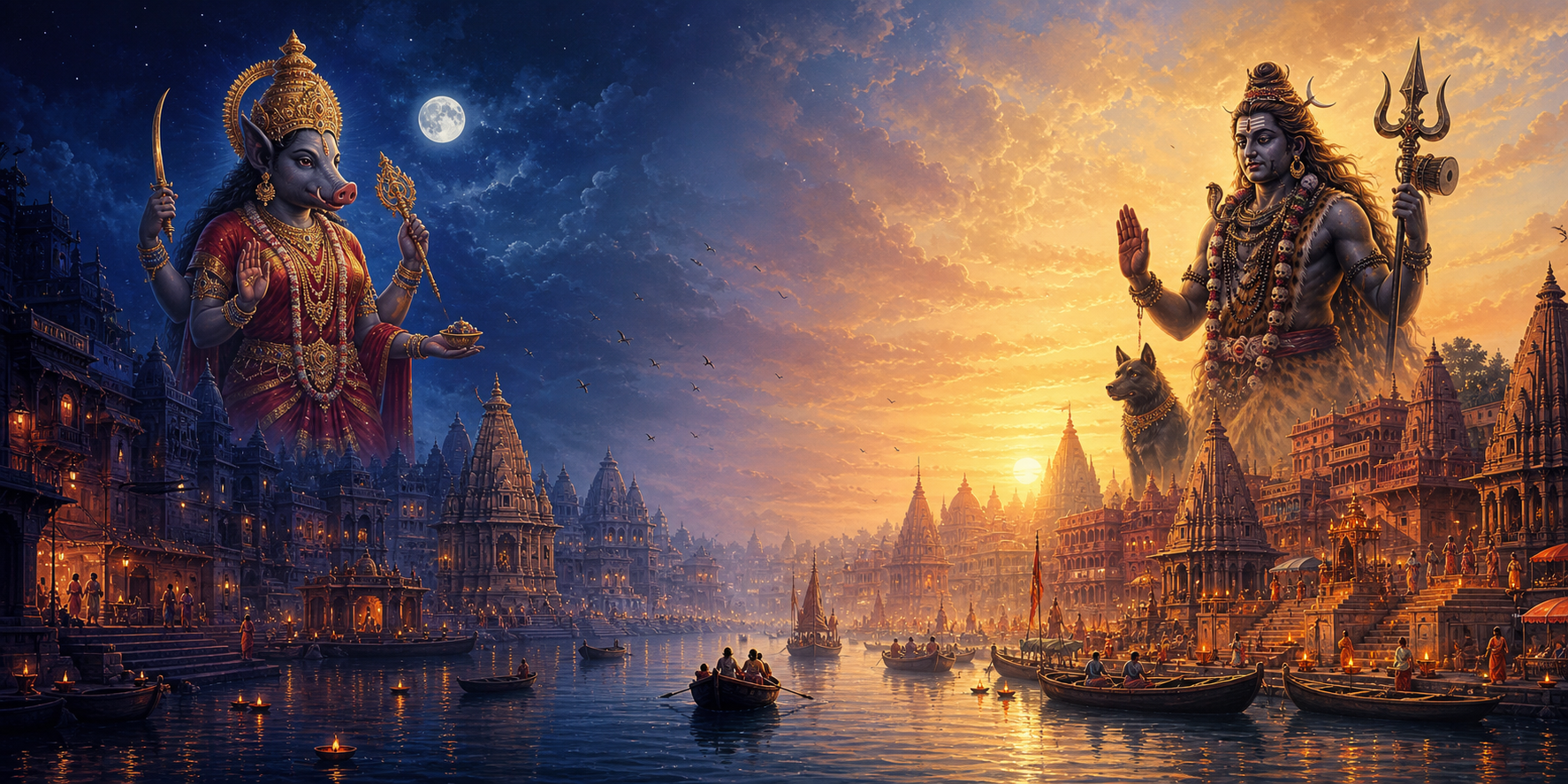
You may have heard two apparently competing answers to a simple question: who guards Kashi? One names Kalabhairava, while another names Goddess Varahi. You do not have to choose between them. The distinction rests on when and how their guardianship is contemplated.
Within a Kashi-specific sacred tradition, Goddess Varahi protects the city at night and Kalabhairava guards it by day. This pairing is most useful when you read day and night as complementary conditions of sacred protection, not as a literal change of duty in which one deity becomes absent.
The short answer: two guardians, two modes of protection

The local assignment is precise: Varahi is the nocturnal guardian, and Kalabhairava is the daytime guardian. Its precision matters, but so does its symbolic character. Divine guardianship is not a municipal watch schedule. The tradition uses the complete cycle of day and night to express protection that does not lapse.
- Varahi as nocturnal guardian: the protective power of Shakti is foregrounded when ordinary visibility recedes.
- Kalabhairava as daytime guardian: fierce Shaiva authority is foregrounded amid visible movement, decisions and boundaries.
- Kashi as the protected field: guardianship concerns the sacred order of the city, not merely physical security at its gates.
Hold all three points together. If you treat the language as logistics, you shrink the theology. If you turn Varahi and Kalabhairava into vague, interchangeable energies, you erase the deities whom devotees actually worship. A sound understanding respects both their personal forms and the meanings disclosed through those forms.
Why Kashi’s guardianship is divided between day and night
A holy city needs no protection only when we imagine holiness as fragile decoration, safely removed from ordinary life. Kashi’s sacred vision is more demanding. It places divine order within a full cycle: brightness and darkness, public action and concealed conduct, clarity and uncertainty. The day-night pairing says that no part of that cycle lies outside sacred attention.
Only the assignment in the second column below is the local traditional claim. The other columns offer a disciplined way to contemplate it; they should not be mistaken for a fixed canonical glossary.
| Guardian | Role in the Kashi tradition | Contemplative lens | Question for the devotee |
|---|---|---|---|
| Goddess Varahi | Guardian by night | Protective Shakti when normal visibility and certainty recede | What must you guard when no one else can see your conduct? |
| Kalabhairava | Guardian by day | Fierce Shaiva authority amid time, action, limits and visible boundaries | What must you keep in right order while acting in the world? |
Night in this reading is not evil, and daylight is not automatically pure. Each presents a different spiritual problem. Darkness tests awareness when familiar cues weaken. Daylight tests discipline when activity, choice and distraction multiply. Varahi and Kalabhairava therefore need not be ranked or made to compete. Their pairing depicts guardianship as continuous and complete.
The pairing of a fierce form of Devi with a fierce form of Shiva also protects the teaching from becoming one-sided. Power without boundary can become disorder; boundary without living power can become sterile control. Read together, Varahi and Kalabhairava express active protection governed by sacred order.
How to read each guardian without reducing the deity to a symbol
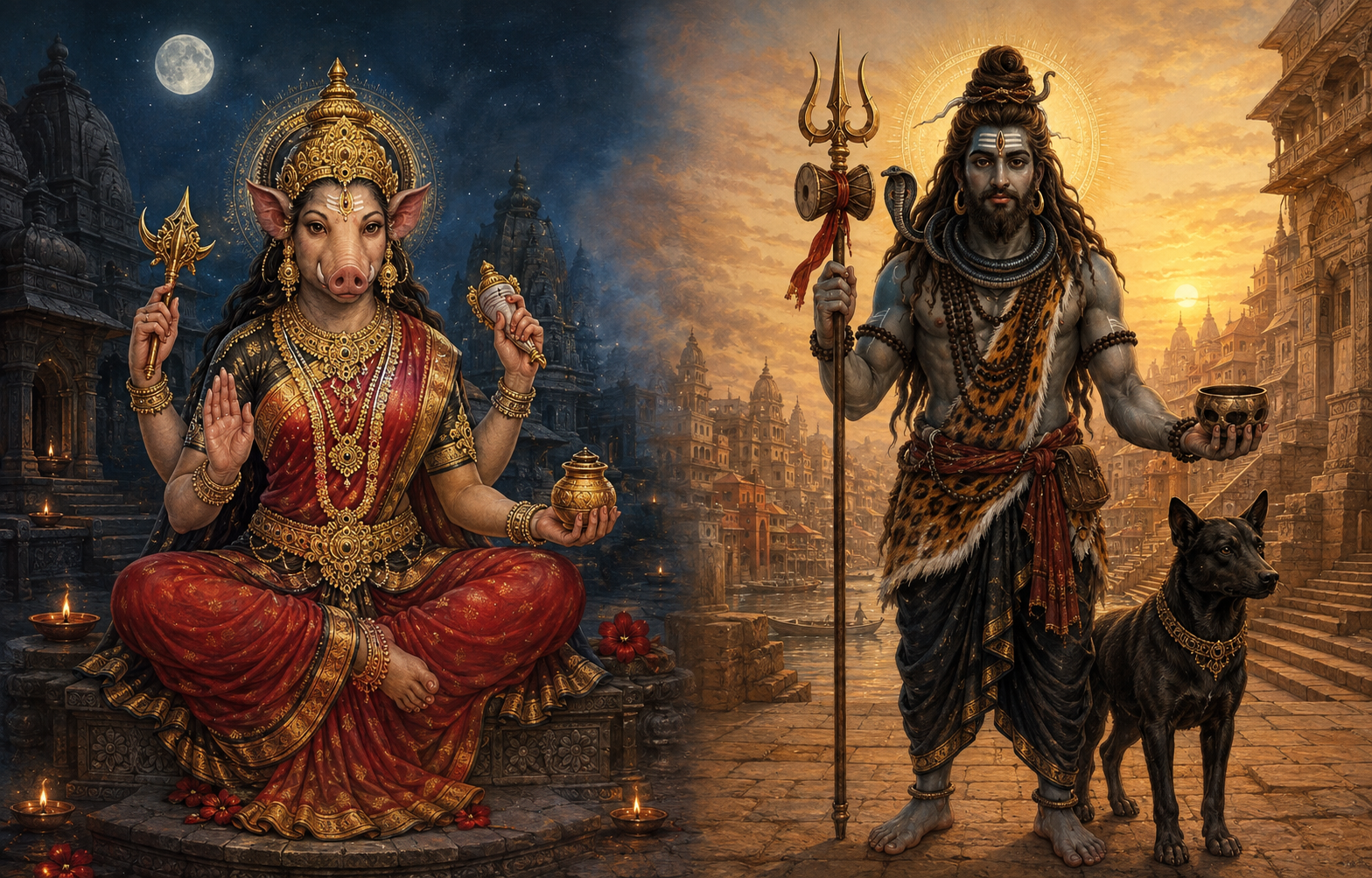
There are two common mistakes here. The first is excessive literalism: imagining that the deities exchange control at a particular hour like human guards. The second is excessive abstraction: speaking only about psychological qualities until the worshipped forms disappear. A Dharmic reading can recognise symbol, deity, place and practice at the same time.
Varahi: protection when ordinary sight is insufficient
Varahi is a fierce form of Devi associated with boar imagery and Tantric worship. Her nocturnal guardianship can be contemplated as the action of Shakti where ordinary sight is no longer enough. Night conceals, quiets and removes many of the signals by which people usually regulate themselves. Protection under those conditions must reach deeper than outward supervision.
You can apply that meaning without pretending to perform a temple rite. Before sleep, identify one area in which your standards weaken when no one is watching: speech on a private channel, an indulgent habit, resentment repeatedly rehearsed, or a promise quietly neglected. Set one clear restraint for that vulnerable period. This is an ethical contemplation inspired by the symbolism, not a prescribed Varahi ritual.
Kalabhairava: accountability within time and visible action
Kalabhairava is a fierce form of Shiva. His fierceness is not well understood as random aggression. It points toward uncompromising authority: time has consequences, limits matter, and sacred boundaries cannot be treated as optional whenever convenience intervenes. His daytime guardianship places that authority amid the visible flow of work, travel, exchange and decision.
For daytime contemplation, choose one boundary that your activity tends to blur. It might concern truthful speech, the use of another person’s time, a duty repeatedly postponed, or the line between legitimate ambition and harmful conduct. Name the boundary before the day’s momentum takes over. Again, this is a practical reflection, not a claim that it reproduces formal Kalabhairava worship.
If your lineage associates Kalabhairava strongly with night, worships Varahi at another time, or gives either deity a different ritual function, do not manufacture a contradiction. Hindu traditions can hold pan-Indian meanings, regional sacred geography, temple custom and lineage-specific practice at once. The day-night guardianship discussed here belongs specifically to Kashi’s local sacred imagination. It does not invalidate other authorised arrangements.
How to approach the tradition during worship or a Kashi visit
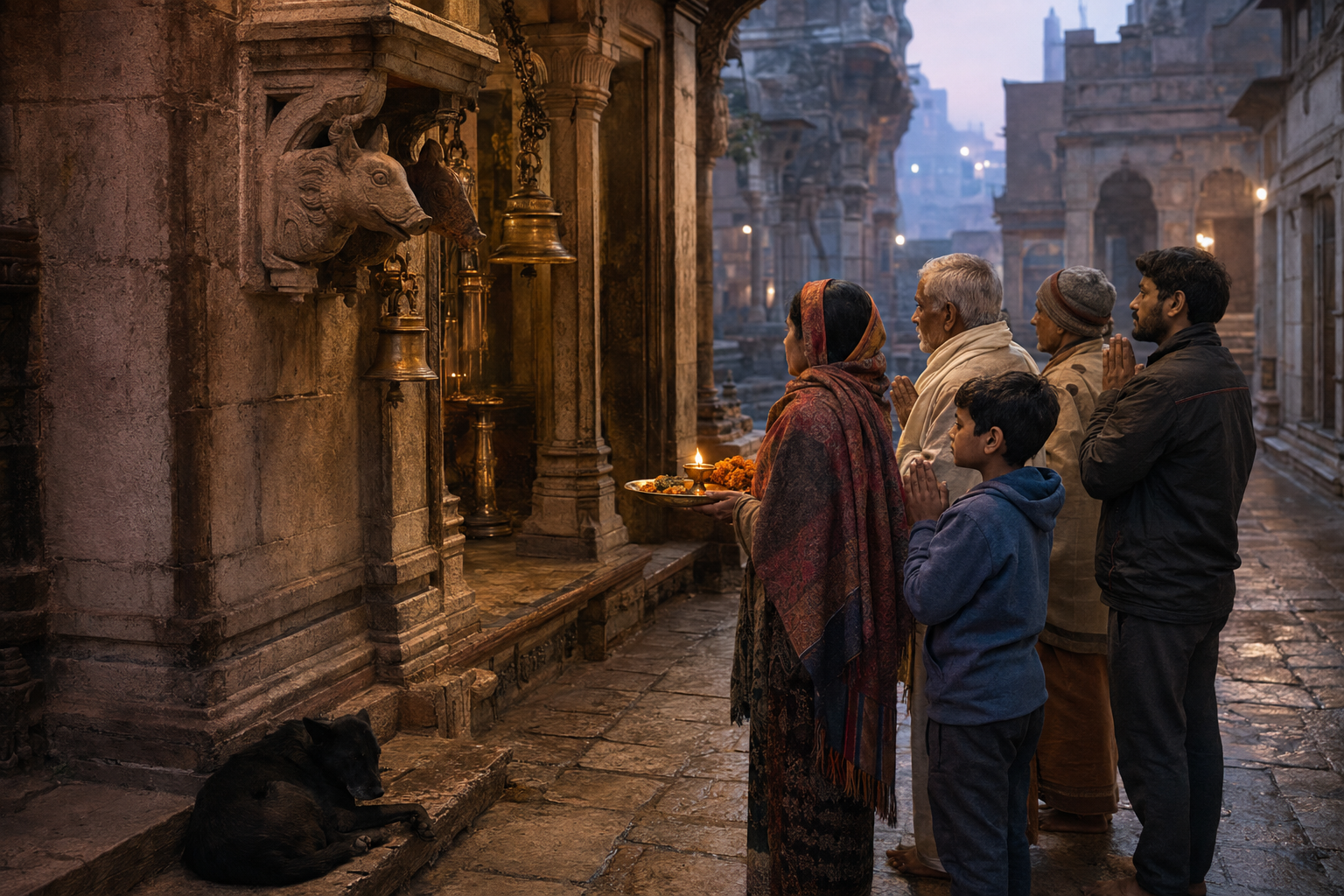
The day-night distinction can deepen your darshan, but it should not make you invent procedures. If you plan to visit Kashi or speak about its guardians, use the following sequence.
- Name the teaching accurately. Say that a local Kashi tradition regards Varahi as guardian by night and Kalabhairava as guardian by day. Do not present that arrangement as the only Hindu understanding of either deity.
- Separate sacred symbolism from practical opening hours. A deity’s nocturnal or daytime role does not, by itself, tell you when a shrine admits visitors. Confirm current timings and local rules directly before travelling.
- Do not turn complementary guardians into rivals. Asking which deity is more powerful misses the point. The pairing concerns unbroken protection across different conditions.
- Carry a focused question into darshan. Before Varahi, consider what remains unguarded when awareness dims. Before Kalabhairava, consider which boundary your visible actions must respect. A precise question is more useful than collecting unexplained iconographic details.
- Keep formal Tantra within proper guidance. Do not infer a mantra, initiation, nyasa, offering, midnight observance or other specialised procedure from the guardian symbolism alone. Follow the established custom of the temple or the instruction of a qualified lineage teacher.
If you need to explain the tradition in one sentence, keep it simple: Kashi remembers Varahi as its protective Shakti by night and Kalabhairava as its fierce Shaiva guardian by day, expressing protection through the whole cycle. That formulation preserves the local claim without pretending to settle every theological question around the two deities.
Key takeaways
- Varahi is honoured as Kashi’s nocturnal guardian, while Kalabhairava is honoured as its guardian by day.
- The division describes complementary sacred roles, not a literal shift change or a limit on either deity’s power.
- Varahi’s place in the pairing foregrounds protective Shakti under conditions of obscurity and reduced ordinary awareness.
- Kalabhairava’s place foregrounds fierce Shaiva authority amid time, boundaries and visible action.
- The arrangement is a Kashi-specific local tradition; actual worship should follow the relevant temple or lineage rather than an improvised symbolic interpretation.
The next time someone asks who guards Kashi, resist the urge to answer with only one name. Give the day-night distinction, identify it as a local tradition, and let its deeper demand remain intact. Guard what becomes hidden under Varahi’s night, and keep your visible conduct within rightful limits under Kalabhairava’s day.
References
