

When a dispute involves a Shankaracharya, a temple committee, government officials, or a large Hindu organisation, you may feel pressed to choose a side before the facts are clear. That pressure is itself part of the problem. A dharmic response must protect the dignity of the acharya, establish what happened, and correct institutional failures without turning incomplete claims into collective accusations.
You can revere the Shankaracharya office and still insist on evidence. You can defend the autonomy of a matha and still recognise legitimate requirements of safety and temple administration. Unity in the parampara does not mean suppressing disagreement. It means handling disagreement without degrading the lineage, confusing jurisdictions, or making devotees carry the cost of an avoidable institutional quarrel.
Unity must protect the peethas without merging them
The familiar four-peetha framework comprises Govardhan Matha at Puri, Sringeri Sharada Peetham, Dwarka Sharda Peeth, and Jyotirmath at Joshimath. These institutions preserve Vedic learning, Advaita Vedanta, monastic discipline, spiritual counsel, and the continuity of guru-shishya transmission. Their authority cannot be reduced to ceremonial visibility at public events.
At the same time, unity does not require the four peethas to behave like branches of one central bureaucracy. A living parampara contains distinct lineages, inherited practices, responsibilities, and institutional histories. Attempts to produce unity through forced uniformity can weaken the very continuity they claim to defend.
Three distinctions help you judge whether a call for unity is sound:
- Solidarity is not automatic endorsement. One peetha can defend the dignity and fair treatment of another without accepting every factual claim or public statement connected with a dispute.
- Respect for an office is not a verdict about an incident. The Shankaracharya office deserves maryada even while the conduct of particular officials, organisers, or representatives is being investigated.
- Coordination is not centralisation. Shared protocols for visits, ceremonies, and dispute resolution do not give one peetha jurisdiction over the doctrine or internal succession of another.
This is the form of unity worth defending: each peetha retains its integrity, all four recognise a common responsibility toward the parampara, and none allows a manageable disagreement to become public contempt for a sacred institution.
Decide who governs what before deciding who failed
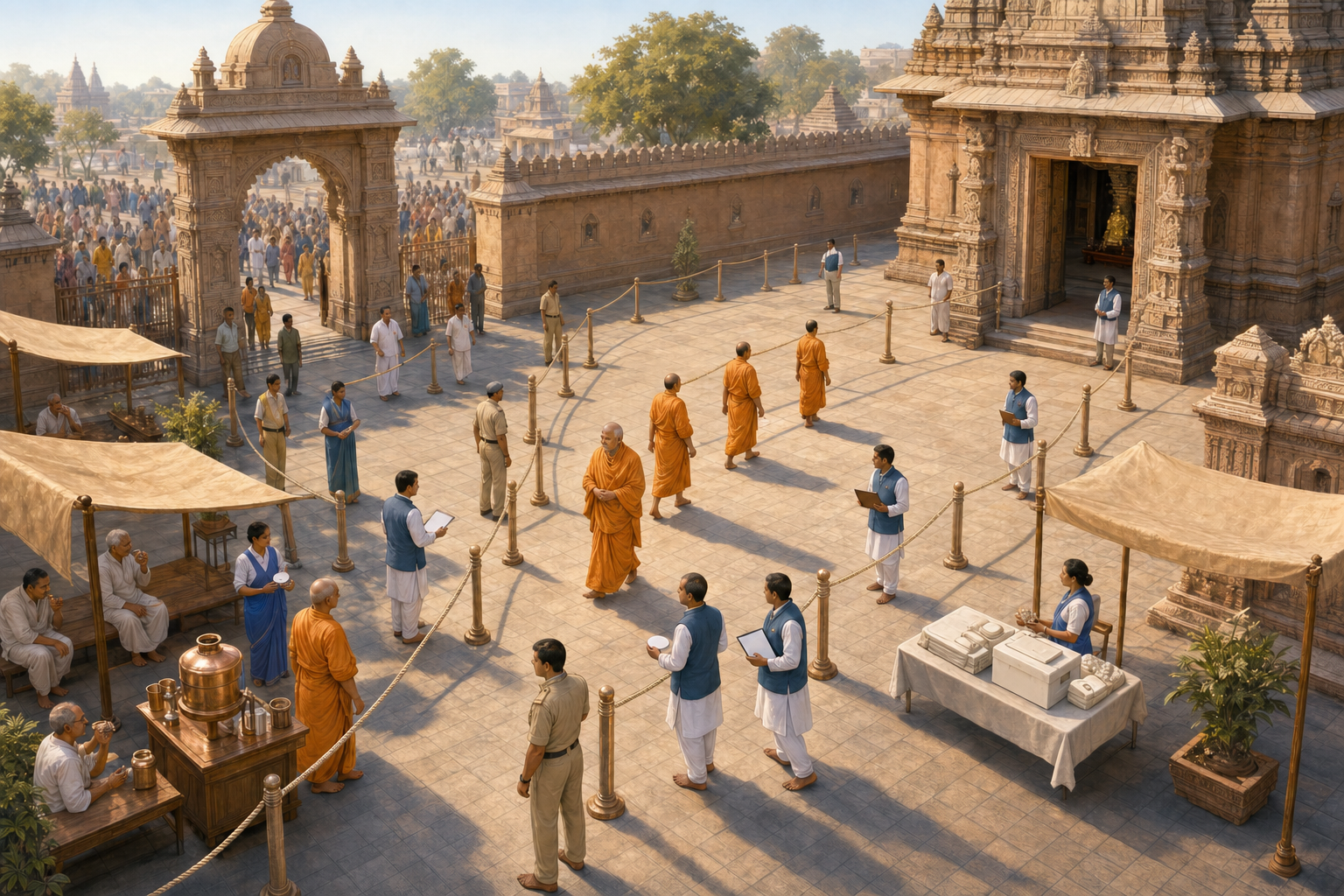
Many clashes that appear ideological begin as failures at an institutional handoff. A matha expects customary honours. A temple committee is working from a statutory or operational procedure. Security personnel receive instructions about access but no briefing about religious precedence. Volunteers then improvise in front of devotees. By the time senior leaders hear about the problem, an avoidable mistake has acquired political meaning.
The first remedy is to distinguish the principal spheres of responsibility:
| Institutional sphere | Primary responsibility | What it should not decide alone |
|---|---|---|
| Shankaracharya and matha | Scriptural teaching, monastic discipline, liturgical propriety, spiritual counsel, and preservation of the lineage | Crowd movement, emergency controls, finances, or public-service operations at a large statutory temple |
| Temple committee | Infrastructure, finances, access systems, pilgrim services, scheduling, and implementation of applicable rules | The spiritual validity of a lineage or the removal of customary honours without informed dialogue |
| Security and law-and-order personnel | Safety, routes, restricted areas, emergency response, and crowd control | Theological rank, monastic status, or ceremonial precedence |
| Devotees and civil-society organisations | Documenting concerns, seeking accountability, supporting reconciliation, and protecting the sanctity of public discourse | Assigning guilt through crowds, rumours, blanket allegations, or partisan retaliation |
These boundaries are not walls. They identify where coordination is required. A security restriction can be legitimate and still be communicated disrespectfully. A customary honour can be spiritually important and still require advance operational planning. A temple board can possess administrative authority without acquiring authority over shastra. A monastic institution can command reverence without independently controlling every aspect of a public pilgrimage system.
Articles 25 and 26 of the Indian Constitution place religious freedom and denominational autonomy alongside public order, health, and morality. That framework does not settle every operational disagreement in advance. It makes disciplined role definition more important. The exact legal position in a particular temple depends on its governing law and the facts, but neither spiritual dignity nor administrative power should be used as a pretext for institutional overreach.
When you assess a controversy, therefore, ask a narrower question before a louder one: which institution controlled the disputed decision? If a security officer acted from an incomplete briefing, that is different from a temple committee formally rejecting customary protocol. If an unauthorised volunteer spoke rudely, that is different from an organisation adopting a hostile policy. Accountability becomes possible only after the responsible level has been identified.
Maryada becomes dependable when protocol is explicit
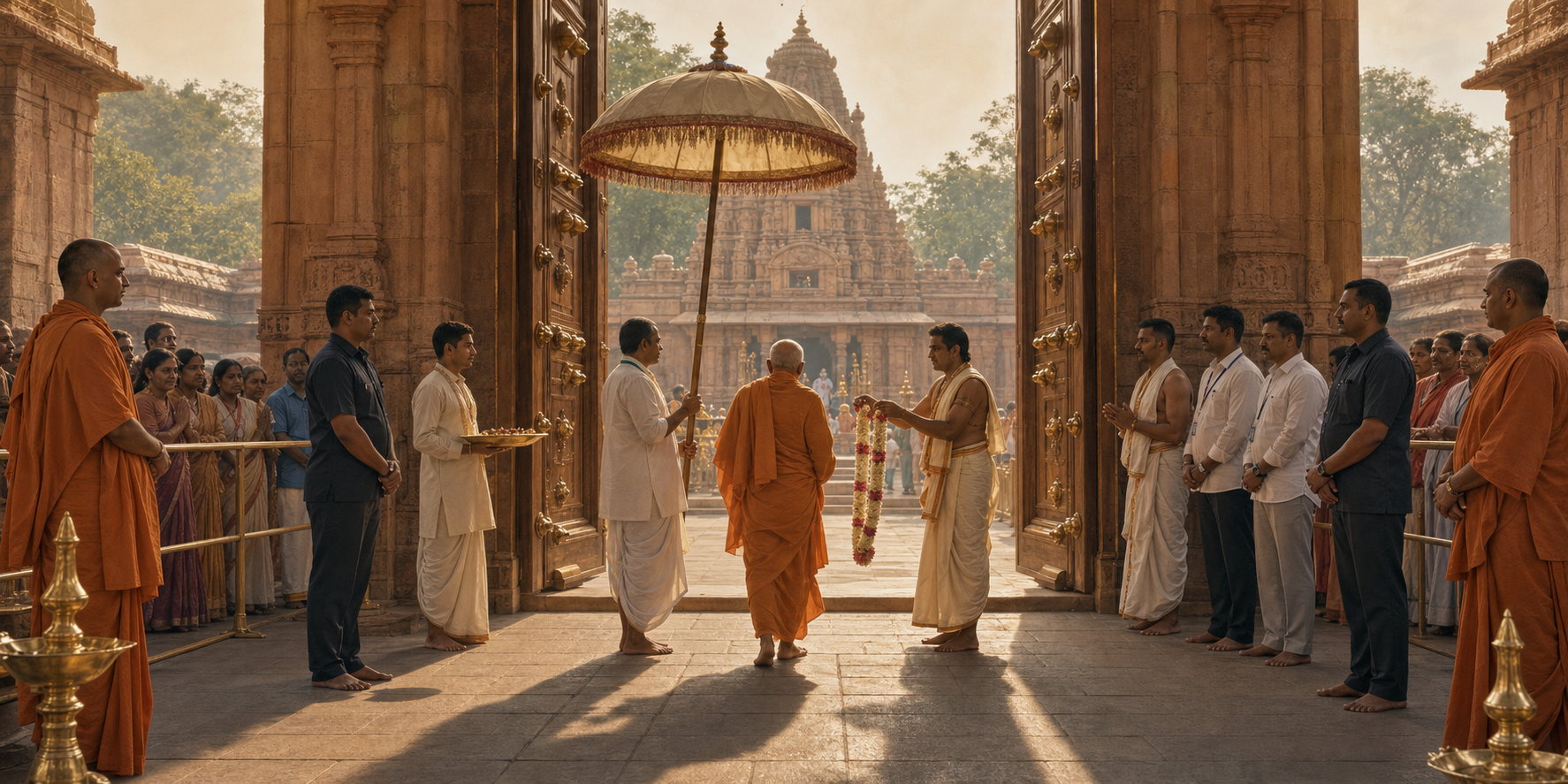
Reverence cannot be manufactured by paperwork, but predictable conduct can. A written protocol prevents spiritual dignity from depending on whether the official standing at a gate happens to understand the Shankaracharya parampara. It also prevents administrators from receiving last-minute demands they cannot safely implement.
For visits by a Shankaracharya to a major temple or pilgrimage centre, a concise protocol should cover eight matters:
- Advance notice. The matha communicates the expected date, time, accompanying party, intended observances, and any access requirements through an agreed channel.
- Named liaison officers. The matha and temple administration each appoint one person empowered to resolve routine questions. Security personnel should know both names.
- Arrival and movement. The parties agree on the entry point, route, waiting arrangements, escort, restricted areas, and any crowd-management adjustments before the acharya arrives.
- Customary honours. The protocol identifies the welcome, seating, darshan arrangements, ceremonial precedence, and authorised representatives. Staff should not have to infer these customs at the last moment.
- Operational briefing. Temple staff, volunteers, and security teams receive a short explanation of the Shankaracharya office and the conduct expected around the acharya. The briefing must reach the personnel who will actually control access, not remain in a senior official’s file.
- Escalation path. A disagreement at the site goes first to the two liaison officers and then, if necessary, to named senior representatives. Public argument at a chokepoint should never become the default dispute mechanism.
- Contemporaneous record. Changes, refusals, delays, and remedial decisions are recorded with times and responsible officials. This protects both the matha and the administration from later exaggeration.
- Public correction when needed. If something goes wrong, the responsible institution states the verified facts, the remedy, and the preventive change. A sober correction serves devotees better than competing declarations of outrage.
The useful protocol is the one a gate officer can follow. A document that invokes respect in general terms but leaves the arrival route, point of contact, and escalation authority undefined will fail at the exact moment it is needed.
A permanent dharmic liaison mechanism could maintain these arrangements across recurring events. Representatives of the four peethas and selected temple boards would not form a new theological authority. Their limited purpose would be to keep contact information current, preserve agreed procedures, prepare staff, and address friction before it becomes a public confrontation. That narrow mandate is important: coordination should strengthen the peethas, not create an unaccountable institution above them.
Disputes need peer counsel, evidence, and proportionate repair
Former CBI Director M. Nageswara Rao has asked the Shankaracharyas of Puri, Sringeri, and Dwarka to counsel and mediate amid public allegations that the Jyotirmath Shankaracharya, Swami Avimukteshwaranand Saraswati, suffered discourtesy or obstruction. Because the alleged treatment remains contested in public discussion, devotees should neither dismiss the concern nor convert it into settled collective guilt. The right response is prompt, credible fact-finding under conditions that preserve maryada.
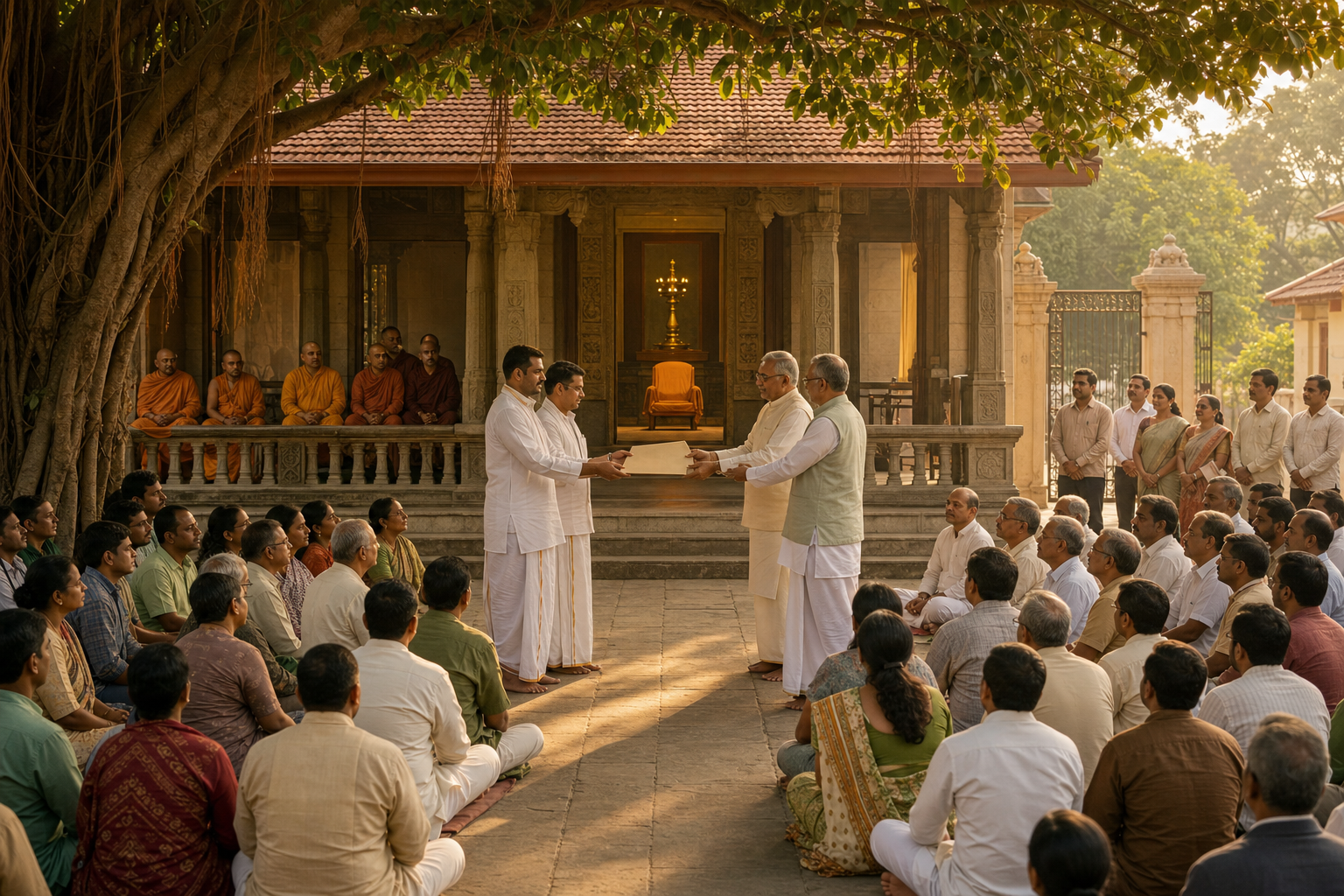
Peer intervention is valuable because the question is larger than ordinary event management. Senior acharyas can recognise the spiritual weight of the office, distinguish a breach of sampradaya from a logistical error, and encourage correction without making the dispute a contest for political ownership. Their role is strongest when it is conciliatory and evidentiary rather than performative.
A disciplined reconciliation process should proceed in this order:
- Define the allegation precisely. Record the act said to have occurred, its time and place, the people directly involved, the applicable protocol, and the remedy being requested. Separate eyewitness testimony from inference and later commentary.
- Protect dignity during the inquiry. Adopt interim arrangements for future access and communication. Fact-finding should not require the acharya or the accused officials to endure a repeat confrontation.
- Hear the parties in a confidential setting. Obtain the matha’s account, the administration’s instructions, security records, and relevant testimony before attempting a joint resolution. Public pressure should not substitute for examination.
- Distinguish kinds of failure. A personal lapse, an unclear rule, a training failure, a deliberate institutional decision, and a disputed customary claim require different responses.
- State what is established and what remains unresolved. A trustworthy outcome does not pretend certainty where evidence is incomplete. It can still identify procedural weaknesses and order preventive changes.
- Match the remedy to the failure. Possible responses include an acknowledgement, apology, restoration of customary honours, staff retraining, disciplinary review, protocol revision, or clarification that a widely circulated allegation was not established.
- Communicate without triumphalism. Devotees need to know that dignity was restored and procedures were corrected. They do not need one institution to humiliate another in the name of vindication.
This process allows accountability without factional warfare. It also protects innocent volunteers and officials from being condemned for decisions they did not make. Ahimsa in institutional life is not passivity. It is the refusal to inflict unnecessary reputational and communal harm while pursuing truth and correction.
A workable 90-day sequence
A time-bound process prevents temporary outrage from being followed by permanent neglect. The following sequence is an administrative proposal, not a claim about canonical procedure:
- Within 30 days: convene a confidential fact-finding and reconciliation meeting, identify the responsible decision points, and adopt interim arrangements for acharya visits.
- Within 60 days: brief security and administrative staff, test the escalation chain, and improve signs or access instructions at sensitive chokepoints.
- Within 90 days: finalise a concise protocol charter endorsed by the participating peetha or peethas and the relevant temple administration, then communicate its operational provisions to devotees and staff.
The next significant visit or festival should then function as a practical test. Smooth facilitation is more persuasive than a declaration that harmony has been restored. If staff still do not know whom to call, the protocol is not finished.
Key takeaways for devotees and Hindu organisations
- Honour the office before debating the incident. No investigation requires mockery, obstruction, or careless language toward a Shankaracharya.
- Ask for the exact allegation. Look for the disputed act, time, place, responsible authority, applicable custom, and requested remedy. A general claim of disrespect is a reason to investigate, not yet a complete finding.
- Separate a person from an institution. Do not turn one official’s conduct into a verdict on an entire temple board, volunteer network, political organisation, or monastic lineage without evidence of an institutional decision.
- Prefer peer mediation to public combat. Counsel from senior acharyas can preserve spiritual dignity while administrators establish operational facts.
- Demand a working protocol. Advance notice, named contacts, customary honours, access arrangements, trained staff, and an escalation path should be settled before the next visit.
- Look for proportionate repair. An apology may answer personal discourtesy; recurrent obstruction may require training, disciplinary review, or a formal protocol change. Different failures need different remedies.
- Judge unity by conduct. The relevant test is whether the peethas can support one another’s dignity, retain their distinct authority, and resolve disagreements without public degradation.
You do not have to choose between defending tradition and demanding accountable governance. The Shankaracharya parampara needs both: reverence that understands what the office represents, and procedures strong enough to protect that reverence under modern administrative conditions.
When the next controversy appears, pause before forwarding the loudest accusation. Ask who made the decision, what evidence exists, which protocol applied, who can mediate, and what repair would prevent a recurrence. Support the response that answers those questions while preserving maryada. That is how devotees can help turn institutional unity from a slogan into a disciplined dharmic practice.

References
