
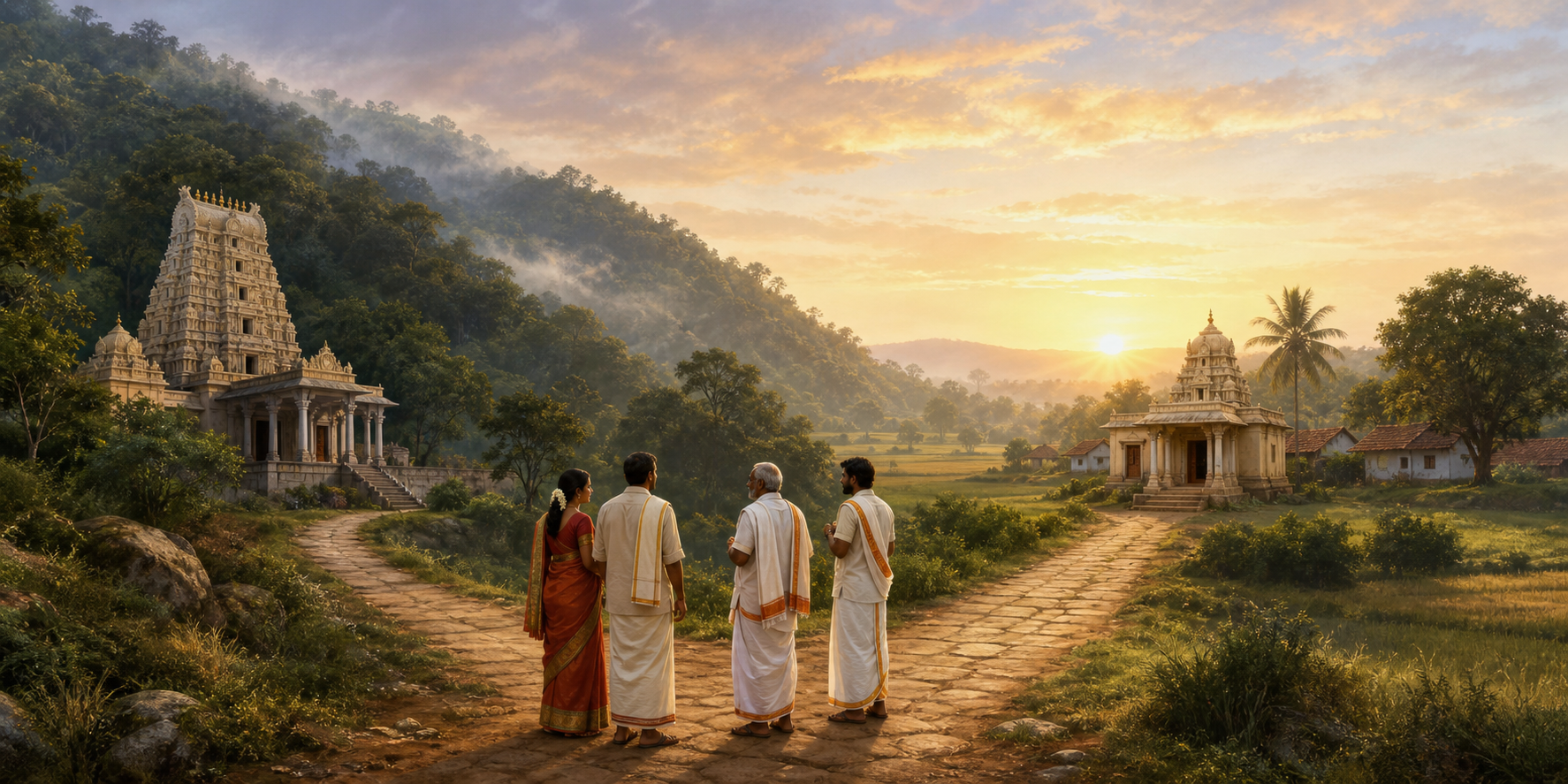
If you search for an Anantha Padmanabha Swamy temple in Telangana, check the location before planning your journey. The name can lead you to two distinct Vishnu shrines: one at Ananthagiri in Vikarabad district and another at Penjerla, near Kothur in Ranga Reddy district.
Both invite contemplative worship, but they are not interchangeable destinations. Ananthagiri is especially connected with Puranic sacred memory and a serene natural setting. Penjerla is known for its Swayambhu association and its accessibility as a quiet pilgrimage from Hyderabad. Choosing between them becomes easier once you know what each place offers.
First, identify which Anantha Padmanabha temple you mean
| Question | Ananthagiri temple | Penjerla temple |
|---|---|---|
| Where is it? | Ananthagiri, Vikarabad district, Telangana | Penjerla village, Kothur Mandal, Ranga Reddy district, Telangana, near Hyderabad |
| What distinguishes it? | A traditional account associated with the Skanda Purana, an ancient-temple identity and a tranquil landscape | A Swayambhu tradition, modest South Indian temple design and a peaceful village setting |
| What kind of visit suits it? | A pilgrimage centred on sacred memory, reflection and the atmosphere of Ananthagiri | An unhurried temple visit or calm day excursion from Hyderabad |
The quickest way to avoid a wrong turn is to save the full place name rather than only the deity’s name. For Ananthagiri, note “Vikarabad district.” For Penjerla, note “Kothur Mandal, Ranga Reddy district.” This distinction matters when asking for directions, arranging transport or sharing the destination with family members.
Do not rely on a photograph alone. Temple images may emphasize the deity, entrance or surrounding greenery without making the location obvious. Confirm the village and district, then verify current opening and worship times locally before leaving. Neither shrine should be assigned a precise daily schedule without an up-to-date local confirmation.
Understand the form of Vishnu before entering the sanctum

Anantha Padmanabha is a form of Lord Vishnu connected with Ananta, the cosmic serpent, and with the enduring order of creation. “Padmanabha” identifies Vishnu with the lotus arising from his navel. The familiar theological image is therefore not merely one of rest. It expresses preservation, continuity and stability at the cosmic level.
That meaning gives you a useful focus for darshan. You need not approach the shrine with an elaborate request. You can contemplate what must be preserved in your own life: dharma under pressure, steadiness in family duties, discipline in work, or clarity when circumstances feel unsettled. The form of Anantha Padmanabha turns stillness into an active spiritual principle. Preservation is not passivity; it is the disciplined protection of right order.
Do not assume, however, that every temple bearing this name must display identical iconography or follow an identical local tradition. The deity’s theological identity is shared, while the history, physical setting and devotional memory of each kshetra remain particular to that place. Let the actual sanctum and its established practice guide your attention rather than arriving with demands based on another temple.
Choose Ananthagiri for Puranic memory and contemplative space
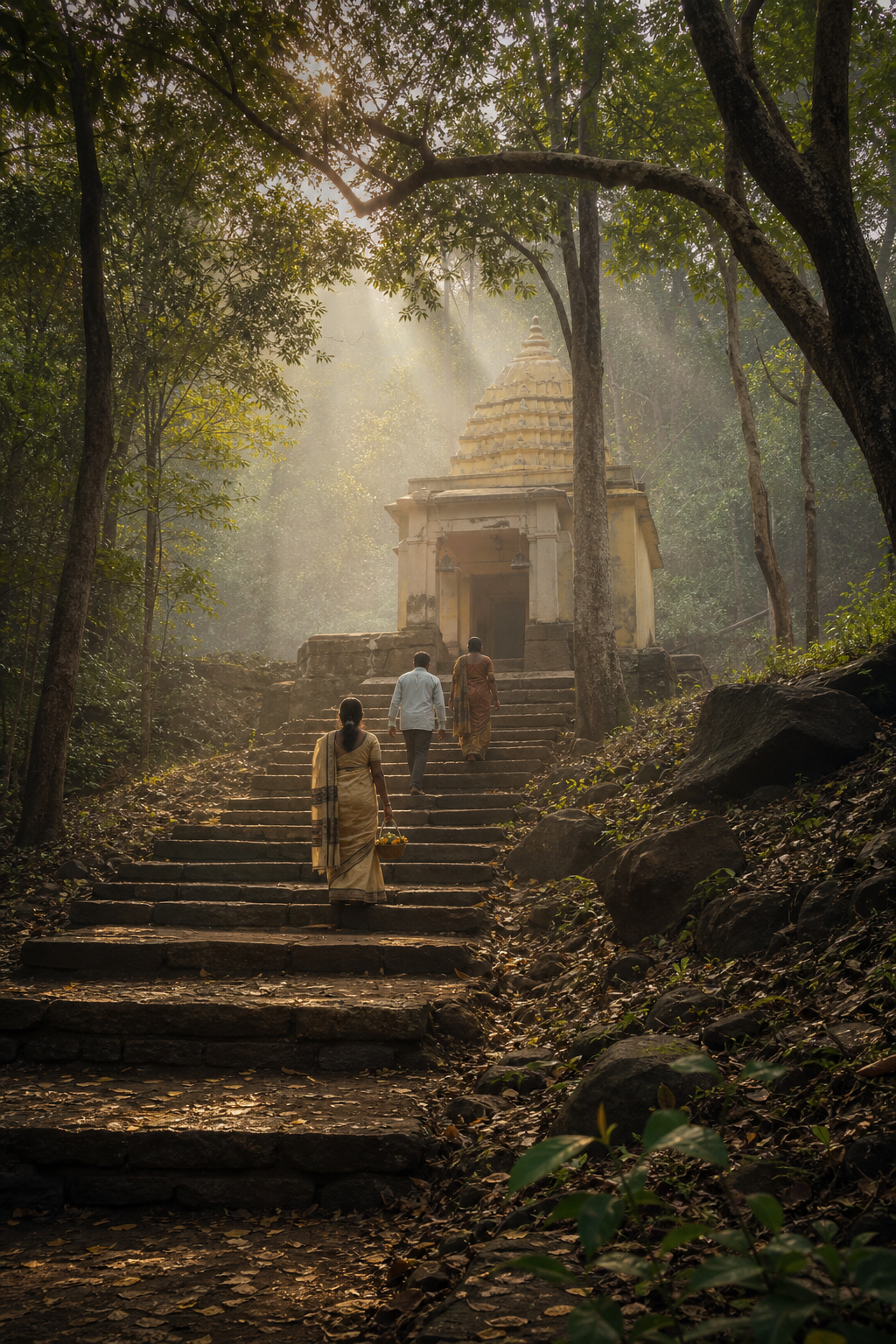
The Ananthagiri shrine in Vikarabad district is associated with a traditional account in the Skanda Purana: Rishi Markandeya is believed to have consecrated it during the Dwapara Yuga. That statement belongs to the sacred chronology of Purana and living temple tradition. It should not be converted into a modern archaeological date, but neither should it be dismissed as decorative folklore. It tells you how generations of devotees have understood the sanctity of the place.
This distinction helps you visit intelligently. A Puranic account answers a devotional question—why this place is sacred within inherited memory—rather than supplying the kind of date established through inscriptions, excavation or modern historical method. You can honour the tradition without pretending that two different forms of knowledge are the same.
Ananthagiri is the stronger choice when the setting itself is part of your pilgrimage. Its gentle landscape, trees, bells and measured rhythm of worship support quiet reflection. Instead of treating the temple as a brief stop before moving on, leave enough room for unhurried darshan and a period of silence afterward. A visit shaped this way is better suited to the character of the place than a rushed circuit organized around photographs.
The Vishnu Sahasranama is an appropriate recitation if it already belongs to your practice. Otherwise, a shorter nama-japa or silent contemplation is enough. The point is not to manufacture complexity. It is to let Vishnu’s association with preservation and cosmic order give form to your attention.
Choose Penjerla for Swayambhu devotion near Hyderabad
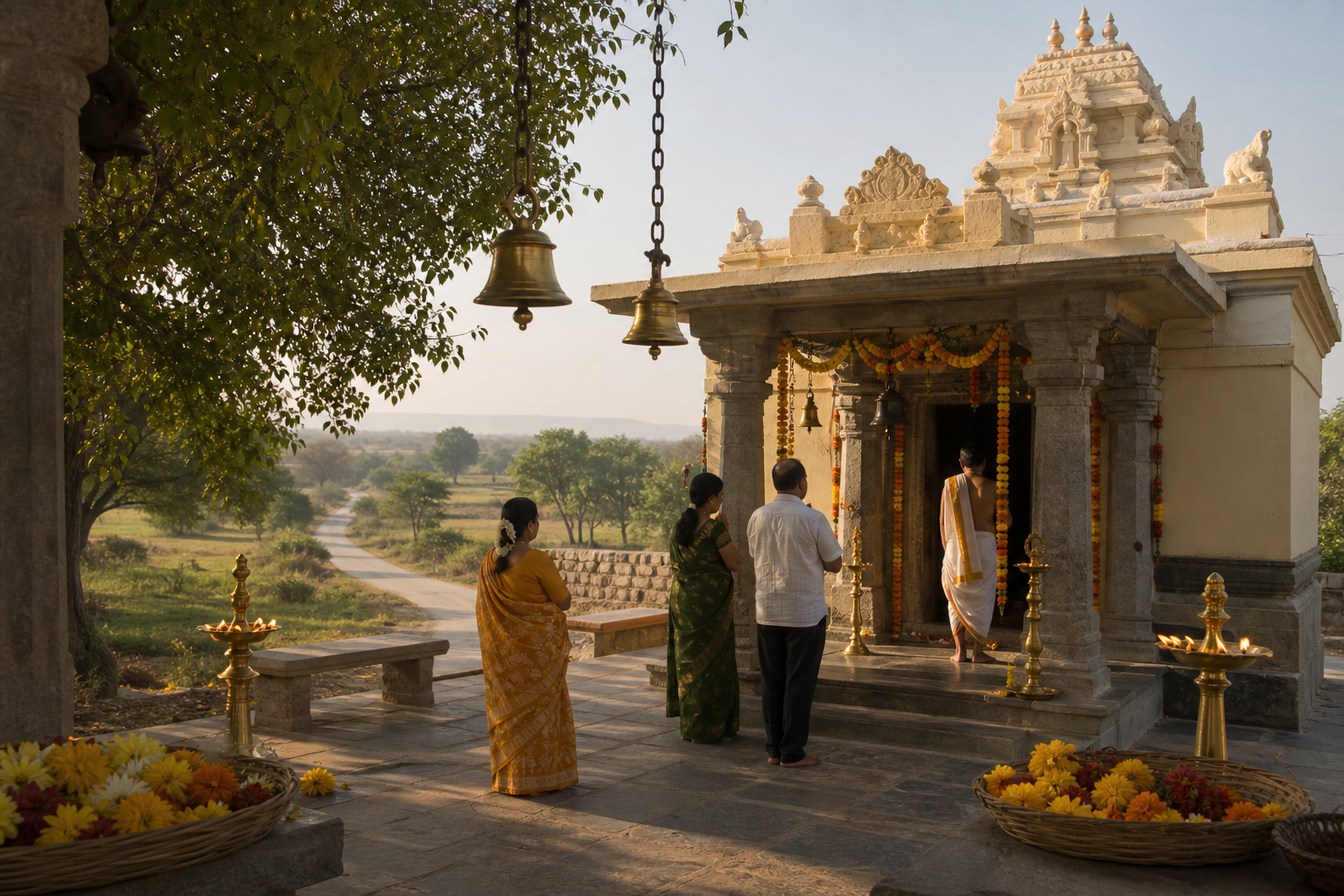
The Penjerla Anantha Padmanabha Swamy Temple stands in Penjerla village in Kothur Mandal, Ranga Reddy district. Its proximity to Hyderabad makes it suitable when you want a focused pilgrimage without turning the day into a complicated multi-stop journey.
Penjerla is commonly revered as a Swayambhu kshetra. In temple vocabulary, Swayambhu means self-manifested: the divine presence is understood as having appeared by itself rather than being established through an ordinary human act of installation. Receive this as a devotional identity. It is not a label that can be proved or disproved merely by inspecting the temple’s masonry.
The temple is modest in scale and reflects a traditional South Indian movement from outer space toward the devotional centre of the sanctum. That modesty is part of its appeal. Penjerla does not require you to turn pilgrimage into sightseeing. The quiet courtyards, lamps and bells favour an inward visit in which attention gathers as you approach the deity.
Early morning or evening is often preferred here for a calmer atmosphere and gentler light, but preference is not the same as a guaranteed opening time. Confirm the day’s schedule before travel, especially if your visit depends on a particular darshan, ritual or family arrangement.
Use a simple plan for darshan at either shrine
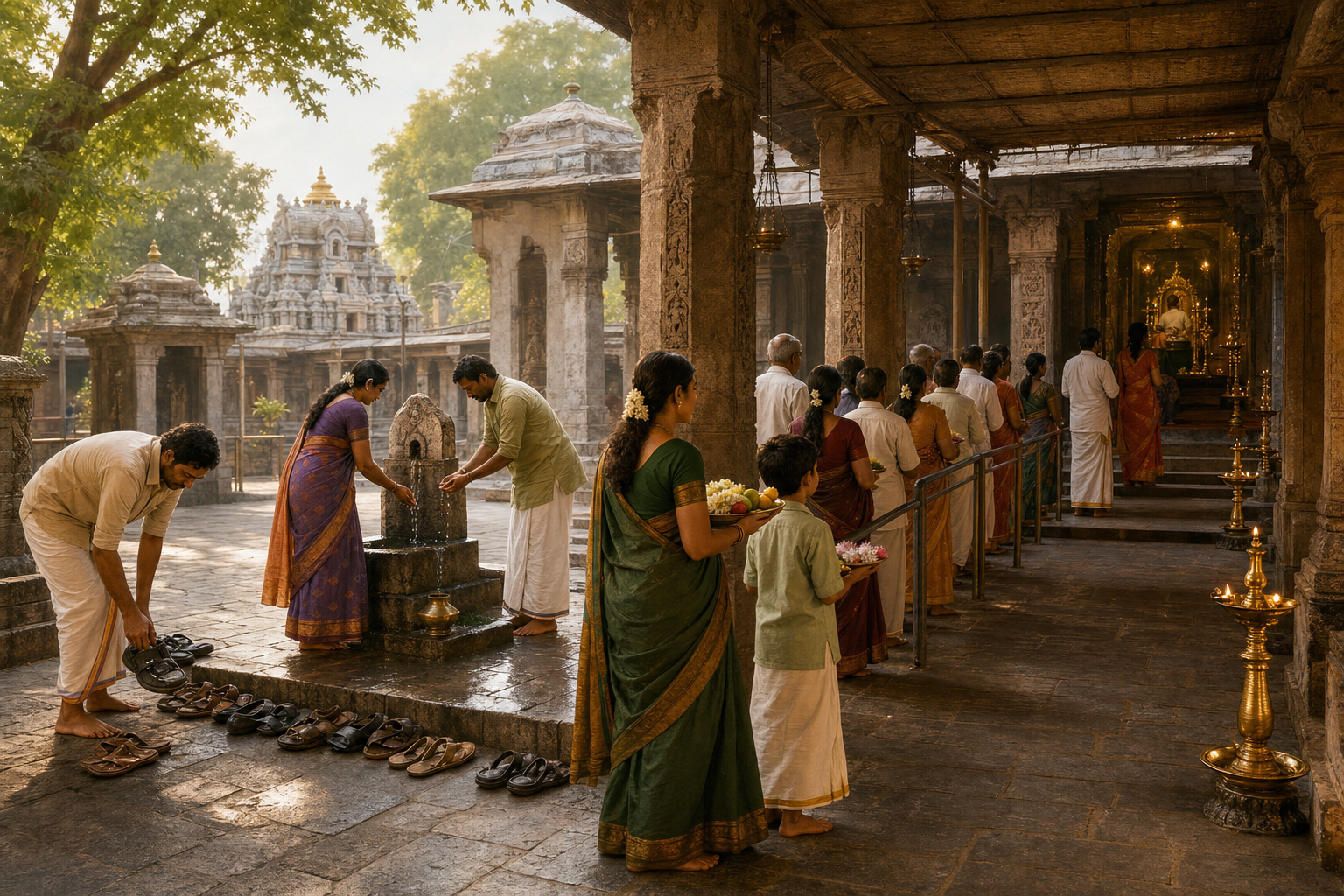
You do not need an elaborate itinerary. A clear sequence protects the visit from becoming hurried and leaves room for the temple’s own rhythm.
- Confirm the exact temple, village and district. Save the full location for everyone travelling with you.
- Check current temple hours locally. Ask separately about general opening, darshan and any ritual you specifically hope to attend.
- Choose one devotional intention before entering. It may be gratitude, steadiness, protection of dharma or clarity in carrying a duty.
- Wear modest clothing, silence your phone and keep conversation away from the sanctum. Follow the instructions of the temple’s custodians rather than assuming that customs are identical everywhere.
- Take darshan without trying to control its duration. If space and temple practice permit, continue with Vishnu Sahasranama, nama-japa or silent meditation away from the main flow of devotees.
- Leave the premises clean. Do not treat lamps, thresholds, ritual objects or quiet corners as props for photography.
- After leaving the sanctum, sit quietly if an appropriate space is available. Decide on one dharmic action that will carry the darshan into ordinary life.
The final step is easy to neglect. A temple visit becomes more than a change of scenery when contemplation leads to conduct. In the spirit of Vishnu as preserver, your action might be repairing a neglected family duty, keeping a promise, serving without display or restoring regularity to a spiritual discipline.
If you are travelling with children or relatives who do not know the temple, explain the distinction between the two shrines before the journey. At Ananthagiri, tell them that the Markandeya account belongs to Puranic sacred memory. At Penjerla, explain what Swayambhu means in a devotional context. A short explanation makes the visit intelligible without turning the sanctum into a classroom.
Key takeaways
- Ananthagiri and Penjerla are separate Anantha Padmanabha Swamy temples in different Telangana districts.
- Choose Ananthagiri when you want Puranic sacred memory, a tranquil landscape and time for sustained contemplation.
- Choose Penjerla when you want a Swayambhu Vishnu shrine near Hyderabad in a quiet, modest temple setting.
- Treat the Dwapara Yuga consecration account as living sacred tradition, not as a modern archaeological date.
- Treat “Swayambhu” as a theological and devotional identity, not as a claim established by architecture alone.
- Verify present-day timings locally, follow the customs of the particular shrine and let darshan lead to one concrete act of dharma.
If your first concern is choosing correctly, write down the full destination now: Ananthagiri in Vikarabad district or Penjerla in Kothur Mandal, Ranga Reddy district. Then plan less around how many places you can cover and more around how much undivided attention you can bring. Anantha Padmanabha is approached most meaningfully through steadiness—the very quality this form of Vishnu asks you to recover.
References
- DharmaRenaissance Blog — Discover Ananthagiri Temple: Complete Guide to Ananta Padmanabha Swamy and Its History
- DharmaRenaissance Blog — Discover Penjerla Anantha Padmanabha Swamy: Complete Guide to the Swayambhu Temple near Hyderabad
