
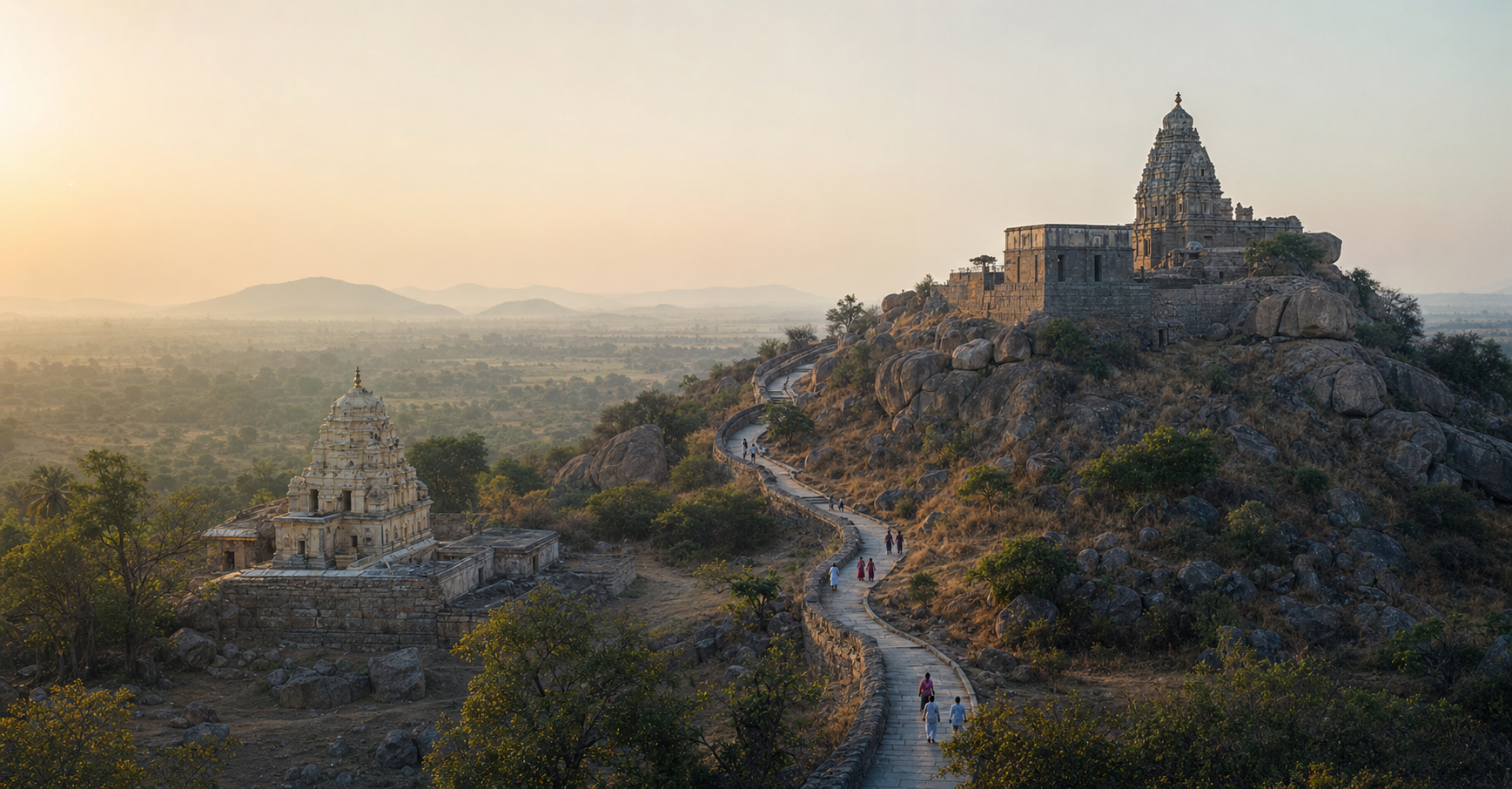
If you are visiting Tripurantakam on the way to Srisailam, the easy mistake is to treat it as a preliminary stop: climb the hill, see the principal sanctum, and resume the journey. That misses the relationship that makes this sacred place spiritually legible. Tripuranthakeswara Swamy and Tripura Sundari Devi invite you into a paired encounter with Shiva and Shakti.
You do not need advanced knowledge of Shaiva or Shakta philosophy to approach that encounter well. You need enough time to visit both shrines, attention to the movement from one to the other, and respect for the customs followed locally. The aim is not merely to collect two darshans. It is to notice how stillness and power, discipline and compassion, and transcendence and divine presence belong together.
Begin with the relationship between Shiva and Shakti
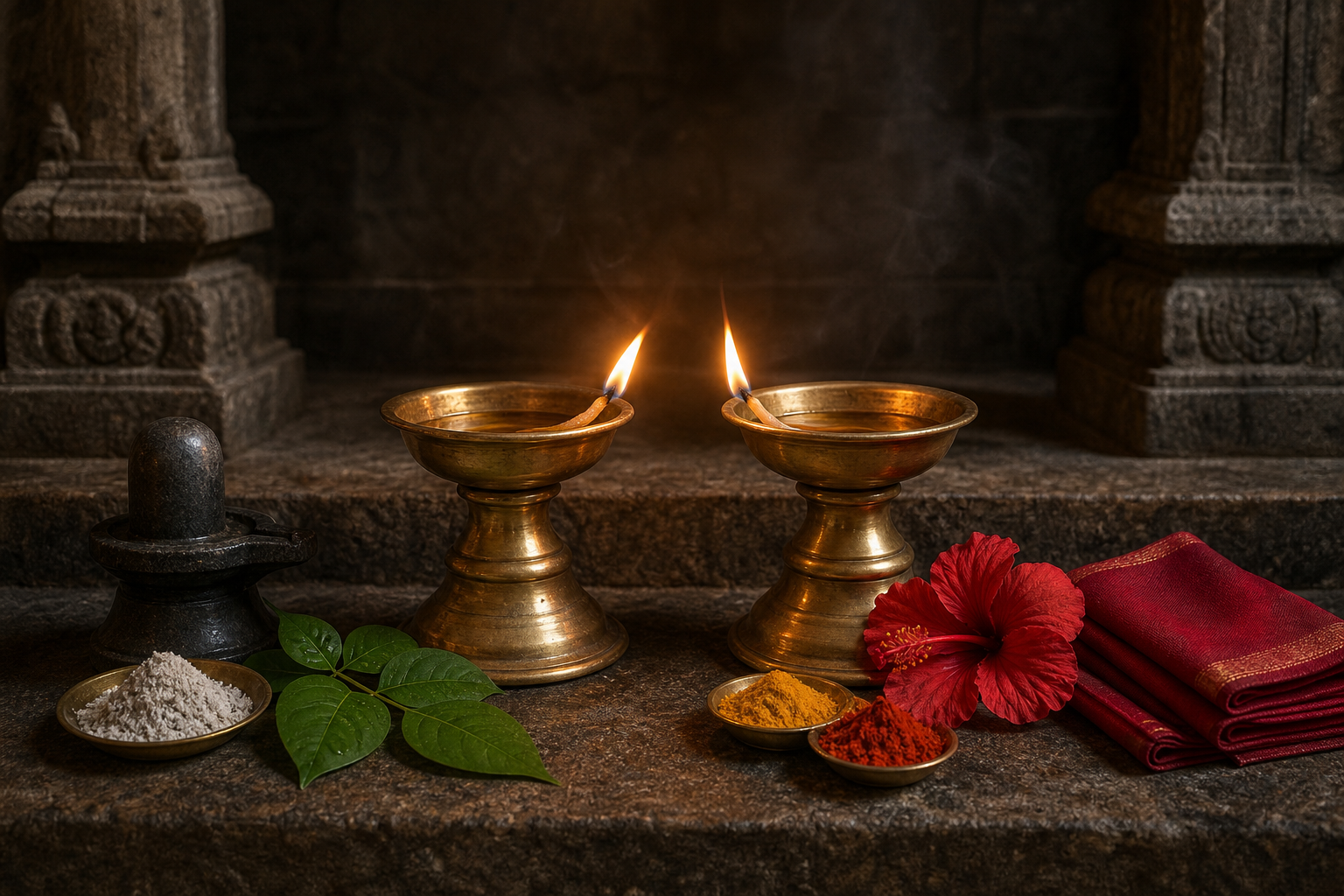
Tripurantakam is revered as the eastern gateway to Srisailam. A gateway is more than a point on a route. It is a threshold at which ordinary movement becomes pilgrimage. If Srisailam is your eventual destination, Tripurantakam asks you to prepare your attention before proceeding.
In several Hindu philosophical and devotional understandings, Shiva evokes unconditioned awareness, stillness, restraint, and the power of withdrawal. Shakti is divine power in expression: creation, protection, movement, compassion, and grace. Sampradayas explain their relationship in different metaphysical language, so no single formula should be imposed on every devotee. The practical point at Tripurantakam is simpler: Shiva should not be approached as inert isolation, and the Goddess should not be treated as an accessory to a more important shrine.
The two shrines correct two common imbalances in spiritual life. Discipline without compassion can become harshness. Activity without inward steadiness can become agitation. Shiva and Shakti together ask whether your inner clarity can guide your actions and whether your strength can protect rather than dominate.
Carry one question into each darshan. Before Tripuranthakeswara, ask what in your life requires restraint, clarity, or a decisive ending. Before Tripura Sundari, ask what requires protection, patient nourishment, or courageous action. These questions are aids to attention, not substitutes for the deities or reductions of them to psychological symbols.
The site can also be approached respectfully by visitors from other Dharmic traditions. Dhyana, tapas, karuna, and satya have recognisable resonances across Hindu, Buddhist, Jain, and Sikh life, even though their theological meanings are not identical. Shared ethical vocabulary should deepen mutual regard, not erase the specifically Hindu and Shiva-Shakti character of the temple.
Read the Tripura legend as more than a victory story

Local sacred memory holds that Shiva established his abode here after subduing the demons Tripura. The name Tripuranthakeswara recalls Shiva as the one who brought Tripura to its end. Yet the spiritual meaning of the place does not stop at conquest.
Notice the sequence within the tradition. Disorder is confronted, but victory culminates in sacred presence. Shiva does not merely destroy and depart; he abides. The movement is from conflict to consecration. That distinction matters when you apply the legend to your own conduct. Dharmic strength is not measured only by what it defeats. It is also measured by the order, protection, and clarity it establishes afterward.
The nearby presence of Tripura Sundari Devi keeps the legend from becoming a celebration of force alone. The power that ends adharma must remain joined to the power that protects, restores, and gives life. Read this as a demand for balance, not as a claim that righteous action should be timid. Shiva confronts what must end; Shakti sustains what must flourish.
A useful reflection follows directly from that pattern. At the Shiva shrine, name an inner tendency rather than a human enemy: anger without discrimination, fear that prevents duty, speech used to injure, or attachment that clouds judgment. At the Devi shrine, identify the virtue or responsibility that must take its place. Ending a harmful habit without cultivating its dharmic opposite leaves an empty space into which the old pattern can return.
You do not have to turn the sacred narrative into a modern allegory to gain this insight. For a devotee, the legend remains sacred memory associated with the deity and the kshetra. Ethical reflection should arise from that sacred frame rather than replacing it.
Let the temple organize your attention
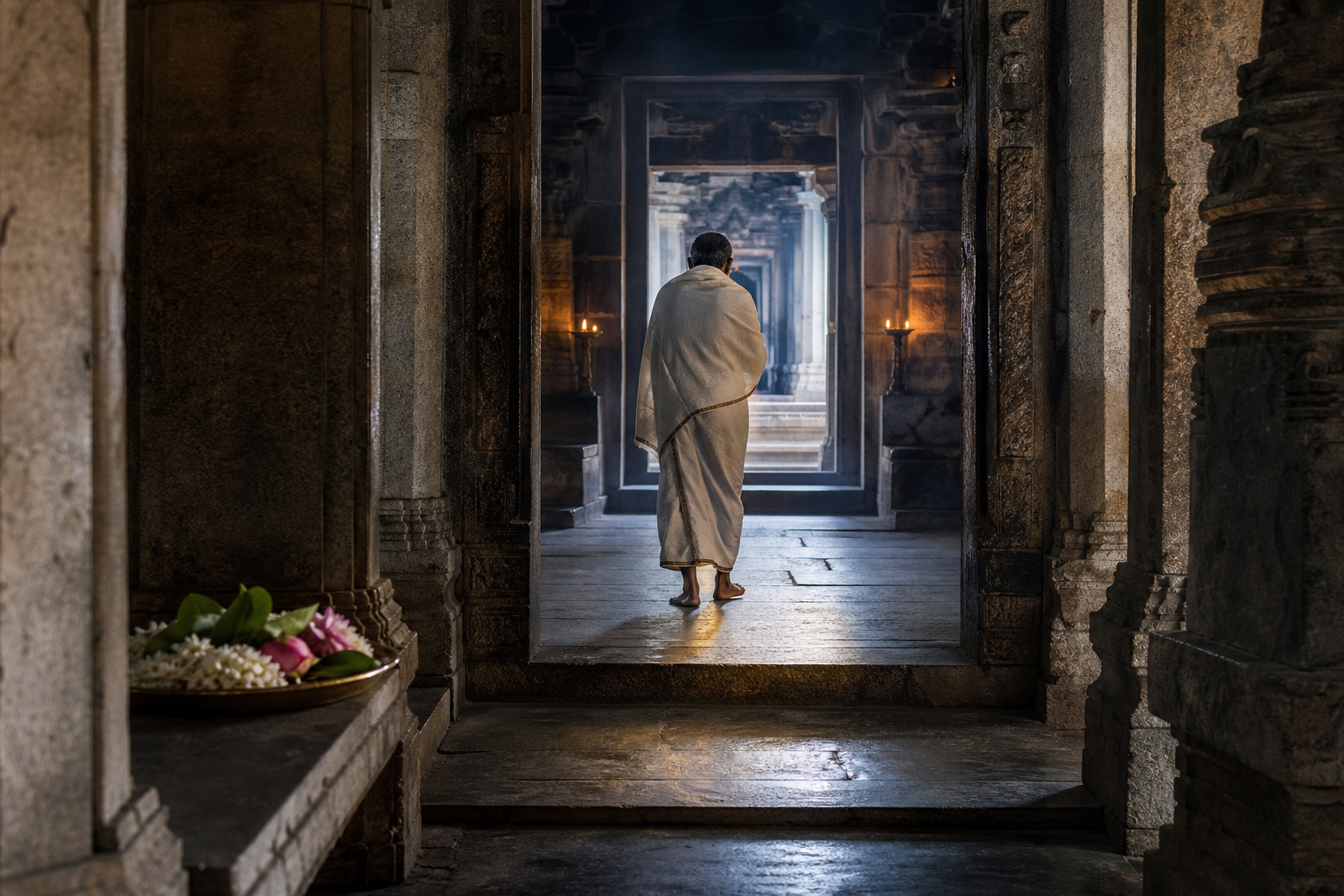
The traditional elements of the complex include the garbhagriha, mandapa, and sculpted iconography associated with Andhra temple architecture. These are not merely architectural labels. Each helps guide a different mode of attention.
The mandapa accommodates shared devotion and the visible life of the community. The garbhagriha concentrates attention toward the deity and the inward act of darshan. Sculpted forms make principles visible through posture, gesture, attributes, and sacred narrative. Do not rush past these transitions as though the sanctum alone counts. The movement from open space toward concentrated presence is part of the temple experience.
- Choose an unhurried window. Morning and evening are well suited to the hill setting and contemplative rhythm. Confirm current access and worship timings locally before travelling, because no timeless description can guarantee a present-day schedule.
- Mark the threshold. Remove footwear where indicated, silence your phone, lower your voice, and follow signs or instructions from temple attendants. These simple acts separate darshan from ordinary sightseeing.
- Use the ascent deliberately. The steps and rocky hillscape naturally slow the body. Let your breathing settle instead of treating the climb as an obstacle to be completed as quickly as possible.
- Receive darshan before interpreting it. Give your first attention to the deity, lamps, bells, and worship already taking place. Reflection becomes more grounded when it follows reverence rather than displacing it.
- Visit both divine presences. Follow whatever shrine order is observed locally. If no particular order is indicated, do not conclude the visit after seeing only Tripuranthakeswara; leave sufficient time for Tripura Sundari Devi as well.
- Pause without obstructing worship. If a permitted space is available, sit or stand quietly after darshan. Recall the two questions you carried in: what must end, and what must now be protected or brought into action?
This sequence is a reflective framework, not a newly invented temple ritual. Local achara takes precedence. Do not insist on a private practice when a queue, puja, festival procession, or instruction from temple authorities requires something different.
Choose between festival energy and contemplative quiet
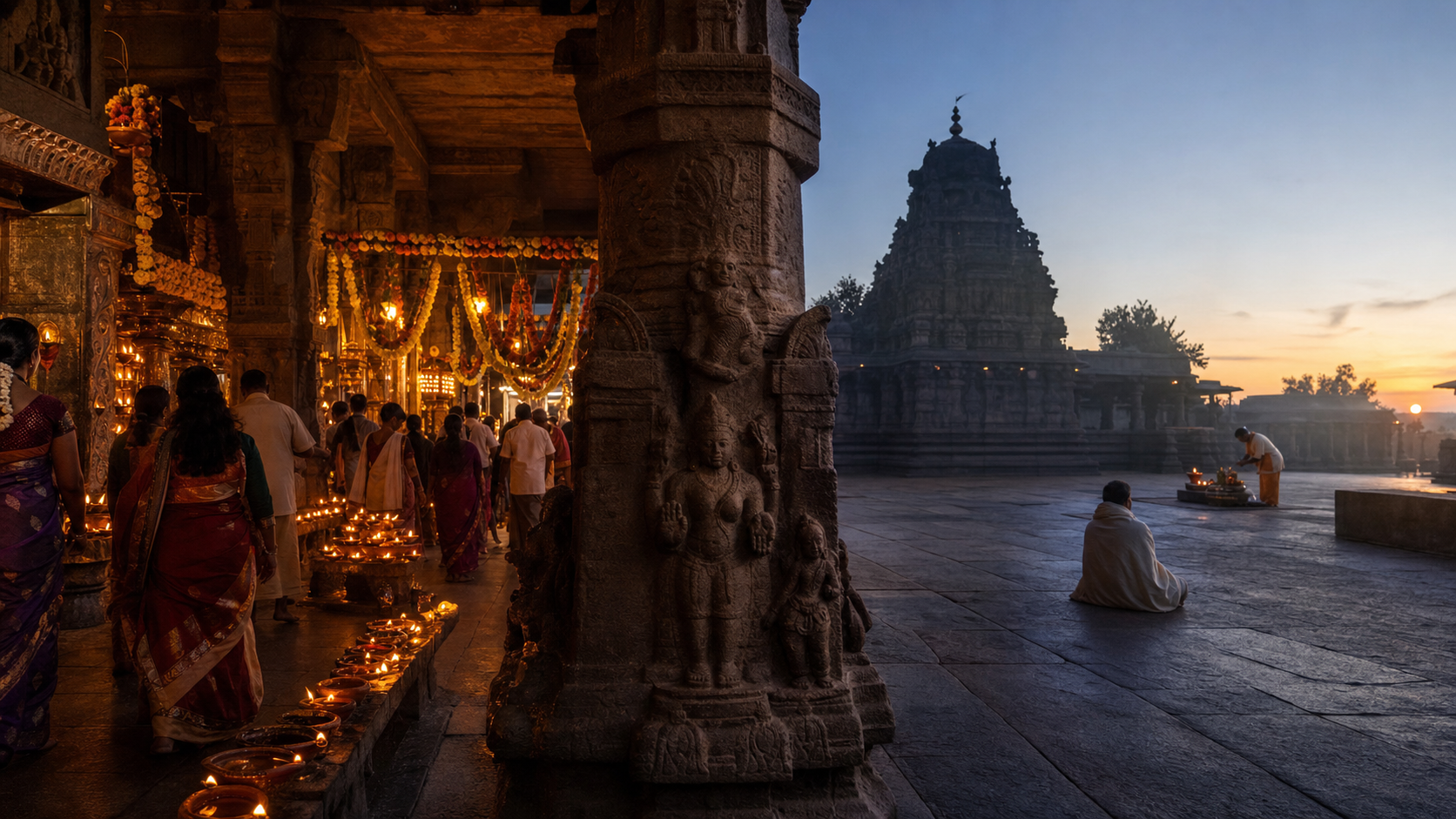
Maha Shivaratri brings larger congregations to Tripurantakam. That can be the right time if you want to participate in collective Shiva devotion and experience the temple as a living centre of community worship. It is not the best choice if your primary need is silence, architectural observation, or an extended pause between the two shrines.
An ordinary morning or evening better supports unhurried darshan. The quieter rhythm lets you attend to the ascent, the transition between communal and inward spaces, and the distinct devotional emphasis of the Goddess shrine. Neither kind of visit is spiritually superior. The mistake is expecting festival intensity to provide solitude or expecting a quiet-day visit to reproduce the energy of a major observance.
If you are combining Tripurantakam with Srisailam, avoid scheduling the first temple as a disposable roadside halt. Build enough margin to complete the ascent, visit both shrines, and regain a settled pace before leaving. Sacred geography works through sequence: Tripurantakam becomes a gateway only when you allow it to change how you enter the onward journey.
Families can prepare for this by discussing the paired tradition before arriving. Tell children and first-time visitors that the visit is not finished after the most prominent sanctum. Give them two concrete things to notice: how the temple leads from open gathering space toward concentrated darshan, and how the presence of Tripura Sundari changes the meaning of Shiva’s victory. That turns a tiring sequence of steps into an intelligible pilgrimage.
Key takeaways for your Tripurantakam visit
- Approach Tripuranthakeswara and Tripura Sundari as a paired Shiva-Shakti encounter, not as a principal shrine followed by an optional addition.
- Read the Tripura tradition as a movement from the defeat of disorder to the establishment of sacred presence.
- Let the architecture guide you from communal devotion in the mandapa toward concentrated attention at the garbhagriha.
- Follow local customs and shrine order; use personal reflection to deepen darshan, never to replace temple practice.
- Choose Maha Shivaratri for collective devotional energy and an ordinary morning or evening when quiet attention is your priority.
- If Srisailam is your destination, treat Tripurantakam as a spiritual threshold rather than a hurried stop on the road.
After you leave, turn the paired darshan into one restrained action and one constructive action. End one habit that weakens your dharma, then strengthen the duty or virtue that should occupy its place. That is a practical way to carry Tripurantakam’s Shiva-Shakti balance beyond the hill and into the next stage of your pilgrimage.
References
