
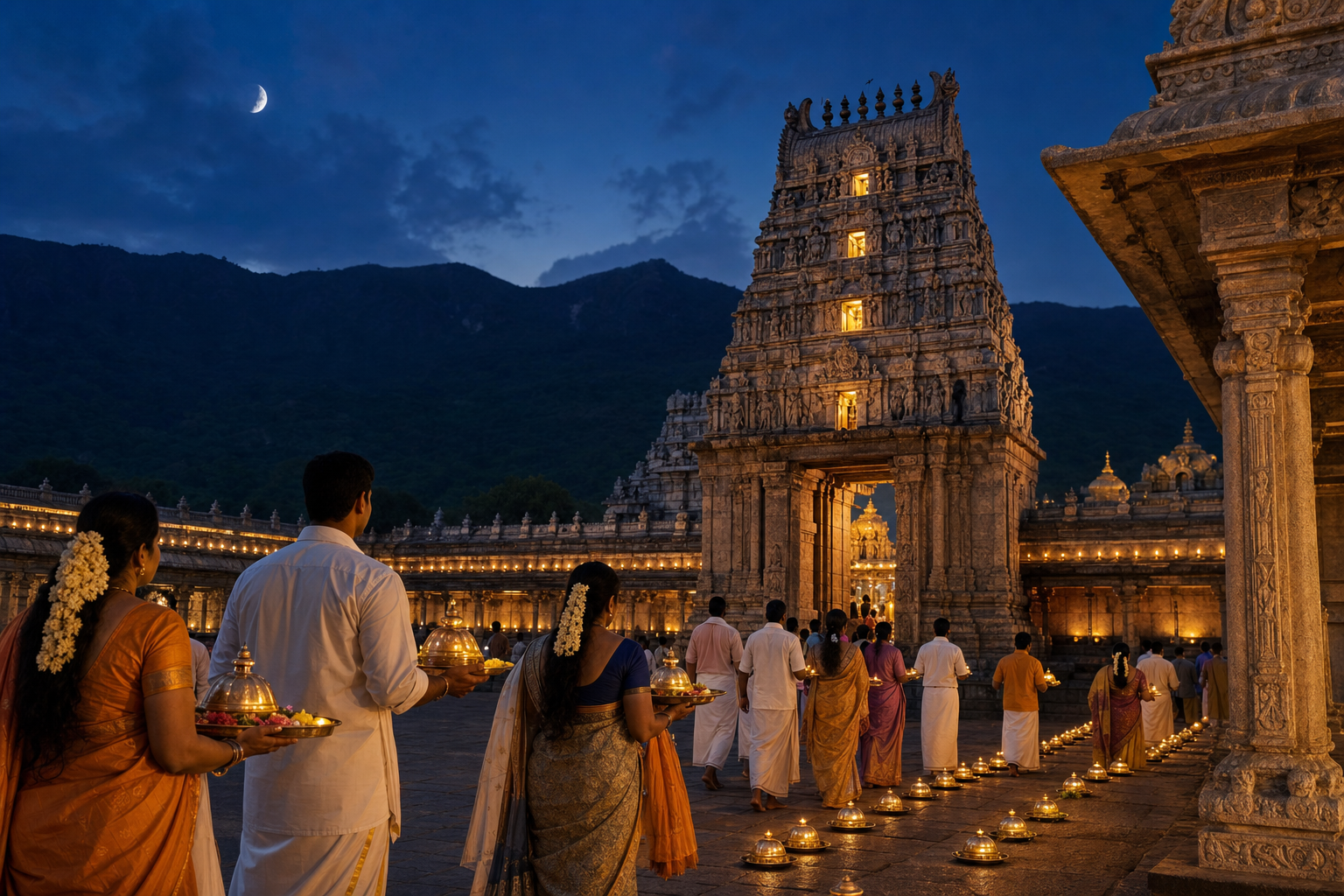
If you came looking for the exact Mahashivaratri 2026 plan in Tirupati, start with the distinction that prevents the most confusion: TTD scheduled one spiritual festival across four city venues, not one continuous programme in a single hall. The dated event was Sunday, 15 February 2026, with an overall programme window from 6:00 pm until midnight.
Because that date has passed, you should read this as an archival schedule and planning guide. It establishes what was announced and explains how the evening related to the lunar calendar. It does not establish what occurred at every venue, and its timetable should not be reused for a later Mahashivaratri without a new TTD notice.
The 2026 schedule at a glance
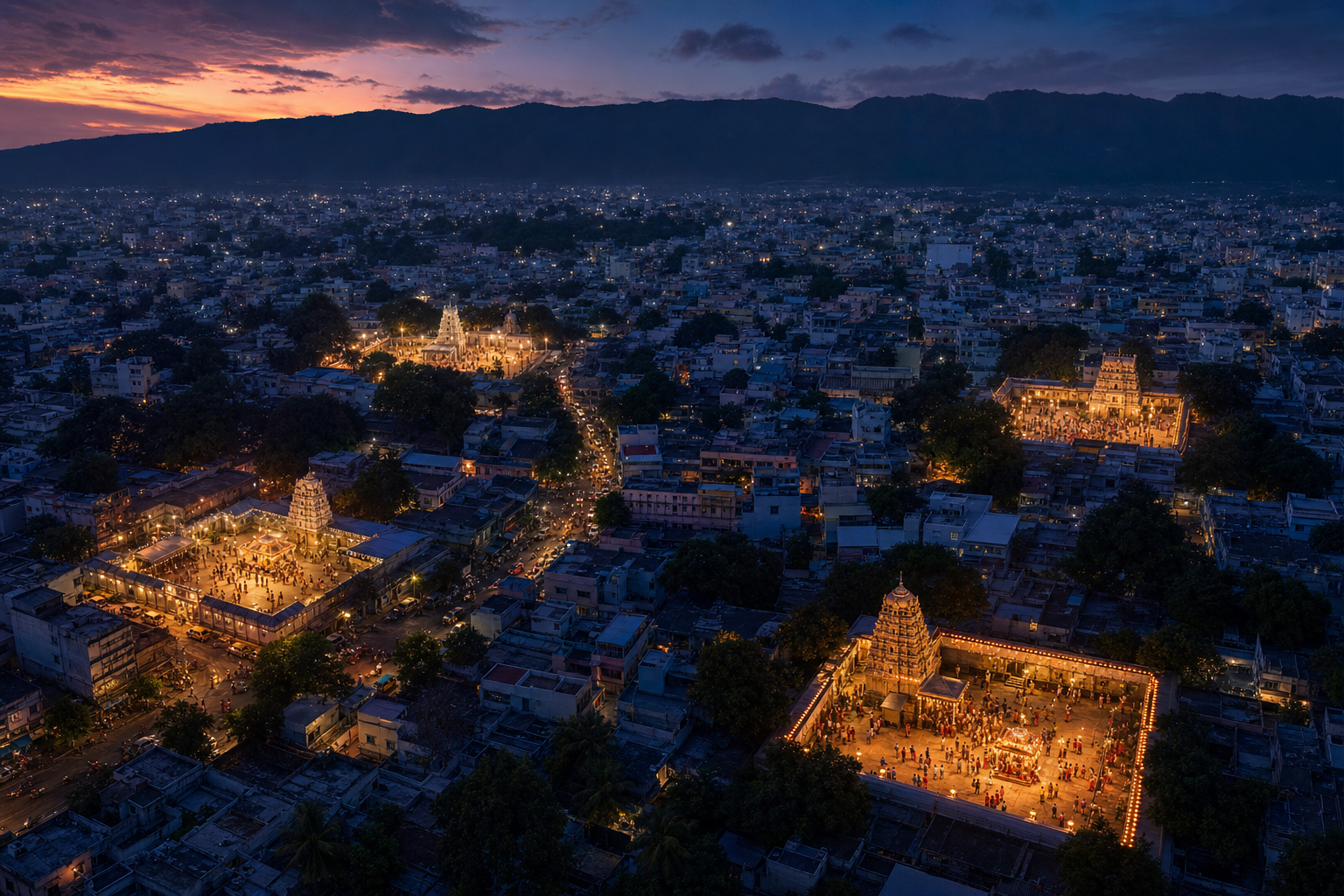
TTD scheduled the event under the name Mahashivaratri Adhyatmika Vaibhavam. Its structure combined devotional recitation, spiritual practice and cultural presentation, with particular emphasis on Shiva Stotras. The essential planning information was as follows:
| Planning point | Announced detail | What it meant for you |
|---|---|---|
| Date | Sunday, 15 February 2026 | This was a date-specific 2026 programme, not a recurring weekly schedule. |
| Overall window | 6:00 pm to midnight | You had a six-hour public festival window, but not necessarily six hours of identical activity at every location. |
| Venues | Mahathi Kalakshetram, Kapila Theertham, Annamacharya Kalamandiram and Ramachandra Pushkarini | You needed to choose an anchor venue or plan a limited circuit rather than assume everything happened in one place. |
| Programme character | Spiritual, cultural and devotional presentations, especially Shiva Stotra recitations | Your choice of venue should have followed the segment you most wanted to attend. |
The 6:00 pm to midnight window described the city-wide festival as a whole. It should not be read as proof that every listed site offered the same sequence for all six hours. A venue-by-venue running order was not included in the cited details, so reconstructing one from the venue list would create false certainty.
Choose an anchor venue before building a circuit
Four venues give you choice, but they also create a practical trap: turning a night of attention into a night of movement. If you try to collect every location simply because it appears on the list, travel and repeated settling can consume the very stillness the observance is meant to cultivate.
A better plan starts with one non-negotiable devotional purpose. Use this sequence whenever you attend a similar multi-venue celebration:
- Decide what matters most to you: sustained Shiva Stotra recitation, contemplative participation, a cultural presentation or attending together as a family.
- Check the venue-wise running order and identify where that priority appears. The city-wide venue list alone cannot answer this.
- Make that location your anchor. Plan to be settled there for the segment you chose instead of arriving while it is already under way.
- Add another venue only when a confirmed programme item justifies the move. Do not move merely to say that you visited every site.
- Choose your stopping point before the evening begins. If your household observance continues after midnight, arrange that continuation separately because the announced public programme ended at midnight.
Before setting out, you would also need to verify the operational details that the city-wide schedule did not settle: the programme assigned to each venue, entry arrangements, accessibility, local traffic guidance and any restrictions communicated for that site. A prominent venue name is not a substitute for a current venue notice.
If you are attending with children, older relatives or a group with different levels of mobility, one stable venue is usually the clearer choice. Agree on the venue’s full name, a meeting point and a departure condition in advance. Mahathi Kalakshetram and Annamacharya Kalamandiram are easy to confuse in a hurried message because both are cultural venue names; write out the selected location rather than sending only a vague reference to the programme hall.
Use the 4:23 pm tithi change correctly
The civil schedule and the Panchang answer different questions. The civil schedule tells you when the public programme was due to run. The Panchang identifies the lunar phase governing ritual time.
For Sunday, 15 February 2026, the stated Panchang timing placed Krishna Paksha Trayodashi until 4:23 pm and Krishna Paksha Chaturdashi from 4:23 pm onward. On that calculation, TTD’s 6:00 pm opening came one hour and 37 minutes after Chaturdashi had begun.
There is therefore no contradiction in saying that the civil date began under Trayodashi while the evening festival fell under Chaturdashi. A tithi can change during a civil day; midnight is not the boundary that determines every Hindu ritual date.
This distinction also prevents confusion with Pradosha. Pradosha observance is traditionally associated with Trayodashi, while the cited calculation moved into Chaturdashi before the public festival began. If your family follows a particular Pradosha rule, do not infer that rule from the 6:00 pm event time. Follow a Tirupati-specific Panchang, the relevant temple notice or the guidance of the tradition in which you actually observe the vrata.
Do not use 4:23 pm as a universal muhurta detached from place and method. Panchang calculations and customary applications can vary by locality and calculation school. The available timing also does not supply Nakshatra or Rashi details. If those factors determine your sankalpa, japa or household puja, verify them through a regional calendar rather than filling in the gaps from memory.
Turn the six-hour window into a coherent observance
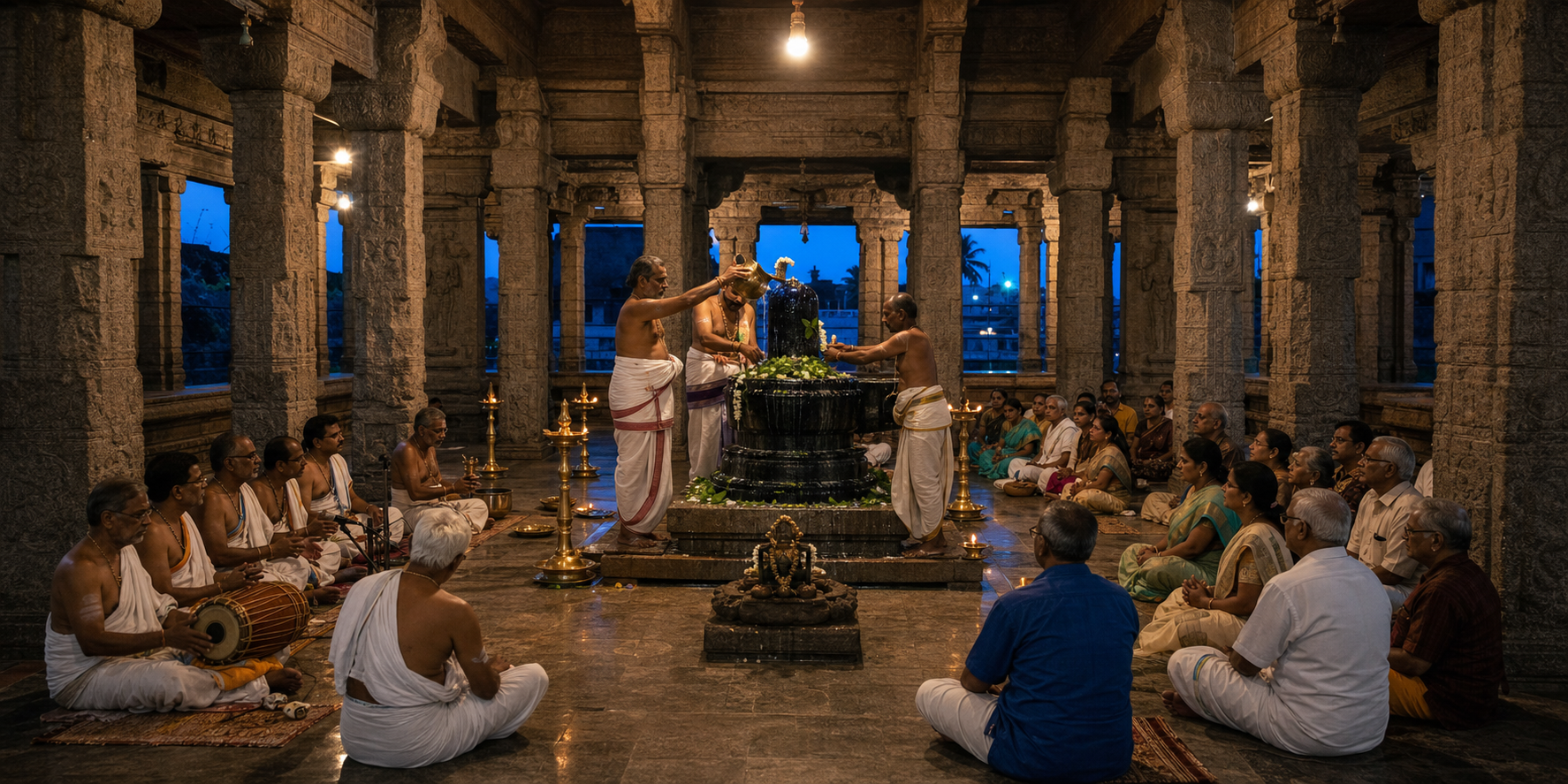
A long programme becomes spiritually useful when its parts support one intention. It becomes tiring when every recitation and performance is treated as another item to collect. Since Shiva Stotra recitation was a central feature, you could have built the evening around sacred sound even when cultural presentations changed the outward form.
- Set your intention before leaving. Choose one clear discipline for the evening: attentive recitation, silent listening, restrained speech, family participation or seva.
- Enter the programme without immediately planning an exit. Give yourself enough time to settle and follow at least one segment as a whole.
- Treat cultural attention as part of participation. A classical or devotional presentation is not merely an interval between acts of worship. Listen without turning the hall into a background for conversation or phone use.
- Make movement between venues purposeful. If you change locations, do it for a known programme reason and preserve the contemplative tone during the transition.
- Decide what midnight means for your vrata. The TTD festival was scheduled only until midnight. If your personal observance extended further, the remaining practice needed its own plan rather than an assumption that the public programme would continue.
The wider dharmic significance lies in disciplined participation, not in blurring distinct traditions. Meditation, restraint, compassion and seva resonate across Hinduism, Buddhism, Jainism and Sikhism, yet Mahashivaratri remains a specifically Hindu observance centred on Shiva. You can welcome respectful participation while preserving that identity clearly.
That clarity matters in a city-wide event. Respect for local instructions, quiet during recitation and consideration for fellow devotees are not secondary logistics. They are the public expression of the same self-discipline being cultivated inwardly.
Key takeaways
- TTD scheduled Mahashivaratri Adhyatmika Vaibhavam for Sunday, 15 February 2026, from 6:00 pm until midnight.
- The four announced venues were Mahathi Kalakshetram, Kapila Theertham, Annamacharya Kalamandiram and Ramachandra Pushkarini.
- The programme emphasised Shiva Stotra recitations alongside spiritual, devotional and cultural presentations.
- Krishna Paksha Chaturdashi began at 4:23 pm in the cited calculation, placing the 6:00 pm festival opening after the tithi transition.
- The city-wide window did not provide a venue-by-venue running order. A sound plan therefore required one anchor venue and current operational confirmation.
- The 2026 schedule is archival. For another year, verify the new date, local Panchang and TTD programme rather than copying these timings.
If you are documenting the 2026 observance, keep the announced facts separate from anything you personally witnessed at a venue. If you are planning a future Mahashivaratri in Tirupati, reuse the method, not the old timetable: verify the local tithi, obtain the venue-wise programme, choose one devotional priority and let that priority govern your evening.
References
- DharmaRenaissance Blog – Mahashivaratri 2026 in Tirupati: TTD’s City-Wide Spiritual Fest Unites Devotees Till Midnight
- DharmaRenaissance Blog – February 15, 2026 Panchang: Exact Tithi Shift – Krishna Paksha Trayodashi to Chaturdashi at 4:23 PM
