You may have only one day near Sirkazhi and a deceptively simple goal: receive darshan at all eleven Thirunangur Divya Desams. The circuit is compact enough to complete, but its small rural temples do not behave like attractions with continuous opening hours. A successful visit depends less on distance than on arranging your day around puja and midday closures.
Allow about four to six hours by car when temple timings align. Give yourself longer if you want to hear the Nalayira Divya Prabandham, notice the different forms of Vishnu, or include Sirkazhi in the pilgrimage. The aim is not merely to count eleven doors. It is to encounter eleven expressions of one sacred landscape.
Why the eleven should be approached as one sacred field
The local sthala-puranas connect the entire group to Shiva’s Rudra Tandava after the immolation of Sati. The tradition holds that aspects of the Ekadasa Rudras emerged from Shiva’s matted locks as the force of the dance spread. Vishnu then appeared to restore harmony and, at Shiva’s request, manifested in eleven forms across Thirunangur.
That origin changes how you should read the circuit. These are Vishnu temples, with distinct Sri Vaishnava identities, but Shiva is not cast as an opponent who must be defeated. His fierce movement initiates the sacred event, while Vishnu’s manifestations bring it into balance. Difference remains visible without becoming hostility.
This is a more demanding idea than a vague claim that all deities are interchangeable. Thirunangur preserves named forms, separate sanctums, particular hymns and established ritual disciplines. Harmony arises through relationship, not erasure. As you move between shrines, notice both sides of that principle: the individuality of every murti and the narrative joining all eleven.
Tirumangai Alvar gives the landscape another kind of unity. His pasurams placed several of these village shrines within the Nalayira Divya Prabandham and therefore within the canonical sacred geography of Sri Vaishnavism. If you hear Tamil verses during worship, pause for them. The recitation is not background music added to the architecture; it is part of what makes the place a Divya Desam.
You can also acknowledge the circuit’s Shaiva frame by visiting Sirkazhi’s Brahmapureeswarar, or Sattainathar, temple before or after Thirunangur. This is an optional extension rather than a ritual condition. It is valuable when you want your physical itinerary to reflect the Shiva-Vishnu relationship preserved in the local tradition.
Build the day around darshan windows, not road distance
Key takeaways
- Use Sirkazhi as the practical gateway and confirm the day’s temple openings locally before committing to a fixed sequence.
- Reserve four to six hours for a car circuit only when the morning or evening darshan windows align.
- Expect midday closures and treat a morning-and-evening plan as normal, not as a failed itinerary.
- Choose a regular day for unhurried sanctum visits or the Thai Garuda Sevai for the collective vision of all eleven processional deities.
- Carry both temple names and deity names; the pair is more useful than either one alone when checking that you have reached the intended shrine.
The shrines stand within a few kilometres of one another, so the map can make the pilgrimage look effortless. The real constraint is access to the sanctums. Midday closure is common, while active worship is concentrated in morning and evening windows. A route that appears efficient on a screen can therefore leave you outside a locked temple while the next open shrine is only a short drive away.
Begin by asking for the current day’s openings at your first temple or through a reliable local contact. Small temples may share practical arrangements across the area, and local guidance can save more time than an aggressively optimized route. Do not build the whole day around an old timing without checking it.
If you have a car, use the morning window for the first cluster and keep enough flexibility to return during evening worship if a sanctum is closed. The four-to-six-hour estimate describes movement through the circuit under favourable timing; it is not a promise that every shrine will remain continuously accessible. If completing all eleven matters more than finishing early, protect both halves of the day.
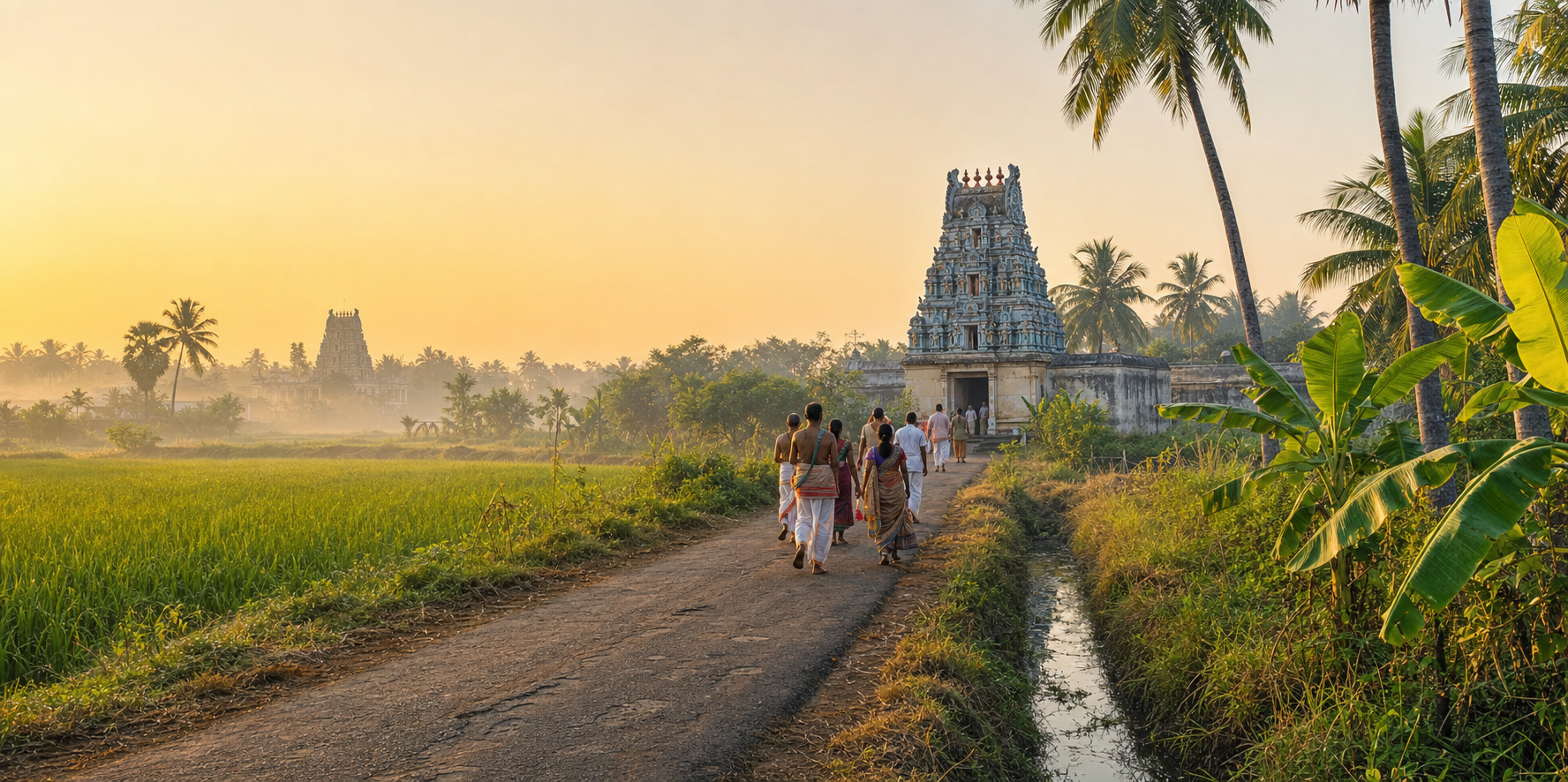
A bicycle and short walks between nearby clusters offer a slower encounter with the paddy fields, irrigation channels and village-scale setting. Choose that mode for immersion, not speed. The intimacy of the terrain is part of the pilgrimage, but it also means you should avoid treating village roads and temple approaches as a race between checkpoints.
December through February offers the preferred combination of cooler weather and clearer light described for this circuit. That period also includes the Tamil month of Thai, when the Garuda Sevai is normally held. If the festival is your purpose, confirm the particular year’s arrangements before travelling; the traditional timing around the Thai new moon is a guide, not an exact date for every future visit.
Learn the shrine identities before you start counting
Several Thirunangur names refer to the sacred place, while another name identifies the presiding form of Vishnu. Keeping both together prevents a common pilgrimage mistake: recognizing a deity name but failing to connect it with the Divya Desam name used on a route list.
| Divya Desam or local name | Form to recognize |
|---|---|
| Arimeya Vinnagaram | Kudamadukkoothan |
| Thiru Vaikunda Vinnagaram | Vaikundanathan |
| Thiru Semponsei Kovil | Perarulalan |
| Thiru Manimadakkovil | A Varadaraja form |
| Thiru Kavalambadi | Gopala Krishna |
| Thiru Vellakulam, also called Annan Koil | Tamarai Kannan |
| Thiruvanpurushottamam | Purushottaman |
| Parthanpalli | Parthasarathy |
This table gives you reliable anchor identities, not a substitute for a current local list of all eleven stops. Use it to understand what changes from temple to temple. At Kavalambadi, Krishna is encountered as Gopala; at Parthanpalli, he is Parthasarathy; at Thiruvanpurushottamam, Vishnu is Purushottaman. The circuit is unified, but it is not repetitive.
The architecture asks for the same kind of attention. These are generally intimate Dravida shrines rather than monumental temple cities. A typical arrangement includes the garbhagriha, an ardha-mandapa, a circumambulatory path within a single prakara and a modestly tiered vimana with lime-stucco ornament. Inscriptions and stylistic features point to Chola and later Nayaka patronage, followed by more recent renovations.
Small scale does not mean slight significance. The proportions, light and acoustics suit recitation and close darshan. Instead of judging each temple by the height of its gateway or the size of its enclosure, notice how near the murti, lamp, chant and congregation remain to one another. Thirunangur’s power lies partly in this compression of cosmic theology into village worship.
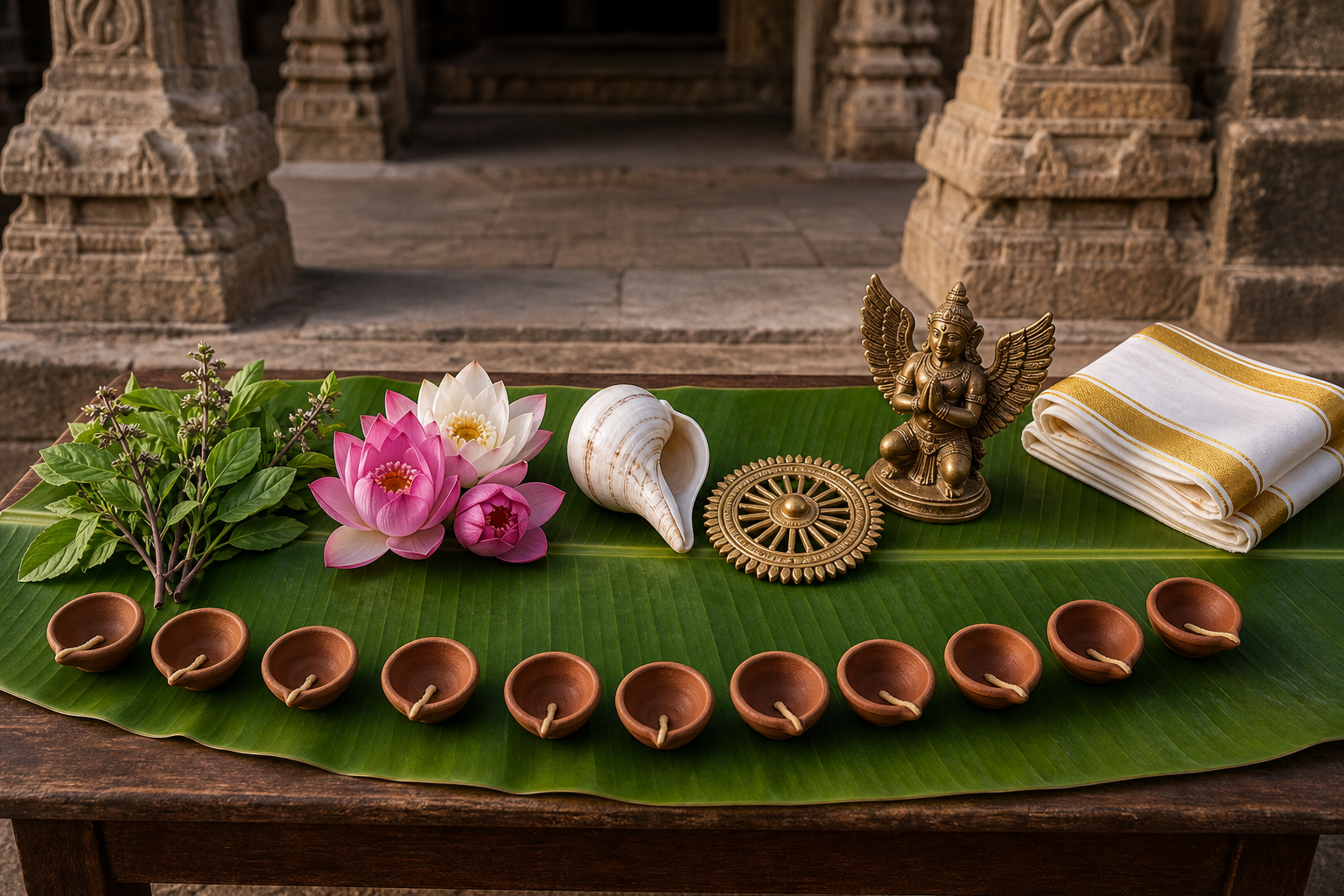
Many shrines follow the Pancharatra Agama while retaining regional customs. Depending on the service you encounter, worship may include abhisheka, alankara, archana using 108 or 1008 names, and offerings such as tulasi, butter or chakkarai pongal. Do not assume that every element will occur during every visit. Let the actual puja set your pace rather than asking a small temple to reproduce a sightseeing schedule.
Look for the Thayar sanctum as well. Lakshmi, often honoured through a local name as Nachiyar, is not an appendix to the principal deity. Her presence expresses the pairing of compassionate accessibility with divine sovereignty that is central to Sri Vaishnava worship. A circuit focused only on the principal Vishnu murtis leaves that theological balance half-seen.
Choose between quiet darshan and the Garuda Sevai
A regular day gives you the temples one by one
Visit outside the principal festival when your priority is to enter individual sanctums, observe architectural differences and remain for arati or Prabandham recitation. You will still need to work around opening hours, but the pilgrimage can unfold as a sequence of distinct encounters. This is the better mode if you want to understand why eleven manifestations are preserved instead of treating them as one interchangeable image.
Garuda Sevai reveals the circuit as one assembly
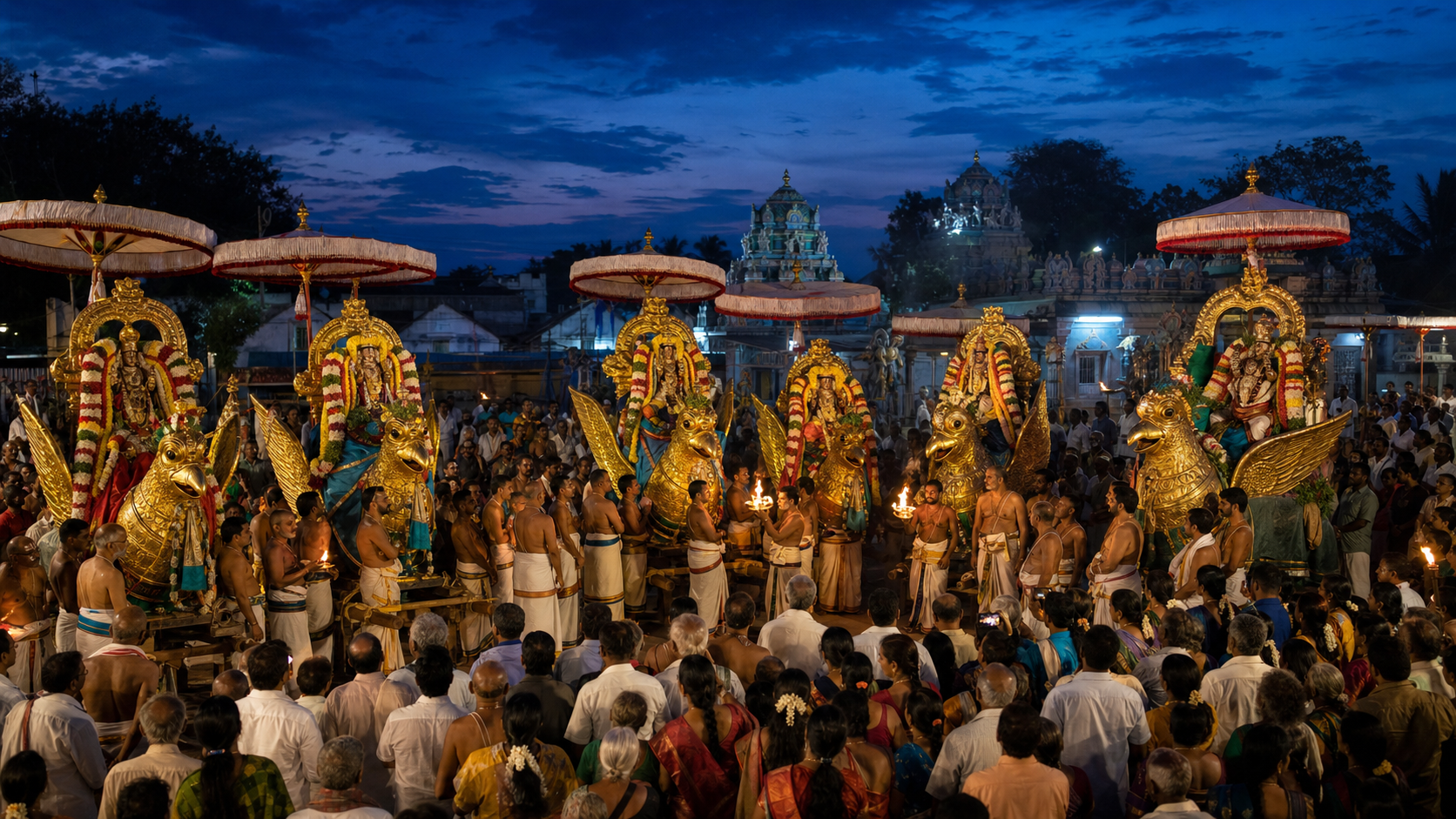
The celebrated Garuda Sevai takes place in Thai, corresponding broadly to January-February, typically around the new moon. The utsava-murtis from all eleven Divya Desams arrive upon Garuda vahanas at a shared venue. Tirumangai Alvar’s processional image comes from nearby Thirunagari, and his pasurams are chanted before the deities in turn.
This is not merely eleven separate processions scheduled on the same day. The assembly makes the underlying sacred geography visible at once: many forms, one connected narrative and a canon of hymns tying each manifestation to the others. Conches, nagaswaram, cymbals, recitation and moments of collective stillness give the festival a liturgical density that an ordinary circuit cannot reproduce.
Choose the Garuda Sevai if you want to witness Thirunangur’s collective identity. Do not assume, however, that attending the gathering automatically gives you the same experience as unhurried darshan inside every temple. If entering all eleven sanctums is your sankalpa, allow separate time for the circuit rather than turning the festival procession into a checklist substitute.
Let your conduct protect the pilgrimage you came to receive
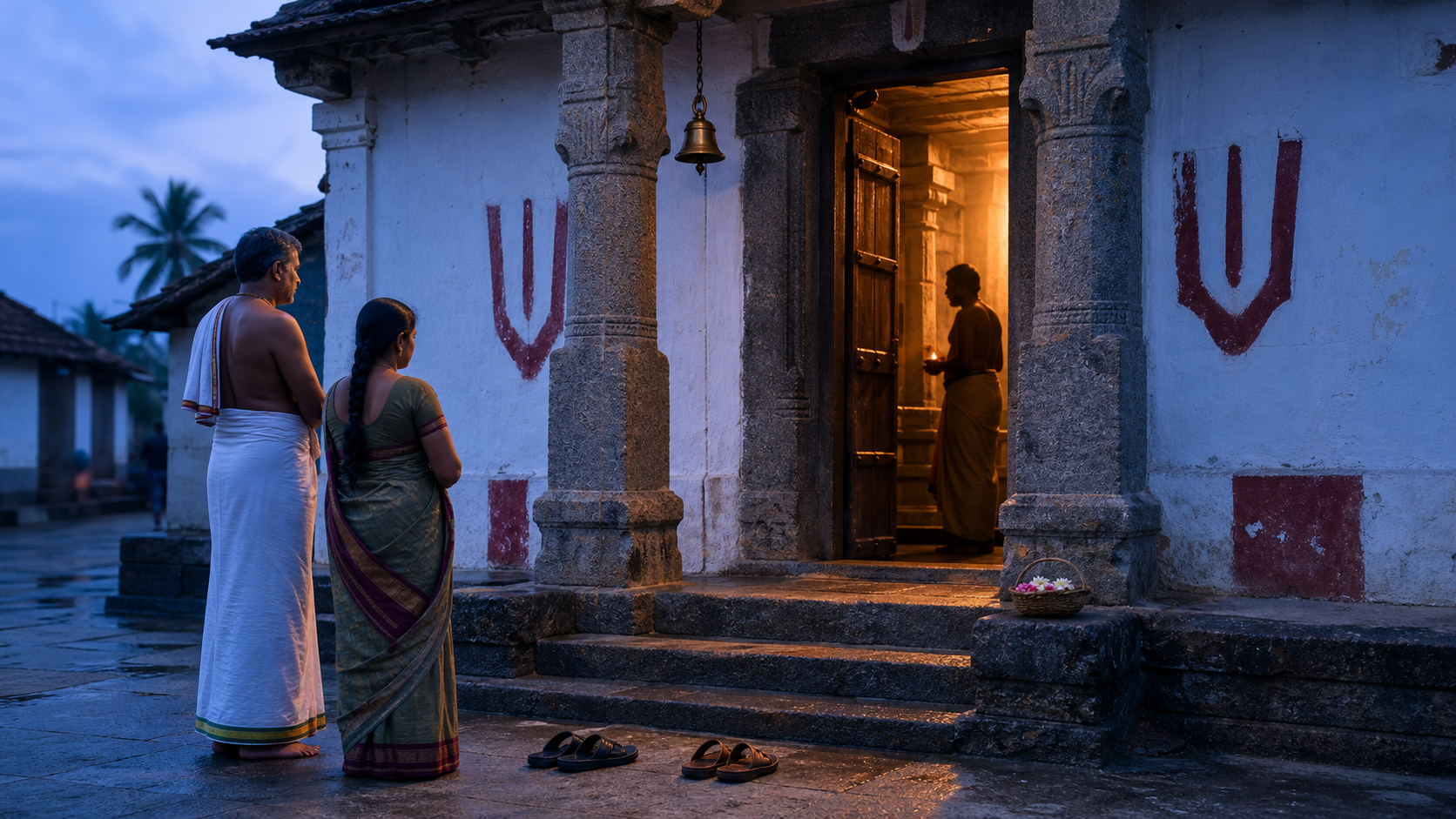
These sanctums function through living village worship, not through the infrastructure of a large tourist complex. Wear modest clothing, lower your voice before entering and follow the archaka’s direction during arati. Ask before photographing a murti, ritual or worshipper. Mindful photography means accepting that some moments should remain unrecorded.
Temple tanks and local water bodies serve both ritual and ecological roles in the Kaveri delta. Do not leave plastic, food containers or discarded offerings near them. An offering does not become harmless waste merely because it began as a devotional object. Use the disposal arrangements provided locally and support greening or maintenance efforts where they are clearly organized.
The Garuda Sevai itself depends on cooperation across villages: archakas coordinate worship, artisans prepare vahanas, families contribute service, and communities manage the movement of eleven processional deities. Your conduct enters that same network. Patience at a closed door, restraint around a crowded ritual and respect for agricultural surroundings are practical forms of seva.
Before you leave Sirkazhi, decide which pilgrimage you are actually making. For all eleven sanctums, protect both morning and evening and verify openings locally. For the collective vision, arrange the journey around the Thai Garuda Sevai. Carry the temple-and-deity names, but put the checklist away when worship begins. That small change lets Thirunangur become a sacred circuit rather than a collection of coordinates.