
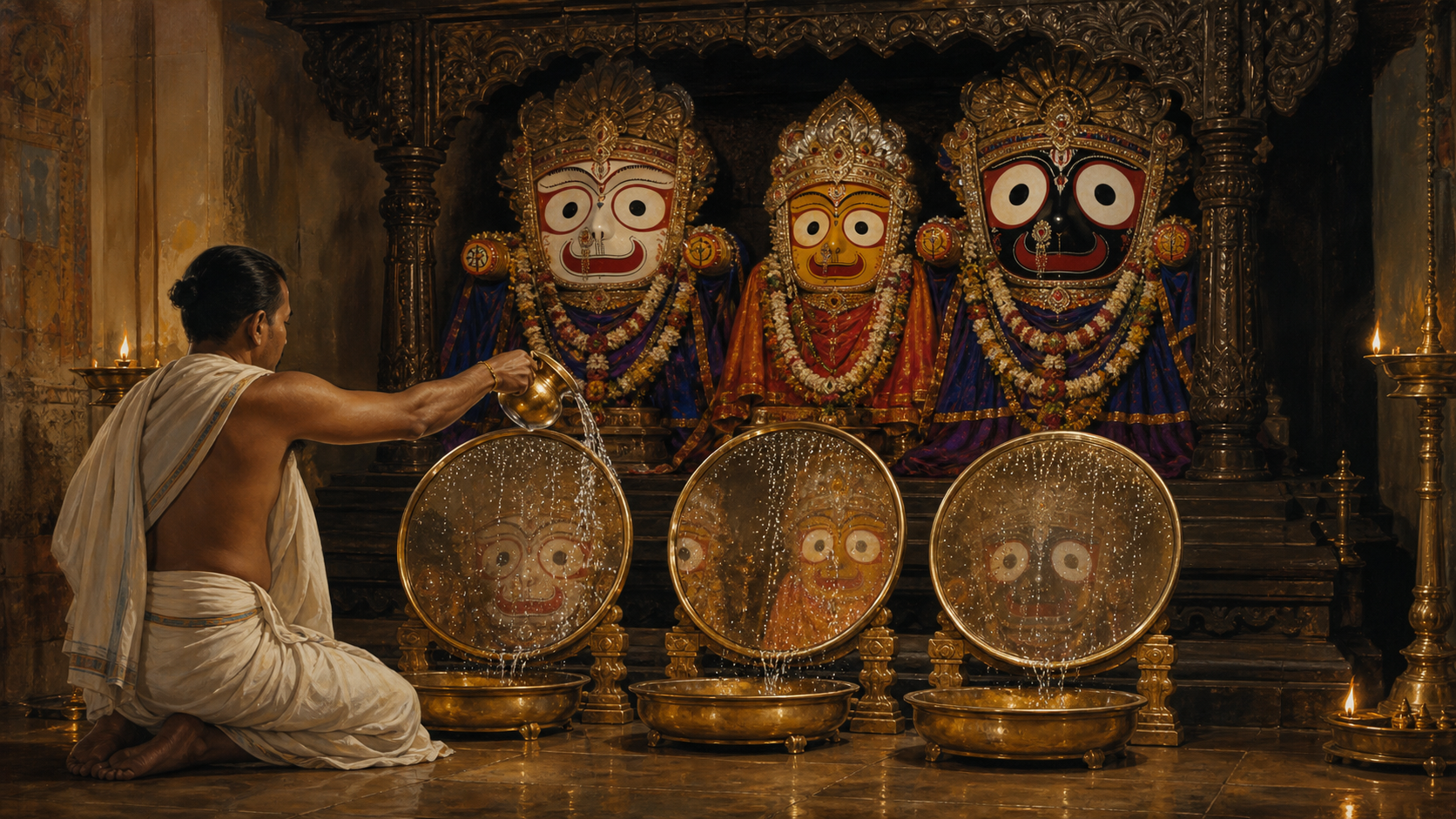
If you have heard that Mahaprabhu Jagannath receives a daily bath at Puri, you may picture water being poured directly over Jagannath, Balabhadra and Subhadra. Snan Darpan asks you to look for something quieter: the bath is offered through a consecrated mirror, allowing the wooden deities to receive the upachara without repeated daily wetting.
This is not an abbreviated bath, a theatrical gesture or a conservation shortcut imposed from outside worship. It is a complete ritual action conducted through a recognized auxiliary focus. Once you understand where it occurs, how the mirror is prepared and what reflection means within the rite, its apparent simplicity reveals an exact union of seva, theology and custodianship.
Look for Snan Darpan within the Abakasha niti
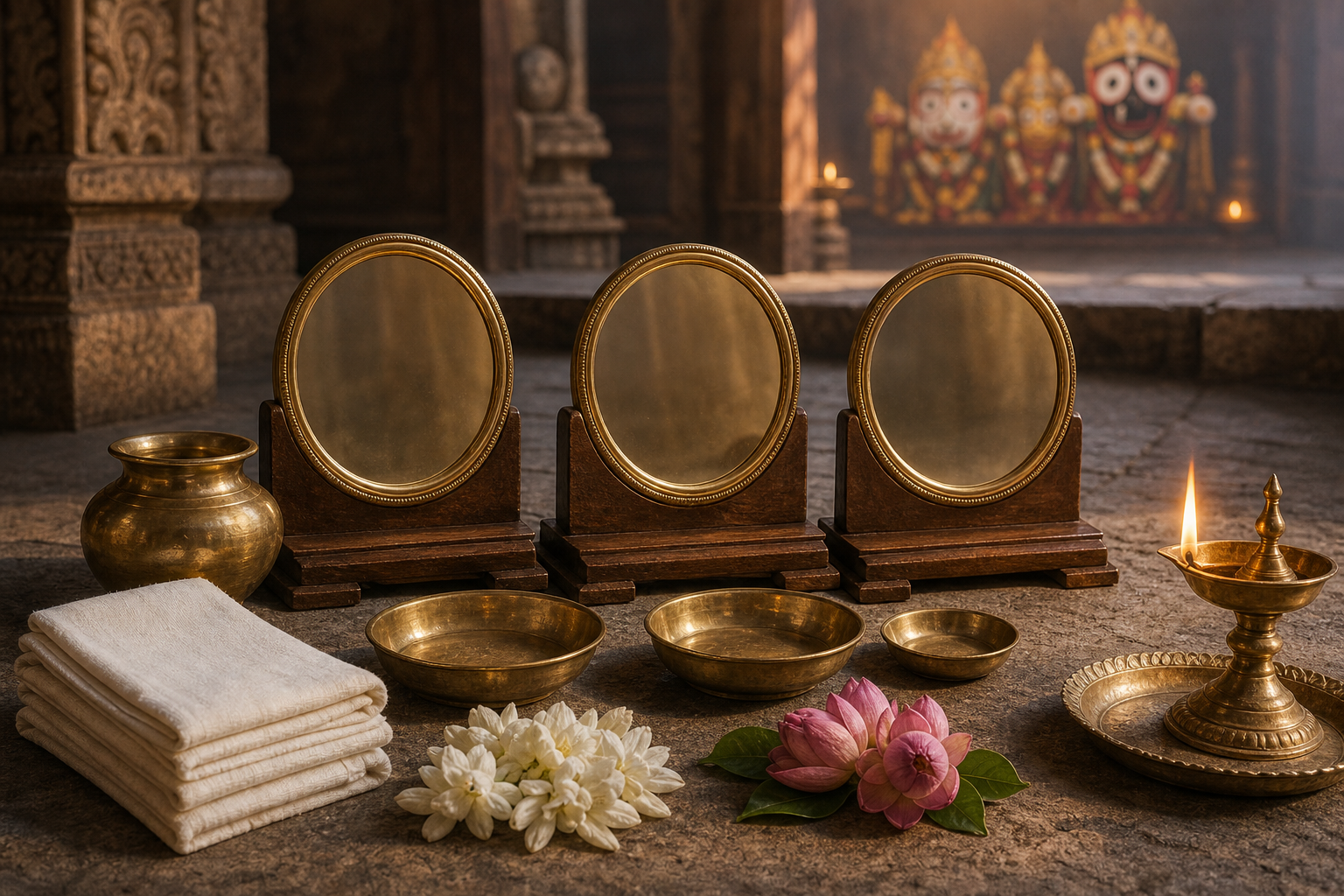
Snan Darpan belongs to the Abakasha portion of Srimandir’s daily ritual cycle. Abakasha follows the opening movements of the day, including Mangala Arati and Mailam, and precedes Sakala Dhupa in the broad sequence of nitis. Exact timing can change with the temple’s festival calendar, so daily should be understood as a place in the ritual cycle rather than a promise about a fixed clock time or unrestricted public visibility.
That distinction matters when you plan darshan or explain the practice to someone else. Asking when the daily abhisheka becomes visible may lead you to expect the wrong event. Ask instead about Abakasha and Snan Darpan. The essential action belongs to the sanctum’s regulated service, and access is governed so that the officiants can maintain ritual purity, concentration and correct sequencing.
The darpana is not taken into service as an ordinary household mirror. It first receives the samskara appropriate to an upachara-bimba: purification, mantra nyasa and deliberate placement. Its surface is oriented toward the deities so that their forms appear upon it. The bathing mantras and prescribed substances are then directed to this consecrated medium, and the reflected forms provide the proximate focus through which Jagannath, Balabhadra and Subhadra receive the snana.
Orientation is therefore part of the ritual, not a cosmetic detail. The mirror must remain steady and properly aligned. Lighting is moderated so that the reflection is legible without becoming harsh, while fabric screens can prevent unrelated reflections from entering the visual field. If the mirror were tilted casually, clouded by fingerprints or surrounded by distracting glare, the carefully constituted relationship between deity, reflection and offering would be disturbed.
The service is distributed among trained sevayats rather than improvised by one person. Pujapanda priests lead the mantras and ritual order, while attendants help maintain the mirror’s alignment, light and steadiness. This division of responsibility is one reason the restrained movement around the mirror should not be mistaken for a lack of ceremony. Precision is the ceremony.
Why the reflection is more than a convenient substitute
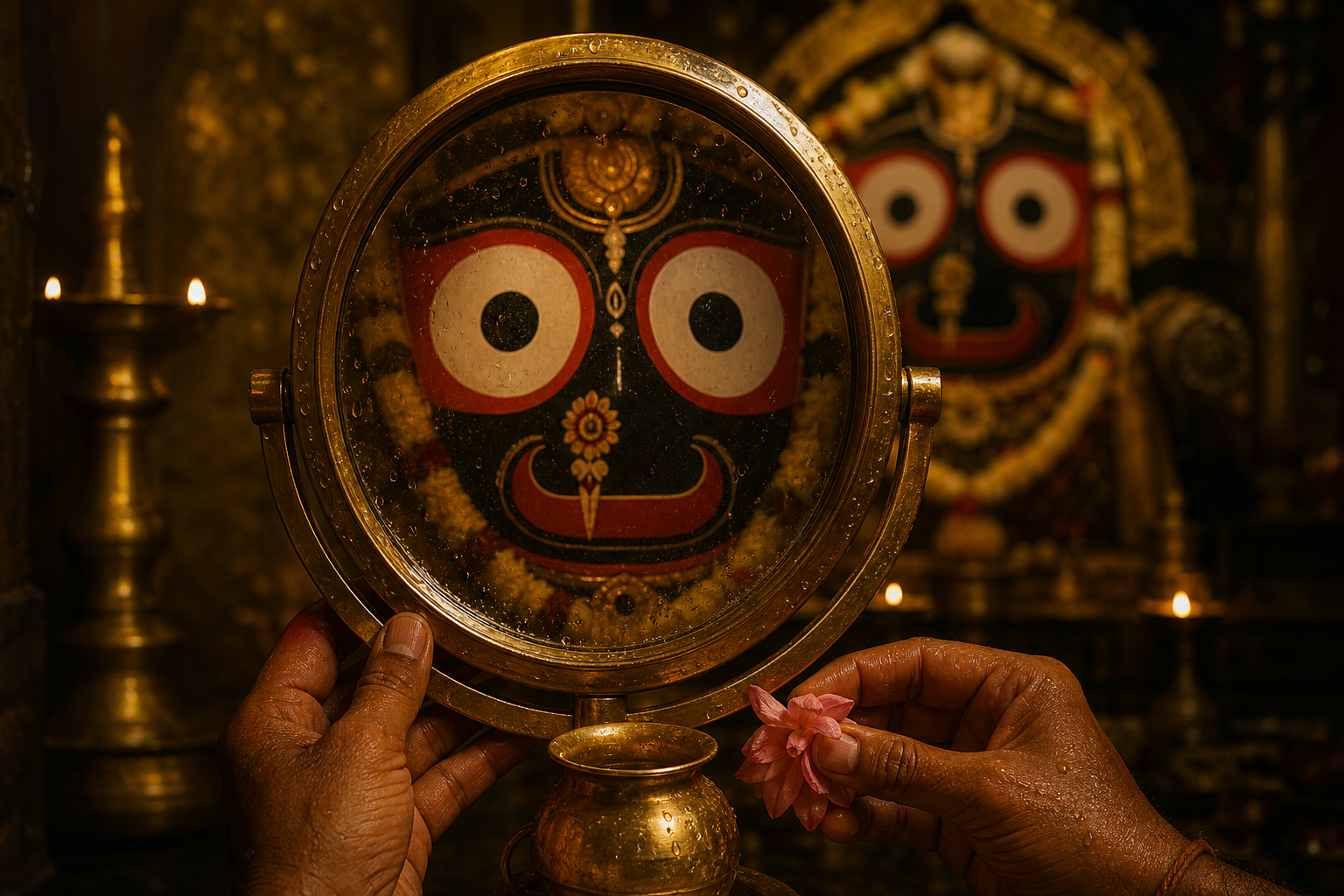
The hardest question is usually not how a mirror works, but how an offering made before a reflection can count as service to the deity. The answer lies in the ritual relationship established for this specific purpose. The darpana becomes an auxiliary murti, or upachara-bimba, during the act. It remains materially distinct from the principal murtis, yet it is no longer functioning as a neutral object.
This belongs to a wider Agamic and Vaishnava ritual grammar of pratinidhi. A flag, yantra, mirror or another duly designated focus can participate in a particular phase of worship when the primary murti is delicate or when direct contact is limited by ritual prescription. The relevant question is not whether any substitute will do. It is whether an authorized medium has been purified, assigned its liturgical function and used within the prescribed sequence of mantra and upachara.
The classical language of bimba and pratibimba helps make sense of this. Bimba is the original form; pratibimba is its reflected appearance. A reflection is neither the original wooden form nor something wholly unrelated to it. It depends upon the original, presents that form to sight and disappears when the relation among form, mirror and light is broken. Snan Darpan turns that philosophical relation into ritual action.
You can also read the rite alongside the Vaishnava principle of Acintya-bheda-abheda, simultaneous and ultimately inconceivable difference and non-difference. The mirror does not become a replacement for Jagannath. Yet, while it serves as the consecrated medium of snana, it cannot be dismissed as separate from the offering made to Him. The distinction remains, and participation remains with it.
Two opposite explanations therefore miss the point. Calling the rite merely symbolic makes the mirror sound like a visual reminder with no ritual efficacy. Calling the mirror permanently identical to the principal murti erases its specific and auxiliary role. Snan Darpan occupies the more disciplined middle: the medium is distinct, consecrated for a defined service and capable of carrying that service through a recognized relationship.
This is a useful way to approach many temple practices that appear unfamiliar. Do not begin with the binary question of whether the material object is really the deity or only an object. Notice the relationships constituted by consecration, mantra, authorized service, time and purpose. Dharma often locates sacred presence in a correctly sustained relationship rather than in material identity alone.
Preserving the wooden murtis is part of the seva
Jagannath, Balabhadra and Subhadra are worshipped as daru-brahma, sacred presence embodied in wood. Their surfaces include organic pigments and binders. Repeated direct exposure to water would encourage surface wear, loss of pigment and biological deterioration. Offering the daily bath through the mirror protects those vulnerable surfaces without deleting the required snana from the daily worship.
This is more than a fortunate side effect. The rite demonstrates that conservation can be internal to religious practice. The sacred form is not preserved by treating it as a museum object removed from use. Nor is devotion measured by how much physical stress a murti can endure. The installed form continues to receive living seva, while the ritual tradition supplies a medium appropriate to its material condition.
The mirror itself receives comparable care. The darpana is described as a highly polished metal surface, commonly made from kansa, or bell metal, or from a panchaloha alloy. Its edges may be wrapped for handling, and it is veiled while being moved. Designated cloths protect it from dust, skin oils and scratches; careful storage limits moisture, corrosion and pitting. Regular inspection preserves the clarity on which its ritual function depends.
These details tell you what custodianship means in a living temple. A clear reflection requires control of abrasion, moisture, touch, angle and light. Handling a liturgical implement carefully is not work performed after worship has ended. The care enables the worship. Surface conservation, ritual purity and optical clarity converge in the same act of seva.
Snan Darpan also offers a measured ecological lesson. It avoids the material excess and cumulative damage that direct daily saturation would create. But it should not be used to claim that any water-saving innovation automatically becomes canonical. Restraint is ritually authentic here because the mirror operates within an established Agamic framework. The practical adaptation and the ritual authorization belong together.
When you hear faith and heritage preservation presented as opposing choices, remember this example. A mature Dharmic response does not ask whether doctrine or material care must surrender. It asks how the required upachara can remain whole while the sacred form entrusted to the community is responsibly protected.
Do not confuse the daily rite with Snana Yatra
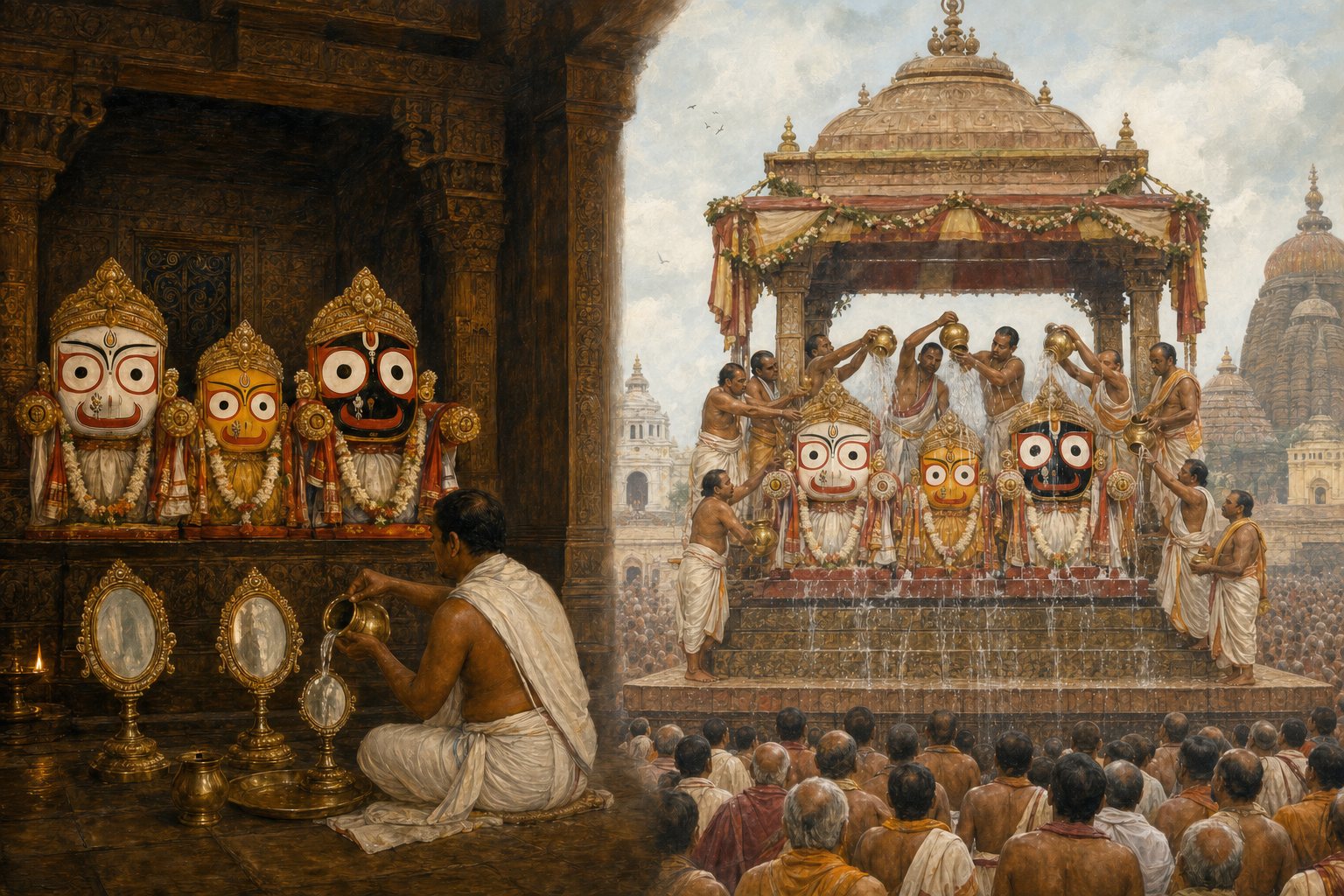
The most common practical mistake is to merge Snan Darpan with the annual Snana Yatra. Both concern bathing, but they differ in frequency, scale, medium and place in the sacred calendar. If you expect one while witnessing or discussing the other, the daily mirror bath will appear incomplete or the annual festival will appear to be a larger version of the same procedure. Neither conclusion is accurate.
| Question | Snan Darpan | Snana Yatra |
|---|---|---|
| How often does it occur? | It belongs to the daily cycle of worship. | It is the annual bathing festival on Dev Snan Purnima. |
| Where does it sit ritually? | Within the Abakasha segment of the daily nitis. | At a major public festival point in the temple calendar. |
| What is the bathing medium? | A consecrated mirror bearing the reflected forms of the deities. | An expansive abhisheka using 108 ritual pots. |
| What follows? | The temple’s normal daily sequence continues. | The festival inaugurates the Anavasara period. |
The daily mirror bath complements rather than replaces Snana Yatra. The annual direct bathing festival does not invalidate the conservation logic of the daily rite. It shows that direct contact can be reserved for a particular calendrical occasion, while ordinary daily service uses a medium suited to long-term preservation.
If you are preparing for a first visit, adjust three expectations. Do not assume daily bath means a publicly visible stream of water over the main murtis. Do not describe the darpana as an ordinary mirror held up for convenience. And do not use Snan Darpan and Snana Yatra as interchangeable names. Those corrections are enough to prevent most misunderstandings.
You should also resist reconstructing restricted sanctum details from a partial view. The guarded movement of the mirror, controlled lighting and division of sevayat roles are part of the rite’s discipline. Limited visibility does not mean that the missing portions are unimportant; it means public spectacle is not the measure of ritual completeness.
Key takeaways for your next darshan
- Snan Darpan is a daily mirror bath conducted during the Abakasha niti at Puri Srimandir.
- The consecrated darpana serves as an auxiliary ritual focus, not as a casual prop or a permanent replacement for the principal murtis.
- The reflected forms of Jagannath, Balabhadra and Subhadra receive the bathing mantras and offerings through the bimba-pratibimba relationship.
- The rite protects wooden murtis, organic pigments and binders from the cumulative harm of direct daily wetting.
- Snan Darpan is distinct from the annual Snana Yatra, whose abhisheka uses 108 ritual pots and begins Anavasara.
The mirror also gives you a discipline for seeing. Its surface must be clean, its orientation steady and its field free from stray reflections. Gaudiya Vaishnavism’s ceto-darpana-marjanam, the cleansing of the heart’s mirror, draws on the same intuitive truth: what you see is affected by the condition of the medium through which you see it.
Mirror imagery appears across Dharmic traditions. Buddhist teachings compare a trained mind to a polished mirror; Jain thought values cognition freed from obscuring residue; Sikh teaching directs attention toward the inner jot that illumines life. These are not interchangeable doctrines, but each gives you reason to examine whether distraction, residue or self-importance is clouding attention.
You do not need to imitate Snan Darpan outside its temple setting. Before your next darshan, apply its discipline instead: release the demand for spectacle, attend to the form actually being served and let careful attention replace hurried judgment. The mirror bath becomes intelligible when you approach it as the sevayats do, with clarity, restraint and care for what has been entrusted to us.
References
