
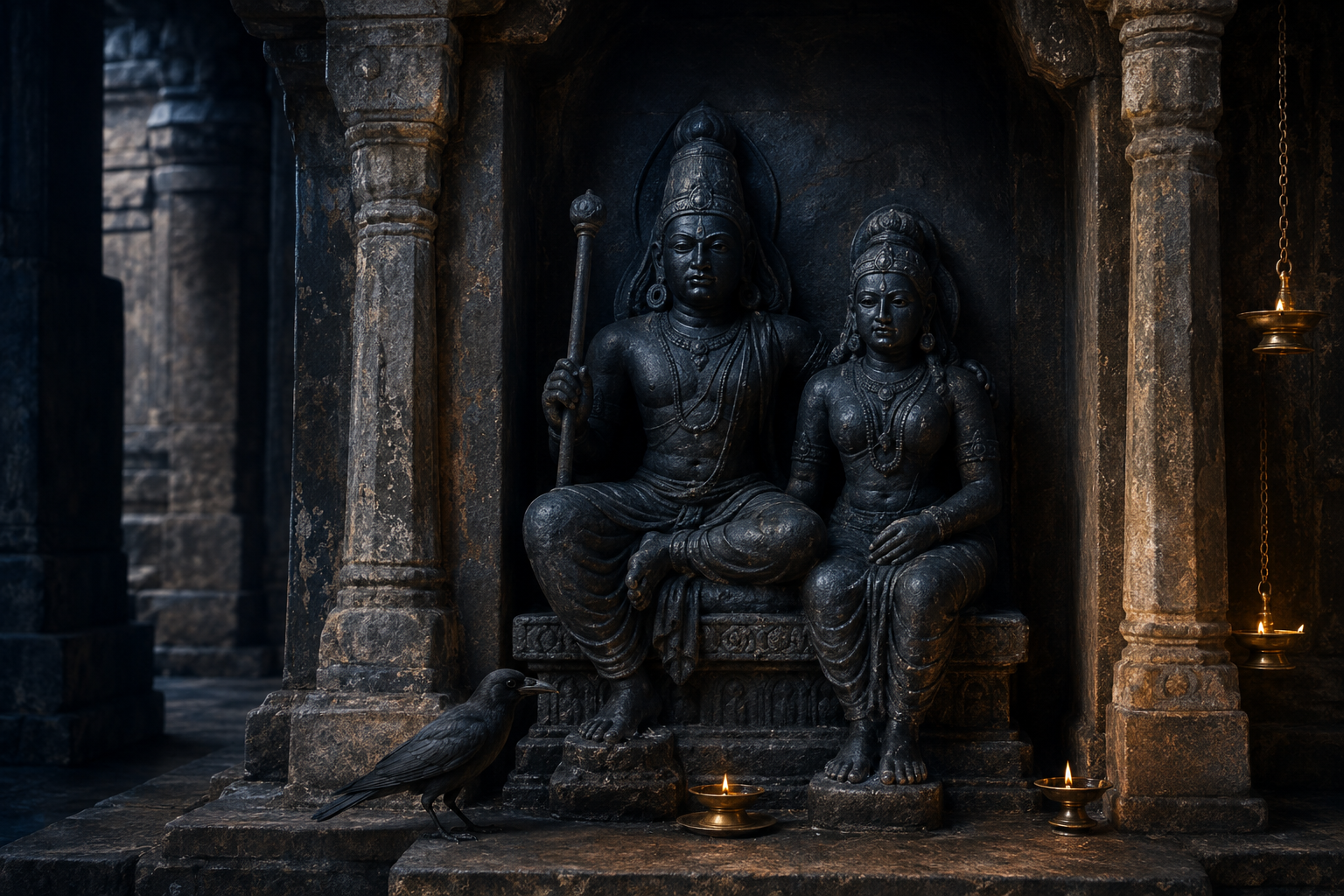
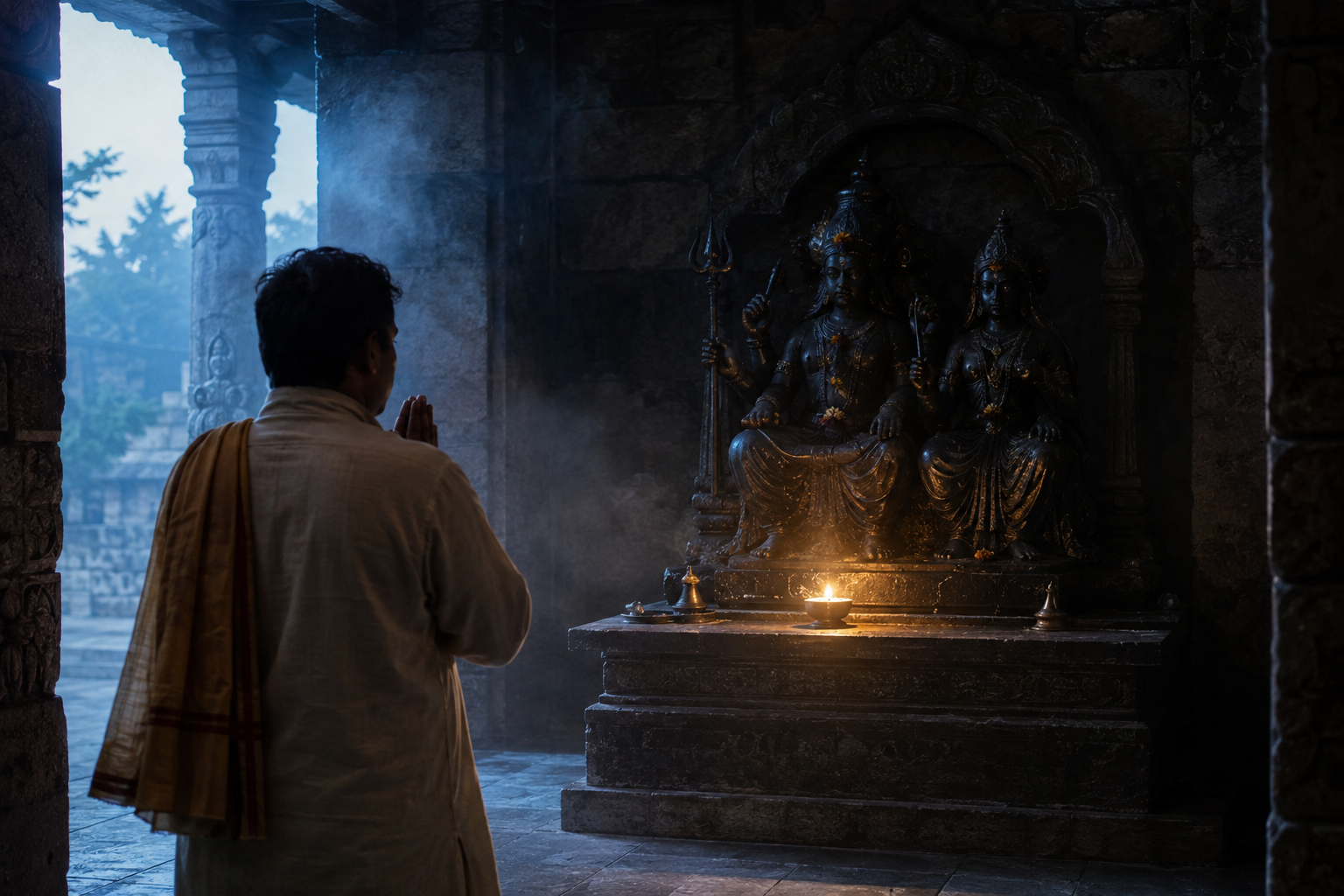
You recognize Shani Bhagavan, but the female figure seated close beside him does not fit the solitary image you expected. Is she a consort, an attendant, another deity, or simply part of a damaged panel? The safest answer begins with the sculpture’s setting and composition, not with a hurried guess based on one attribute.
A rare temple form presents Shani with his consort Neela in a closely seated composition. Learning to recognize that form also teaches a broader skill: how to distinguish what an image visibly shows, what a temple identifies, and what a devotee may reasonably understand from it.
Start with the relationship, not isolated attributes
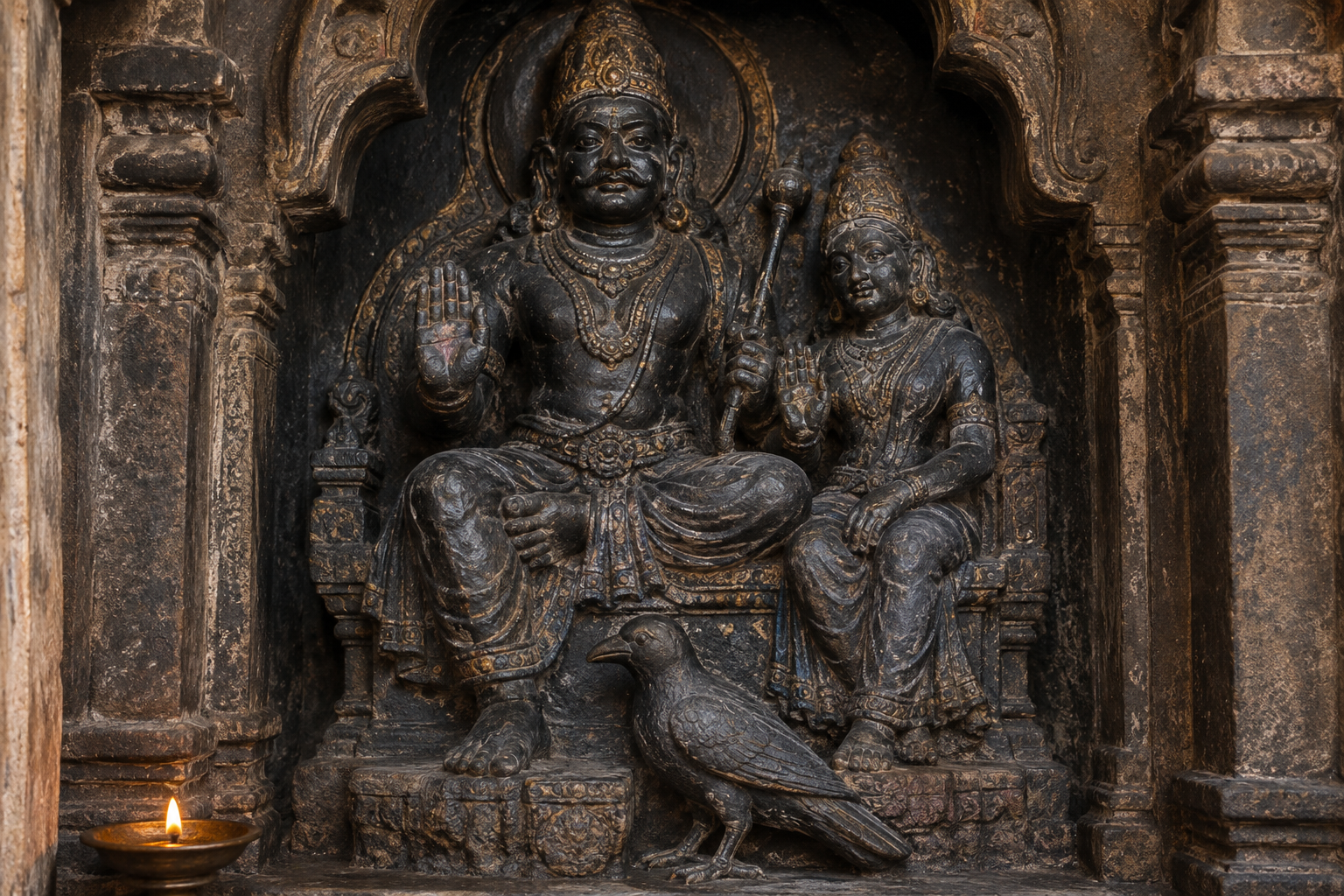
The defining feature of this image is not merely the presence of two figures. It is their relationship. Shani, the divine governor associated with Saturn among the Navagrahas, appears with Neela rather than as a self-contained planetary figure. Their proximity turns the pair into a single theological composition.
In temple iconography, placement works like grammar. Two figures of similar prominence, deliberately arranged around one compositional center, normally ask to be read together. A smaller figure pushed to an edge may have a different role. A figure seated in intentional intimacy with the principal deity cannot responsibly be dismissed as ornament merely because the viewer does not recognize her.
This is why Neela matters to the reading. If you identify Shani but treat the figure beside him as incidental, you have identified only half the image. The sculptural relationship presents Shani through divine companionship. It draws your attention away from a narrow picture of a forbidding planetary power and toward a more complete sacred presence.
Rarity requires restraint, however. A rare form is not automatically secret, older, more powerful, or superior to a familiar one. It tells you that Hindu temple traditions can preserve more than one visual way of approaching the same deity. Do not build a universal rule from a single sculpture.
How to identify Shani and Neela without forcing the evidence
Begin with context before you search for a memorized weapon, gesture, vehicle, or color. Attributes can be worn away, concealed by decoration, repainted, or rendered differently within a regional tradition. The location and relational design may survive more clearly than those details.
- Map the setting. Is the image in a Navagraha arrangement, an independent shrine, an exterior niche, or a larger narrative panel? A Navagraha setting strengthens an identification of Shani, but location is evidence rather than proof by itself.
- Record only what is visible. Note the number of figures, their relative scale, posture, proximity, gestures, objects, pedestal, and surrounding deities. Write “two seated figures” before writing “Shani and Neela.” This keeps observation separate from conclusion.
- Examine the relationship. Ask whether the figures share a compositional center, turn toward one another, or have been deliberately brought into intimate proximity. These choices can distinguish a divine pair from two unrelated figures occupying the same panel.
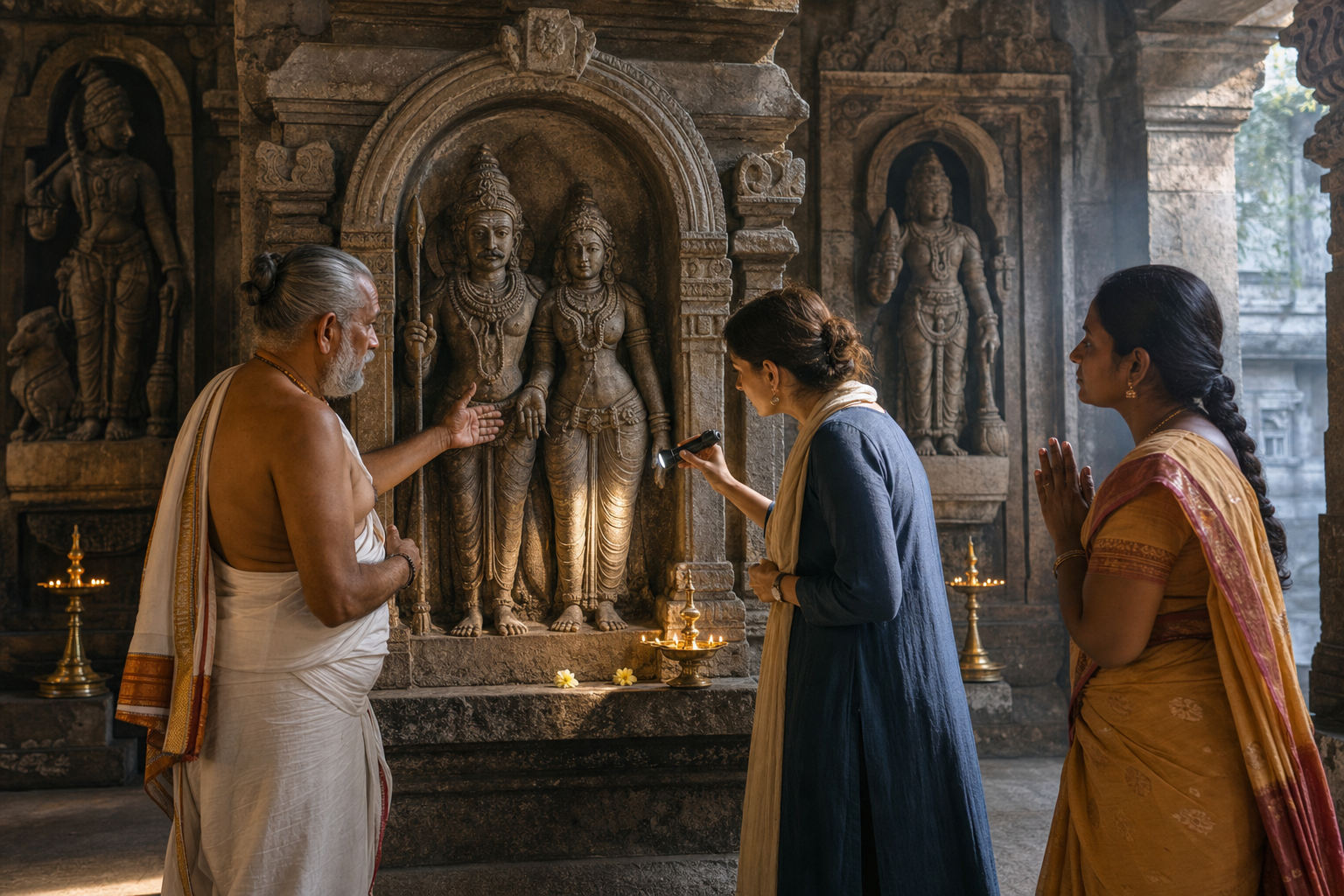
- Look for the temple’s identification. Read any inscription or displayed name. Consult the temple’s account of the shrine, and ask a knowledgeable priest or caretaker, “Whom does this temple identify in this image?” That question is better than prompting someone to confirm your guess.
- Allow for damage and later intervention. A missing hand, eroded base, heavy cloth, garland, metal covering, or modern surface treatment may conceal the feature on which a confident identification would otherwise depend.
- Compare only after gathering local evidence. Similar images can help, but resemblance should support the temple context, not overrule it. Regional sculptural conventions do not always reduce neatly to one standard template.
If the local name, the shrine context, and the paired composition agree, you can identify the image with reasonable confidence. If they conflict, preserve the uncertainty. “Traditionally identified here as Shani and Neela” is often more accurate than presenting a contested identification as indisputable fact.
Keep observation, identification, and interpretation separate
Most mistakes arise because three different acts are compressed into one. First you observe the stone. Then you identify the figures. Only then do you interpret what the composition means. Each stage depends on a different kind of evidence.
Observation describes the image
An observation should be possible for another careful visitor to verify: two figures are seated closely; one occupies the dominant position; both belong to the same carved composition; a hand or pedestal is damaged. Observation does not require you to know the deities’ names.
Identification names the figures
Identification combines what you can see with contextual evidence. In the relevant rare form, the principal deity is Shani and the intimately seated female figure is his consort Neela. A label, inscription, Navagraha setting, or continuous temple tradition can make that conclusion firmer.
Interpretation asks what the pair communicates
Interpretation is where humility matters most. The pairing can reasonably be read as a presentation of Shani through relationship rather than isolation. That does not mean every detail carries one fixed message, nor does it establish that Neela has exactly the same theological emphasis in every temple lineage.
Use local liturgical and Agamic explanations when they are available. If the temple preserves no explanation, describe the compositional effect as an interpretation: “The paired form invites a relational reading of Shani.” Do not promote that inference into an ancient rule merely because it sounds spiritually satisfying.
What the paired form can change in your approach to Shani
People often approach Shani through anxiety about delay, consequence, hardship, or astrological difficulty. That can shrink the deity into a mechanism for fear: placate the planet, avoid punishment, and seek rapid relief. The image with Neela interrupts that reduction. Shani remains the divine presence associated with Saturn, but he is not represented here as an isolated threat.
The sculpture does not need to promise that Neela cancels Shani’s influence or makes difficult consequences disappear. Such a claim would turn iconography into a transactional formula. The more grounded spiritual lesson is that discipline, accountability, patience, and relationship need not be enemies. A serious encounter with consequences can occur without treating the divine as hostile.
You can therefore use the image as a contemplative prompt without pretending that your reflection is the only authorized meaning. Ask where fear has distorted discipline into fatalism. Ask whether you are waiting passively for circumstances to change when a neglected duty is already clear. Ask whether you use accountability to isolate or humiliate yourself instead of returning to right conduct.
These questions do not assign an unsupported list of powers to Neela. They arise from the visible fact of a relational image. The pair can help you approach Shani with seriousness but without superstition: accept consequence, correct conduct, keep patience, and refuse to confuse difficulty with divine abandonment.
A respectful way to encounter the image in a temple
When you meet an unfamiliar murti or sculpture, the first task is not to produce a clever caption. It is to see what the temple has placed before you. A short, deliberate sequence will protect both reverence and accuracy.
- View the whole sacred arrangement before concentrating on the pair. Note the direction you are facing and the deities nearby.
- Look at Shani and Neela as one composition. Attend to posture, scale, proximity, and visual balance before interpreting individual objects.
- Read every available name or explanation, including information outside the immediate shrine if photography or close access is restricted.
- Ask the local name of the form and whether the temple preserves a particular account of Neela. Record the answer as that temple’s tradition rather than silently universalizing it.
- Offer pranam according to the temple’s practice. Follow its rules on photography, touching, circumambulation, offerings, and entry without treating documentation as more important than worship.
- Caption any photograph conservatively. Name the temple’s identification, distinguish missing or uncertain details, and avoid attaching promises about astrological remedies that the temple itself has not made.
This method is useful beyond this one image. Hindu sacred art contains regional forms, damaged works, repurposed panels, and living traditions that cannot always be read from a generic checklist. Context is not an inconvenience around the icon; it is part of the icon’s meaning.
Key takeaways
- The rare form depicts Shani Bhagavan seated in divine intimacy with his consort Neela.
- Identify the relationship between the figures before trying to decode isolated attributes.
- Use shrine context, visible details, inscriptions, and the temple’s living identification together.
- Separate what you observe from whom you identify and what you interpret.
- Do not assume that rarity proves secrecy, antiquity, superiority, or greater ritual power.
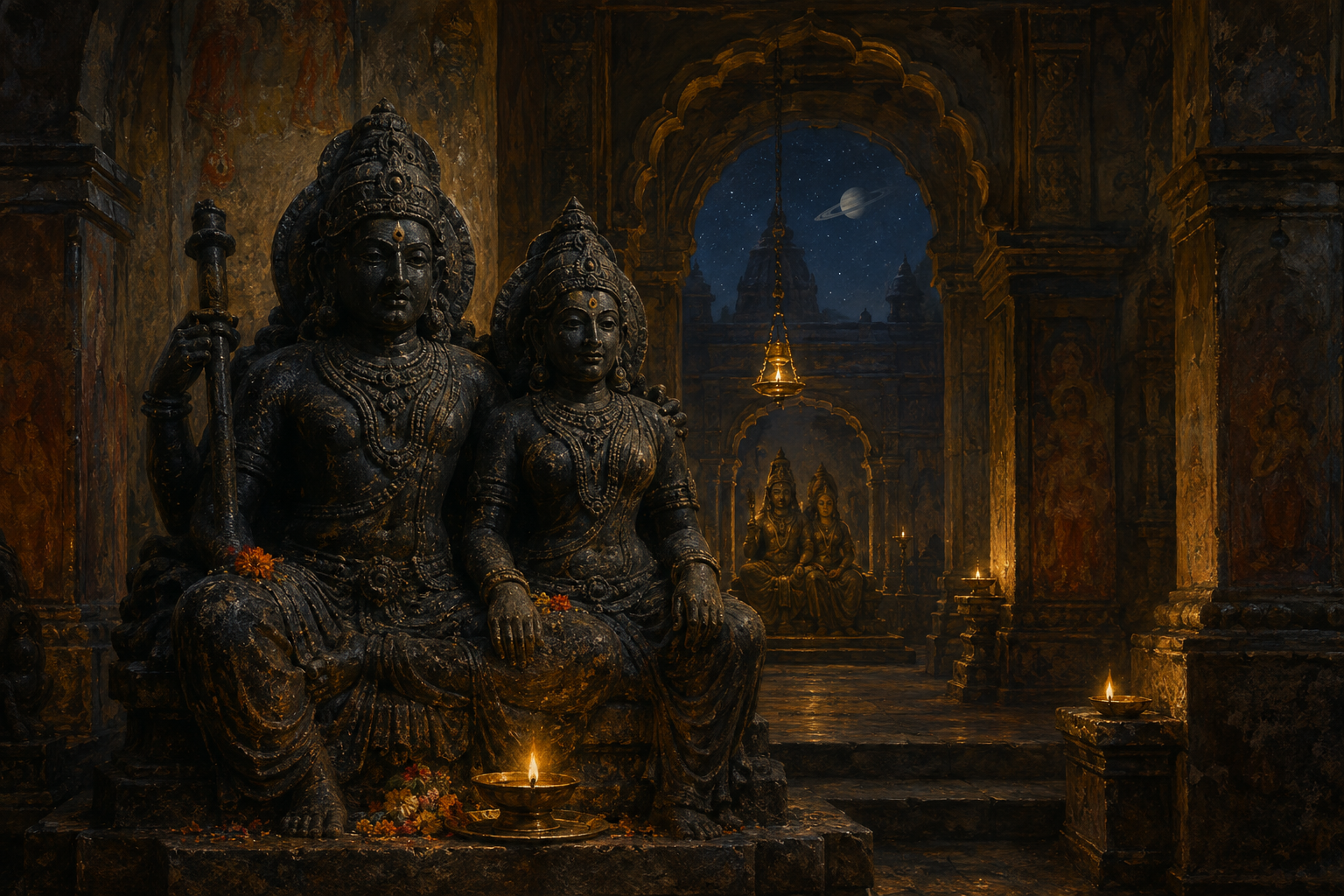
- Read the pair as an invitation to encounter Shani through relational completeness, not merely through fear of planetary adversity.
- Do not convert the sculpture into an unsupported promise that one darshan or remedy will erase consequences.
The next time you encounter an unfamiliar paired image, resist the urge to name it in the first few seconds. Look at the ensemble, ask the temple how the form is known, and let the distinction between evidence and interpretation remain visible. If the image is Shani with Neela, that patient attention is already an appropriate way to begin understanding it.
References
