

You have an obstacle that feels urgent, and Kshipra Ganapati seems made for the moment. Then Ucchista Ganapati appears in your search, surrounded by claims about Tantra, impurity, and forbidden practice. The useful question is not which form is more powerful. It is which form matches your intention, and what kind of practice you are actually prepared to undertake.
For a time-sensitive prayer centered on removing an obstacle, Kshipra gives you the clearer devotional orientation. Ucchista calls for slower study because the form is Tantric, frequently misunderstood, and too easily reduced to its most provocative associations.
Two forms that address different devotional needs
| Question | Kshipra Ganapati | Ucchista Ganapati |
|---|---|---|
| Place among the 32 forms | Tenth form | Eighth form |
| Central emphasis | Quick response to the devotee and the removal of obstacles | A Tantric form whose meaning is often reduced to impurity and Vamachara |
| Best reason to approach | You have a definite, urgent obstruction and want to bring it into disciplined Ganapati worship | You want to understand or practise the form through a complete and trustworthy ritual framework |
| Main error to avoid | Treating divine quickness as a guaranteed deadline | Assuming that a sensational description supplies the whole theology or a usable ritual method |
The eighth and tenth positions identify where the forms occur in the traditional list; the numbers do not establish a hierarchy of spiritual power. Nor are these competing deities from which you must select a winner. They are distinct approaches to Ganapati, and each approach asks something different of the devotee.
Kshipra is comparatively easy to understand at the level of intention: your concern is urgent, and you seek Ganapati’s swift help. Ucchista presents an interpretive problem before it presents a practical one. Its charged associations make context essential. A name, image, or isolated instruction is not a substitute for a complete vidhi.
Kshipra Ganapati: turn urgency into disciplined action
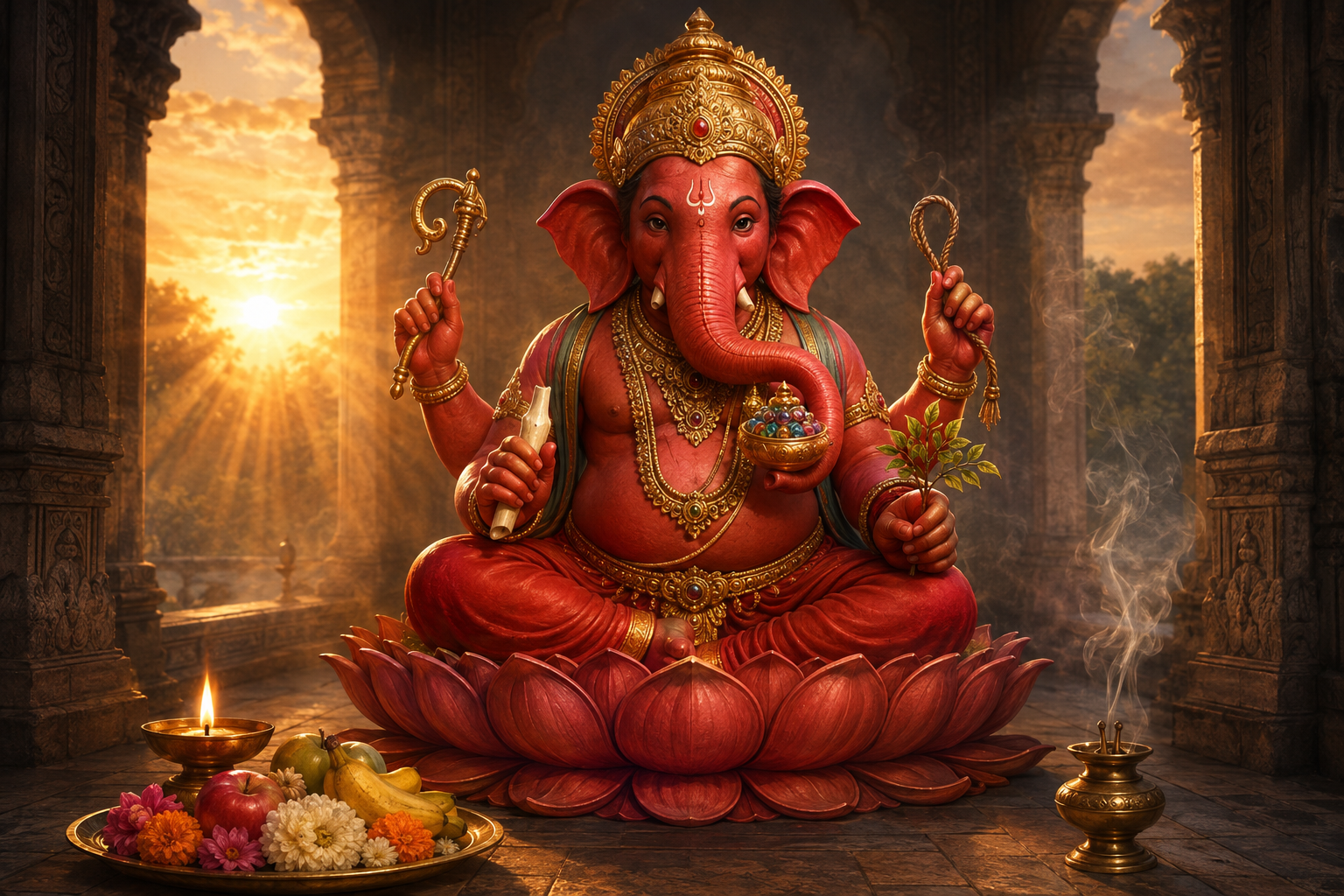
Kshipra Ganapati is regarded as the quick-acting form who satisfies devotees without delay. That is a devotional claim about divine responsiveness, not a contractual promise that a chosen event must happen by a time you set.
This distinction matters when fear is driving your worship. If you decide that a prayer has failed unless a particular answer arrives tomorrow, you turn urgency into bargaining. You may also miss another kind of opening: clearer judgment, the courage to make a difficult call, recognition that your desired route is itself obstructive, or the removal of indecision that kept you from acting.
You can approach Kshipra’s emphasis without inventing a specialized ritual:
- Name one obstacle. Write it in a single sentence. If you need a paragraph, you probably have several obstacles and should separate them.
- Distinguish the obstruction from your preferred outcome. “Remove whatever prevents a sound decision” is more open to discernment than demanding that only one predetermined result occur.
- Use the Ganapati practice you already know. Follow your family, temple, or teacher’s procedure as received. Do not assemble a new mantra-and-offering sequence from unrelated fragments merely because the need feels urgent.
- Take the corresponding human step. Make the call, submit the form, repair the misunderstanding, begin the preparation, or decline the unsuitable path. Prayer to the remover of obstacles should not become a reason to preserve an obstacle you can address.
- Notice the response without forcing a sign. Look for greater clarity and a workable next step as well as the external result you requested.
The practical test is simple: Kshipra worship should make your intention more precise and your conduct less hesitant. If it only makes you watch the clock, the idea of quickness has displaced the discipline of devotion.
Ucchista Ganapati: do not let taboo become the theology
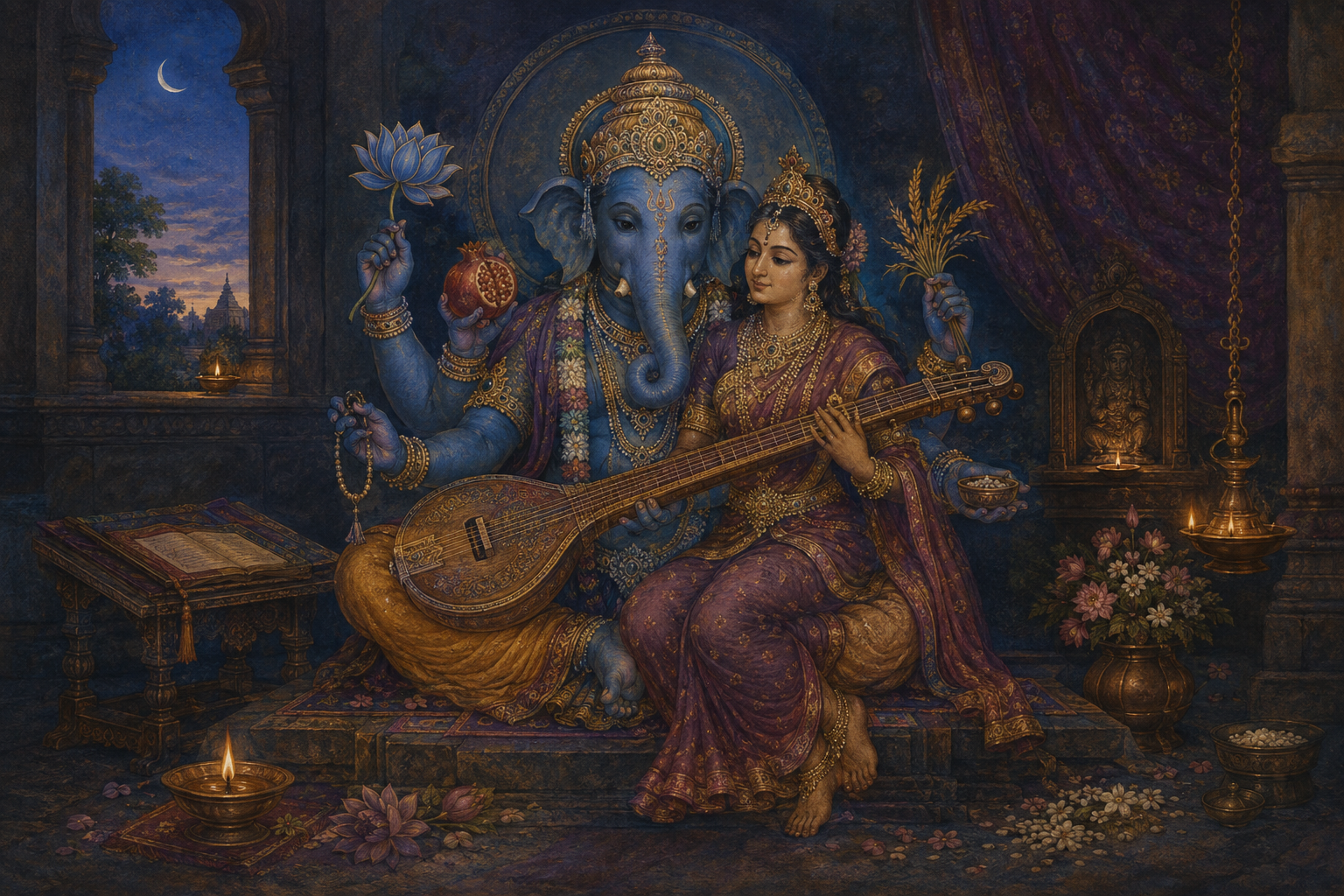
Ucchista Ganapati is the eighth of the 32 forms and is associated with Tantra. A common reduction links the form exclusively with leftover food, uncleanness, and Vamachara. That exclusive interpretation is challenged through the ritual framework known as Ucchista Ganapathi Puja Vidhanam.
Correcting that reduction does not justify the opposite mistake. It does not mean that every ritual attached to the name is casual, universal, or safe to reconstruct from a short description. “Not exclusively an unclean rite” and “suitable for unrestricted improvisation” are entirely different claims.
When you encounter instructions for Ucchista Ganapati, test them before treating them as a practice:
- Is there a complete procedure? An image, a deity name, or an isolated mantra is not a full puja vidhi.
- Is the ritual context identified? Look for a named textual, temple, family, or teacher-based setting rather than an unexplained collection of dramatic claims.
- Does the explanation separate theology from instruction? A discussion of impurity, boundaries, or non-dual symbolism does not by itself tell you what to perform.
- Are prerequisites stated? If a specialized practice omits who may undertake it, what preparation is expected, and how the sequence is learned, you do not yet have enough information to reproduce it.
- Does the explanation rely mainly on shock? When forbiddenness is the principal attraction, the presentation is directing your attention toward transgression rather than Ganapati.
If those questions remain unanswered, stop at respectful study. Continue with the Ganapati worship already established in your life while you seek complete instruction. This is not timidity. It is the same care you would bring to any technical spiritual discipline whose meaning depends on sequence, context, and transmission.
A decision rule for choosing between the forms
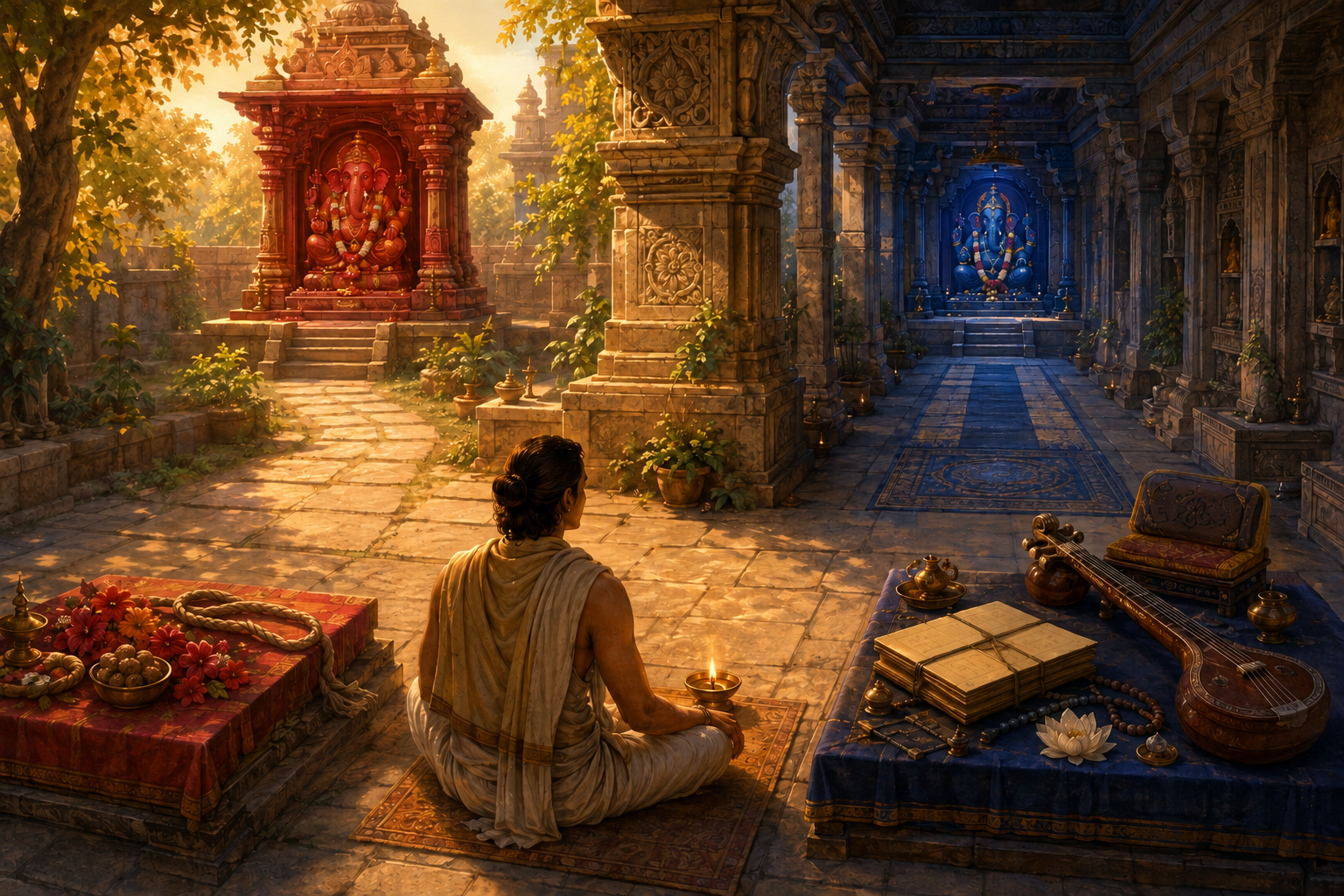
Choose according to the question you are actually bringing to worship, not according to which name sounds rarer or stronger.
- You face a definite and urgent obstacle: Kshipra Ganapati is the more direct devotional orientation. State the obstacle clearly, use an established form of worship, and take the practical step that belongs to you.
- You are studying the 32 forms: Learn Kshipra as the tenth form and Ucchista as the eighth. Keep their distinct emphases intact instead of flattening both into a generic claim about obtaining results.
- You are drawn to Ucchista because of alarming claims: Slow down and establish what is actually being claimed. The label “Tantric” does not prove that every description of uncleanness or Vamachara is complete.
- You have received a specific Ucchista practice: Follow the instruction in its own setting. Do not combine it with stray mantras, visualizations, or offerings found elsewhere merely because they use the same deity name.
- You have no complete specialized instruction: Keep to familiar Ganapati upasana. You can honour Kshipra’s emphasis through an urgent but disciplined prayer without pretending to possess a technical ritual you have not received.
There is also no need to combine the two forms simply because both appear in the same catalogue. A shared identity as Ganapati does not make every form’s ritual vocabulary interchangeable. Combining fragments may produce something new, but it does not establish that the result belongs to either received practice.
If your family or temple already maintains a Ganapati tradition, begin there. A living practice with known context is more useful than an exotic name detached from its vidhi. Specialized study can then deepen what is already stable instead of replacing it with novelty.
Key takeaways
- Kshipra Ganapati is the tenth of the 32 forms and expresses the devotee’s hope for swift removal of obstacles.
- Quick action is a devotional expectation, not a guaranteed timetable for one predetermined outcome.
- Ucchista Ganapati is the eighth form and is Tantric, but reducing the form exclusively to uncleanness and Vamachara is too narrow.
- Rejecting that narrow interpretation does not authorize improvised Tantric practice.
- Use familiar worship for an urgent need; require complete context and instruction before attempting a specialized vidhi.
Your next step can be modest and exact. Write the obstacle before you in one sentence. If urgency is the heart of the matter, bring that sentence into your established Ganapati practice and complete one matching action. If Ucchista is the heart of your inquiry, write down where the proposed procedure comes from and what it leaves unexplained before you perform anything.
References
- Hindu Pad – Ucchista Ganapati, Tantric form of Lord Ganesha
- Hindu Pad – Kshipra Ganapati: Ganesha in the quick acting Form
