

You may know how to bow before Devi at a temple yet struggle to carry that devotion into an ordinary Tuesday. Or you may keep a home practice that has become mechanical and wonder whether a pilgrimage would make it feel alive again.
You do not have to choose between the two. Build one continuous practice: sadhana prepares your attention, pilgrimage gathers that attention around a sacred place, and your conduct after darshan shows whether the encounter changed anything.
Give sadhana and pilgrimage different jobs
Daily sadhana works through repetition. You return to one place, one mantra, and one intention until devotion begins to shape your habits. Pilgrimage works through displacement. You leave familiar routines, enter a place sustained by generations of worship, and discover what remains when convenience and novelty fall away.
Confusing those roles creates two common problems. If you expect a journey to do all the spiritual work, the experience may fade into a vivid memory with no daily consequence. If you treat home practice as nothing more than a ritual count, it can become detached from the living presence, community, and sacred geography that pilgrimage makes tangible.
A coherent Shakti path therefore needs a clear thread running through both. Choose a quality of Devi that you are prepared to embody, not merely request. Compassion, emotional steadiness, wise use of resources, and nourishing speech are suitable examples within a Bhuvaneshwari-centered practice.
This is especially clear in the traditional Rohini correspondence. Rohini is associated with the Moon, nourishment, growth, and creative ripening, while Bhuvaneshwari is regarded as its primary Mahavidya, bringing lunar sensitivity into the spacious, maternal awareness of the cosmic mother. If this is your chosen framework, the aim is not to become more governed by changing moods. It is to let sensitivity mature into stable care.
If your family, sampradaya, or teacher has already given you another form of Devi and another practice, keep that continuity. The practical pattern still applies: one sankalpa, regular upasana, attentive pilgrimage, and ethical follow-through. Consistency matters more than collecting spiritual identities.
Build a Bhuvaneshwari sadhana you can sustain
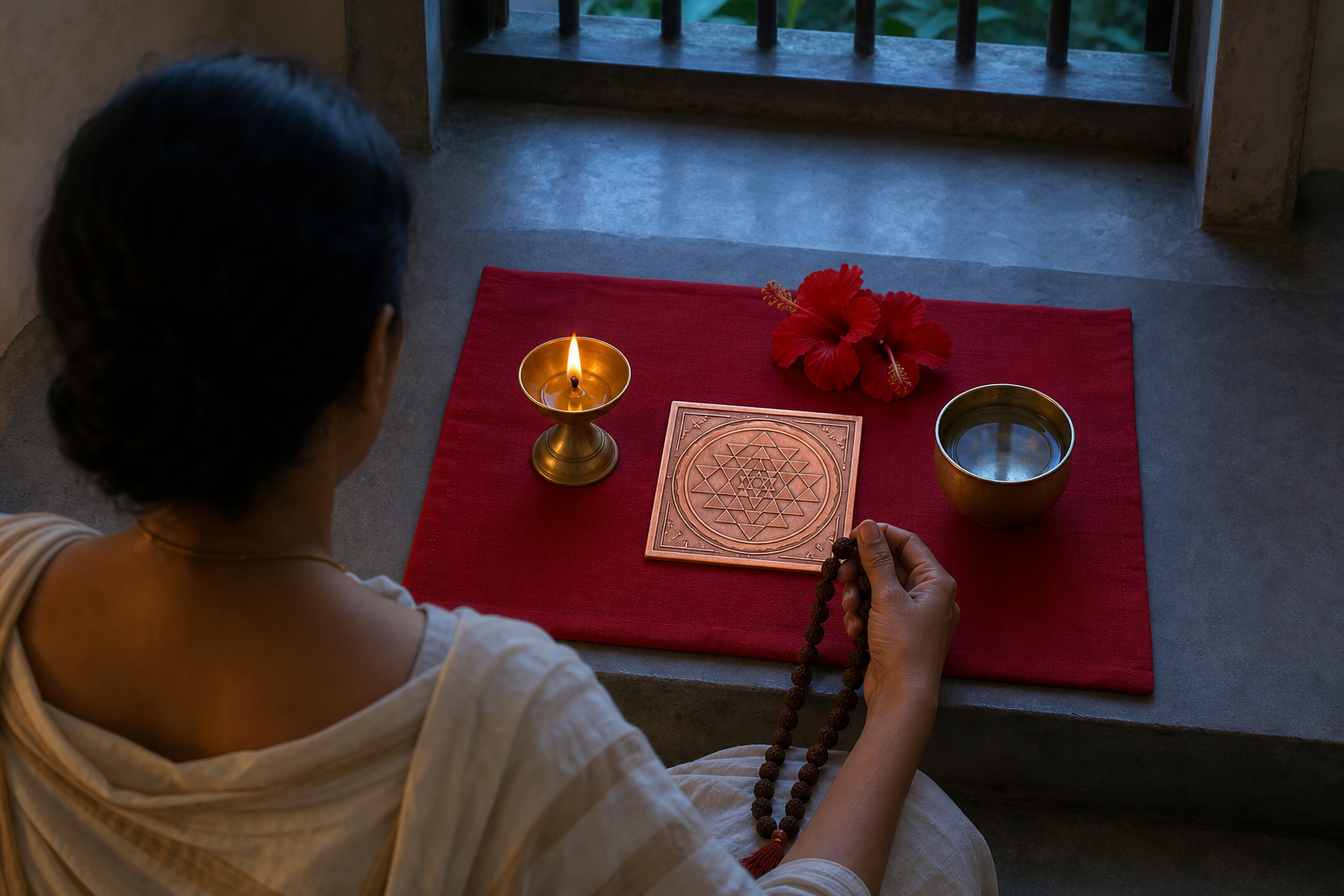
A useful home practice should be dignified but small enough to repeat. Elaborate preparation can feel impressive while quietly becoming the reason you skip practice. We would begin with a clean place, a fixed sequence, and an intention connected to daily behavior.
- Prepare one clean seat and altar. Use a red or white cloth with a Bhuvaneshwari image or yantra, fresh flowers, and a small lamp. Milk or fruit may be offered as symbols of nourishment. If you light a lamp, place it safely and never leave it unattended.
- State one sankalpa. Keep it short enough to remember after the ritual. You might resolve to cultivate calm speech, compassionate firmness, responsible stewardship, or steady care for your household. A sankalpa such as this gives the practice a direction beyond obtaining a desired result.
- Settle the body. Sit with a relaxed, upright spine and allow the breath to become soft and even. The purpose is steadiness, not strain.
- Complete the mantra-japa. A widely used formula is Om Hreem Bhuvaneshwaryai Namah. Begin with 108 repetitions and increase only when the larger count can be maintained without haste or resentment.
- Let the sound settle into dhyana. After the final repetition, rest briefly in an awareness of spaciousness, like a moonlit sky. Do not rush to fill the silence with another request.
- Name the day’s expression of the practice. Before rising, choose one concrete act: listen without interrupting, share food, give time or knowledge, repair agitated speech, or handle a resource more responsibly.
Mondays, the Rohini Nakshatra transit, and Purnima are traditionally supportive times for this practice. Use such timing to reinforce discipline, not to postpone it. If waiting for an ideal lunar moment repeatedly breaks your routine, keep the ordinary sitting and let the special day deepen it.
Watch for changes in decisions and relationships rather than chasing unusual sensations. Is your speech less agitating? Can you remain receptive without being swept away by another person’s mood? Are beauty, comfort, land, money, or food handled with greater care? Those questions translate Bhuvaneshwari upasana into something observable.
Simple grounding also matters when lunar sensitivity feels changeable. Unhurried walking, gentle pranayama, moderation in pleasure, light sattvic food, truthful commitments, and adequate pauses before reacting all support the same movement toward steadiness. Sadhana is not an escape from responsibility; it is training for a more refined way of meeting it.
Make an Alopi Devi visit a pilgrimage, not sightseeing
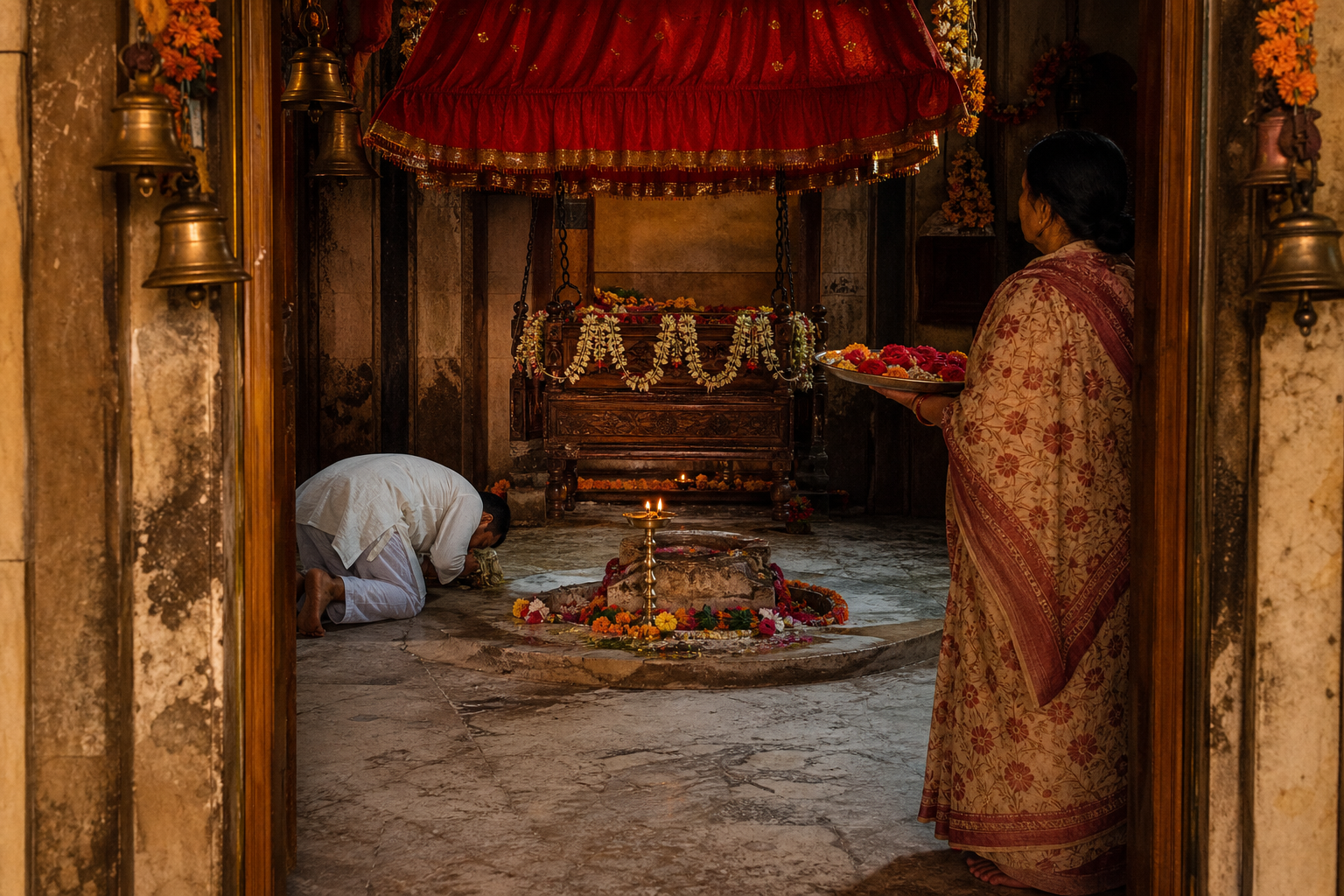
Alopi Devi Mandir in Prayagraj offers a particularly direct encounter with Shakti beyond conventional form. The sanctum does not center an anthropomorphic murti. It holds an empty wooden doli, or palanquin, honored as the presence of Alopshankari Devi. That changes how you should approach the visit: less as a search for spectacle and more as an exercise in attentive presence.
Before you go
- Carry the same sankalpa used at home. Do not invent a completely different spiritual agenda for the journey. Continuity turns travel into pilgrimage.
- Choose a quieter period when possible. Early morning and evening are generally preferred for peaceful darshan. Navaratri attracts especially large congregations, and Kumbh Mela brings pilgrims who often include Alopi Devi in a wider Prayagraj itinerary.
- Plan the location sensibly. The mandir is in Alopibagh, near the Triveni Sangam. Auto-rickshaws and taxis connect the area with Prayagraj’s station districts and Civil Lines.
- Dress and behave for a living shrine. Wear modest clothing, follow the queue, and ask before taking photographs. Restrictions may apply near the sanctum.
- Keep offerings simple. Chunari, sindoor, bangles, and red flowers belong to the temple’s established devotional language. An offering is an act of reverence, not a way to purchase a particular outcome.
At the sanctum
The absence of a conventional image can tempt the mind to ask what it is supposed to see. Let that question soften. Notice the doli, the cloth, bells, conch sounds, chants, aarti, and the ordered movement of devotees, but do not confuse sensory intensity with darshan itself. The central discipline is to remain present before a form that points beyond visible form.
Offer your pranam without demanding a dramatic feeling. Recall the quality named in your sankalpa. If you came seeking steadiness, allow the crowded or hurried moments of the visit to test steadiness. If you came seeking compassion, practice it in the queue. If you came seeking protection, consider how your own speech and actions can become protective toward someone more vulnerable.
After darshan, preserve a little silence if local conditions allow. You do not need to evaluate the experience immediately or collect multiple impressions for display. When you resume your home practice, use the same mantra and sankalpa. This is how the shrine enters your daily life without being reduced to a souvenir.
Let the unseen presence refine your understanding of Shakti

Two devotional narratives are associated with the name Alopi. In one, the last remnant in the story of Sati’s dismemberment disappears at this place. In another, a newlywed bride vanishes from danger when bandits attack her palanquin, leaving the doli behind. These are living sacred narratives, not details that should be flattened into a single forensic history.
Devotees regard the mandir as a Shakti Peetha, while its precise beginnings remain entwined with local lore and oral memory. You can respect that uncertainty without treating the shrine’s living tradition as uncertain. Continuous worship, community patronage, ritual practice, and pilgrimage are themselves part of its history.
The doli also prevents a shallow opposition between form and formlessness. The sacred object is visibly present, decorated, approached, and served, yet it directs attention toward what cannot be contained by an image. Bhuvaneshwari dhyana develops a complementary intuition. Space is not mere emptiness; it is the vast field within which worlds, emotions, relationships, and responsibilities arise.
That insight should make your worship more careful, not less embodied. Clean the altar. Protect the temple’s order. Honor the offering. Restrain harmful speech. Serve another person. Presence beyond form is not permission to dismiss forms; it is a reason to handle them without mistaking any one object, emotion, or private experience for the whole of Devi.
This orientation also permits respectful recognition across Dharmic paths without pretending they are interchangeable. A Buddhist practitioner may recognize the discipline of boundless compassion; a Jain may recognize ahimsa and inner purification; a Sikh may hear an echo of all-pervading reality in Ik Onkar. The respectful response is not to erase theological differences. It is to let shared commitments to non-harm, wisdom, discipline, and service improve how communities meet one another.
Key takeaways: keep the pilgrimage alive at home
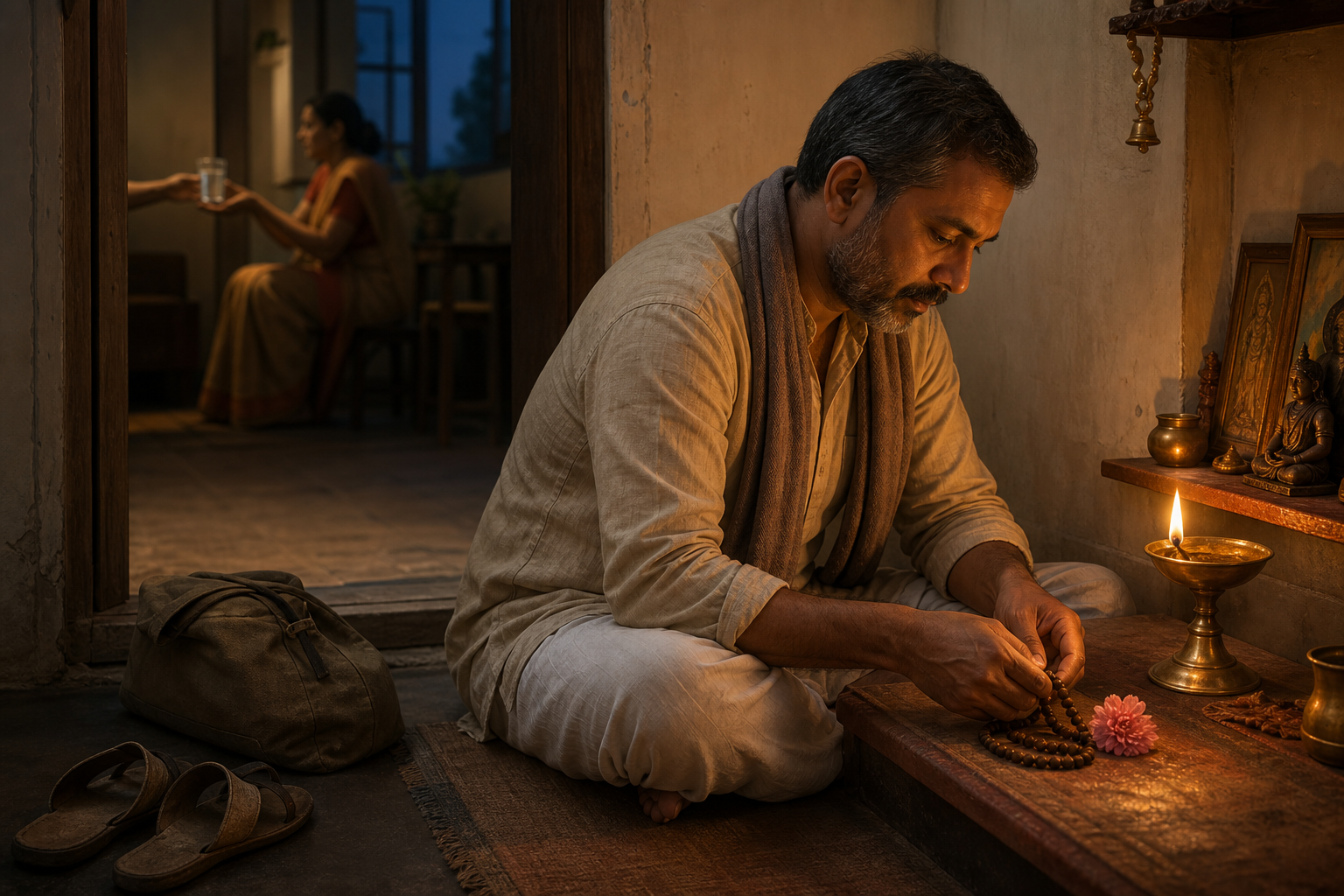
- Use daily sadhana to form attention, pilgrimage to concentrate it, and conduct to verify it.
- If you follow the Rohini correspondence, center Bhuvaneshwari worship on emotional steadiness, compassionate spaciousness, and responsible nourishment rather than on mood or novelty.
- Keep the home sequence repeatable: clean altar, clear sankalpa, even breath, 108 repetitions of Om Hreem Bhuvaneshwaryai Namah, quiet dhyana, and one concrete act of care.
- At Alopi Devi Mandir, approach the empty doli as an invitation to attend to presence beyond conventional image, not as an absence to be explained away.
- Respect the shrine’s distinct traditions, local rules, crowds, offerings, and oral narratives. Pilgrimage includes how you treat the place and its people.
- Measure the practice in speech, restraint, listening, stewardship, ahimsa, and seva. A powerful darshan that leaves these untouched is still unfinished.
At your next sitting, make one sankalpa, complete the 108 repetitions without rushing, and choose one act that will carry Devi’s quality into the day. If you later travel to Prayagraj, take that same intention to the doli of Alopshankari. Let the pilgrimage deepen a discipline already alive, and let the discipline keep the pilgrimage alive after you return.
References
- DharmaRenaissance Blog – Ultimate Rohini Nakshatra Guide: Discover Bhuvaneshwari Sadhana for Lunar Mastery
- DharmaRenaissance Blog – Alopi Devi Temple, Prayagraj: Complete Guide to the Unique ‘Disappearing’ Shakti Peetha
