
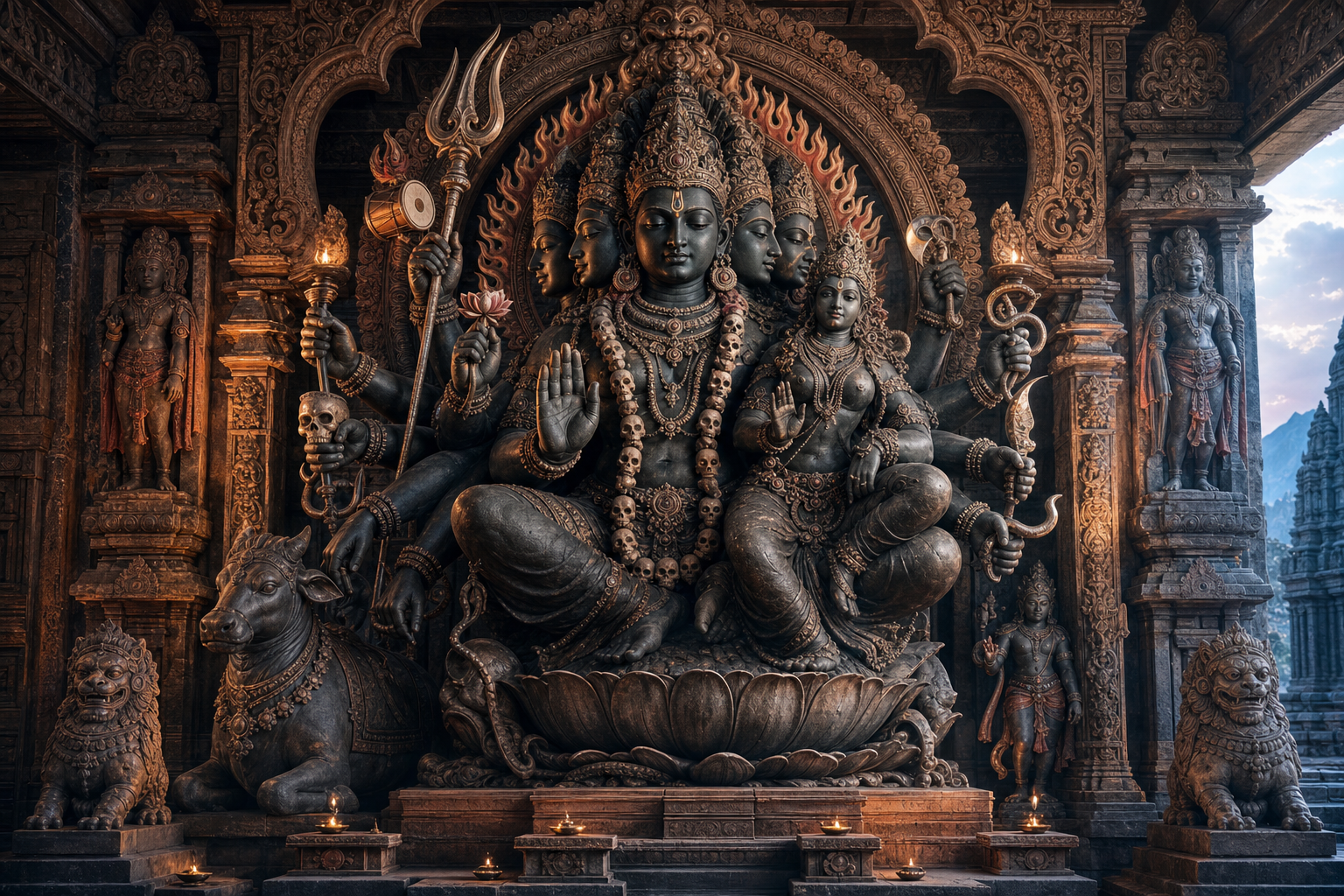
You are standing before a many-faced Shiva or a lion-headed Yogini. There are flames, skulls, serpents, mudras and more arms than you can count at a glance. Is the image describing a deity, mapping consciousness, warning the unprepared, or teaching a method of practice?
Usually, it is doing several of those things at once. The useful question is not simply, “What does this object mean?” It is, “How do the form, number, direction, setting and attributes work together?” Read those layers in order and an apparently bewildering image becomes a precise lesson in stillness, power, speech, discernment and transformation.
Begin with the whole image, not the nearest weapon
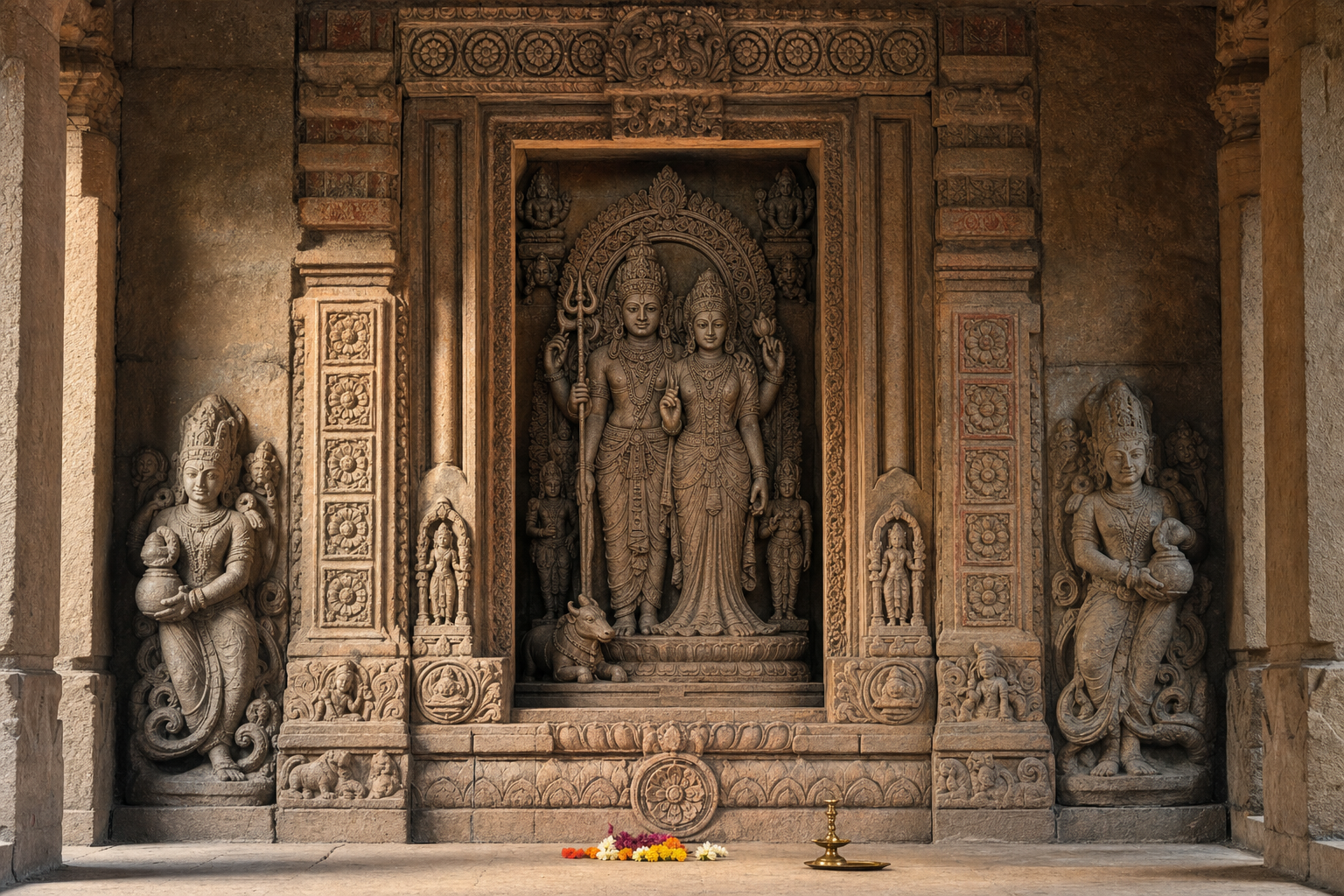
The most common mistake is to treat Tantric iconography as an inventory. You identify a trident, drum, skull-cup and rosary, then assume that adding their dictionary meanings will explain the murti. It will not. An attribute changes force according to who holds it, which hand holds it, what gesture answers it on the opposite side, and whether the surrounding form is serene, fierce or deliberately mixed.
Start with the governing relationship. Is the central body still while the arms radiate movement? Does a peaceful face preside over instruments of severance and fire? Does a protective hand balance an implement associated with restraint or dissolution? These contrasts are not inconsistencies. They show power held in awareness rather than power released impulsively.
Mahasadashiva offers an unusually clear example. His principal faces may remain composed even while twenty-five heads and fifty arms expand around them. The result is not a picture of confusion. It is a visual account of unity expressing many functions. The still centre matters as much as the multiplication surrounding it.
Next, determine the image’s broad register. A serene or saumyā form invites you to notice order, assurance and contemplative presence. A fierce or ugra form may place teeth, flame, skulls, animal features or weapons in the foreground. Do not translate ugra as evil. In Shaiva-Shakta settings, ferocity commonly marks the intensity required to expose delusion, protect a threshold or dissolve an obstruction.
Finally, look at placement. A relief on a prakara wall does not function exactly like a consecrated image at the ritual centre of a shrine. Exterior temple walls can form a graduated teaching environment: guardians, divine attendants, narratives and metaphysical forms prepare the visitor for the relative simplicity of the sanctum. A complex image encountered during pradakṣiṇā may therefore train your attention before you face the linga’s concentrated silence.
Numbers and directions are theological coordinates
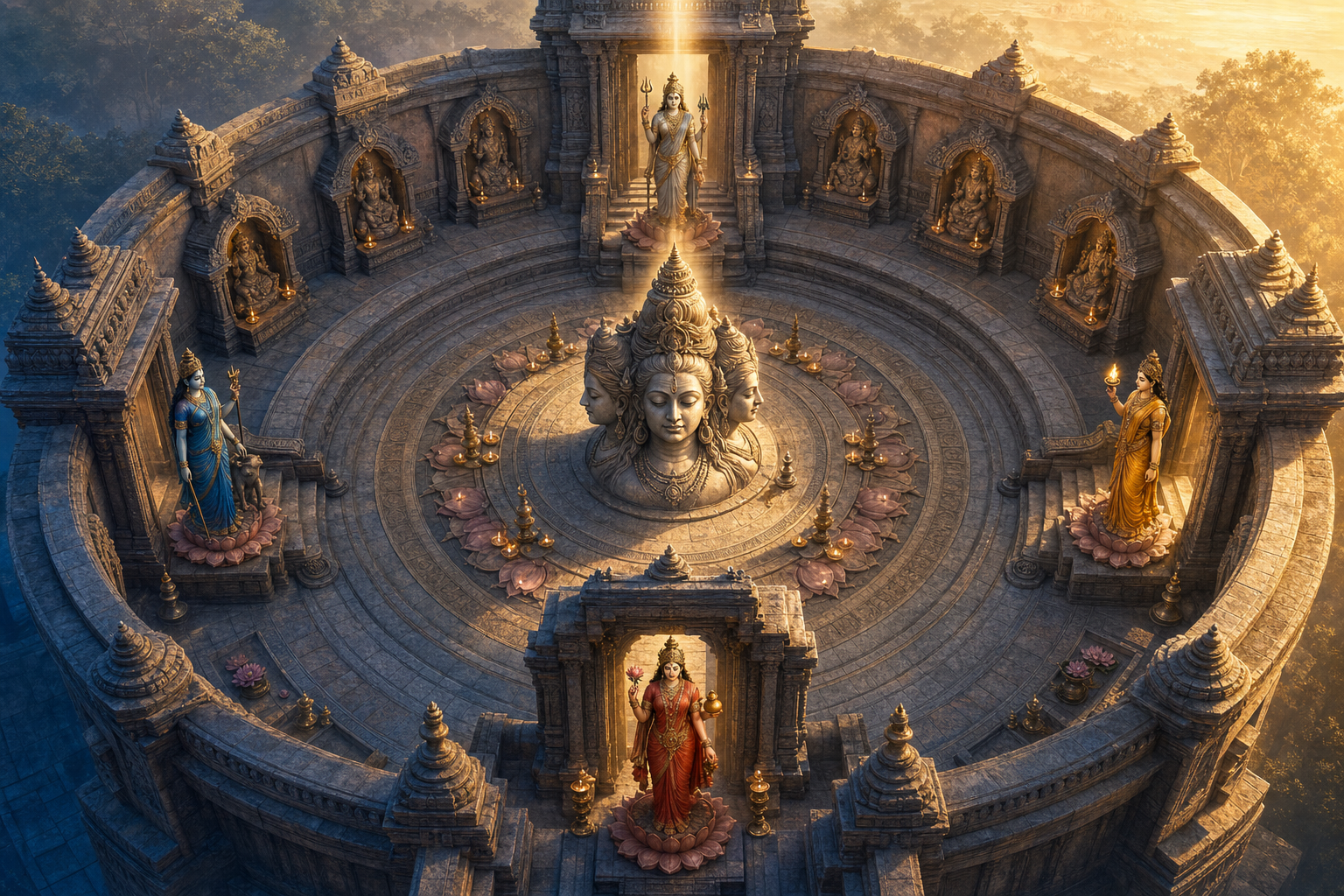
Multiple heads do not usually mean multiple competing personalities. Multiple arms do not merely advertise supernatural strength. They allow a sculptor to make simultaneous powers visible: protection and dissolution, knowledge and action, stillness and manifestation. The number and orientation of those parts tell you how the powers are ordered.
For a multi-faced Shiva, begin with the fivefold framework of the pañca-brahma. The usual orientation is:
| Face | Direction or position | What to notice on site |
|---|---|---|
| Īśāna | Above or crowning the vertical axis | Look upward before concluding that only four faces are present. |
| Tatpuruṣa | East | Establish the temple’s orientation rather than assuming the face nearest you is east-facing. |
| Aghora | South | Do not identify it only from a fierce expression; position is part of the evidence. |
| Vāmadeva | North | Read it in relation to the other directional faces. |
| Sadyojāta | West | Check whether the rear face is hidden, damaged or inaccessible. |
This directional map prevents a frequent error: naming a face from expression alone. Weathering, local style and the viewing angle may obscure facial character. Direction, crown arrangement and relation to the central axis provide additional evidence.
Mahasadashiva expands the fivefold scheme into twenty-five heads, often understood as five groups of five. The expansion elaborates the pañca-brahma rather than abandoning it. When you encounter such a relief, look for repeated tiers, crown bands, hair arrangements and necklines. South Indian sculptors used those devices to keep a dense five-by-five program visually legible.
The fifty arms carry another layer. A prominent Shaiva-Shakta interpretation relates them to the fifty mātrikā letters of the Sanskrit varṇamālā, linking divine manifestation to sound, vibration, letter and meaning. The arms are therefore not only limbs holding objects. They can represent the differentiated field through which consciousness becomes expressible.
That reading helps you understand why the ḍamaru and akṣamālā matter. The drum indicates rhythm and generative sound; the rosary indicates ordered repetition and sustained discipline. Agni marks transformative or dissolving force. The triśūla conveys discrimination and concentrated power. The pāśa restrains or binds, while the aṅkuśa directs. A deer can evoke the mobile mind held within mastery. Abhaya offers protection; varada extends grace or a boon. No single object explains the whole figure, but each contributes a verb to the composition.
Other features establish the identity and scope of the form. The jaṭā-makuṭa, crescent moon, Gaṅgā emerging from the locks, serpents, tiger skin and third eye combine the languages of asceticism, sovereignty and penetrating awareness. The third eye is especially important: it tells you that the image concerns a mode of knowing that pierces ordinary appearance, not simply an increase in physical power.
The metaphysical background is equally layered. Shaiva Siddhānta and Kashmir Shaivism, with differences of emphasis, speak of the pure tattvas Shiva, Shakti, Sadashiva, Ishvara and Shuddhavidya. They map the movement from undifferentiated awareness toward the first conditions of distinction. Mahasadashiva can function as an exalted designation of supreme lordship, beyond yet present throughout the thirty-six tattvas. You should therefore resist turning the twenty-five-headed form into a literal anatomical proposition. It is a pictorial theology of pervasive consciousness.
Do not force a damaged sculpture to satisfy a numerical formula. If you can see only nineteen heads or cannot identify every hand, record what is actually visible. A broken arm, eroded attribute or head concealed by the relief’s angle is not evidence for an entirely different deity. Count first, note damage second, and propose an identification only after comparing the composition, orientation and surviving attributes.
Fierce Shakti images test the quality of your reading
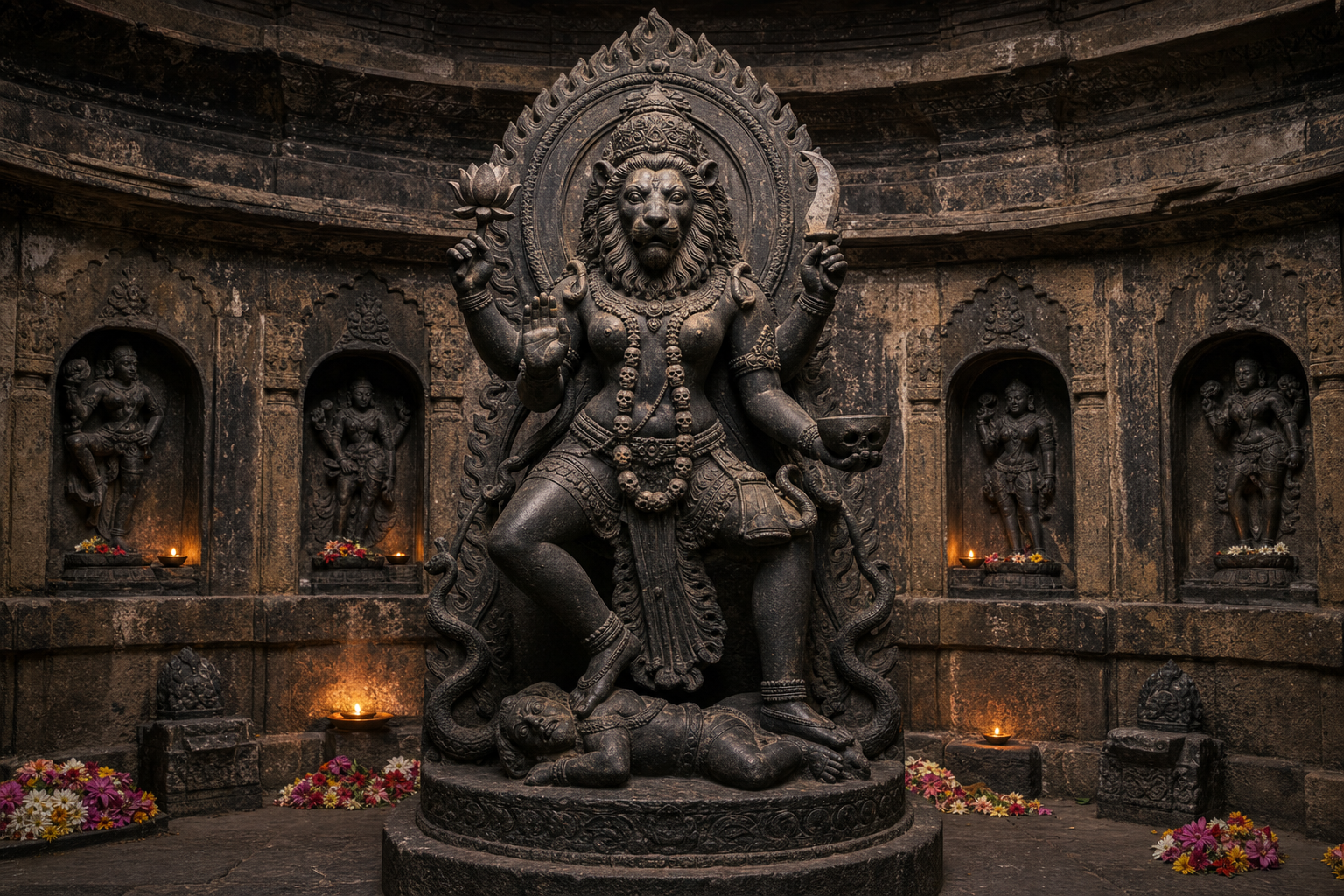
A fierce Yogini makes literal-minded interpretation especially hazardous. A lion face, skull vessel and circle of fire can look threatening if you isolate them from their Tantric purpose. Read together, they ask whether force has been disciplined by insight and whether speech has been purified before it is amplified.
Shakini Yogini gives you a practical model. Her lion face conveys sovereignty, vigilance and the fearless proclamation of truth. Her association with Bhairava Samvarta places her within a field of extreme dissolving power, but the target of that ferocity is delusion rather than vulnerable beings. The governing movement is from destructive intensity to responsible clarity.
Read her implements as a coordinated discipline:
- Lion face: speak truth without surrendering vigilance or self-command.
- Triśūla: discriminate before acting; intensity without discernment is merely reactivity.
- Ḍamaru: submit sound and emotion to rhythm rather than letting them scatter.
- Kapāla: confront impermanence and allow false identities to be emptied.
- Akṣamālā: replace dramatic spiritual performance with steady repetition.
- Pustaka: keep power answerable to learned and transmitted knowledge.
The lesson is particularly sharp when Shakini is associated with Viśuddha, the throat chakra. In Shakta and Kaula mappings that make this connection, the throat is a centre of sound, refined expression and truthful articulation. The seed sound HAM, breath, japa and controlled resonance belong to that discipline. When she appears with five faces, those faces may be read through the five tanmātras: sound, touch, form, taste and smell. Sensory experience must be clarified before it is converted into speech.
This mapping is lineage-specific, not a licence to declare that every lion-headed or five-faced female deity is Shakini. Tantric forms vary across textual schools, regions and ritual systems. Some descriptions emphasise the lion head; others stress multiple faces or arms. Treat such variation as a reason to collect more evidence, not as permission to choose whichever identity feels most appealing.
The cremation ground and circle of flames sharpen the same instruction. They place the practitioner where comforting social identities cannot hide impermanence. The point is not fascination with death. It is the refusal to let fear, vanity or defensive storytelling govern action. A kapāla in this setting is not decorative horror; it is a vessel formed from the fact that embodied life is finite.
The wider circle also matters. Yoginis may be organised as eight or, more famously, sixty-four. Open-air circular Chausath Yogini temples turn that plurality into architecture: the sky remains exposed while differentiated Shaktis form a mandala around the practitioner. A single Yogini should therefore be read both as a distinct power and as a participant in a larger economy of powers.
Here is the ethical test that keeps fierce imagery from being misused: does your interpretation reduce harm, increase clarity and make power more accountable? If it instead excuses aggression, contempt or spiritual grandiosity, you have read the image backwards. Shakini’s lion-like force joins satya to ahiṁsā. It calls for speech strong enough to resist falsehood and restrained enough not to wound for pleasure.
This is where Shaiva and Shakta imagery meet most clearly. Shiva is not simply a motionless male deity while Shakti supplies decorative movement. The still point and its power of expression are mutually intelligible. Bhairava’s dissolving intensity and the Yogini’s fierce wisdom show one force crossing a threshold and assuming an instructional form. Likewise, Mahasadashiva’s many arms make active capacities visible without displacing the still awareness at their centre.
Use this five-pass method at a temple or museum
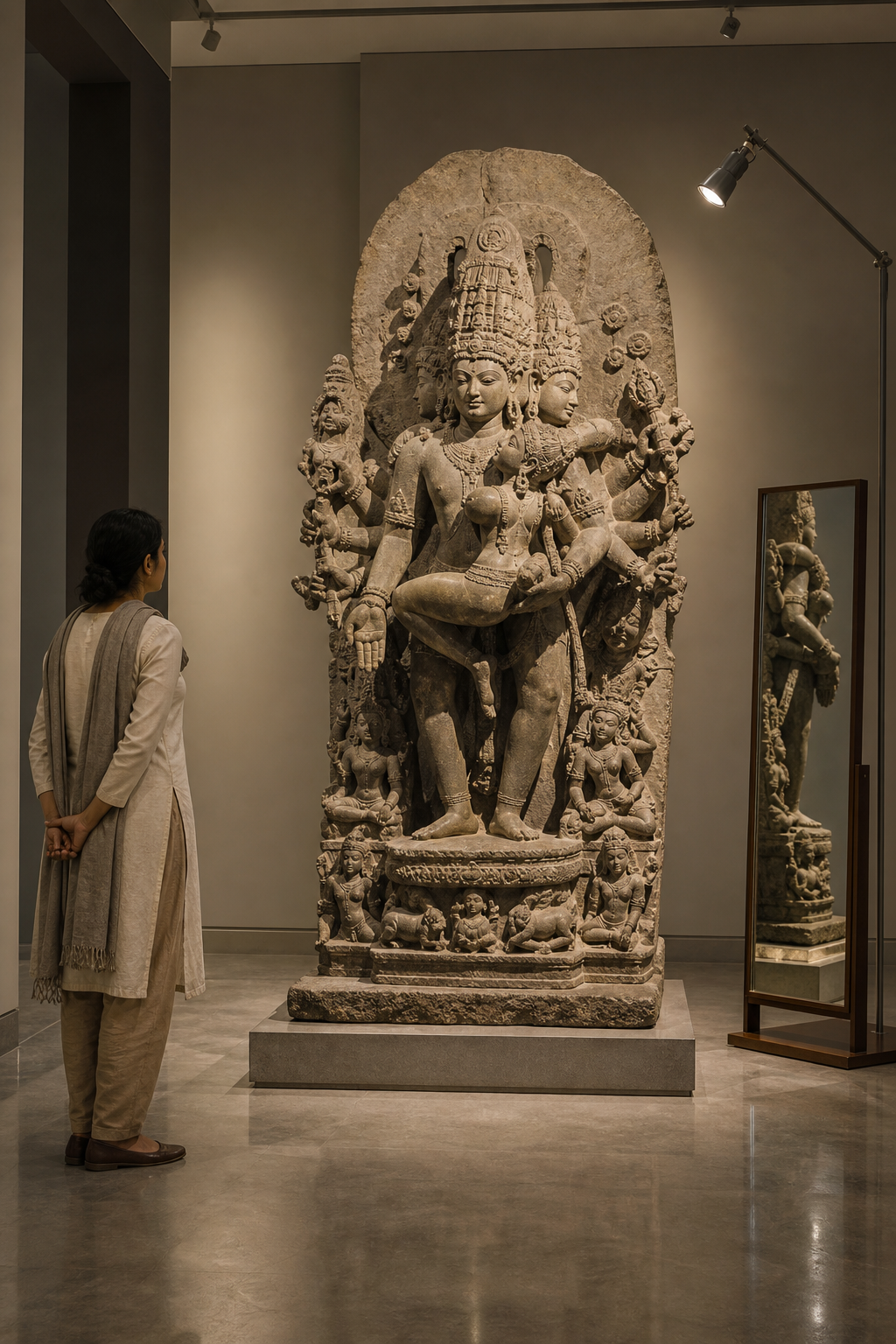
You do not need to identify every hand immediately. A slower sequence produces a more reliable reading and prevents the first dramatic feature from dominating everything that follows.
- Establish the setting. Record whether the image is in a sanctum, niche, prakara, gateway, circular Yogini enclosure or museum display. Note the direction it faces and the figures immediately around it. Context can separate a principal deity from a guardian, attendant or member of a mandala.
- Describe before naming. Write down the visible number of heads, arms and legs; the posture; animal features; crown or matted hair; ornaments; vehicle; pedestal; flames; attendant figures; and apparent damage. Use neutral phrases such as “lion-headed female figure with four visible arms” until several features support a name.
- Map the axes and repetitions. Find the principal face and vertical centre. Then look for directional faces, repeated groups, mirrored hands and deliberate asymmetry. In a Mahasadashiva relief, test whether the visible arrangement supports a fivefold or five-by-five structure. Do not count broken projections as intact attributes.
- Read gestures and implements as relationships. Identify abhaya or varada before concentrating on weapons. Ask what balances the trident, fire, noose, goad, drum, rosary, book or skull-cup. A protective gesture beside a severe implement often reveals that the composition concerns governed power rather than uncontrolled violence.
- State the teaching as an ethical action. Finish with one sentence that connects the icon to conduct. For example: “This image joins fearless speech to disciplined repetition,” or, “This form places manifold action under a still centre.” If your sentence glorifies force but cannot explain its restraint, return to the image and look again.
Light affects what you can see. Early morning or late afternoon can cast raking light across an exterior relief, making shallow hands, crown tiers and chisel boundaries easier to distinguish. Move a few steps to either side rather than relying on one frontal photograph. Where photography is permitted, take an overall view before close details so each attribute retains its spatial context.
A notebook is more useful than an immediate search for a label. Sketch the central axis, number the visible faces, and mark uncertain attributes with a question mark. If local temple personnel or a displayed record gives an identification, preserve it alongside your visual observations. Local tradition, Agamic prescription and the surviving stone may not answer every question in exactly the same way.
Keep observation distinct from ritual participation. Recognising a bīja, nyāsa pattern or Tantric implement does not confer authority to improvise an initiation-dependent practice. Fierce imagery is especially vulnerable to projection. Ethical foundations, lineage guidance, textual grounding and accountability within a practice community are safeguards, not obstacles to spiritual seriousness.
If you already have an authorised practice, the image can deepen it by giving visible order to mantra, direction and gesture. If you do not, attentive darśana, respectful pradakṣiṇā and careful study are complete and meaningful responses. You do not have to turn every iconographic insight into a private ritual.
Key takeaways
- Read the entire composition before assigning fixed meanings to individual objects.
- Treat extra heads and arms as an ordered display of awareness and function, not as visual excess.
- Use direction, number, posture, setting and surviving attributes together when identifying a form.
- In Mahasadashiva, the twenty-five heads elaborate a fivefold pattern, while the fifty arms can connect manifestation with the mātrikā letters and sacred sound.
- In fierce Yogini imagery, flame, animal features and skulls concern the transformation of fear and delusion; they do not excuse cruelty.
- Test every interpretation ethically: genuine Tantric power should become more discerning, restrained and accountable.
On your next temple visit, choose one complex image and give it ten unhurried minutes. Locate its centre, map its directions, record only what you can actually see, and identify the force that restrains its fiercest attribute. That single discipline will teach you more than memorising a long list of isolated symbols.
References
- DharmaRenaissance Blog — Mahasadashiva Unveiled: Rare 25-Headed, 50-Armed Cosmic Shiva in South Indian Temples
- DharmaRenaissance Blog — Shakini Yogini Unveiled: Lion-Headed Shakti, Bhairava’s Wrath, and Deep Tantric Symbolism
