

You may come to the Oachira Temple legend with one immediate question: why would the Supreme Divine appear as a buffalo? That question is not an obstacle to understanding the story. It is the doorway into it.
The sacred memory associated with Akavoor Chathan and Oachira Vallyachan asks you to examine how you recognize divinity, whom you consider spiritually qualified, and whether your reverence survives when the Divine appears outside the form you expected.
The buffalo is the point, not an awkward detail
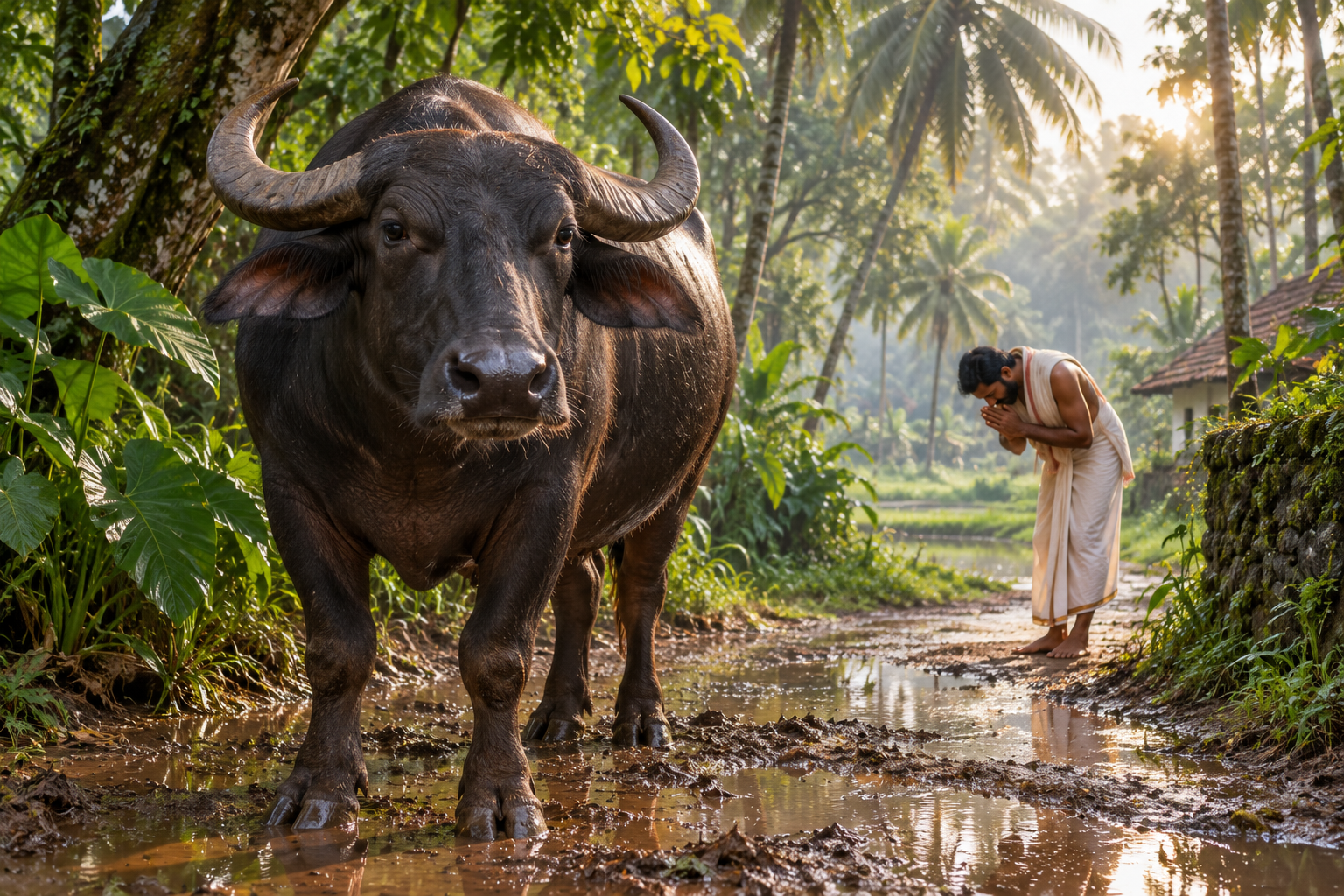
Within this Kerala legend, the Supreme Divine appears as a buffalo. The form matters because it interrupts the religious imagination. A devotee may expect a radiant vision, a familiar murti, or some unmistakably celestial sign. The buffalo overturns that expectation.
Do not solve the discomfort too quickly by turning the animal into a decorative symbol. First notice what the form does to you. If you can accept divinity only when it arrives in a culturally approved image, then recognition still depends on your preferences. The legend places the Divine in an unanticipated form and makes the devotee’s response the real test.
This does not require you to treat every unusual claim as a miracle. Discernment remains necessary. The sharper lesson is that discernment and prejudice are not the same thing. Discernment examines what is present; prejudice rejects it because it does not resemble what was expected.
When you hear the story, therefore, ask a more useful question than “Why a buffalo?” Ask: “What would I fail to recognize because its appearance offended my assumptions?” That question carries the legend from folklore into spiritual practice.
Akavoor Chathan represents the devotee who does not negotiate with faith
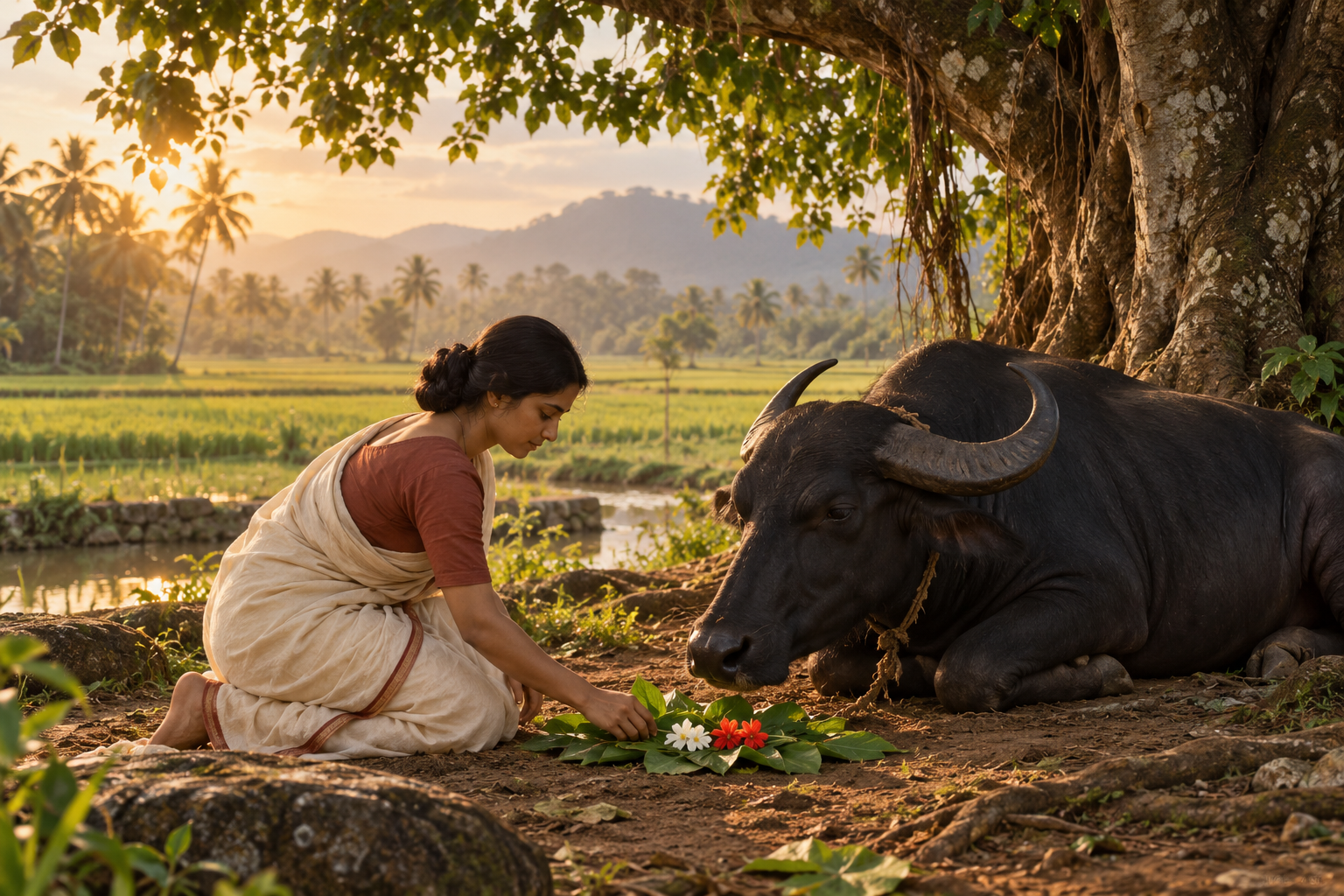
The remembered power of Akavoor Chathan lies in faith, humility, and purity of heart. These are often praised as general virtues, but the legend gives each one a demanding practical meaning.
- Faith means remaining open to the Divine when the form is unexpected. It is not merely agreement with a doctrine.
- Humility means accepting that spiritual recognition may not follow social rank, intellectual refinement, or outward sophistication.
- Purity of heart means approaching the sacred without using devotion to display superiority, win approval, or control the experience.
You can use those distinctions to test your own practice. If faith disappears when events do not match your picture of holiness, it is still attached to form. If humility disappears when another person’s devotion looks simple, it has become status. If prayer is mainly a performance for an audience, purity of intention needs attention.
The legend does not make simplicity identical with ignorance. Its challenge is subtler: knowledge about the Divine can help you, but it cannot replace receptivity to the Divine. A person may possess religious vocabulary and still be unable to see past appearances. Another may lack elaborate language yet respond with an undivided heart.
Read the account as sacred folklore without forcing the wrong question
The account belongs to Kerala folklore. That tells you something important about how to approach it. A sacred legend carries communal memory and spiritual instruction through a memorable event. It need not function like a modern incident report in order to disclose what a community has learned about devotion.
Two common readings miss this distinction. One insists that only a literal reconstruction can give the story value. The other dismisses the whole account because folklore is not documented in the manner of contemporary history. Both readings make historical verification the only measure of meaning.
A more disciplined approach separates three questions:
- What does the tradition remember? A divine appearance in buffalo form associated with Akavoor Chathan, Oachira Vallyachan, and Oachira Temple.
- What does that remembered event teach? The Divine is recognized through unwavering faith, humility, and a pure heart rather than through outward expectation alone.
- What can the available account establish historically? Only what its details support. Do not manufacture dates, locations within the temple, ritual instructions, or biographical particulars that have not been preserved in the material before you.
This approach protects both reverence and intellectual honesty. You do not have to mock a sacred inheritance to ask careful questions. Nor do you have to convert every devotional meaning into a historical assertion. Let the legend speak in its own genre, and be precise about what you know.
How to carry the legend into your own practice

Whether you encounter this tradition at Oachira or read it at home, the most useful response is not to chase an extraordinary vision. The story points toward a change in attention. You can practise that change in four concrete steps.
- Name the form you expect. Before prayer, identify the image, emotion, answer, or sign you assume a divine response must take. Naming the expectation prevents it from quietly becoming a demand.
- Notice what you instinctively dismiss. Pay attention to the person, creature, duty, or ordinary moment you treat as spiritually insignificant. The buffalo form makes this blind spot impossible to ignore.
- Offer one act without display. Choose a small act of worship, service, restraint, or care that no audience needs to see. This tests whether devotion can remain sincere without recognition.
- Judge the fruit, not the drama. Ask whether the practice leaves you humbler, less contemptuous, and more attentive. An appetite for spectacle is not the same as spiritual perception.
This is also a useful way to explain the legend to a child or to someone unfamiliar with Hindu traditions. Begin with the unexpected form. Then ask why a person might overlook the Divine when looking only for grandeur. That keeps the conversation anchored in the story’s moral pressure instead of reducing it to a strange animal tale.
For a devotee, the practical warning is even more direct. Do not use the legend to claim that every intuition is divine. Use it to challenge arrogance. A pure heart is not one that believes every impression; it is one that does not make ego, status, or appearance the final judge of the sacred.
Key takeaways
- The buffalo form overturns the assumption that divinity must appear in a conventionally exalted form.
- Akavoor Chathan’s significance lies in unwavering faith, humility, and purity of intention.
- The legend should be respected as Kerala sacred folklore without inventing historical or ritual details that the available account does not establish.
- The most useful response is to examine what you dismiss, perform devotion without display, and look for humility rather than spectacle.
The next time you remember Akavoor Chathan at Oachira, pause before asking whether you would have recognized the buffalo. Identify one ordinary form of life you routinely overlook, and meet it with a little more attention. That is where the legend begins to work on you.
References

Leave a Reply
You must be logged in to post a comment.