
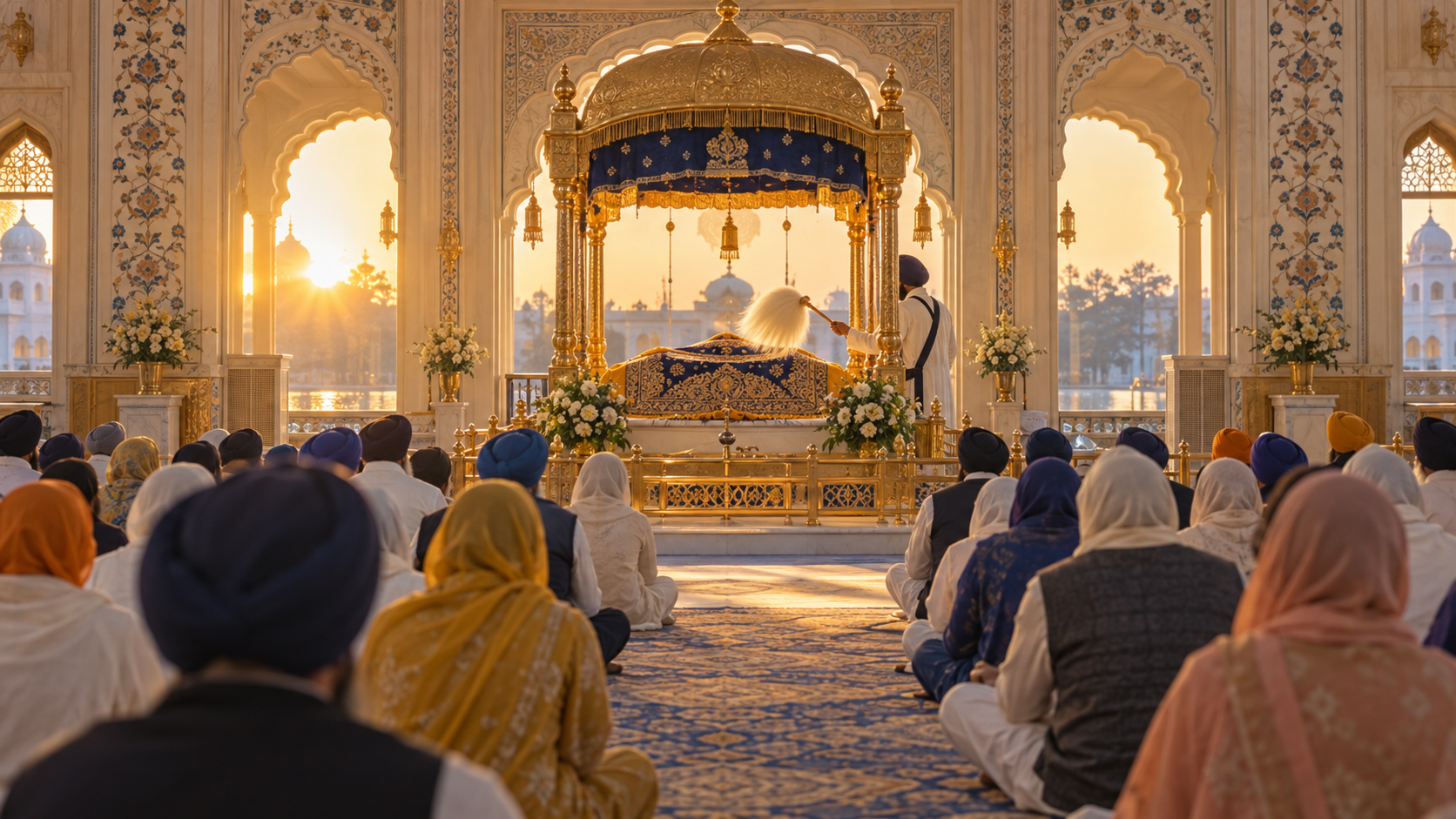
You may have seen First Prakash on a Sikh calendar and wondered what, exactly, is being commemorated. Is it the writing of the scripture, its completion, or simply the first time someone read from it? The clearest answer is that it remembers a first ceremonial installation and opening before the Sikh congregation, provided we understand prakash as a sacred act rather than ordinary book handling.
That distinction changes how you approach the occasion. First Prakash is not mainly an anniversary to observe from a distance. It directs you toward the relationship between Guru, bani, and sangat: sacred instruction, the word through which it is encountered, and the community that gathers to hear and live it.
What the words “First Prakash” actually name
Prakash ordinarily carries the sense of light or illumination. In Sikh liturgical practice, it also names the respectful opening and ceremonial installation of a saroop of Sri Guru Granth Sahib for the congregation. The first prakash of Sri Guru Granth Sahib therefore refers to an event in sacred history as well as a pattern still recognizable in Sikh worship.
The word “first” marks the historical commemoration. Prakash itself is not confined to that one occasion; it remains part of the disciplined rhythm through which Guru Granth Sahib is attended, opened, heard, and respectfully placed at rest. Remembering the first event while noticing the continuing practice keeps the observance from becoming a museum anniversary.
Historical vocabulary requires one further distinction. The most precise name for the scripture at the time of its first prakash is the Adi Granth. Sri Guru Granth Sahib is the title by which Sikhs now approach the scripture as Guru. Using the present title expresses living reverence; retaining the term Adi Granth when discussing historical sequence avoids projecting every later development backward.
This is why “book launch” is the wrong mental model. A launch makes a new publication available to consumers. Prakash makes sacred instruction present to a gathered sangat within an ordered discipline of listening, reverence, and response. The centre of gravity is not the object as a possession but the Guru whose bani addresses the community.
Why the physical protocol is part of the teaching
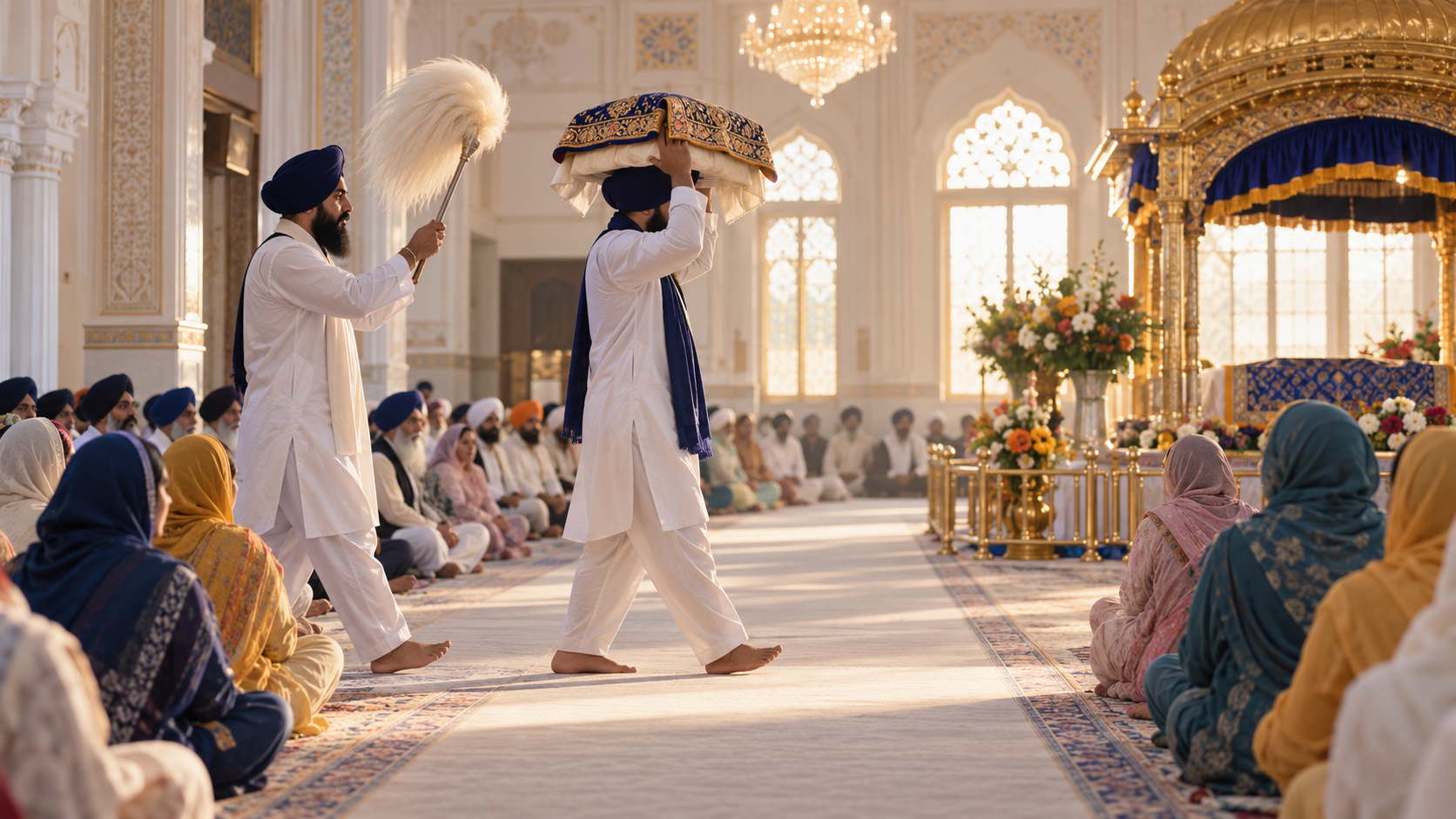
In Sikh self-understanding, Sri Guru Granth Sahib is Guru, not merely a book that contains information about a Guru. That is the first fact an outside visitor needs in order to read the ceremony correctly. The canopy, clean setting, careful handling, attentive congregation, recitation, and bowing are not decorative additions placed around a text. They express the relationship between Sikh and Guru.
Two opposite misreadings are common. One dismisses the practice as respect paid to paper and binding. The other absorbs it into a familiar ritual category from another tradition and assumes that the resemblance settles its meaning. Both approaches overlook Sikh explanations of Guru and Shabad. The saroop is treated with profound reverence because this is how the Guru is present and encountered in the life of the Panth; the ceremony should therefore be interpreted through Sikh vocabulary before comparisons are attempted.
The protocol also trains the person who enters the darbar. Removing shoes interrupts casual movement. Covering the head marks a transition into disciplined space. Sitting with the sangat reduces the impulse to claim a privileged vantage point. Listening before speaking reverses the habits of ordinary public life. Each action turns attention away from personal display and toward what is being heard.
Notice this when you attend. Do not concentrate only on the beauty of the setting or the historical importance of the day. Watch what the congregation’s conduct teaches: authority is received rather than invented; sacred words are heard in community rather than reduced to private opinion; reverence becomes visible through restraint; and instruction is expected to affect conduct after the ceremony ends.
How to participate respectfully at a gurdwara

You do not need to be Sikh to approach First Prakash respectfully. You do need to enter as a participant or sincere learner, not as a spectator collecting images. Local programmes and customs can differ, so the safest practical rule is to follow the gurdwara’s maryada and ask a sevadar when you are uncertain.
- Confirm the programme before you go. A calendar label does not tell you the time, language, sequence, or length of the local observance. Contact the gurdwara and ask when visitors should arrive, whether an explanation will be offered, and which parts of the programme are most suitable for someone attending for the first time.
- Prepare for the darbar, not a cultural exhibition. Wear clean, modest clothing. Cover your head before entering the prayer hall, leave shoes in the designated place, use the washing facilities as directed, and silence your phone. Do not carry tobacco, alcohol, or other intoxicants onto gurdwara premises.
- Let local practice guide your movements. Enter quietly and observe where people sit. Floor seating is customary where physically possible; accessible seating can be requested when needed. If you do not understand the act of bowing before Guru Granth Sahib, ask a sevadar rather than copying hurriedly or treating it as a photo opportunity.
- Ask before taking any photograph or recording. Permission at one public event does not create permission everywhere. The darbar is a place of worship, and parts of a First Prakash programme may not be appropriate for casual photography. Keep the device away unless a responsible person explicitly says recording is welcome.
- Listen before trying to classify. You may encounter recitation, kirtan, exposition, or a hukam. If Punjabi or Gurmukhi is unfamiliar, attend to the cadence and the congregation’s response, then consult a reliable translation or ask a knowledgeable Sikh about the meaning. A translated line is more useful when you understand how it functions within the whole passage.
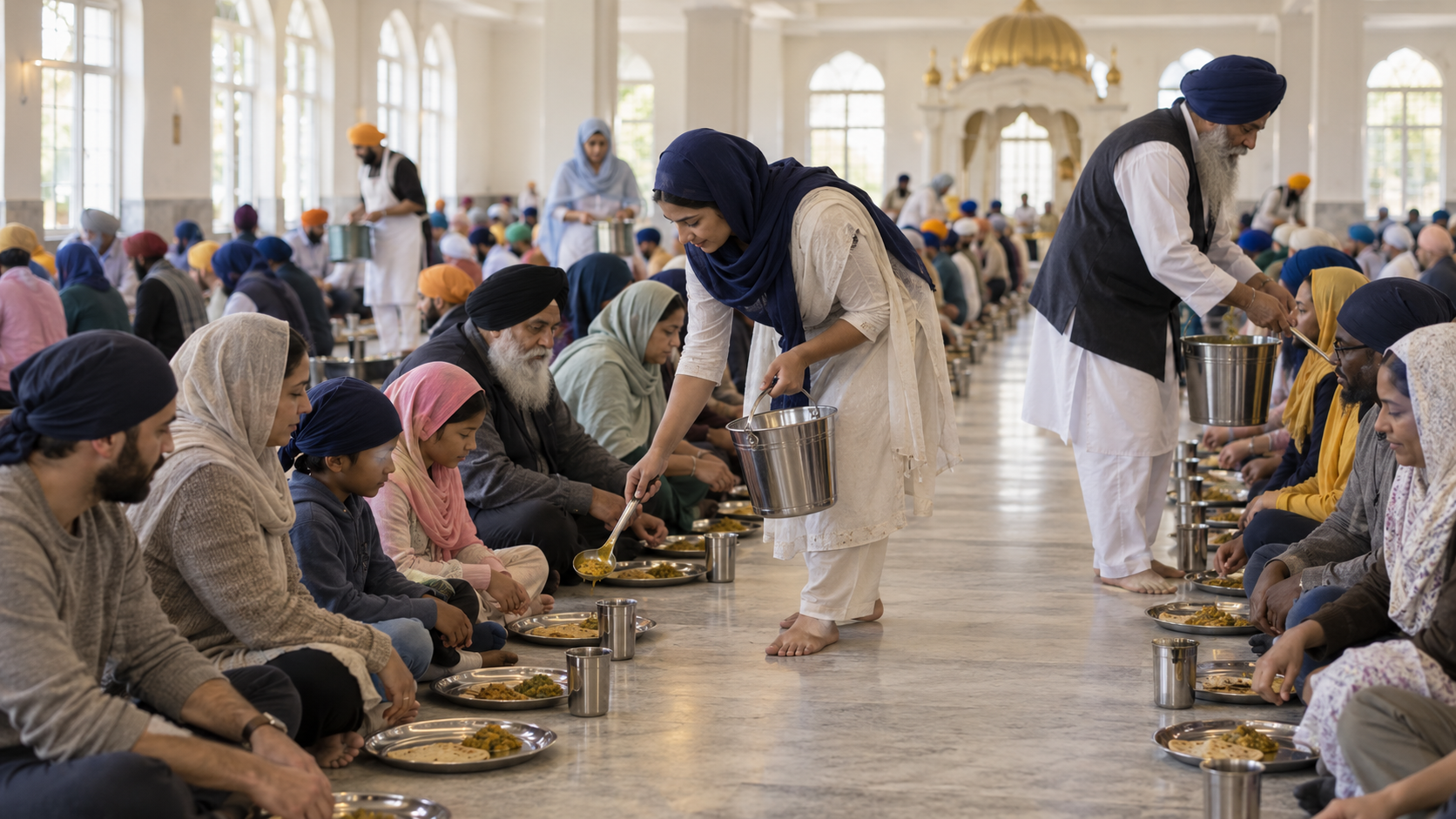
- Receive langar in the same spirit. Langar is not a restaurant attached to the event. Join the shared meal with humility, follow the serving arrangements, mention any dietary or accessibility need plainly, and avoid wasting food. The equality practised in the dining hall belongs to the day’s teaching.
- Offer seva without making yourself the centre. Ask where help is actually needed. Serving water, assisting with langar, arranging shoes, or helping with cleanup can be more fitting than inventing a visible role. Seva begins with usefulness and instruction, not with being noticed.
Do not worry about performing every gesture with an insider’s fluency. A careful question is more respectful than confident improvisation. The important difference is between not yet knowing the maryada and behaving as though the maryada does not matter.
How a Dharmic reader can recognise kinship without erasing difference
A reader formed by Hindu, Buddhist, or Jain traditions may recognise several resonances: the transformative force of sacred sound, the authority of a guru, the discipline of service, and the gathering of a community around recitation and teaching. Those resonances can open the door. They cannot decide in advance what First Prakash means for Sikhs.
Do not equate Sri Guru Granth Sahib automatically with the Veda, a murti, a Buddhist sutra, or a Jain agama. Such comparisons can help identify a question, but they become misleading when treated as exact equivalences. Begin instead with three observations: whom the Sikh congregation recognises as Guru, how Shabad is encountered through bani, and what the community’s maryada asks people to do in response.
This approach matters for a Dharmic magazine because civilizational kinship should make us more attentive to particular traditions, not less. First Prakash belongs to the sacred history of Bharat and specifically to the memory and discipline of the Sikh Panth. Honouring the larger civilizational field does not require dissolving the Panth’s self-understanding into another tradition’s theology.
Shared vocabulary is best used as a doorway, not a verdict. If the concept of guru helps you sense why the occasion matters, let it lead you into the Sikh account of Guru Granth Sahib. If reverence for sacred speech helps you notice the centrality of bani, continue by asking how Sikhs understand Shabad. The comparison has done its job when it produces closer listening.
Key takeaways and your next step
- First Prakash commemorates the first ceremonial installation and opening associated historically with the Adi Granth; it is not merely a manuscript-completion or publication anniversary.
- Prakash is also a continuing liturgical practice, so the historical memory remains connected to the daily discipline of attending to Guru Granth Sahib.
- Sikhs approach Sri Guru Granth Sahib as Guru. The physical protocol surrounding the saroop expresses that relationship rather than serving as ornamental pageantry.
- A visitor should verify the local programme, follow the gurdwara’s maryada, ask before recording, listen carefully, and receive langar or undertake seva without seeking attention.
- Dharmic parallels can prepare you to understand the occasion, but Sikh categories should govern its meaning.
If First Prakash has entered your calendar, make your next move concrete. Contact a nearby gurdwara, ask when its programme begins and what a first-time visitor should know, and reserve enough time to remain present rather than making a brief ceremonial stop.
Then carry one teaching out with you. Write down a line or idea you understood, check its meaning with someone qualified if necessary, and choose one corresponding act of humility, truthful conduct, or service. That movement from respectful hearing to disciplined action is a more fitting observance than admiration that ends at the door.
References

Leave a Reply
You must be logged in to post a comment.