You may be drawn to Nemili because Sri Bala appears as a child, yet the worship around her carries the disciplined language of the Sri Chakra and Sri Vidya. That can leave a first-time pilgrim with a fair question: may you approach through simple devotion, or does everything here require initiation?
You may certainly come for darshan and prayer. The important distinction is between approaching the Goddess with devotion and taking up a formal mantra practice on your own. Once you understand that boundary, the small house-temple at Nemili becomes easier to read: its childlike warmth and its ritual precision are not competing features. Each protects the other.
Begin with Bala, not with an esoteric technique
Bala Tripurasundari is the ever-youthful form of Lalita Tripurasundari. Her child-form does not indicate an incomplete, junior, or less powerful deity. It reveals supreme Shakti without an intimidating exterior. Innocence is the form; sovereignty remains the reality.
This is why Vidya and Karuna – sacred knowledge and compassion – belong together in Bala worship. Knowledge without tenderness can become pride. Tenderness without discernment can become sentimentality. Bala holds the two in one form: clear intelligence approached through affection, humility, and trust.
Nemili makes that theology tangible. The peetam is a residence adapted into sacred space, not a monumental temple complex. Local oral tradition holds that Sri Bala made her presence known through promptings received by a devout family. The shrine’s standing consequently rests on continuing household worship, the Sri Chakra, and a community that treats the Goddess as a living divine child.
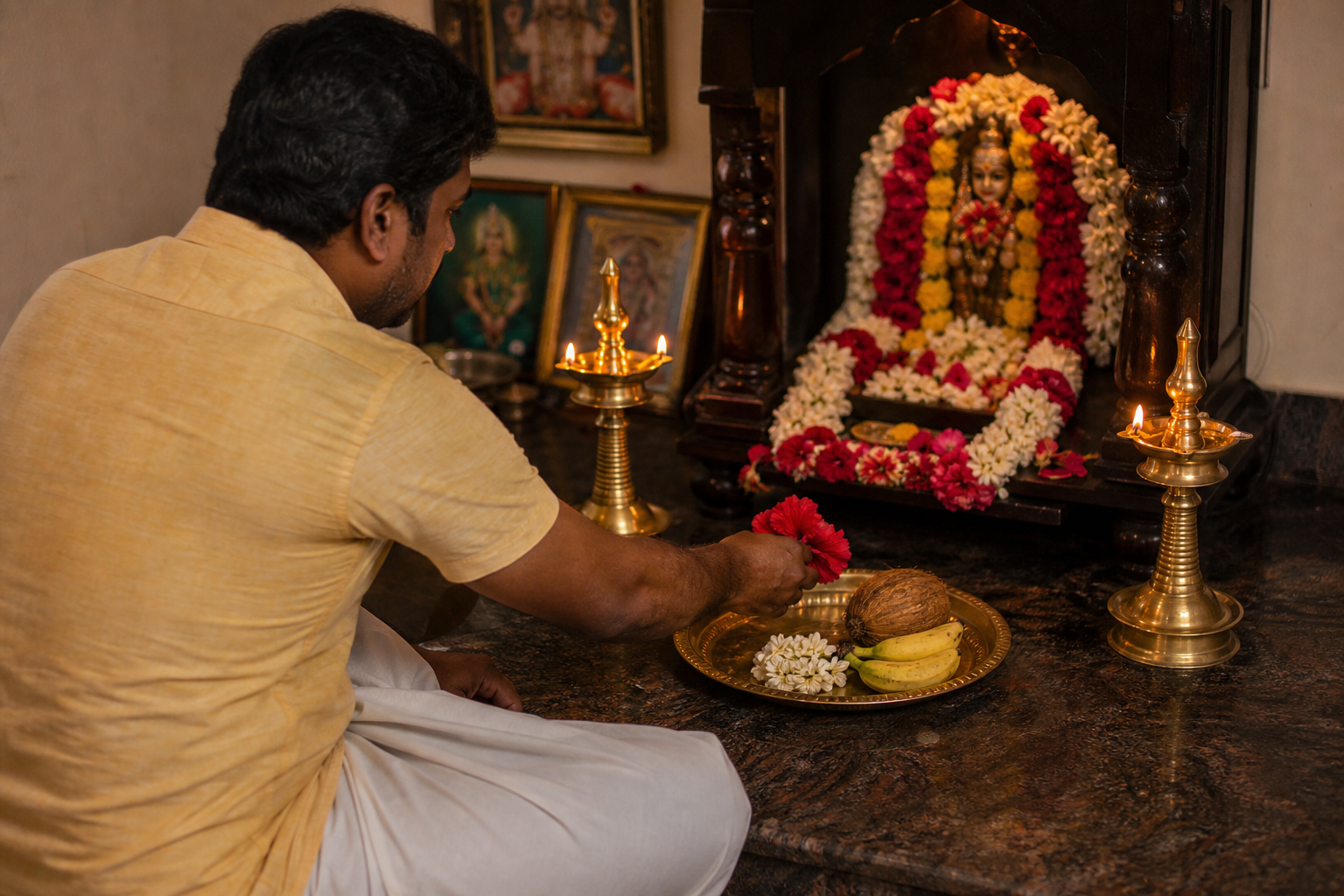
Your first adjustment, then, is relational. Do not approach Bala as an occult mechanism for obtaining a result. Approach her as you would approach a sacred child who is also Devi: cleanly, attentively, without noise, bargaining, or display. Milk, fruit, sweets, bangles, ribbons, toys, and a pattu pavadai set can express that relationship. One thoughtfully chosen offering is enough; ask a regular or volunteer when and how it should be presented.
The offering is not payment for grace. It trains the devotee in care. A ribbon or sweet may look modest beside an elaborate ritual object, but its appropriateness lies precisely in the child-deity relationship. What matters is whether the gesture reduces self-importance and makes your attention steadier.
How the Sri Chakra changes the way you take darshan
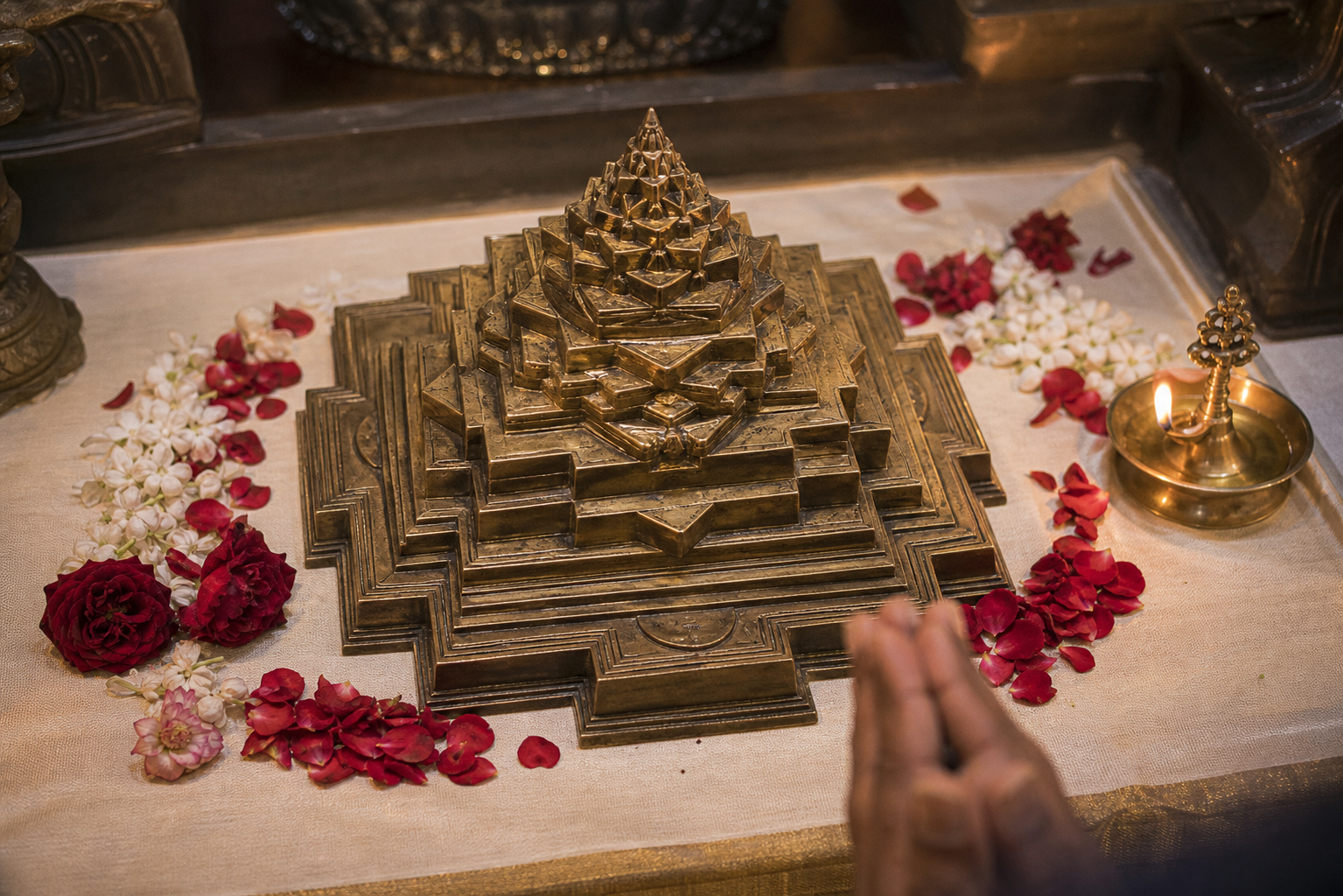
The Sri Chakra is not decorative geometry placed beside worship. It is a ritual and contemplative focus within Sri Vidya: nine interlocking triangles form 43 smaller triangles, while nine avaranas, or enclosures, express a progressive inward movement of consciousness and devotion.
You do not need to memorize the enclosures before visiting. Instead, notice what the geometry asks of your attention. The eye encounters plurality, symmetry, convergence, and a center. The devotional movement follows a similar course: scattered concerns are gathered, the mind becomes less restless, and attention turns inward without rejecting the world around it.
This inwardness explains why a compact sanctum can be spiritually effective. Repeated sacred names and stotra recitation fill a small space differently from a large ceremonial hall. During Lalita Sahasranama, hymns to Bala, or archana, resist the urge to keep looking around. Listen to the cadence, keep your body still, and allow the repetition to collect the mind. A short period of silence after the archana may be more valuable than rushing immediately to the next destination.
Sri Bala is doctrinally associated with the seed-syllables aim, klim, and sauh. They are connected respectively with sacred knowledge, love or attraction, and the fullness of Shakti. Those associations help you understand the spiritual grammar of the shrine, but seeing the syllables in print is not the same as receiving authorization for a formal practice.
That is the boundary a serious visitor should keep clear. Darshan does not require you to claim an initiation you have not received. You may bow, pray inwardly, listen to established recitations, and participate at the level directed by the peetam. Where a mantra practice requires formal guidance, seek it from a qualified traditional teacher rather than constructing a method from fragments found online.
This restraint is not exclusion. It is part of Sri Vidya’s precision. Bala’s accessibility means that no sincere devotee needs to pretend to possess technical knowledge. Her connection with Vidya should make you more teachable, not more eager to perform expertise.
A first visit in six deliberate steps
Because this is a functioning home as well as a peetam, a successful visit depends less on elaborate preparation than on arriving ready to follow its rhythm. Use this sequence.
- Verify the current darshan window shortly before travelling. Morning and evening periods are customary, but a residential shrine’s timings can change with the season, puja schedule, and festival observances. A generic clock time copied from elsewhere should not overrule current local information.
- Decide what kind of visit you want. Choose an ordinary weekday for quieter darshan. Choose Friday, a full-moon observance, Aadi, or Navaratri if participating in a fuller ritual atmosphere matters more to you than avoiding crowds.
- Bring one suitable offering rather than an assortment you cannot manage. Fruit or sweets are straightforward choices; child-oriented offerings such as bangles, ribbons, toys, or clothing express Bala’s distinctive devotional relationship. Wait for instructions before handing anything toward the sanctum.
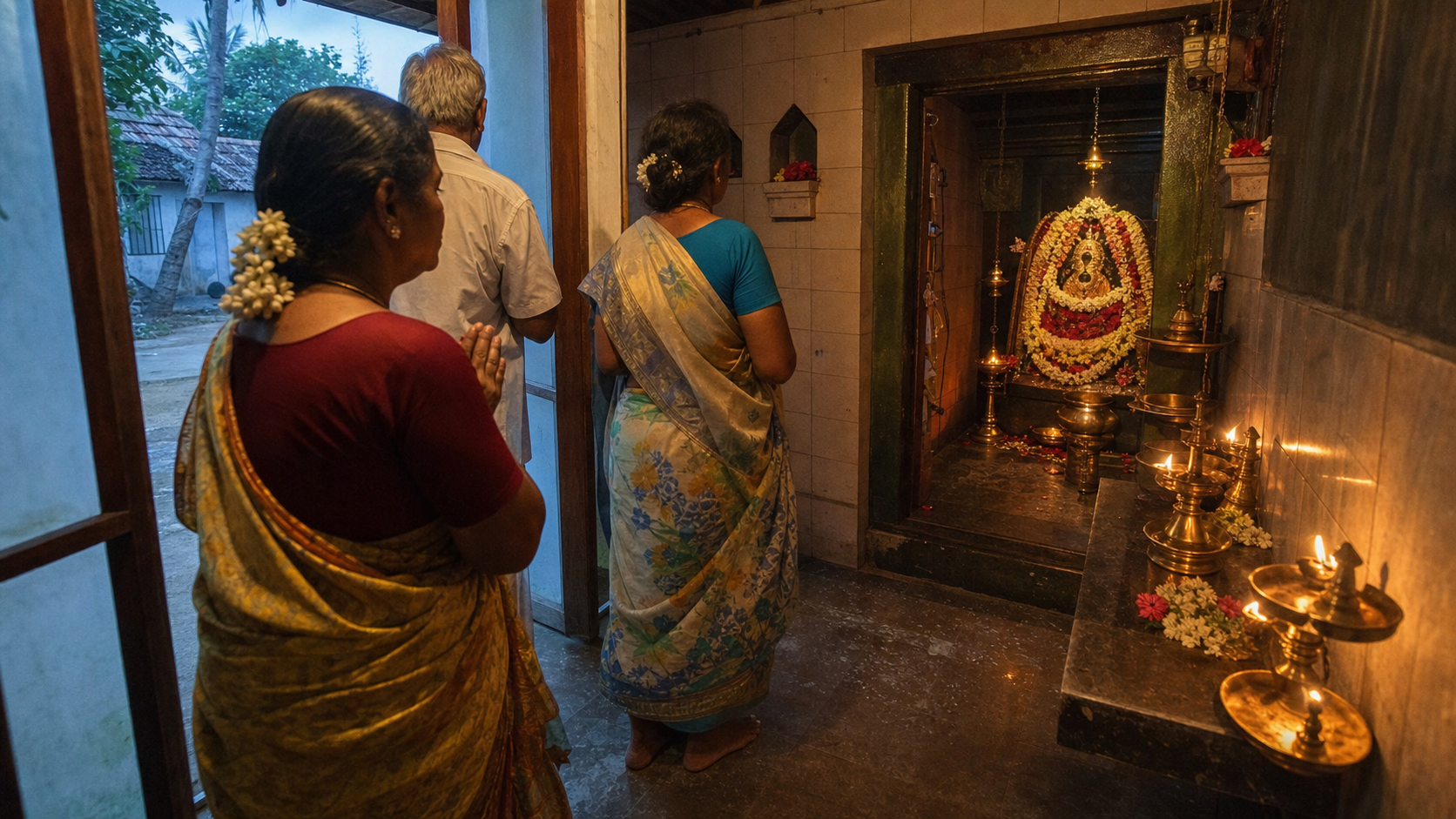
- Arrive in modest clothing, leave footwear outside, silence your phone, and let regulars show you where to stand or sit. In a compact room, shifting repeatedly or trying to obtain a better view can disturb the puja for everyone.
- Observe the ritual movement. Daily worship commonly includes abhishekam, alankaram, and archana, with Lalita Sahasranama or hymns to Bala forming part of the devotional soundscape. Join only what you know or what the congregation is clearly invited to recite; listening is itself participation.
- Stay still for a few moments after darshan if space and the local routine allow it. Let the names, alankaram, and Sri Chakra settle in the mind before returning to conversation, photographs, or travel logistics.
Families can give children one simple responsibility: carry the fruit, remember to lower their voice, or watch how an offering is received. That teaches temple conduct through service rather than through a string of warnings. Bala’s child-form gives parents an unusually direct way to connect reverence with care, gratitude, and self-restraint.
Do not measure the visit by the number of rituals you managed to request. At Nemili, closeness is part of the shrine’s character. The better measure is whether you were present for the worship already taking place and whether you left with less mental noise than you brought in.
Choose the day, route, and pace deliberately
Quiet darshan and festival darshan serve different needs
Fridays carry particular importance in Tamil Shakta practice and usually bring more visitors. Full-moon observances and Aadi also intensify the ritual calendar. Navaratri is the principal festival period at the peetam, with changing alankarams, extended chanting, and kolu arrangements giving each day a distinct devotional texture.
Choose by purpose, not by the idea that the busiest day must automatically be the best. If this is your first encounter with a Sri Chakra-centered shrine and you want time to notice the worship, an ordinary weekday may serve you better. If you already understand the setting and want collective chanting and festival alankaram, Navaratri or a significant Friday may be worth the greater density of people.
Aadi and Navaratri can also be warm. Carry water for the journey, wear light clothing that remains suitable for a shrine, and arrive early enough that heat and a hurried last mile do not define your state of mind. During monsoon spells, take care on the small lanes, which may become slick.
Build a last-mile plan rather than relying on the main highway
Nemili is in present-day Ranipet district, within the wider Vellore region, and lies about 20 kilometres from Kaveripakkam. Travellers approaching on the Chennai-Bengaluru corridor, NH 48, commonly continue by local road from the Kaveripakkam or Walajah Road side.
If you travel by rail, Arakkonam and Walajah Road Junction are the major nodes to consider, followed by a bus, auto, or taxi for the remaining distance. Chennai International Airport, MAA, is the main air gateway. The crucial planning problem is not reaching the region; it is completing the last stretch to a residential locality without unnecessary confusion.
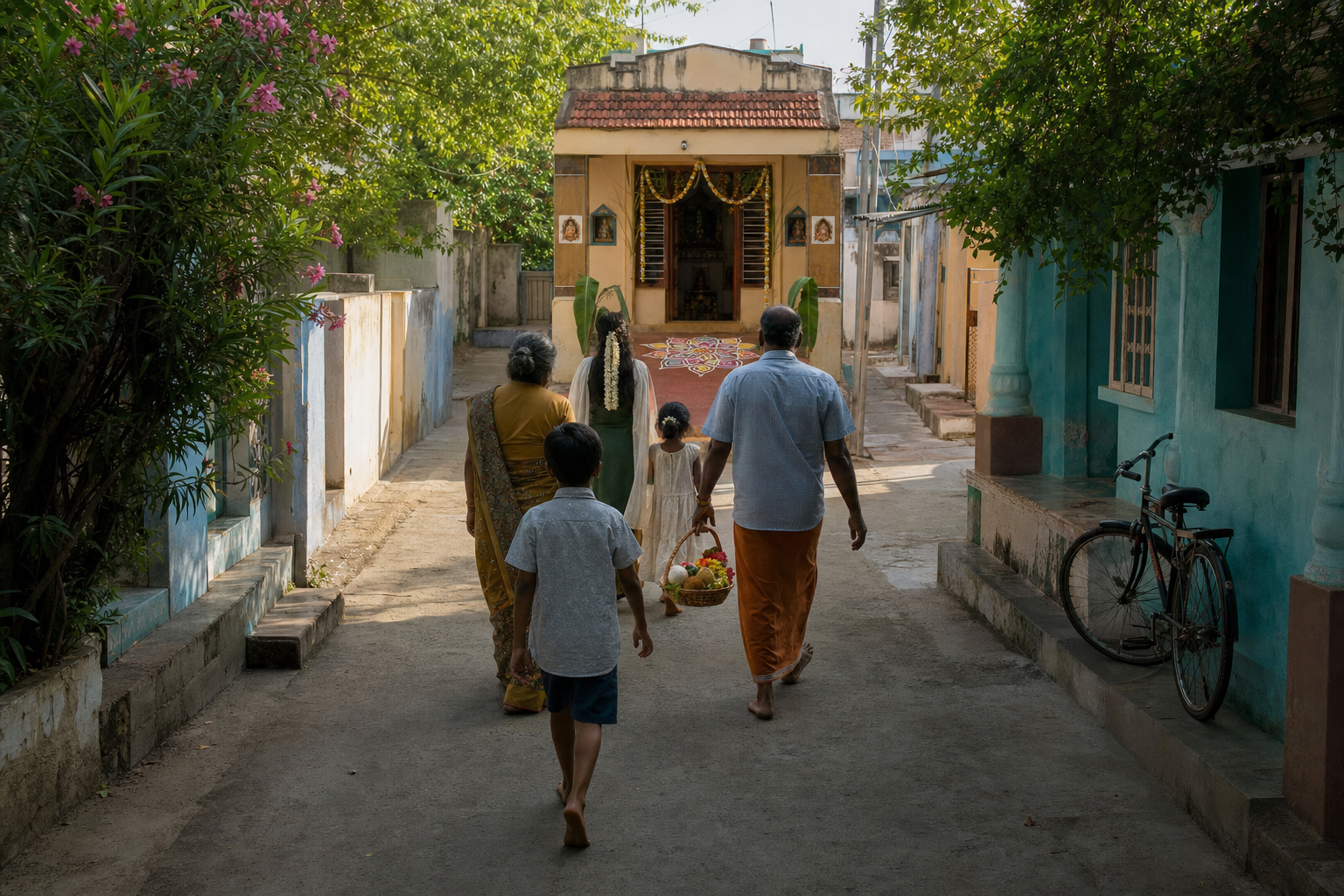
Carry the address written in Tamil for an auto or taxi driver. Do not assume that every driver will recognize an English spelling or the word “peetam” without further context. If arriving by car, expect limited parking and be ready to walk from a nearby lane. Build that walk into the time you allow before puja rather than treating it as an unexpected delay.
Treat the surrounding home and lanes as part of the sacred boundary
A house-temple cannot absorb crowd behaviour in the way a large complex can. Keep conversations low, do not block entrances, and remain considerate of neighbours. Ask before taking photographs anywhere near the sanctum; if the rule is unclear, assume that the worship takes priority over recording it.
The compact layout also calls for realistic accessibility planning. An elder visitor may benefit from a companion’s assistance, especially on a crowded day. A light shawl or sitting cloth can help during a longer recitation, but bring only what you can keep close without narrowing the available space. Tamil is the primary language; basic help in English or Hindi may be available through other pilgrims, but written destination details are still the safer plan.
FAQ: Practical decisions for a first pilgrimage
Do you need Sri Vidya initiation simply to visit?
No. You may come for darshan, make a respectful offering, listen to recitations, and pray without claiming formal mantra authority. Initiation becomes relevant when you intend to undertake a practice that the tradition reserves for guided transmission. Visiting the Goddess and adopting a technical mantra discipline are different decisions.
Is Bala a gentler but lesser form of Devi?
No. Her youthfulness communicates accessibility, purity, Vidya, and compassion; it does not reduce her identity as Lalita Tripurasundari. Let the child-form change the manner of your approach – toward tenderness and humility – without mistaking tenderness for a lack of divine power.
What can you combine with a Nemili pilgrimage?
Kamakshi Amman at Kanchipuram provides a natural Shakta connection. Temples in the wider Vellore region and Vellore Fort can add religious and historical context. Keep the circuit modest on a festival day, however. A schedule that forces you to leave before the puja settles defeats the reason for choosing an intimate shrine.
Before setting out, make two decisions. First, verify the current darshan window and choose between a quiet weekday and a fuller festival atmosphere. Second, decide to approach Sri Bala without demanding either spectacle or instant esoteric knowledge. Arrive with one modest offering, follow the household rhythm, and let disciplined attention be your first act of Sri Vidya.