
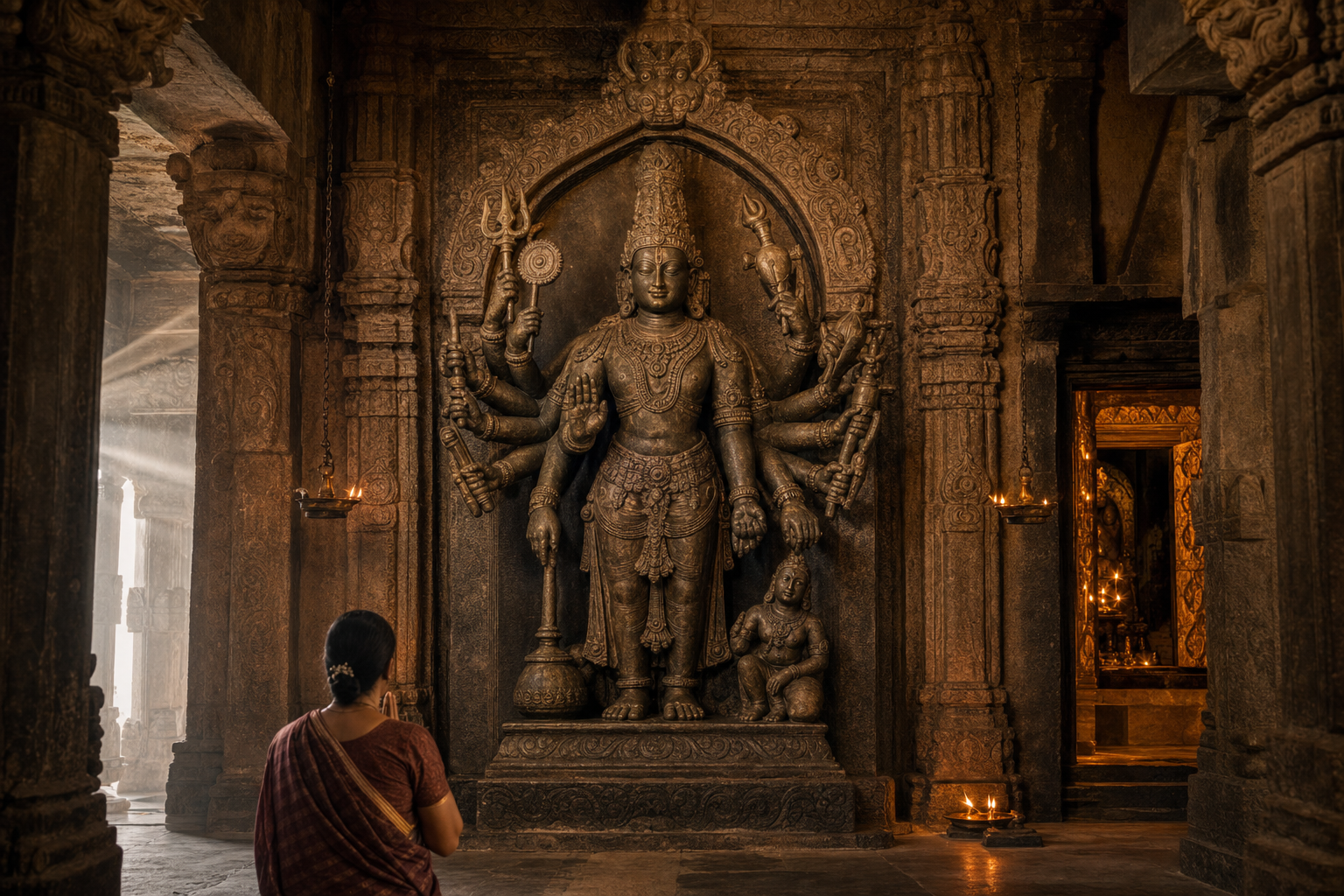
You recognize Ganesha, but why does this murti have eight arms? You recognize Shiva, but why is he standing on one leg? If a temple visit leaves you reaching for a quick symbol dictionary, resist the urge to assign one English keyword to every unusual feature.
A symbolic form becomes intelligible when you read its geometry, posture, attributes, setting and devotional purpose together. The goal is not to solve the murti like a puzzle. It is to see carefully enough that your interpretation rests on the form actually before you.
Use three layers, and keep them in the right order
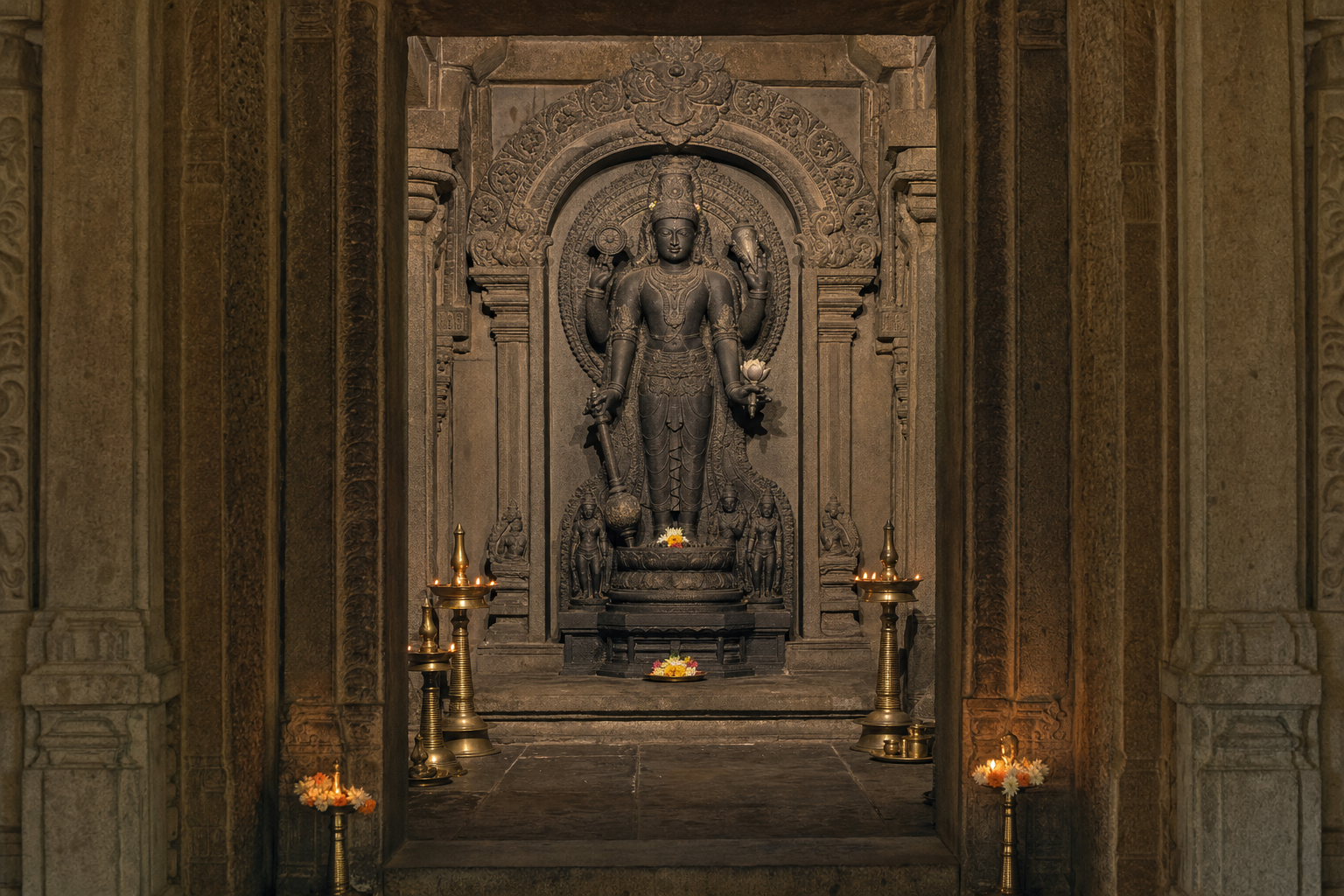
A disciplined reading moves through three layers. Confusion begins when we collapse them, treating a private impression as a traditional identification or treating an iconographic label as the complete meaning of darshan.
- Observation: Describe what is visibly present. Count the arms or supporting legs. Note whether the figure is upright, seated, expansive or tightly centered. Record the direction of the gaze, the position of the hands and any damage that makes an attribute uncertain.
- Traditional interpretation: Connect those observations to the deity, named form, regional lineage and temple context. If the temple identifies an Agamic or regional convention, let that inherited understanding outrank a spontaneous personal association.
- Contemplative response: Ask what the form requires you to notice about attention, duty, protection, wisdom, steadiness or ethical action. This is where iconography becomes relevant to your life, but only after you have respected what the image is.
Keep these layers distinct in your notes and in your mind. A personal association can deepen contemplation, but it cannot establish the historical name of a murti. Conversely, knowing the correct name does not by itself complete the encounter. Identification gives you a foundation; attentive darshan asks what you will do with it.
Read number and geometry before individual objects
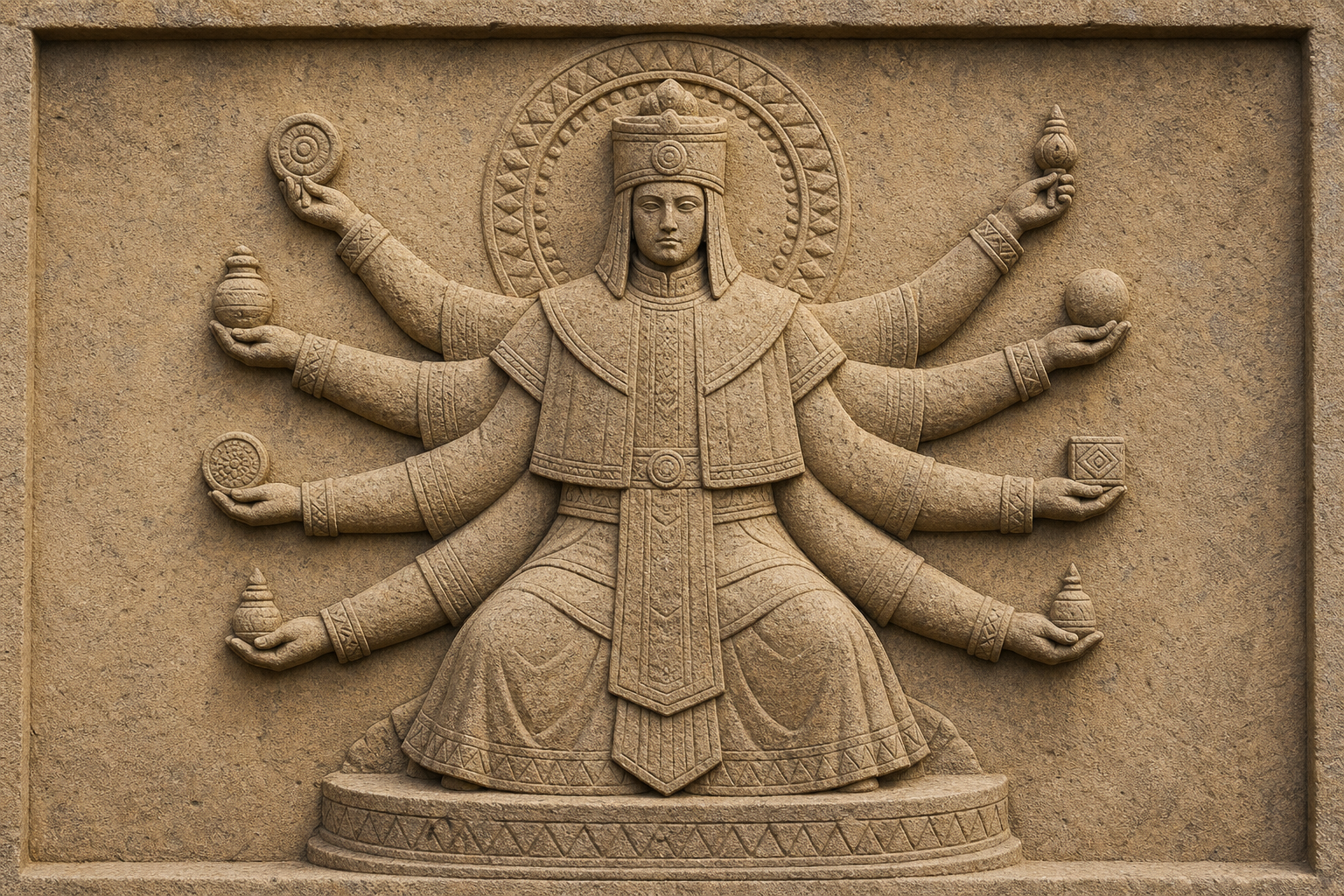
An unusual number of limbs or an uncommon stance is rarely a decorative afterthought. It changes the entire geometry of the image. Begin there before trying to name every object in every hand.
At Ramtek in Maharashtra, Ganesha appears in an Ashtabhuja, or eight-armed, form. The expanded form brings wisdom, protection, prosperity and compassionate guidance into one visual field. Its meaning is not that the devotee receives eight separate promises. The multiplication of arms allows the murti to communicate a range of divine capacities that an ordinary human body could not display at once.
When you encounter such a form, scan from the center outward. Notice how the arms surround, balance or extend the central body. Instead of immediately asking what each hand will give you, ask what the complete arrangement holds together. Then make the question practical: Which responsibility requires wisdom? Which obstacle calls for steadiness rather than force? Which success should be met with gratitude?
Ekapada Shiva works through almost the opposite geometry. The single supporting leg evokes the skambha, the cosmic pillar or axis. Rather than spreading divine capacity across the composition, the form concentrates attention into an unwavering vertical center. It expresses stability, cosmic order and one-pointed concentration.
Let your eyes follow that vertical axis before examining secondary details. The useful contemplative question is not whether you could physically imitate the pose. It is what must remain centered while circumstances change around you. The image can direct attention toward a duty, truth or discipline that should not be abandoned when life becomes crowded.
These forms offer a practical interpretive rule: multiplication can expand the field of meaning, while reduction can concentrate it. Treat that as a starting point, not a universal formula. The identity of the deity, the posture, the attributes and the regional tradition must still confirm or correct your first impression.
Let posture, attributes and setting correct your first reading
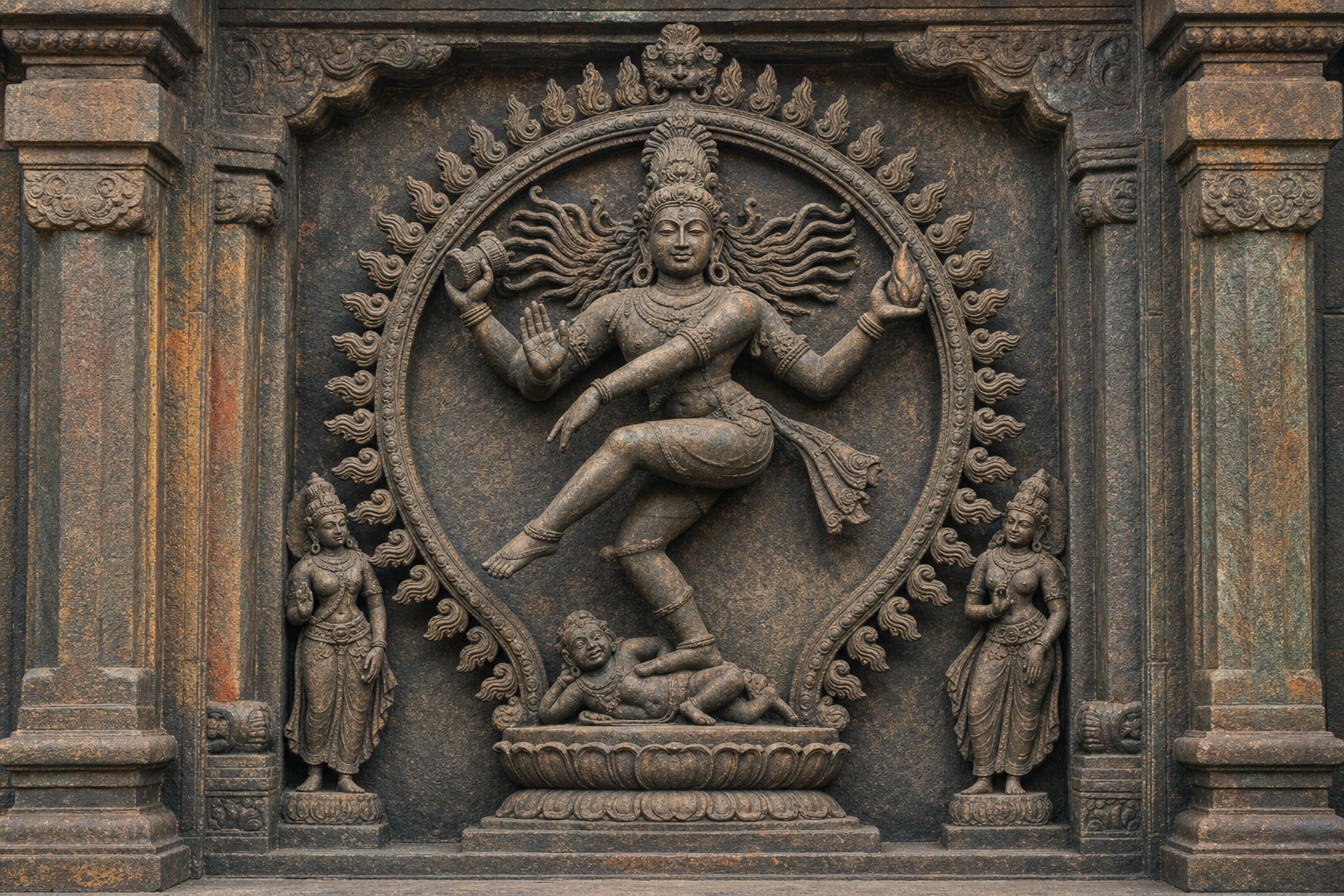
Once the broad geometry gives you a possible direction, test it against the rest of the composition. You can think of the deity’s identity as naming who is present, the posture as showing how that presence is expressed, and the attributes and setting as qualifying the expression. No single element should be made to carry the whole interpretation.
Posture gives the image a verb
Ask what the body appears to be doing. Is it establishing a center, extending power, receiving devotion or holding several forces in balance? Where does the visual weight fall? Does the composition lead your eye outward or return it repeatedly to the middle?
This prevents a common error with Ekapada Shiva. A one-legged figure viewed without context could be mistaken for an image of precariousness. The strong vertical organization, the identity of Shiva and the symbolism of the cosmic pillar direct the reading toward stability instead. One visible fact can produce very different interpretations depending on its relationship to the whole.
Attributes must be read relationally
When objects or hand gestures are visible, do more than name them. Note which hand bears an object, whether it is raised or lowered, how it relates to the other hands and whether it is repeated or paired. In a multi-armed form, the arrangement matters as much as the inventory.
Do not guess when erosion, distance, ornament or lighting obscures a detail. Mark it as uncertain and continue with what you can see. A careful partial reading is more useful than a confident misidentification that distorts every conclusion after it.
Temple setting belongs to the meaning
A murti encountered in worship is not exhausted by an art-historical label. Ekapada Shiva appears in select temples, with a notable presence in Odisha, where regional temple traditions preserve specialized Shaiva forms. That regional concentration is a clue: rarity does not make a form less important, but it does warn you against assuming that every temple uses an identical visual vocabulary.
At Ramtek, the eight-armed Ganesha is approached amid prayer, incense, offerings and darshan. Those practices show how symbolic meaning is lived rather than merely catalogued. Wisdom, protection and guidance are not only ideas attached to a sculpture; they become the focus of prayer, intention and conduct.
During a visit, observe where devotional attention is directed and how worshippers approach the sacred space. Follow the temple’s local rules, and do not let photography or note-taking interrupt worship. If an exact iconographic identification matters, consult information supplied by the temple or ask a knowledgeable priest or guide respectfully. Local explanation can distinguish a general resemblance from the temple’s own inherited understanding.
A five-question method for your next darshan
You do not need an encyclopedic memory to begin. Use these questions in sequence whenever a form seems unfamiliar:
- What do I literally see? Record the visible limb count, stance, central axis, gestures, attributes and condition of the image without assigning meanings yet.
- What has been expanded, reduced or made unusual? Extra arms, a single supporting leg or an exceptionally strong vertical structure may reveal where the visual argument begins.
- What holds the composition together? Find the center to which the gaze, limbs and surrounding forms lead you. This is often more informative than the most eye-catching isolated detail.
- What context corrects my first impression? Consider the deity’s identity, the named form, regional tradition, placement, neighboring figures and the worship taking place around it.
- What dharmic response does the form invite? Translate the reading into one concrete obligation: greater attention, wiser action, steadiness under pressure, gratitude, compassion or protection of what has been entrusted to you.
A compact note can follow the sequence: observation, contextual clue, possible meaning, practical response. For the Ramtek Ganesha, the observation is eight arms; the context is an Ashtabhuja form of Ganesha; the possible meaning is a coordinated range of wisdom, protection, prosperity and guidance; the response is to meet one present obstacle with discernment rather than agitation.
For Ekapada Shiva, the observation is one supporting leg and a dominant vertical center; the context is a Shaiva form associated with the cosmic axis; the possible meaning is stability and concentrated attention; the response is to identify the duty that must remain firm while other demands move around it.
Use the phrase possible meaning until the temple’s own tradition confirms a more exact reading. Symbolic interpretation is not permission to make a murti mean anything we wish, and it should not be turned into a private omen. Personal application comes after careful seeing and inherited context; it does not replace them.
Key takeaways
- Describe the visible form before decoding it: count, posture, axis, gesture, attributes and condition.
- Treat unusual geometry as a primary clue. Eight arms can expand the field of divine capacity; one supporting leg can concentrate attention on a stable center.
- Check every interpretation against the deity’s identity, the complete composition, the regional tradition and the living worship around the murti.
- Keep traditional identification separate from personal contemplation. The second may deepen darshan, but it cannot establish the first.
- Leave damaged or unclear details unresolved until reliable temple-specific knowledge is available.
- Complete the encounter with one dharmic action, not merely a collection of symbolic definitions.
On your next temple visit, give one unfamiliar form three unhurried minutes. Spend the first observing its silhouette, the second tracing the relationships among posture, hands and center, and the third naming one duty the form brings into clearer focus. You do not have to decode everything. See one feature accurately, test one interpretation honestly and carry one worthy response beyond the temple.
References
- DharmaRenaissance Blog — Ashtabhuja Ganesh Mandir, Ramtek: A Soul-Stirring Sanctuary of Faith in Maharashtra
- DharmaRenaissance Blog — Ekapada Shiva Unveiled: The One-Footed Cosmic Axis in Ancient Hindu Temple Iconography
