
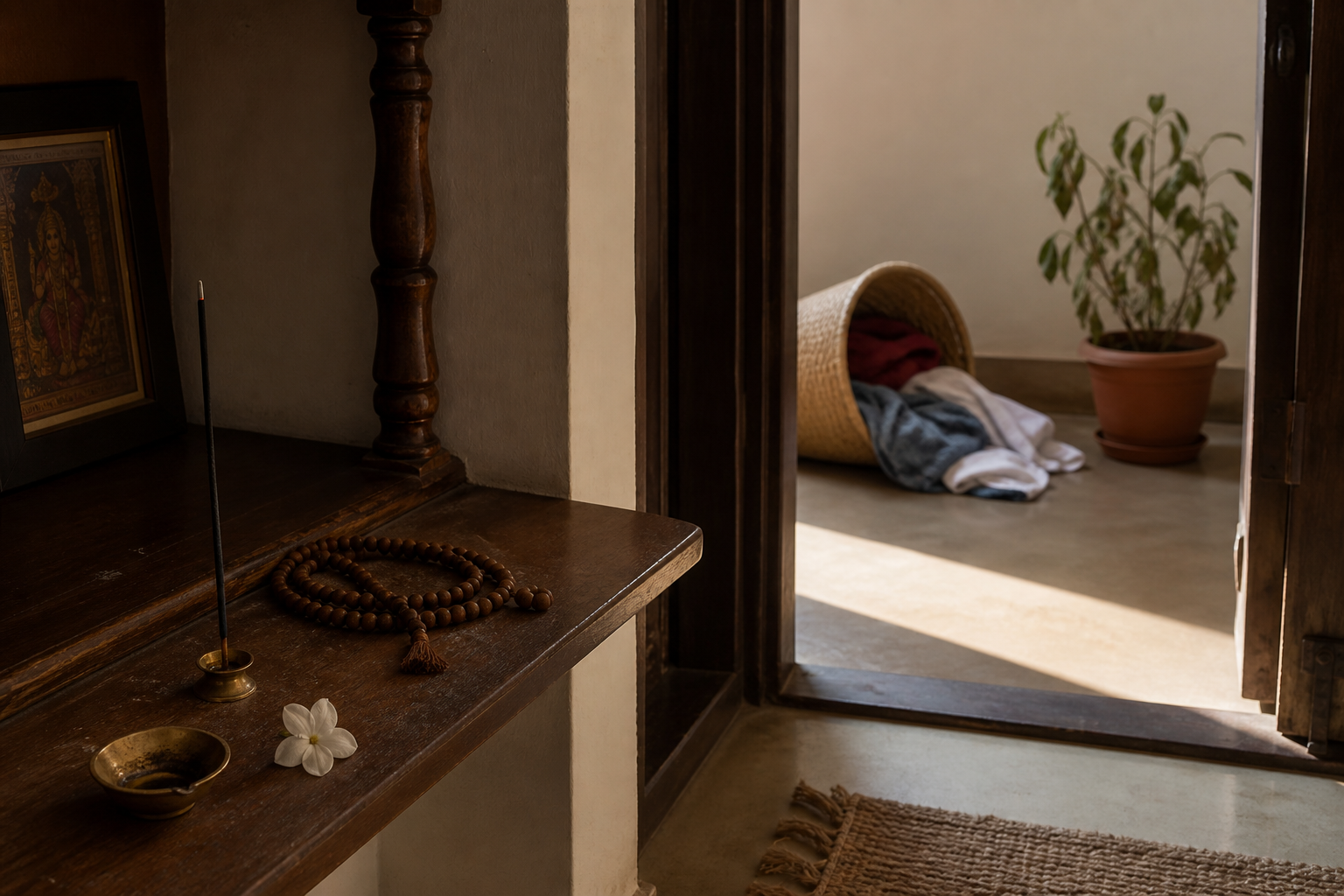
You may enter a Devi temple knowing the goddess’s name and still feel unsure about what you are seeing. Is the owl a vehicle, a warning, or both? Are elephants simply signs of wealth? Does a compassionate gaze tell you more than the objects held in the deity’s hands?
The most reliable approach is to read the whole sacred relationship: the local name of the goddess, her form, the beings around her, the shrine’s location, and the worship unfolding before her. That approach lets you receive darshan attentively without turning a living temple tradition into a collection of decorative symbols.
Iconography is a grammar, not a universal symbol code
A symbol does not always carry the same meaning wherever it appears. Its role depends on what it is doing, where it is placed, which form of the goddess it accompanies, and how the local tradition understands it. An animal beneath a deity may be a vahana. An animal at her side may instead be an attendant, a participant in a narrative, an emblem of the surrounding world, or a regional addition to the composition.
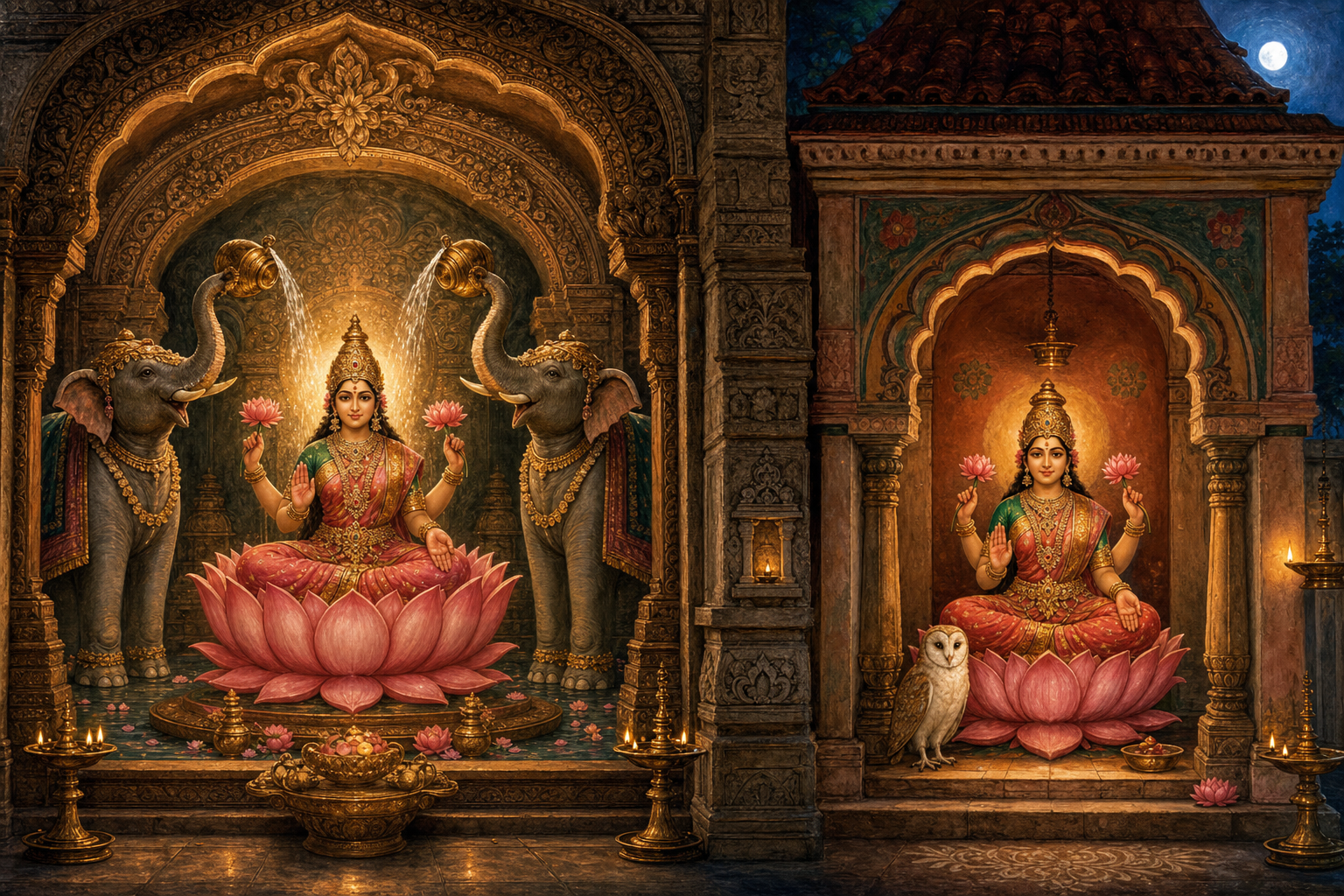
Lakshmi makes this distinction especially clear. The owl serves as her vahana in important eastern Indian traditions, while a deer appearing near Lakshmi in selected murals and paintings is not her canonical vehicle. Elephants in Gaja-Lakshmi imagery perform yet another role: they flank the goddess and pour water from ritual vessels. Calling every nearby animal a vahana would erase three different visual relationships.
The same caution applies to gestures, flowers, weapons, ornaments, and attendant figures. Identify what you can see before assigning a meaning to it. If garlands, clothing, or low light obscure a hand, do not force it into a familiar mudra. If the temple’s Agama, sampradaya, or local sacred history is unknown to you, leave room for a local explanation rather than manufacturing certainty.
- Begin with the deity’s full local name, not only a general label such as Devi or Lakshmi.
- Describe the visual relationship: held in a hand, seated beneath the deity, standing beside her, pouring water, or appearing in a surrounding panel.
- Notice the location: sanctum, doorway, lintel, subsidiary shrine, festival image, mural, or household decoration.
- Observe the ritual moment. Lamp worship, flowers, sacred sound, procession, and festival decoration can emphasize aspects that a still photograph cannot show.
This basic record prevents the most common interpretive mistake: deciding what an isolated object means before noticing how the temple has placed it in relation to the goddess.
Use a five-pass method during an unfamiliar darshan
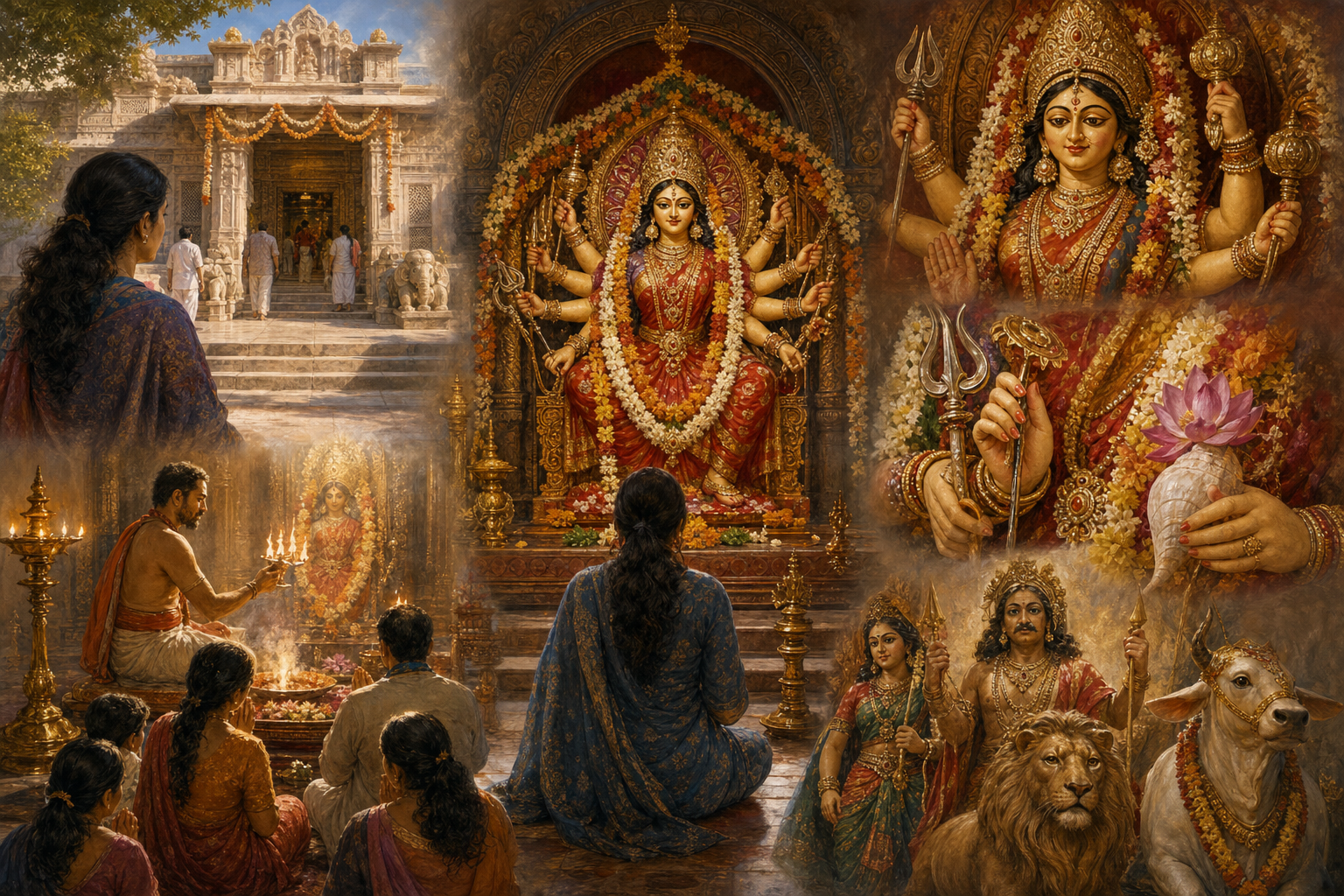
You do not need specialist training to look carefully. On your next visit, make five mental passes through the shrine. Keep the process quiet and subordinate to worship; take written notes only after you have moved away from the sanctum.
- Ask the name. Read the temple sign or ask a priest or regular devotee for the complete local name. An epithet often tells you which relationship the shrine foregrounds. In Sri Kalyana Kamakshi Amman, for example, Kalyana evokes auspicious marriage and sacred harmony, while Kamakshi directs attention toward a gaze of love and compassion. The name prepares you to see the form.
- Receive the whole form before inspecting details. Notice whether the first impression is serenity, protection, abundance, force, maternal reassurance, or another quality. This is an orientation, not a final verdict. It keeps one dramatic attribute from swallowing the meaning of the entire murti.
- Separate what the goddess holds from what surrounds her. Hands and their attributes belong to the deity’s embodied presentation. Animals, attendants, plants, and architectural motifs create relationships around that presentation. Record those roles separately.
- Read the shrine’s spatial sequence. A doorway image addresses you at a threshold; the presiding murti anchors worship; a subsidiary panel may preserve a narrative or related manifestation. Placement is part of the message.
- Verify the local reading. Ask a narrow question such as, “Why is the owl shown with this form of Lakshmi here?” A precise local question is more useful than asking what an owl must mean in every Hindu image.
The goddess’s gaze deserves particular attention because darshan is not merely visual inspection. You have come to behold and be present before the divine form. A name such as Kamakshi makes that reciprocity difficult to miss: the eyes are not a minor artistic detail but a devotional centre of gravity.
Lakshmi’s animals show how visual roles change
Lakshmi is often reduced in popular conversation to “the goddess of money.” Her iconography offers a more disciplined account of prosperity. It connects abundance with rain, fertility, household stability, judgment, restraint, ecological balance, and responsibility toward others. The animals around her help you distinguish those dimensions.
Elephants portray abundance under sacred order
In Gaja-Lakshmi compositions, elephants commonly stand on either side and pour water from vessels. The motif was prominent on temple lintels and coins in the Shunga, Kushana, and Gupta eras, carrying associations of rainfall, fertility, royal legitimacy, and ordered abundance.
The action matters. These elephants are not simply expensive or powerful animals placed beside a wealthy goddess. Strength is shown participating in blessing and order. When you encounter the composition above a threshold, ask what kind of prosperity is being welcomed into the space. The image points beyond acquisition toward abundance that sustains life and remains governed by dharma.
The owl joins wealth to vigilance
In Bengal and Odisha, Lakshmi’s owl, Ulooka, gives prosperity a more cautionary edge. Its ability to perceive in darkness supports a devotional lesson about foresight, greed, and impulsive use of wealth. Household traditions such as Manabasa Gurubara in Odisha carry that lesson through ritual narratives and visual art.
The owl therefore does more than certify that the goddess is Lakshmi. It asks whether the person seeking prosperity can see the consequences of possessing it. You can turn that image into a concrete examination: Are your resources serving duty and shared well-being, or are appetite and display making the decisions? The icon does not reject abundance; it disciplines the way abundance is received and used.
The deer refines prosperity through gentleness
A deer near Lakshmi must be read differently from both the owl and the Gaja-Lakshmi elephants. It appears in selected regional paintings and murals as an accompanying presence rather than a canonical vahana. Grace, serenity, ecological harmony, the Buddhist memory of the Deer Park at Sarnath, and the Jain commitment to ahimsa give that presence a wider dharmic resonance.
Here prosperity is refined by non-harm and calm. A household can possess much and remain inwardly agitated, environmentally careless, or indifferent to vulnerable life. The deer exposes that incompleteness. It asks whether abundance has made life gentler.
Other associations extend the field without replacing these roles. Cattle can signify nourishment, agrarian wealth, and community resilience. Horses in courtly or festive settings can suggest energy and enterprise under proper direction. Fish and wave motifs in coastal visual traditions can recall Lakshmi’s emergence during samudra-manthana and connect wealth with water, trade, natural cycles, and stewardship. Treat each as a contextual clue, not as a new universal vahana.
Three questions will keep your reading grounded: What blessing is being pictured? What danger or excess corrects it? What responsibility follows from receiving it? With the elephants, abundance is ordered and life-giving. With the owl, it requires foresight. With the deer, it must remain compatible with gentleness and non-harm.
Worship supplies the context that a photograph cannot
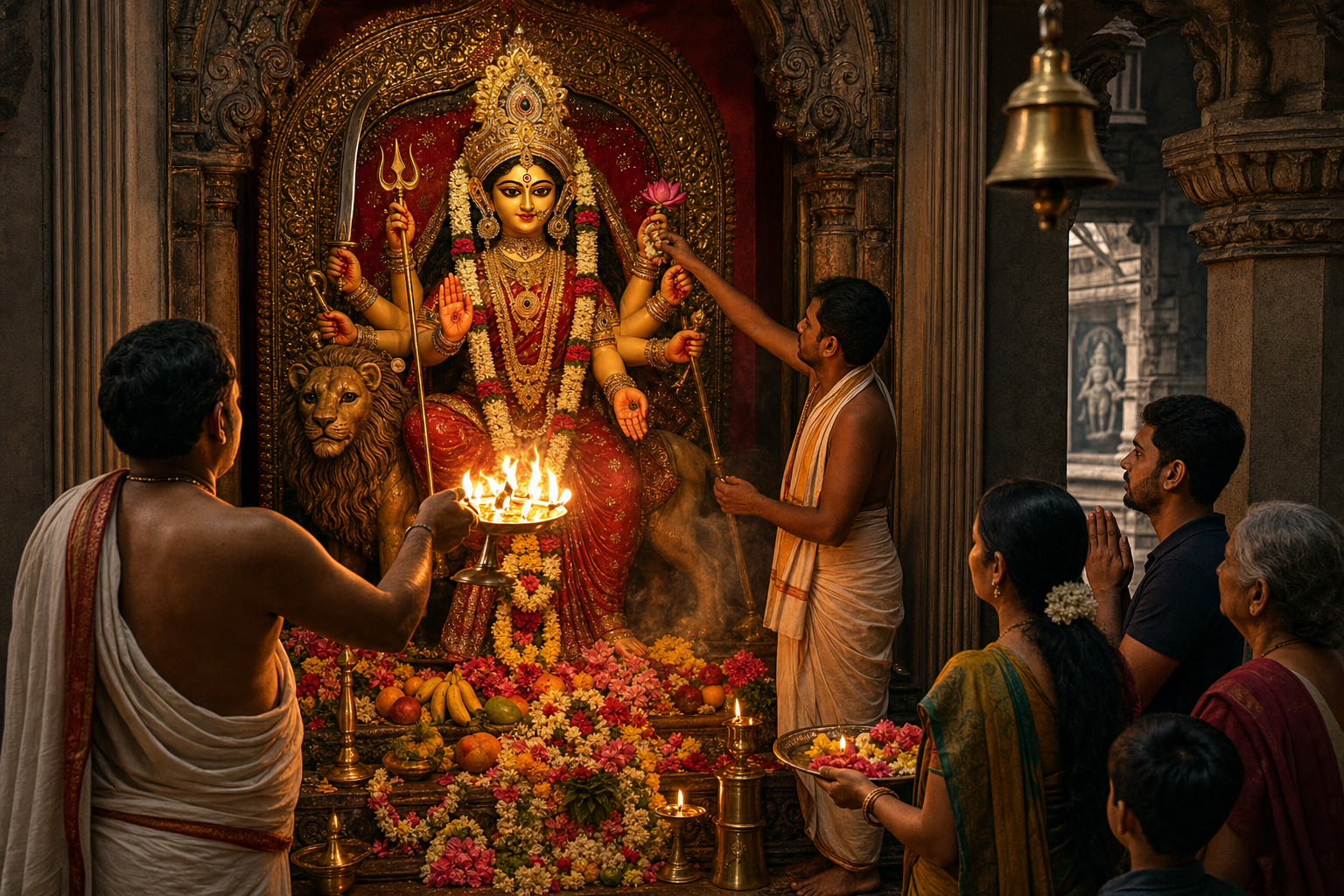
A museum label can identify an object, but temple worship shows how devotees live in relation to a sacred form. Light, fragrance, sound, movement, offerings, and the gradual approach to the sanctum direct attention. They are not a decorative frame added around the murti.
At the Kalyana Kamakshi Amman Temple in Hosur, movement from the outer precincts toward the sanctum unfolds amid lamps, flowers, incense, and sacred sound. The temple’s regular Friday worship and Navaratri celebrations also place the same divine presence within different rhythms of family devotion and collective observance. The name, image, sacred space, and act of worship work together.
- At the threshold: read posted rules, silence your phone, and ask before taking photographs. A clear view does not create permission to record a sanctum.
- On the approach: notice which images prepare you for the presiding deity. Doorway figures, subsidiary shrines, and recurring motifs may establish the temple’s visual vocabulary.
- During darshan: resist the urge to catalogue everything. Hold one relationship in attention – the gaze, a gesture, an animal’s action, or the way lamps reveal the form.
- During aarti or another offering: follow local cues rather than improvising. Temple etiquette varies, and participation should respect the community that maintains the shrine.
- After leaving the sanctum: translate one visual lesson into conduct. Lakshmi’s owl might prompt an examination of waste and greed; her elephants might prompt gratitude joined to responsibility; Kamakshi’s compassionate gaze might prompt you to bring greater care to a strained relationship.
Choose the setting that serves your purpose. A quieter visit may give you more space to study the iconography, while a festival reveals how the community clothes, praises, carries, and celebrates the divine form. Neither experience is a complete substitute for the other.
Shared dharmic values also need careful handling. The deer can evoke Buddhist and Jain teachings on contemplative calm and non-harm, while compassion, discipline, service, and ethical responsibility resonate across Hindu, Buddhist, Jain, and Sikh life. These affinities create meaningful conversation; they do not prove that every tradition shares the same theology of sacred images or the same form of worship. Respectful comparison preserves both kinship and difference.
The discipline is simple: do not freeze a regional symbol into a pan-Hindu rule, call every animal a vahana, or detach a beautiful image from the people who worship through it. Local variation is not noise around a supposedly pure symbol. It is part of the living history through which the symbol teaches.
Key takeaways for your next temple visit
- Start with the goddess’s complete local name; an epithet often tells you which quality or relationship the shrine emphasizes.
- Read the whole composition before decoding an individual object.
- Distinguish a vahana from an attendant, narrative participant, or neighboring motif.
- Use architectural placement and ritual action as evidence, not as background decoration.
- Ask local devotees or temple custodians a precise question instead of imposing a universal answer.
- Complete the interpretation by identifying the conduct the image asks of you: vigilance, restraint, gratitude, compassion, non-harm, or responsible prosperity.
On your next darshan, choose one form and look slowly. Learn her local name, notice one relationship in the image, verify its meaning where you can, and carry one corresponding discipline home. That is how iconography moves from something you have seen to something that can shape how you live.
References
- DharmaRenaissance Blog – From Deer to Owl: Unraveling the Powerful Animal Symbols of Goddess Lakshmi
- HinduPad – Hosur’s Kalyana Kamakshi Amman Temple: A Timeless, Serene Goddess Shrine in Tamil Nadu
