
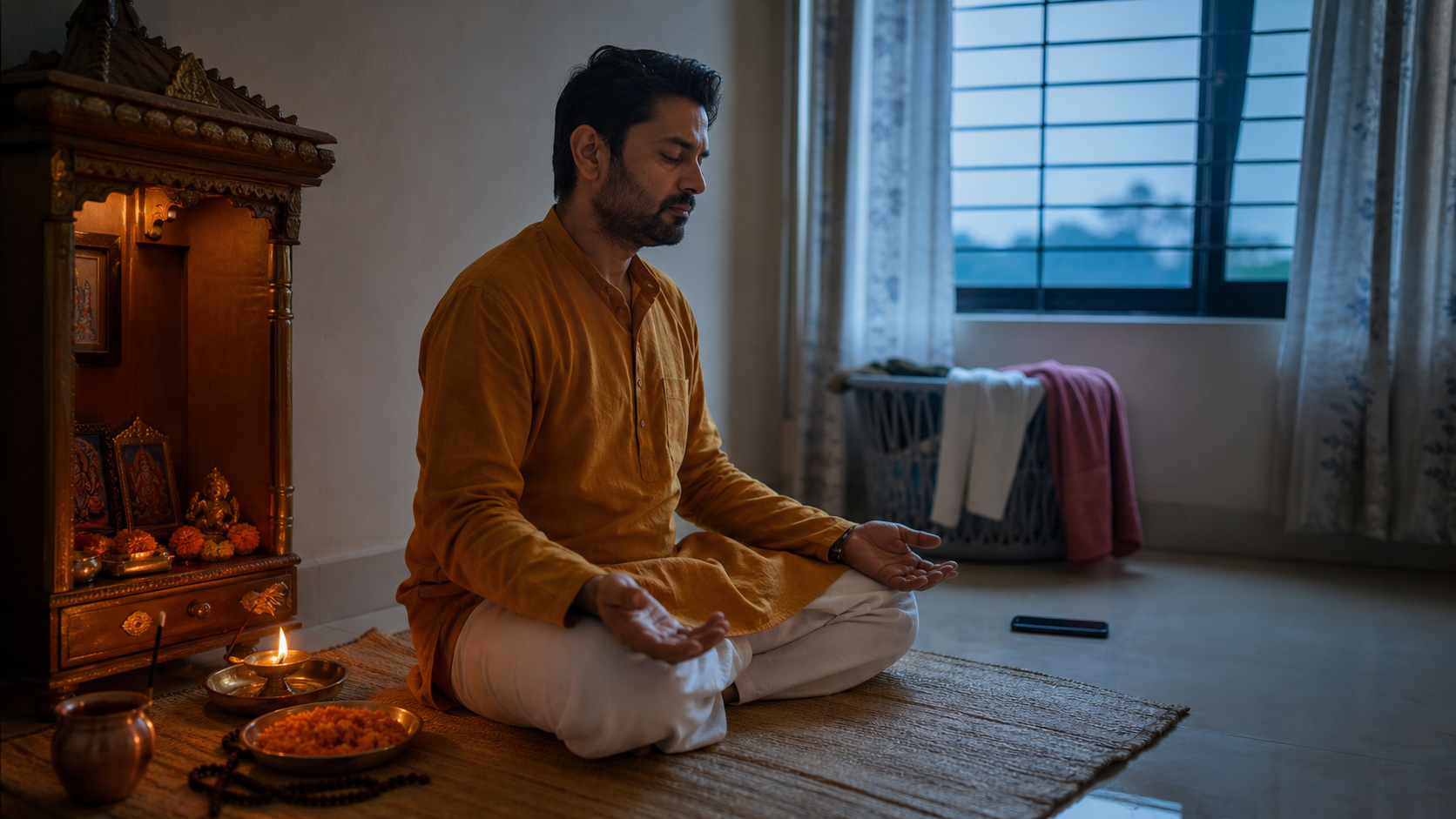
You can be regular in puja, japa, or scriptural reading and still feel that your days are being spent rather than offered. The routine remains, but its inner direction has faded. You finish the practice and return almost immediately to distraction, irritability, or an obligation you keep avoiding.
When that happens, you usually don’t need a more elaborate ritual. You need to reconnect spiritual practice with its work: gathering scattered attention, clarifying the duty in front of you, refining conduct, and orienting life toward the Divine and moksha. Inner renewal begins when practice changes what you do next.
Purpose is closer than a grand life mission
Purpose is often imagined as one exceptional role that will finally explain your entire life. That expectation can become another distraction. You wait for a dramatic calling while neglecting the dharma already visible in your relationships, work, speech, habits, and use of attention.
Dharma is larger than a career choice or personal ambition. It asks how you should act within the real conditions of your life. Your present purpose may include earning honestly, caring for someone who depends on you, correcting a harmful habit, completing neglected work, protecting time for sadhana, or making amends after a failure. None of these requires applause to be spiritually significant.
This doesn’t mean every demand placed upon you is dharma. Social pressure, fear, attachment, and inherited expectations can also push you toward adharma. Test the responsibility before accepting it:
- Does this choice require honesty, or does it depend on concealment and self-deception?
- Does it reduce avoidable harm, or merely protect your comfort at someone else’s expense?
- Is it a real responsibility, or an attempt to control an outcome that isn’t yours to command?
- Can you perform the next action carefully even if recognition and success are uncertain?
- Will doing it make your mind more fit for remembrance, discernment, and service?
The Bhagavad Gita’s discipline of action without attachment to its fruits is useful here. Nonattachment doesn’t mean indifference to quality or consequence. It means giving yourself fully to right action without demanding that the world reward you in a particular way. Purpose then becomes a direction for action, not a flattering story about who you are.
Find the crack before adding another practice

Human life can be understood as a vessel: the body and mind provide a limited but precious capacity for awareness, wisdom, devotion, and purposeful action. The practical question isn’t whether your vessel looks impressive. It is whether it can hold what you keep pouring into it.
In this image, pramada is the leak. It is heedlessness: living without sufficient attention to what you are doing, why you are doing it, and what the repetition is making of you. A person can be extremely busy and still live heedlessly. Motion isn’t the same as direction.
Before changing your entire routine, identify the main place where attention and dharma have separated:
- Attention: You reach for noise or a screen whenever a quiet interval appears, so the mind never settles long enough to notice its own impulses.
- Intention: Your prayers name one set of values, but your calendar and spending repeatedly serve another.
- Speech: You perform japa, then allow irritation, gossip, contempt, or needless harshness to govern conversation.
- Duty: You use spiritual reading to postpone an apology, a decision, or ordinary work that clearly belongs to you.
- Consistency: You begin severe disciplines in a burst of emotion, abandon them, and treat the lapse as proof that renewal is impossible.
Choose the most active leak. Then match the practice to it. Pratyahara can place a boundary around compulsive input. Dhyana can reveal reactivity before it becomes action. Japa can give attention a sacred center. Svadhyaya can correct a confused understanding of duty. Tapas can restrain an appetite that has been making decisions for you. Seva can loosen a spirituality that has become absorbed in the self.
Don’t adopt all of these at once. A practice should repair your actual pattern, not decorate a spiritual identity. If digital excess is the crack, for example, another hour of listening to spiritual material may still be excess. The more fitting tapas may be to protect the first quiet part of the morning from ordinary input and use it for attentive remembrance.
Build renewal around a simple daily rule

A daily rule is a small structure that survives changes in mood. It doesn’t have to imitate a monastic schedule. It needs to place remembrance, reflection, service, and self-examination at points where they can influence the rest of your day.
- At dawn, gather the mind. Sit before taking in ordinary messages and demands. Let the breath become measured, then repeat a Divine name familiar to your tradition. If your guru has given you a mantra and instructions, follow them. Before rising, name the main dharmic responsibility you intend to meet that day.
- During the day, consult wisdom for action. Read a brief passage from the Bhagavad Gita or an Upanishad. Don’t measure the session by how much you cover. Ask what the passage changes about your next conversation, decision, or obligation.
- Give something without display. Perform a concrete act of seva or quiet kindness. Help with work that needs doing, offer patient attention, share a useful resource, or relieve a burden without turning the act into evidence of your virtue.
- Use a transition for remembrance. Before work, at dusk, or when moving from public duties into home life, pause for japa. This keeps the momentum of one part of the day from governing the next.
- Review the day before rest. Notice where you acted in accord with dharma, where heedlessness took over, and what repair now belongs to you. Keep the review factual. Its purpose is correction, not self-punishment.
Nama-smarana and japa use sacred sound to redirect attention toward the Divine and toward ethical clarity. Familiar recitations such as Hare Krishna or Om Namah Shivaya can steady the mind when they are practiced with sincerity and awareness rather than treated as background noise.
Mechanical repetition isn’t a reason to abandon japa. It is something to notice. When you realize the mouth is continuing while the mind has wandered, hear the next repetition clearly. Recall whom or what the name invokes. Then connect remembrance to the conduct now required of you. Returning is part of abhyasa; the return isn’t evidence that the practice failed.
Keep the daily rule modest until it becomes dependable. If you miss one anchor, resume at the next one instead of postponing your return until a more auspicious or emotionally satisfying beginning. A lapse needs correction, not a new identity as someone who cannot be disciplined.
Let conduct show whether renewal is real

A peaceful meditation session can be valuable, but the feeling isn’t the final measure. Look for changes in the interval between impulse and action. Are you less eager to answer anger with anger? More willing to admit an error without inventing an excuse? Better able to complete an unglamorous responsibility? More careful about the effect of your speech?
The Divine name is not a loophole around consequences. If you have harmed someone, repetition doesn’t replace stopping the harm, acknowledging it precisely, apologizing where appropriate, or making a practical repair. Japa can give you the steadiness and humility required to do those things. That is very different from using devotion to escape them.
When you recognize a failure, move through it in a disciplined order:
- Stop repeating the harmful action as soon as you can.
- Name what you did without enlarging or minimizing it.
- Repair the effect where repair is possible.
- Identify the condition that made repetition likely, such as unguarded speech, hurried decisions, resentment, or excess sensory input.
- Choose a restraint or practice that addresses that condition, then resume sadhana without theatrical despair.
This movement from remorse to responsibility is inner renewal in practical form. It prevents two errors: pretending nothing happened and becoming so preoccupied with guilt that you avoid the duty of correction.
Other Dharmic traditions preserve related disciplines without becoming interchangeable with Hindu practice. Buddhist mindfulness joins awareness with compassion. Jain ahiṁsa and pratikraman join restraint with honest ethical review. Sikh remembrance of Naam joins simran with seva. Their doctrines and forms remain distinct, but each refuses to separate inward discipline from the way a person meets other beings.
Key takeaways
- Look for your next dharmic responsibility before searching for a dramatic life mission.
- Diagnose the main leak in attention or conduct, then choose a practice that directly addresses it.
- Give each part of a simple daily rule a job: remembrance, discernment, service, or review.
- Use japa to support right action, not to avoid apology, repair, or consequences.
- Judge renewal by reduced heedlessness and more reliable conduct, not only by spiritual emotion.
- After a lapse, correct what can be corrected and return at the next available moment.
Begin with the next honest act

At the next quiet transition in your day, put aside ordinary input. Settle the breath, repeat the Divine name you already trust, and identify one duty you have been postponing. Make that duty small enough to begin immediately, then do its first honest part before consuming more spiritual content.
Return to the same pattern at dawn and before rest. Protect attention, remember the Divine, act without bargaining for praise, and repair the cracks you can see. Purpose becomes clearer as your practice makes you more capable of carrying it.
References
- DharmaRenaissance Blog — The Potter’s Gift and the Wasted Vessel: Hinduism’s Powerful Life Symbol and a Call to Purpose
- DharmaRenaissance Blog — The Transformative Power of Divine Names: Vedas, Upanishads, and Epics for Inner Renewal
