
If you are visiting Mayapur or deciding whether a heritage initiative deserves your support, don’t ask only whether the finished work looks ancient. Ask whether it restores a living relationship among sacred narrative, regional material, trained artisans, temple architecture and sustained patronage.
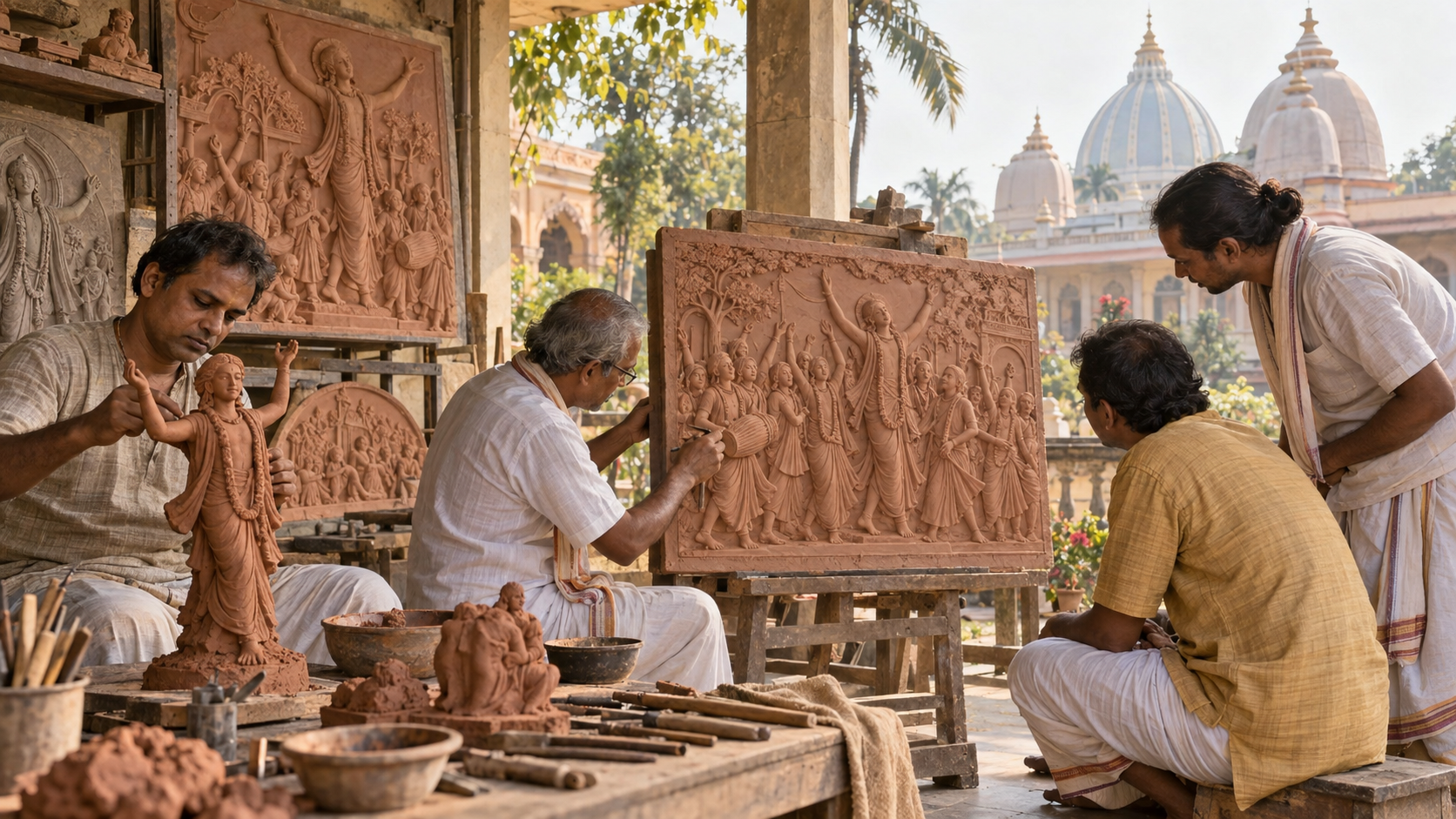
Mayapur makes that test unusually concrete. A team of four devotional artists has created bas-reliefs illustrating sacred narratives, including events in the life of Lord Caitanya. Their work gives you a practical way to understand what the revival of Vedic art can mean, how to look at it intelligently and what must continue after the panels are installed.
What Mayapur is actually reviving
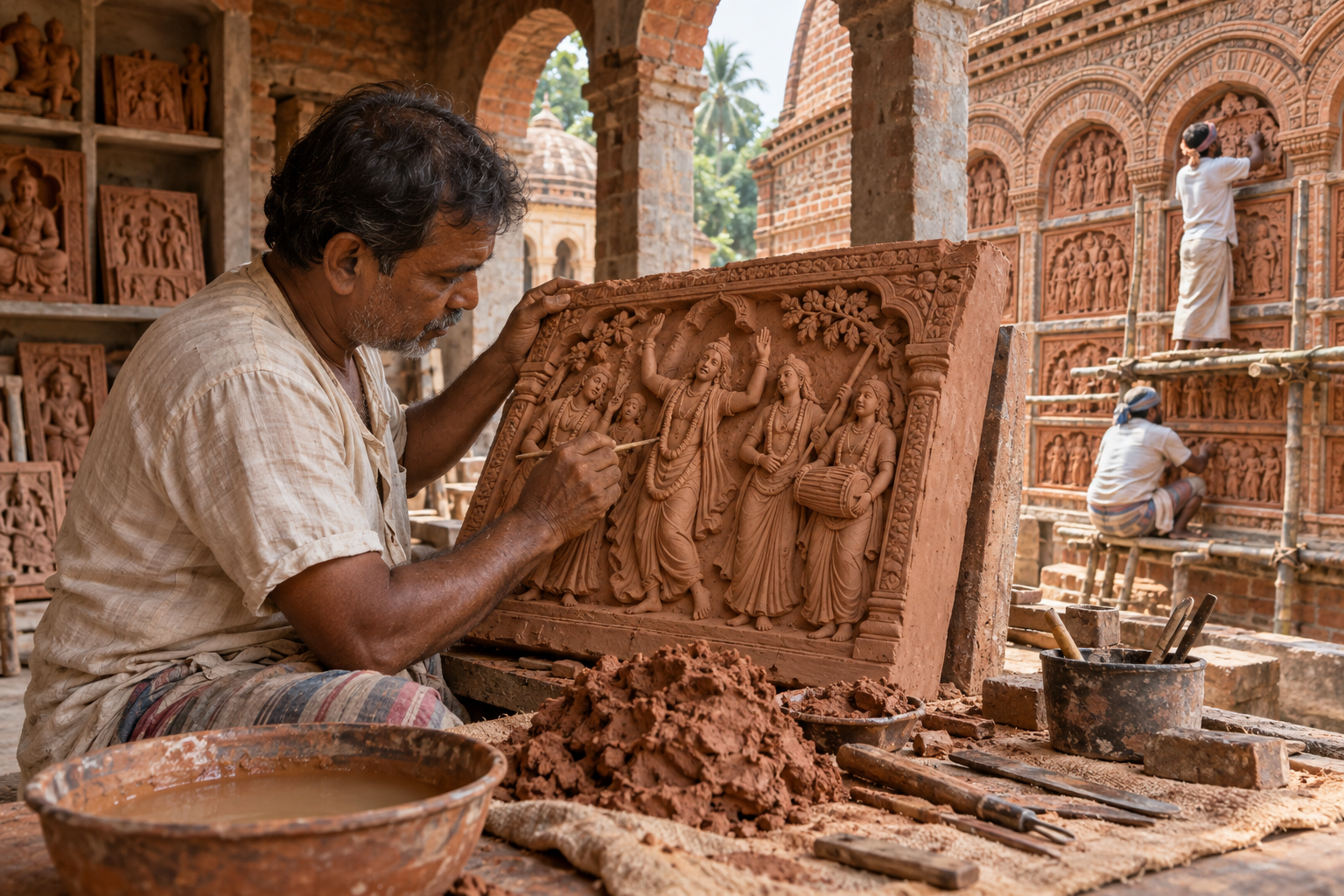
The phrase “Vedic art” can be too broad to tell you what is happening. Mayapur is not reconstructing an archaeological object from the Vedic period. It is renewing Bengal’s tradition of decorating sacred architecture with narrative terracotta reliefs while presenting teachings rooted in the Bhagavata and Gaudiya Vaishnava traditions.
Terracotta literally means baked earth. Clay is modelled and fired to create a hard ceramic material suitable for pottery, building and sculptural decoration. In a bas-relief, figures project from a relatively shallow background rather than standing free as complete statues. This lets an artist place people, architecture, gestures and symbols within a single narrative field.
The scale matters. The Mayapur workshop has produced seven-, ten- and fifteen-foot-square reliefs depicting episodes from the Srimad-Bhagavatam and Sri Caitanya-caritamrta. These are architectural works rather than small devotional souvenirs. Their meaning depends partly on how they occupy a wall, meet the building and guide a devotee’s attention.
The choice of subject is equally deliberate. For Gaudiya Vaishnavas, Lord Caitanya is Krishna appearing in the disposition of His own devotee. Depicting His life in a traditional Bengali medium therefore joins place, theology and visual language. The revival has two inseparable layers: an inherited craft is being practised again, and that craft is being entrusted with sacred teaching.
Key takeaways
- Mayapur’s revival renews Bengal’s terracotta temple tradition; it should not be mistaken for a claim that each new panel is an artefact from the Vedic period.
- The project treats scriptural fidelity as part of artistic integrity, grounding its narratives in the Srimad-Bhagavatam and Sri Caitanya-caritamrta.
- A genuine revival must preserve skilled makers and future training, not merely produce an impressive finished facade.
- You can assess the work by asking about its material, textual basis, artists, architectural setting and long-term care.
Why Bengal’s terracotta tradition needed revival
Terracotta became an important bearer of sacred memory in Bengal because temple walls could do more than ornament a building. They could make a narrative visible. A devotee approaching a shrine could encounter recognisable figures and episodes before hearing a formal explanation or opening a text.
During the sixteenth-century religious renewal associated with Lord Caitanya and His followers, Bengal’s nobility, landed gentry and intellectuals supported temple construction while sacred teaching also flourished in poetry, drama and other literature. Terracotta temple sculpture developed alongside that religious literature, turning built surfaces into durable records of narratives already moving through recitation and performance.
This relationship explains why patronage is not incidental to sacred art. A craft tradition survives when patrons repeatedly commission work, artisans can devote time to mastering it and younger makers can see a viable path into the discipline. Once that chain breaks, knowledge may survive only in scattered objects or migrate into other crafts.
By the second half of the nineteenth century, Bengal’s temple patronage had declined amid the Westernisation of the Indian middle class and Calcutta’s position as the capital of British India. Artisans without temple commissions turned to work such as wood carving, while concrete and steel further displaced the brick-and-terracotta tradition. This sequence is useful for understanding the craft’s vulnerability, though it should not be treated as a complete social history of Bengal.
The practical lesson is sharp: count people and future commissions, not just completed panels. A new facade may commemorate a tradition without securing its future. If no one is being trained, no artisans are credited and no subsequent work is planned, the result is restoration or reproduction rather than a durable revival.
Why scriptural accuracy is part of the craft
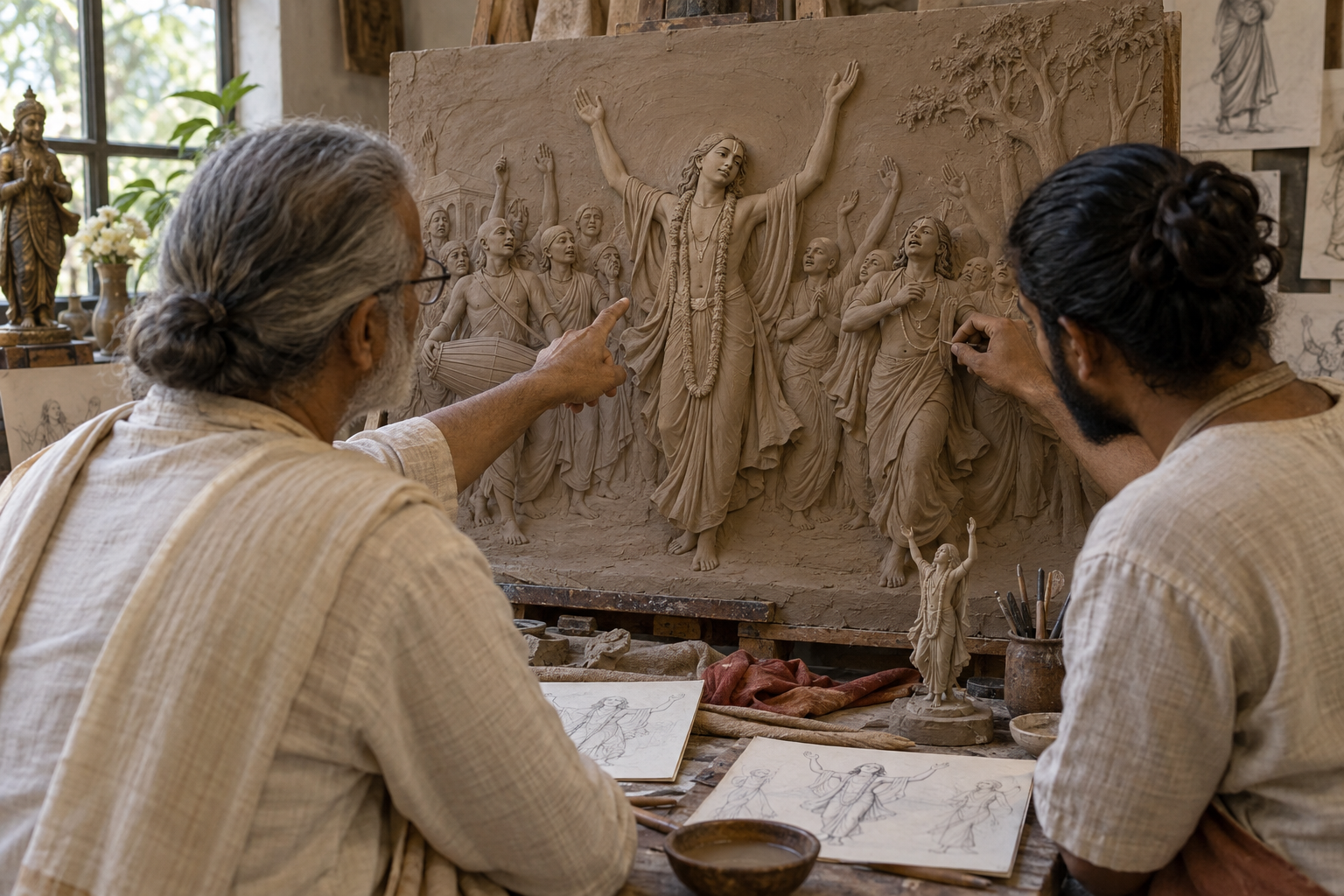
A sacred image does not merely show a story. It interprets the story through posture, sequence, attributes, scale and the selection of a particular moment. Even a beautifully modelled scene can mislead if it combines unrelated episodes or introduces a detail that changes the theological meaning.
Many makers in Bengal’s earlier terracotta tradition could not read Sanskrit and therefore relied on local Bengali poets and dramatists for narrative material. Those retellings sometimes introduced new episodes or distinctive interpretations. This does not make vernacular poetry culturally worthless. It does mean that a viewer cannot assume every old temple image is a literal visual transcription of a Sanskrit text.
The Mayapur artists follow a specific curatorial rule: their scenes are based on narratives in the Srimad-Bhagavatam and Sri Caitanya-caritamrta. That choice aligns the visual programme with the scriptures central to the temple community. It also makes the panels accountable to something more exact than an artist’s impression of a vaguely traditional scene.
Canonical fidelity is not automatic merely because a project names a scripture. If you are assessing a panel, exhibition or proposed commission, ask four concrete questions:
- Which passage or episode is being depicted?
- Which visible details come directly from the narrative, and which come from later artistic convention?
- Who reviewed the iconography before the clay was fired?
- Does the finished installation give viewers enough information to identify the scene for themselves?
These questions do not force art into mechanical illustration. They distinguish informed interpretation from carelessness. A traditional medium does not excuse a confused narrative, and textual accuracy does not compensate for weak workmanship. Sacred art needs both disciplined meaning and accomplished form.
How to read a Mayapur relief instead of merely photographing it
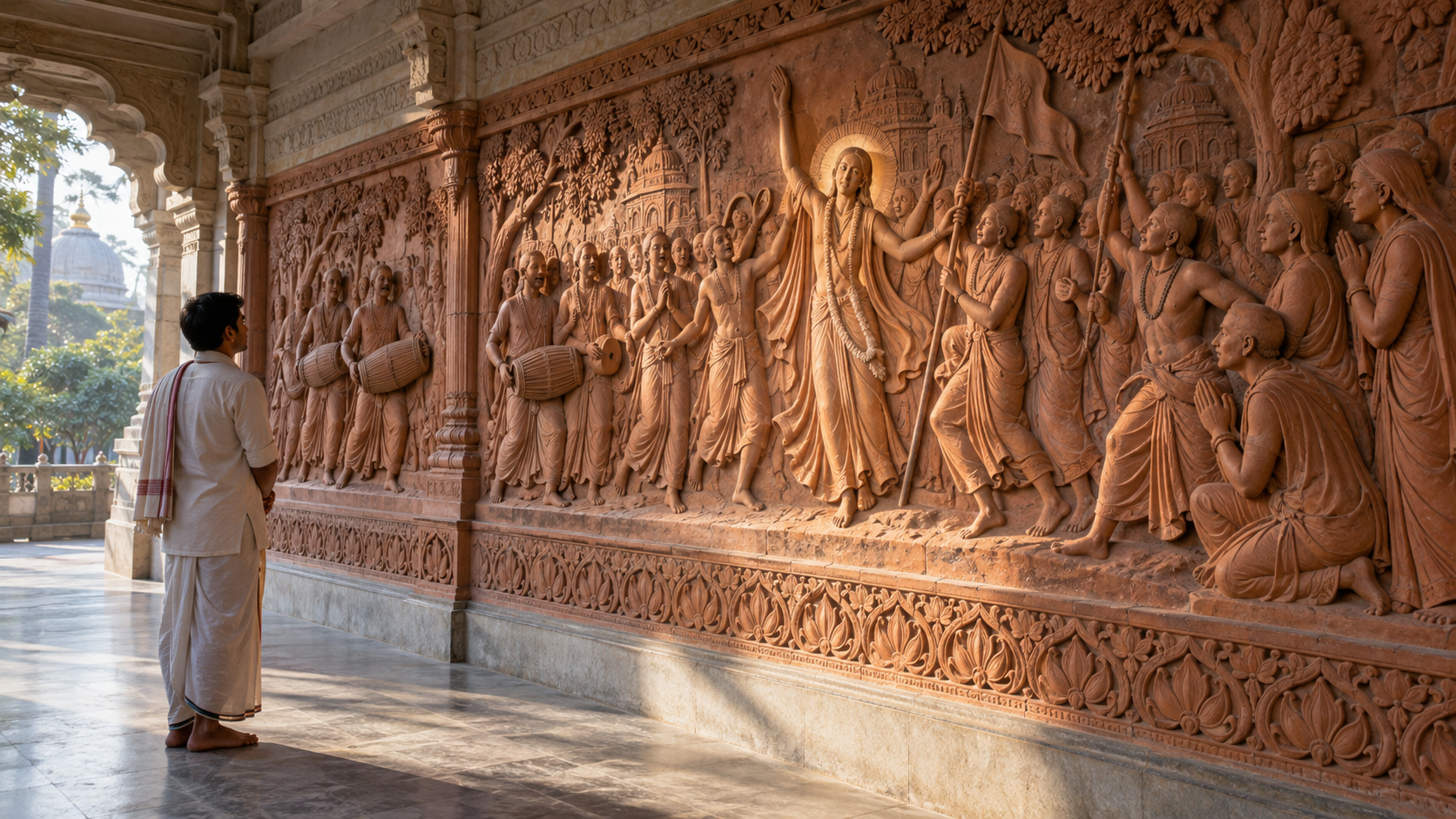
A large relief rewards a slower method of looking. Use this sequence when you encounter one in Mayapur or at another terracotta temple:
- Begin at architectural distance. Notice where the panel sits in relation to entrances, pathways and the shrine. Ask what a devotee is meant to see first. The placement is part of the meaning.
- Identify the narrative before judging the decoration. Look for a caption or ask which episode is represented. If the scene shows Lakshmi-devi enthroned while devas and devis bring offerings, for example, identifying the event will help you interpret the surrounding figures instead of treating them as generic ornament.
- Move closer and study the relief as clay. Observe how depth separates foreground figures from attendants and architectural features. Where paint or glaze is present, distinguish the contribution of colour from the modelling underneath it.
- Read gesture and hierarchy. Look at the direction of faces, hands and bodies. Notice who occupies the centre, who serves, who witnesses and who receives attention. These relationships often carry more narrative information than decorative detail.
- Connect image and scripture. Find the relevant passage in the Srimad-Bhagavatam or Sri Caitanya-caritamrta. Compare the text’s essential actions with the artist’s selected moment. The useful question is not “Does it look exactly as we imagined?” but “Does the visual interpretation preserve the event’s theological centre?”
- Record the maker as well as the image. Photograph or note the artist’s name, date, textual reference and location when that information is available. Documentation keeps a living artisan from disappearing behind the anonymous label of “traditional art.”
This approach changes a panel from a picturesque background into a form of darshana and learning. You begin to see why material, placement, narrative selection and devotional intention cannot be separated.
How to recognise and support a living revival
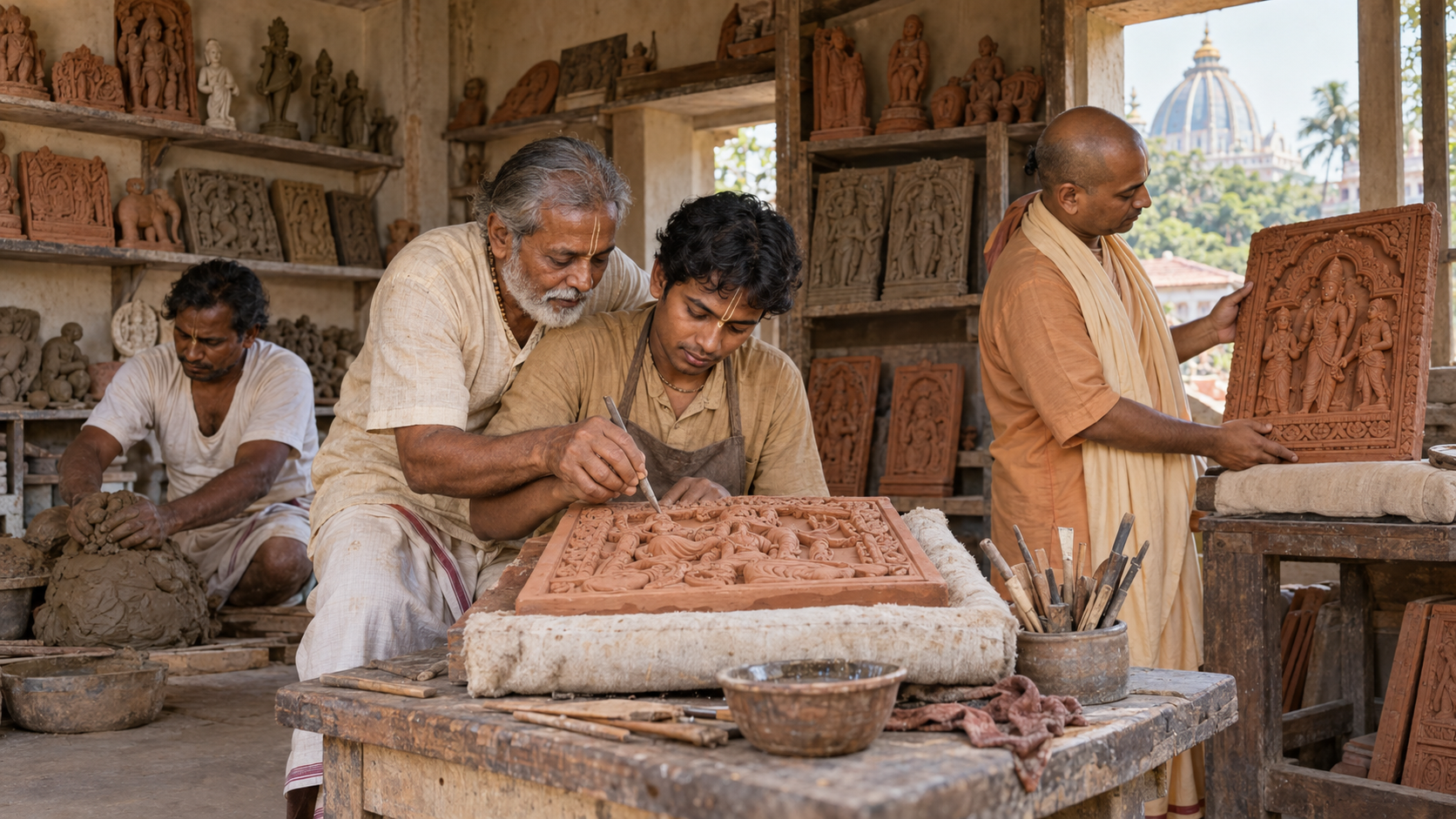
Ageing a surface, copying an old motif or installing a few clay tiles can create a traditional appearance. A living revival requires a deeper structure. Before you donate, commission work or describe a project as a revival, look for these signs:
- Artisans are identifiable. Their names, roles and knowledge are treated as part of the project’s heritage rather than as disposable labour.
- Training continues. Experienced makers have apprentices or a documented way to transfer modelling, firing, glazing and narrative skills.
- The medium fits the place. Terracotta is chosen because it belongs to the region’s architectural vocabulary and the building’s purpose, not simply because it photographs well.
- Iconographic decisions are reviewed. The project can name its textual basis and explain how disputed or unspecified details were handled.
- Maintenance is planned. Fired clay may be durable, but an architectural artwork still needs inspection, appropriate cleaning and repair by people who understand its material.
- Patronage extends beyond inauguration. Funds support documentation, conservation and future commissions as well as the first installation.
If you are in a position to help, ask where your contribution will go. Funding an apprentice, documenting an artist’s process, conserving an existing panel or supporting the next scripturally grounded commission may do more for continuity than adding another decorative object without a care plan.
On your next visit, choose one relief and give it more than a passing glance. Identify its narrative, find its textual foundation and learn who made it. Then direct your support toward the people and practices that will still be capable of making sacred art when the present programme is complete. That is where revival becomes inheritance.
References

Leave a Reply
You must be logged in to post a comment.