

If you arrive in Ujjain with only a list of temples, you can complete every darshana and still miss the relationship that makes the city a sacred whole. Mahakaleshwar, Harsiddhi Mata and the Bhairava traditions are not three unrelated attractions. They express time, divine power and the discipline required to approach that power.
Lambakarna Bhairava helps you read that relationship. His role as the guardian of the Avanti Shakti Peetha turns a temple circuit into an inner sequence: become attentive, examine your intention and then enter the presence of Shakti. That sequence is useful whether you are planning a pilgrimage, trying to understand Ujjain’s theology or wondering why a fierce deity belongs beside the Goddess.
Read Ujjain as a sacred field, not a collection of shrines

Sacred geography is created by relationships. A river, a Jyotirlinga, a Shakti Peetha and its guardian acquire fuller meaning through their place within the same ritual landscape. Movement between them is therefore more than travel across a city. It becomes a way of moving through connected theological realities.
Ujjain, the ancient Avanti, unfolds along the River Shipra. Within this landscape, Mahakaleshwar Jyotirlinga, Harsiddhi Mata and the city’s Bhairava shrines form an interwoven Shaiva-Shakta field. The Avanti-khanda of the Skanda Purana situates Ujjain within a wider network of tirthas whose sanctity is maintained through ritual relationships and protective presences.
- The Shipra establishes the wider tirtha landscape in which the sacred city is encountered.
- Mahakaleshwar presents Shiva as Mahakala, the sovereignty before which time, status and worldly certainty lose their apparent permanence.
- Harsiddhi Mata embodies the Shakti at the centre of Ujjain’s Avanti Peetha tradition.
- Lambakarna Bhairava serves as kshetrapala, the guardian who preserves the conditions under which the Goddess may be approached with reverence.
A simple way to carry this map is to remember three words: time, power and discernment. Mahakala confronts you with time. Harsiddhi reveals power as Shakti. Bhairava asks whether your intention is disciplined enough to meet either. This is an interpretive aid, not a claim that every local ritual follows one compulsory route.
If your physical itinerary has to change, the relationship does not disappear. You can visit in the order available to you while holding the theological sequence in mind. If you are undertaking a formal vrata, fulfilling a vow or following a prescribed Shakti Peetha circuit, confirm the ritual order with the relevant temple tradition rather than treating a general pilgrimage plan as liturgical authority.
Why the guardian of Avanti is the long-eared Bhairava

The name Lambakarna joins lamba, meaning long, with karna, meaning ear. The epithet identifies him as the long-eared Bhairava, but the ears are not merely an unusual physical feature. They make listening the defining quality of his guardianship.
A kshetrapala does more than defend a boundary from physical intrusion. The guardian distinguishes a reverent approach from one shaped by pride, distraction or exploitation. Lambakarna is remembered within Ujjain’s Avanti tradition as the Bhairava who hears both the vows and the vulnerabilities of devotees. His vigilance is fierce because a sacred threshold should not be crossed carelessly; it is compassionate because the discipline protects the pilgrim as well as the shrine.
You can honour that symbolism without inventing a new temple ritual. Before entering a shrine associated with this sacred field, use the threshold as a deliberate pause:
- Stop long enough to hear the actual sounds around you before adding your own words.
- State your intention inwardly in one plain sentence. If you cannot name why you have come, notice that honestly.
- Identify one tendency that should not govern the encounter: haste, self-display, entitlement, resentment or inattentiveness.
- Enter with less mental noise than you brought to the doorway.
This pause is a contemplative application of Lambakarna’s symbolism, not a substitute for the customary instructions of a temple. Its purpose is practical: it prevents darshana from becoming a hurried transaction in which you ask to be heard without first becoming capable of hearing.
The emphasis on hearing belongs to a broad Dharmic vocabulary. Vedic revelation is shruti, that which is heard. The classical movement from shravana to manana and nididhyasana proceeds from listening, through reflection, into sustained contemplative assimilation. Images of the Buddha use elongated earlobes to recall renunciation of royal ornament and awakened responsiveness to suffering. Jain Tirthankara imagery connects a similar feature with restraint and insight. The repeated suni-ai, or listening, of the Japji presents hearing as transformative rather than passive.
These parallels should help you notice a shared ethical accent, not erase the differences among Hindu, Buddhist, Jain and Sikh teachings. The common point is precise enough: truthful action begins when attention is no longer monopolised by the self. Lambakarna gives that civilisational insight a specifically Bhairava form. He listens in order to discern, and he discerns in order to guard.
How to read Lambakarna’s fierce iconography
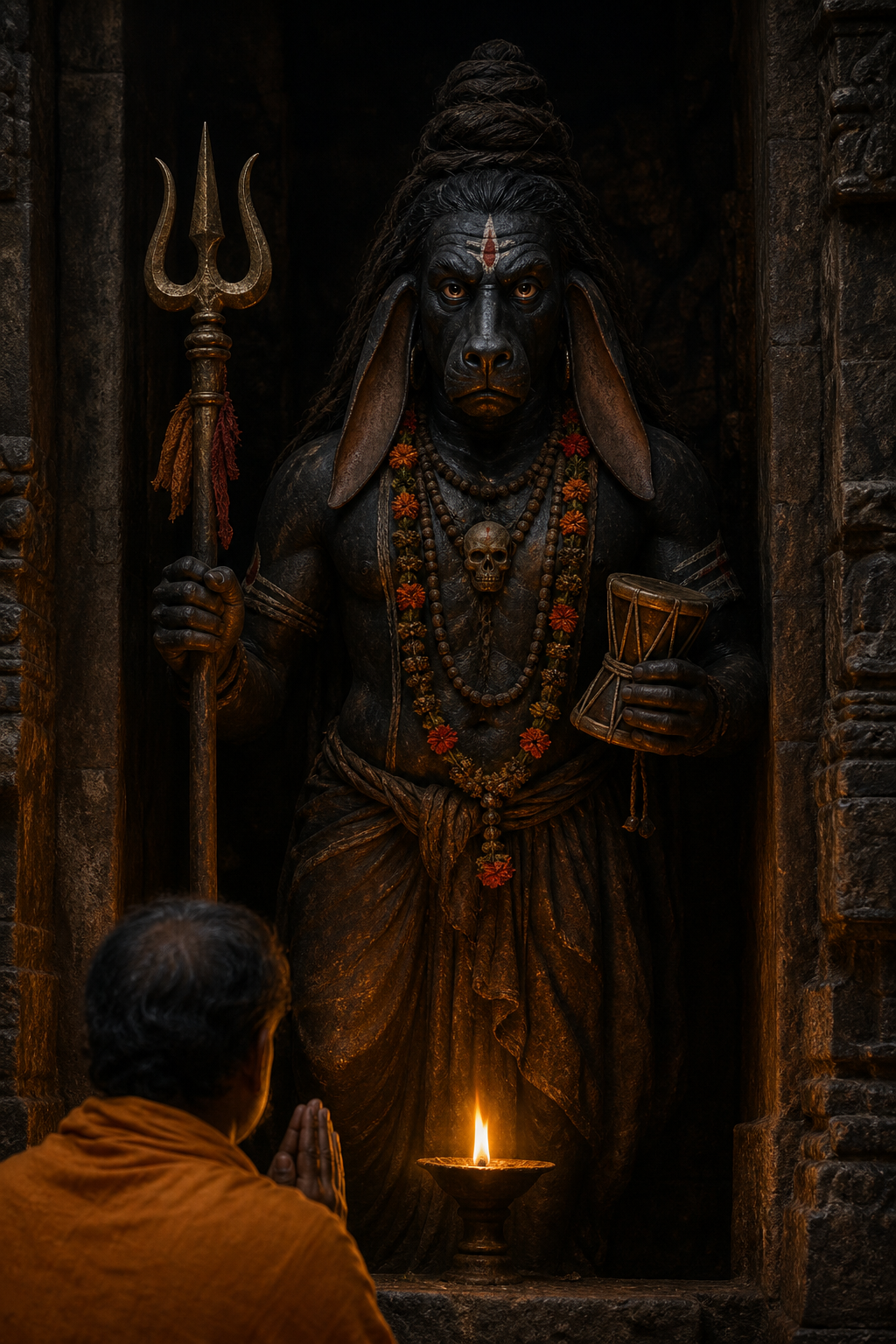
Bhairava can be unsettling when his imagery is viewed through categories that equate a frightening appearance with evil. Within Shaiva and Shakta traditions, fierceness often performs a protective and revelatory function. It confronts the attachments that ordinary gentleness may leave undisturbed.
Lambakarna participates in the wider iconographic vocabulary of Bhairava. The vocabulary is typical rather than a promise that every representation will contain every feature, so use it to interpret an image rather than to impose a rigid authentication checklist.
- Matted locks and ash-smeared limbs point beyond polished social identity and the wish to make the sacred conform to worldly respectability.
- Serpentine ornaments express a power able to remain present around danger rather than flee from it.
- A garland of skulls and the kapala, or skull bowl, make mortality impossible to conceal. They direct attention toward impermanence and the transformation of ego and fear.
- The trishula, or trident, signifies the cutting of the threefold knots of bondage rather than aggression for its own sake.
- The damaru, or drum, evokes primordial rhythm and nada, the dimension of sound that leads attention beyond ordinary noise.
- The dog as Bhairava’s vahana represents loyalty, alertness and awareness at the threshold.
- The elongated ears distinguish Lambakarna’s particular teaching: protection requires the capacity to hear before reacting.
Once you understand those functions, the apparent contradiction between terror and grace becomes easier to read. Bhairava’s skulls do not celebrate death; they deny the ego’s fantasy that death can be ignored. His weapons do not license uncontrolled anger; they depict the precision required to cut bondage. His position at the boundary does not keep sincere devotees away; it asks them to abandon what would corrupt the encounter.
Tantric practice intensifies this relationship between sound and protection. Bhairava mantras may employ seed syllables such as hum and phat in practices concerned with breaking inner obstruction and establishing boundaries. Knowing that symbolic function is not the same as receiving instruction in a mantra discipline. If you do not belong to a lineage or have specific guidance, attentive silence is a more honest response than turning an esoteric syllable into a tourist technique.
Four confusions that distort the sacred geography
Ujjain’s traditions are rich enough to resist a perfectly uniform diagram. You do not need to eliminate every variation before approaching them, but you should know where certainty ends and interpretation begins.
1. A sacred circuit is not merely a walking order
The practical route between shrines and the meaning connecting them are related but not identical. A useful inner reading of the circuit is to let Mahakala ask what you falsely imagine will last, Harsiddhi ask how you intend to use the power entrusted to you, and Lambakarna ask what truth you have refused to hear. Those questions can accompany your journey without being presented as a mandatory temple rite.
2. Lists of the Shakti Peethas do not agree on every detail
Regional enumerations vary over the part of Sati associated with Ujjain. That disagreement should be preserved rather than concealed behind a false precision. The stable point for understanding the city’s living Shakta geography is Harsiddhi Mata’s place at the centre of the Avanti Peetha tradition. You can affirm that role without pretending that every textual or regional list uses the same identification.
3. Bhairava enumerations are also regionally variable
Pan-Indian arrangements of the eight Bhairavas and the sixty-four Bhairavas are not uniform across texts, regions and schools. A local name should not be dismissed merely because it is absent from a different enumeration. Lambakarna’s importance rests in Ujjain’s received memory of the Bhairava who guards the Goddess of the Avanti Peetha. Local sacred identity and a systematised list answer different questions.
4. Kal Bhairav and Lambakarna Bhairava should not be casually collapsed
Ujjain’s renowned Kal Bhairav temple demonstrates the city’s powerful public devotion to Bhairava, but fame does not make every Bhairava designation interchangeable. Lambakarna names the guardian associated specifically with the Avanti Shakti Peetha tradition. If a vow or formal pilgrimage instruction names Lambakarna, do not assume that visiting another Bhairava shrine automatically fulfils the same requirement. Ask locally about the intended shrine and observance.
The same care applies to the long-eared symbolism across Dharmic traditions. Similar visual forms can carry related ideas of renunciation, wisdom or attentive compassion without proving that all four religions teach the same metaphysics. The comparison is strongest when it sharpens a shared practice of listening and weakest when it flattens distinct traditions into a vague universalism.
During Mahashivaratri and Navaratri, processions, lamps, recitation and fasting make Ujjain’s religious relationships visible at the scale of the city. The sacred field then appears not only through fixed shrines but through moving communities of attention. If you encounter Ujjain in such a period, look beyond spectacle: notice how sound, movement and disciplined observance temporarily turn streets and thresholds into parts of the ritual landscape.
Key takeaways for approaching Lambakarna Bhairava
- Lambakarna Bhairava is the long-eared guardian associated with Harsiddhi Mata and Ujjain’s Avanti Shakti Peetha tradition.
- His elongated ears turn listening into a form of spiritual vigilance: hear clearly, discern intention and protect what is sacred.
- Mahakaleshwar, Harsiddhi Mata and Bhairava are best understood relationally as expressions of time, Shakti and protective discernment.
- Fierce Bhairava imagery addresses mortality, ego, bondage and the need for strong boundaries; it should not be mistaken for malevolence.
- Regional Shakti Peetha and Bhairava lists vary, so distinguish durable local tradition from claims of universal textual uniformity.
- A formal vow requires local ritual guidance, while any visitor can practise a respectful pause and attentive listening at the threshold.
Before you go to Ujjain, write three questions in your pilgrimage notes: What am I pretending will last? What will I do with the power I seek? What have I not been willing to hear? Carry them through Mahakaleshwar, Harsiddhi and the Bhairava presence. Then let your next action protect whatever the journey made audible.