
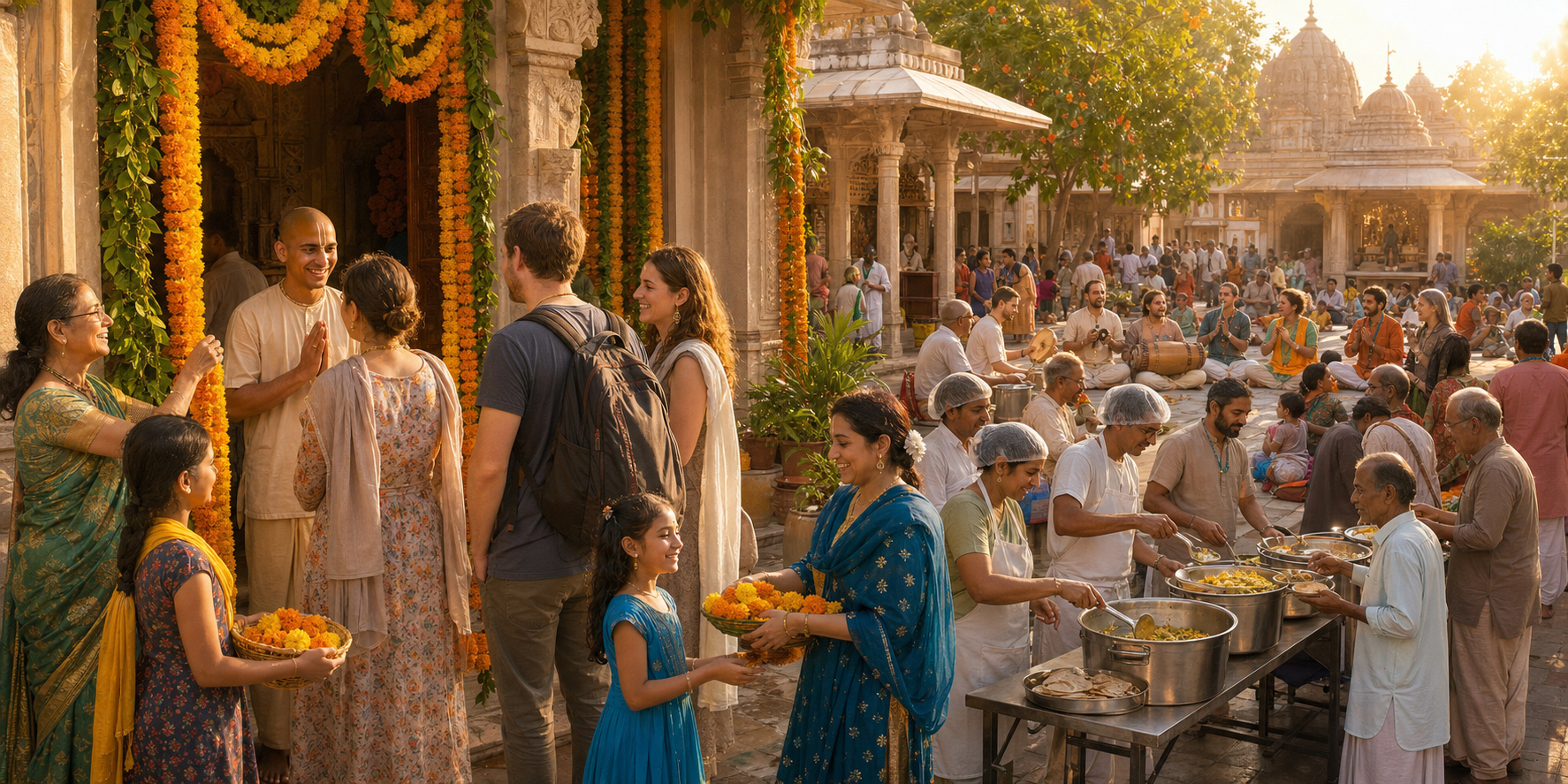
If you want to support ISKCON’s public work, the hard choice is usually not whether seva matters. It is where your time, money, or skills will do the most good: inside a temple, through a food-relief program, or at a public festival.
Choose by the barrier you can help remove. Temple service addresses inconsistency. Food relief addresses material need. Festivals address distance between devotional culture and the wider public. The best contribution is not necessarily the most visible one. It is the responsibility you can carry faithfully.
Three doors into public life, each with a different job
Temple service, food relief, and festivals should not be treated as interchangeable forms of publicity. Each creates a different kind of relationship with the public.
| Form of outreach | What it gives the public | What it requires from you | The question to ask before committing |
|---|---|---|---|
| Temple service | A dependable sacred place, regular worship, hospitality, and continuity | Reliability, respect for local standards, and willingness to do work that may not be seen | Can I take responsibility for a recurring task and complete the handoff properly? |
| Food relief | Freshly prepared nourishment delivered through an organized service | Operational discipline, accountability, and respect for recipients | Am I supporting verified delivery today or only a future capacity claim? |
| Public festivals | A direct encounter with living devotional culture | Preparation, welcome, crowd awareness, and careful follow-through | Can I help a first-time visitor participate without pressure or confusion? |
The distinction matters. A festival can introduce thousands of people to a tradition, but it cannot replace the daily work that makes a temple trustworthy. A large kitchen can serve an urgent need, but its value depends on meals actually reaching recipients. A beautiful temple can anchor a community, but only if people experience it as a place of worship and service rather than a monument closed in on itself.
Temple seva gives outreach a dependable home
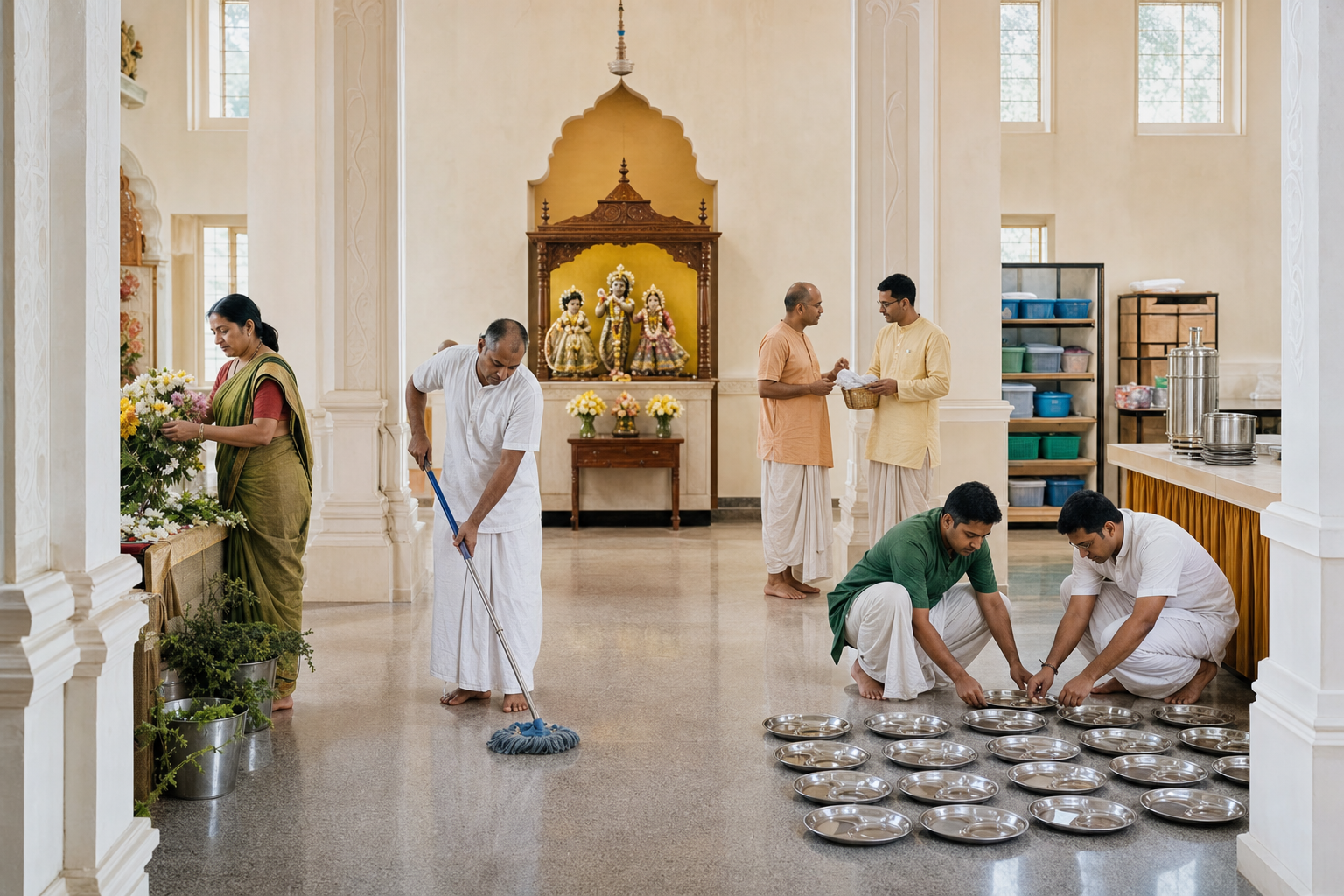
Public outreach begins before a visitor arrives. Clean surroundings, punctual programs, clear directions, respectful hospitality, maintained facilities, and orderly prasada service all shape whether someone feels able to return. These duties may appear ordinary, but they determine whether the temple’s public invitation can be trusted.
Temple-centered outreach can also travel beyond the building. The TOVP Marathon 2026 connected a shared seva mission with a Surinam and Guyana tour. That model carries a useful lesson: a temple project becomes public outreach when people are invited into a meaningful responsibility, not merely shown an impressive structure.
If you want to volunteer, do not begin by asking for the most prominent role. Ask the temple coordinator:
- Which task currently fails when no regular volunteer takes ownership?
- What training, authorization, or devotional standard applies to that task?
- When must it be completed, and who depends on it afterward?
- What should you do when you cannot attend?
- How will responsibility be handed to the next volunteer?
These questions separate an intention to help from an actual service commitment. If you accept responsibility for welcoming visitors, for example, learn the day’s program well enough to answer basic questions. If you help with cleaning or facilities, confirm which areas, materials, and timings are permitted. If you assist with worship, food, children, finances, transport, or security, follow the temple’s training and safeguarding requirements rather than improvising.
Consistency is the public message. A newcomer may not know the theology yet, but they immediately notice whether people keep promises, treat one another respectfully, and care for the sacred space.
Food relief must be judged by delivery, not capacity alone
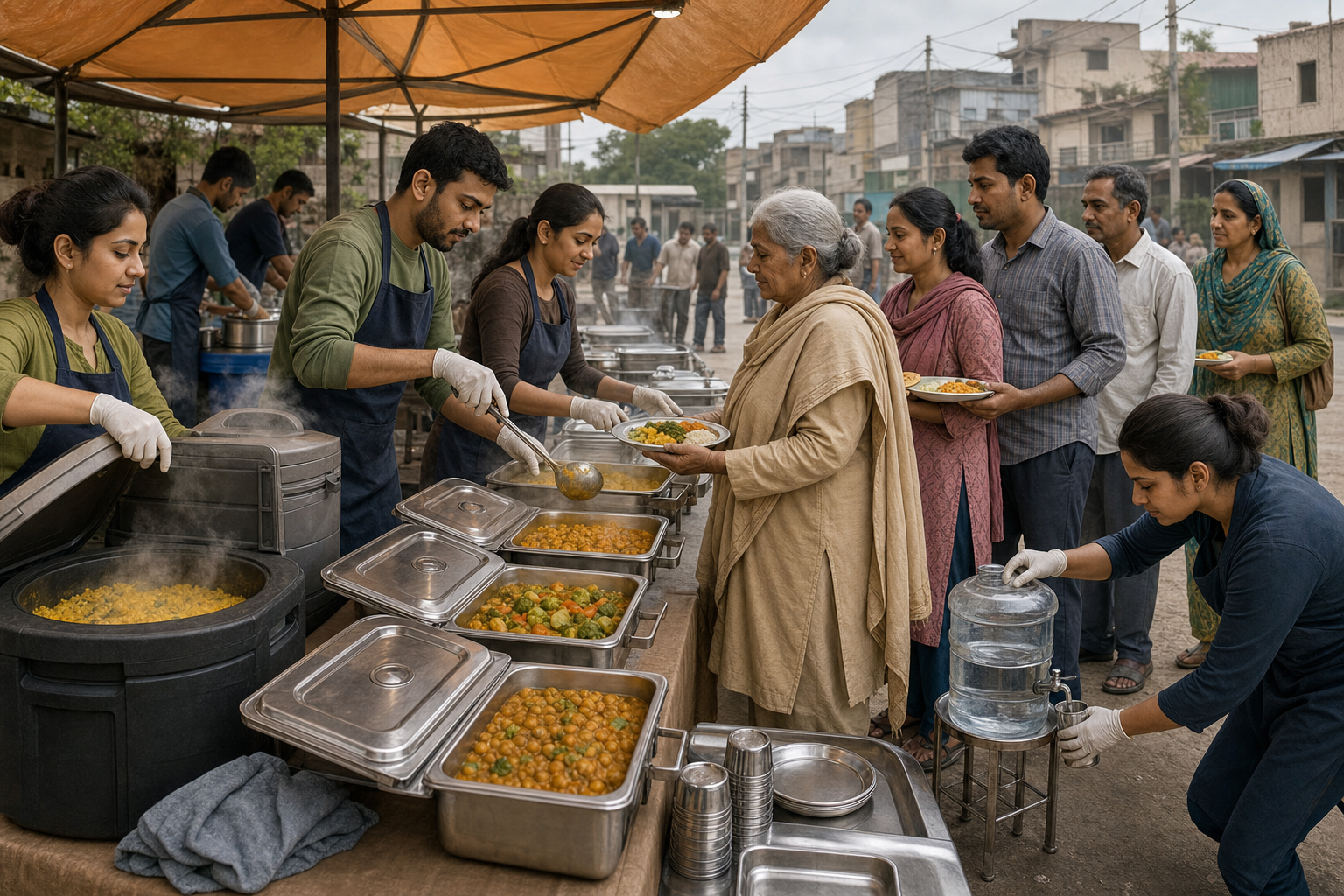
Food relief makes seva tangible to people who may never attend a temple or procession. It also brings a demanding test: compassion has to survive procurement, cooking, transport, timing, institutional coordination, and accurate reporting.
A new centralized kitchen in Kolkata is intended to begin by providing freshly prepared midday meals to approximately 44,000 students in hundreds of government and government-aided schools. Its expected reach may later rise to as many as 250,000 children through West Bengal’s school nutrition program.
The difference between approximately 44,000 initial recipients and capacity for as many as 250,000 is not a minor detail. The first figure describes the intended starting reach; the larger figure describes planned expansion. Supporters should never repeat maximum capacity as if it were current delivery. That mistake makes charitable work sound larger while making its real progress harder to evaluate.
If you are deciding whether to donate money, equipment, transport, or professional help, ask for the unit behind every claim:
- Does the figure describe meals prepared, meals dispatched, or meals received by students?
- Is it a current operating figure, an average, a target, or the kitchen’s maximum capacity?
- How many schools are active recipients rather than planned participants?
- Which part of the chain needs support: ingredients, kitchen operations, vehicles, delivery coordination, or serving?
- How are missed deliveries, closures, wastage, and food-safety concerns recorded and addressed?
This is not suspicion toward seva. It is respect for it. Clear measurement protects donors from exaggerated impressions, helps managers find bottlenecks, and keeps attention on the child receiving the meal.
Food relief also needs a clean ethical boundary. Nourishment should not be made conditional on listening to a religious message, joining a program, or displaying gratitude in public. The meal is service, not leverage. Devotional motivation is expressed most convincingly through the quality, dignity, and dependability of the care given.
Festivals let people encounter devotion before understanding it
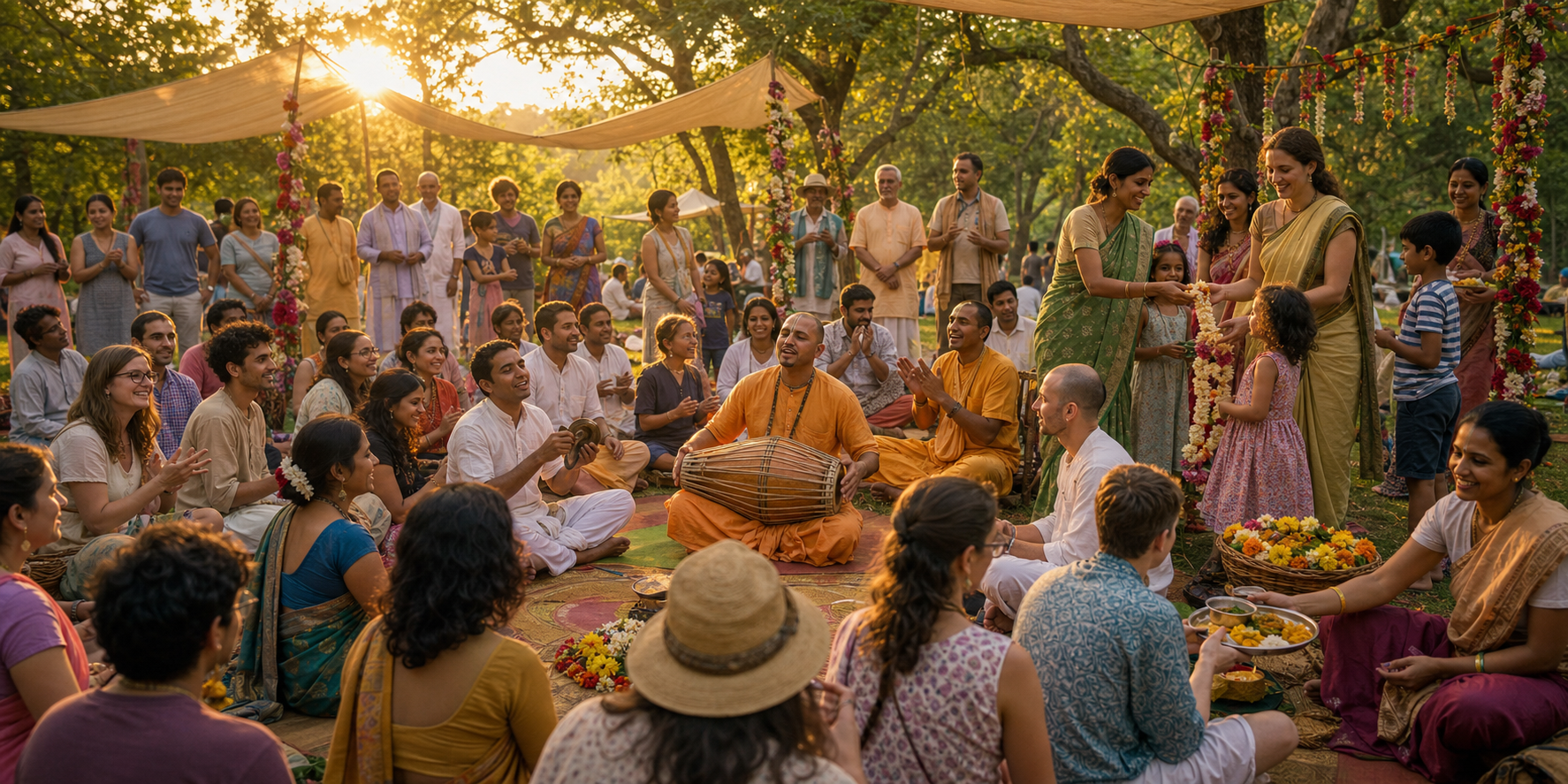
A public festival does something a leaflet cannot. It allows people to hear kirtan, see sacred images and ritual forms, watch a community cooperate, and decide at their own pace whether to come closer. The first encounter is embodied rather than argumentative.
On August 2, 2026, the 50th Annual Festival of the Chariots moved along Main Street in Santa Monica with three hand-pulled, ornately decorated chariots, each approximately 40 feet tall. The scale made Krishna devotion visible in an unmistakably public setting, while the act of pulling the chariots made participation central to the procession.
Visibility, however, is only the opening. A visitor still needs to know where to stand, what is happening, whether participation is welcome, where to find food or information, and how to learn more afterward. If those questions go unanswered, a striking procession can remain a spectacle viewed from the pavement.
Festival volunteers can close that gap at each stage:
- Before the event: attend the organizer’s briefing, learn your assigned area, know the public schedule, and confirm who has authority over safety decisions.
- During the event: offer plain directions, make space for families and people with mobility needs, keep routes clear, and refer questions you cannot answer rather than guessing.
- At devotional activities: explain what people may join, what they should not touch, and any temple or procession etiquette without scolding them for not already knowing it.
- After the event: help with cleanup, return equipment, report problems to the responsible coordinator, and direct interested visitors to an opt-in local contact or published program.
Do not improvise around a moving chariot or managed crowd route. Follow the designated stewards and event organizers. Enthusiasm does not override safety responsibility.
The tone of welcome matters just as much. A newcomer does not need to be cornered into a theological discussion. They need an honest answer to the question they are actually asking. Good festival outreach lets curiosity deepen naturally.
Key takeaways: choose the promise you can keep
- Choose temple service when you can carry a recurring duty and help make the sacred space consistently ready for worshippers and newcomers.
- Choose food relief when your skills fit logistics, institutional coordination, accounting, food operations, transport, or careful measurement of delivery.
- Choose festival service when you can prepare for a concentrated public event and help visitors move from spectatorship to informed, voluntary participation.
- If you donate, distinguish present reach from planned capacity and ask what defined outcome your contribution will support.
- If you are new to ISKCON service, attend first, observe how responsibility is assigned, and then accept a role through the local coordinator.
You can act now with a simple message to your nearest ISKCON community: state your available time, relevant skills, physical or scheduling limits, and willingness to take an unfilled responsibility. If you are considering a donation, ask for the current operating need and the unit used to report results. If a festival is approaching, request the volunteer briefing rather than arriving with a self-assigned role.
The most useful seva is rarely the one that produces the best photograph. It is the promise to worshippers, recipients, visitors, and fellow volunteers that you are prepared to keep.
References
- Dandavats – TOVP Presents: The TOVP Marathon 2026 | Surinam & Guyana Tour | One Goal, One Seva, One Mission
- Dandavats – Hon’ble Chief Minister of West Bengal Shri Suvendu Adhikari Inaugurates Annamrita Foundation’s Mega Kitchen
- Dandavats – Faith in Motion: Festival of the Chariots Dances Through Santa Monica
