
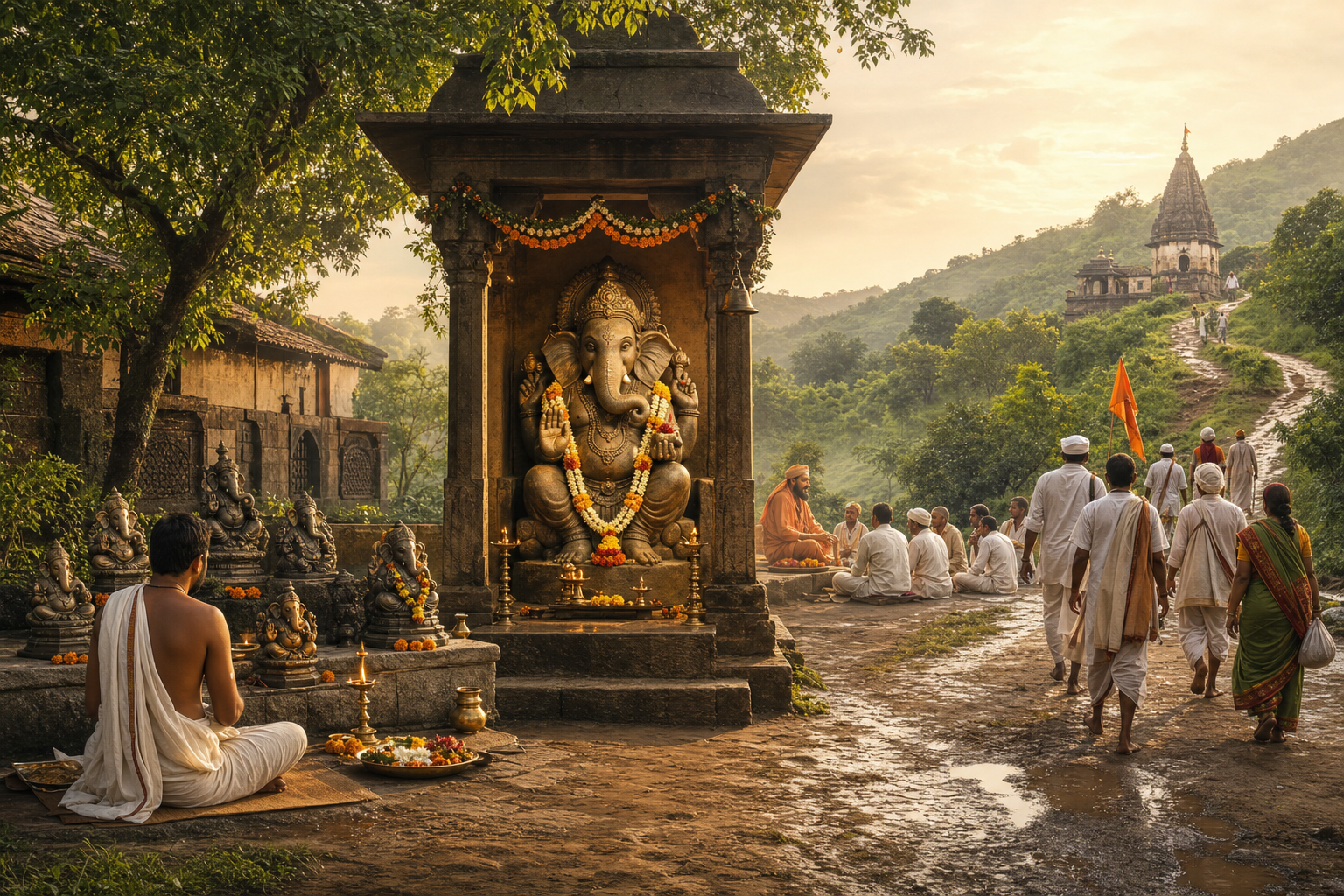
You may feel close to Ganesha yet remain unsure how several forms, a revered Maharashtrian saint, and a circuit of eight temples belong to the same devotion. Should you choose one practice, combine them, or regard one as more authentic than the others?
The useful answer is to see them as distinct disciplines. A form trains your attention. A saint gives devotion a remembered human life and community. A pilgrimage makes you carry that attention through time, distance, and place. Once you know what each mode asks of you, you can practise without flattening all three into generic Ganapati worship.
Begin with three different ways of approaching Ganesha
You do not need to decide which mode is highest before beginning. You need to notice what kind of relationship each one establishes.
- Rupa, or form: You attend to Ganesha through a particular name, image, and presentation. The form gives your attention boundaries. It prevents devotion from becoming a vague appeal to a vaguely remembered deity.
- Sant, or saint: You encounter devotion through a life remembered by a community. The saint may be honoured as a teacher, exemplar, bearer of grace, or divine manifestation, depending on the tradition making the claim.
- Tirtha and yatra, or sacred place and pilgrimage: You leave your normal setting and approach the deity through particular temples. Travel, waiting, local customs, and repeated darshan become part of the practice rather than inconveniences surrounding it.
This distinction gives you a quick diagnostic. If changing the named form would make no difference to your observance, you may not yet be attending to the form. If you know nothing about the saint beyond a divine label, the person has become a devotional shortcut. If the temples are merely pins on a map, the pilgrimage has become a road trip.
Choose the discipline your current practice lacks. If your worship has become automatic, work with form. If it has become solitary and detached from inherited memory, learn through a saintly tradition. If it exists only in thought, undertake a pilgrimage that makes your body, schedule, and conduct participate.
Nine forms should create continuity, not a collection
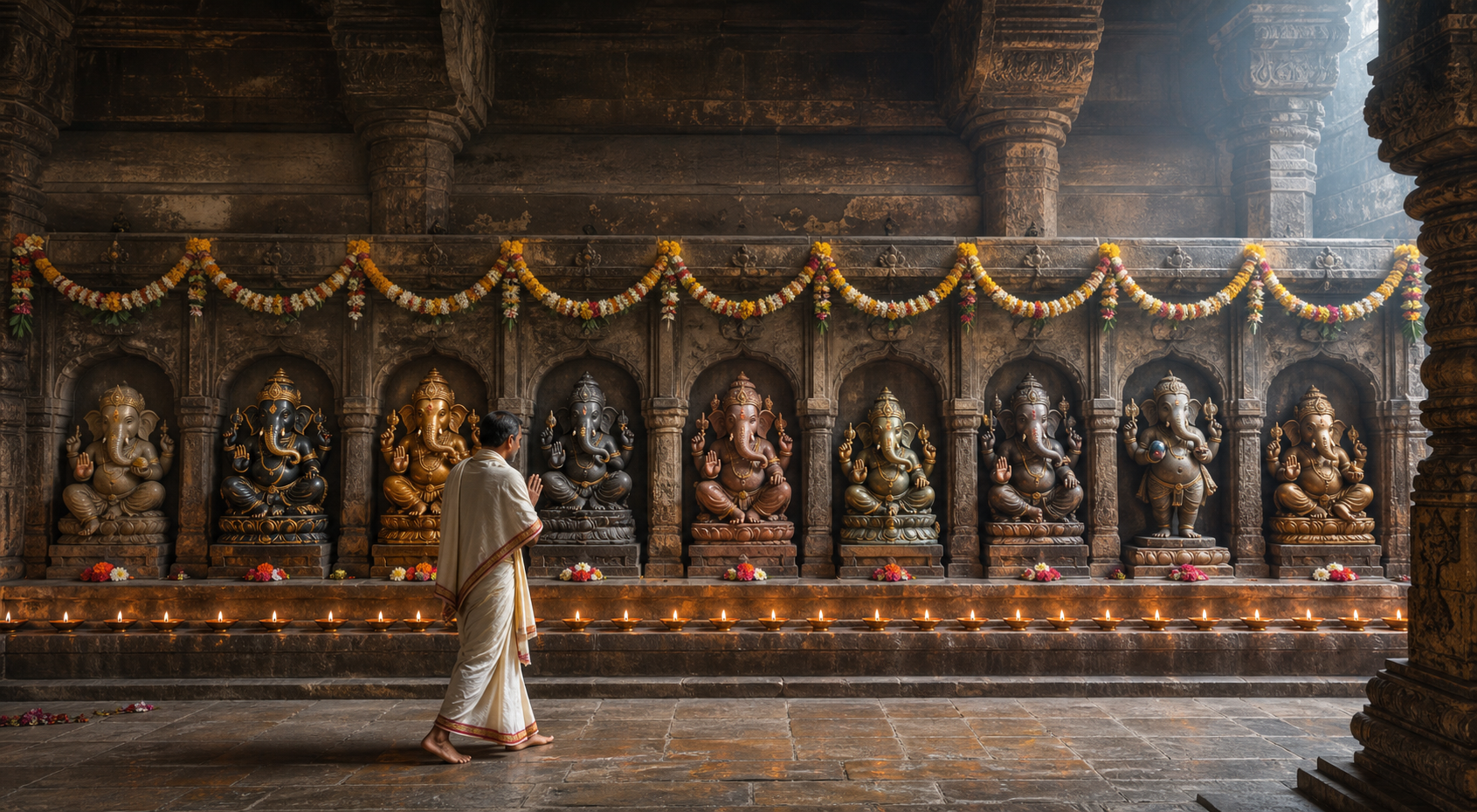
A nine-day Ganesh Chaturthi Navaratri observance places nine forms of Ganesha at the centre of worship. The pattern is associated with Puranic traditions named in the Ganesha Purana, Mudgala Purana, and Matsya Purana. Its practical strength lies in sustained attention: you return on successive days, but the form before you changes.
Do not begin by gathering nine attractive images from unrelated places. First determine which temple, sampradaya, family calendar, or teacher you intend to follow. Ask for the exact names, order, and prescribed worship. If two lists differ, that is a reason to identify their traditions, not an invitation to manufacture a supposedly universal sequence.
You can then give the nine days a clear structure without pretending that your personal method is an inherited ritual:
- Write down the form exactly as your tradition names it. Preserve spelling and order. Do not silently substitute a more familiar name.
- Keep one devotional anchor stable. Use the same manageable time and place each day, while following the actual ritual directions you have received. Stability lets the change of form become noticeable.
- Observe before interpreting. Note the name and the features your tradition emphasizes. If no meaning has been supplied for a feature, leave it open rather than assigning symbolism from memory or social media.
- Name one obstacle honestly. Ask not only what you want Ganesha to remove, but how your own habit, avoidance, pride, or confusion helps maintain it. Choose one corrective action small enough to complete that day.
- Review the sequence after the ninth day. Look for changes in your attention and conduct. Do not rank the forms or declare one spiritually superior because it produced the strongest emotion.
The key mechanism is repetition with difference. Repetition keeps you from chasing novelty; difference keeps repetition from becoming mechanical. A nine-form observance has done useful work when you can recognize what was particular about each encounter and identify at least one change that continued beyond its assigned day.
Gajanan Maharaj shows how saint and deity can meet
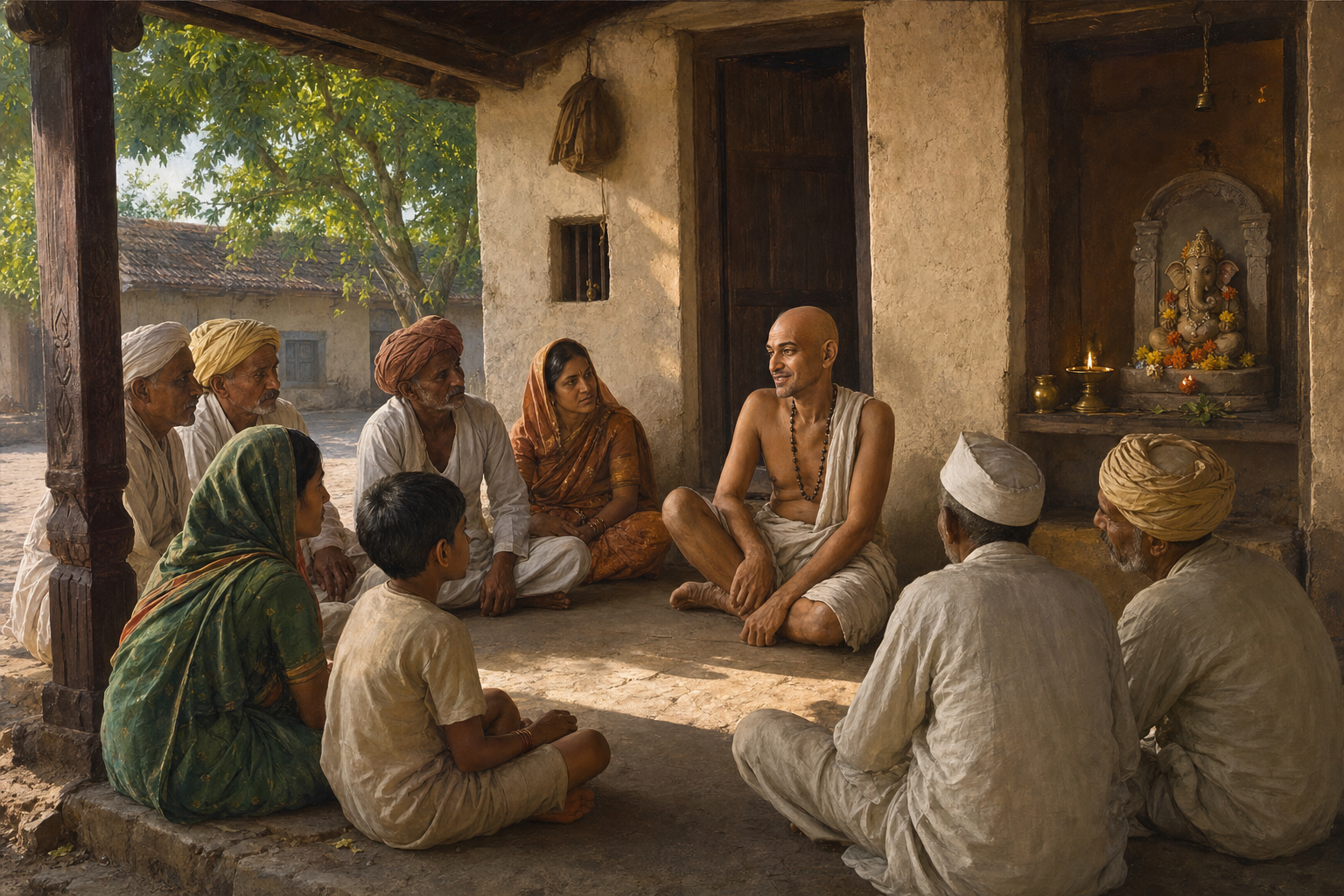
Sant Gajanan Maharaj belongs to Maharashtra’s devotional world and is remembered as first appearing at Shegaon as a young man and revered as an incarnation of Lord Ganesha. That last statement is a devotional claim held by his community. It should be expressed with conviction where it is inherited and with precision where readers may belong to other Hindu traditions.
Three layers are present, and confusing them weakens rather than strengthens devotion:
- Ganesha is the deity toward whom the divine identification points.
- Gajanan Maharaj is the guru and sant remembered in connection with Maharashtra and Shegaon.
- Recognition of him as an incarnation of Ganesha is the community’s theological understanding of that saintly life.
You can therefore honour the tradition without turning its claim into a compulsory doctrinal test for every Hindu. Equally, you should not enter a Gajanan Maharaj observance and reduce the community’s conviction to mere poetic comparison. Respect requires hearing a tradition in its own vocabulary before translating it into yours.
Punyatithi adds a fourth layer: sacred remembrance in time. It commemorates the saint’s passing rather than functioning as a generic Ganesha festival. In 2026, Gajanan Maharaj Punyatithi falls on September 15.
If you plan to participate, make the date change your behaviour now:
- Mark September 15, 2026, rather than relying on a last-minute reminder.
- Identify the Gajanan Maharaj community or temple whose observance you will follow, and obtain its announced schedule directly.
- Ask whether you are attending primarily for remembrance of the sant, worship of Ganesha through the sant, community service, or darshan. More than one may apply, but naming your intention will stop you from drifting through the event.
- Use the community’s authorized account of the saint’s life if you prepare through reading or listening. Do not build your understanding from isolated miracle claims detached from the tradition that preserves them.
- After the observance, write one sentence about the quality you are being asked to embody. A saint has become spiritually relevant when remembrance alters conduct, not merely when a date has been observed.
This is the crucial difference between studying a divine form and approaching a saint. A form concentrates attention through iconography and name. A saintly tradition asks what divine presence looked like in a remembered life and what loyalty to that memory now asks of you.
Make the Ashtavinayak Yatra more than eight arrivals

Ashtavinayak means eight Ganeshas. The Ashtavinayak Yatra joins eight ancient holy Ganapati temples in and around Pune, each associated with a distinct Ganesha murti. The number matters, but distinctness matters just as much. You are not visiting the same interchangeable image eight times.
Before you leave
Decide whether you are undertaking the complete eight-temple yatra or visiting selected temples. Both can be meaningful, but they are not the same claim. If you reach only part of the circuit, describe it plainly as a partial visit rather than treating intention as completion.
- Obtain the route and any traditional ordering from a reliable temple or pilgrimage authority connected with the circuit.
- Verify current darshan hours, closures, transport, and access conditions directly before booking. Sacred status does not make logistical information permanent.
- Create a page with eight empty rows. For each stop, leave space for the local name, one visible feature of the murti, one teaching or custom learned there, and one change in your own prayer.
- Leave interpretations blank before the journey. A pilgrimage should allow the places to instruct you rather than merely confirm a chart completed at home.
At each temple
Pause long enough to encounter the particular murti. Notice the form as it is presented, including the trunk when local iconography calls attention to it. Record the temple’s own terminology before reaching for a generalized symbolic explanation.
- Write the local name accurately.
- Record one feature that distinguishes this murti from the previous one.
- Note one instruction, custom, or account actually given at the site.
- State the prayer or concern you carried into the temple in one sentence.
- Before leaving, ask whether that prayer became more precise, less self-centred, or more demanding of your own action.
Do not let documentation consume darshan. If photography is restricted, put the phone away without treating the rule as an obstacle to your pilgrimage. Your notebook exists to sharpen attention afterward, not to place a screen between you and the murti.
After the eighth temple
Read your eight entries side by side. Look for movement rather than a favourite stop. Did your requests change? Did one temple expose impatience, another gratitude, and another reluctance to act? Those observations are more useful than ranking architecture, crowds, or emotional intensity.
Then choose one practice to carry home. It might be greater care in addressing a particular form, a promise connected with the purpose of your yatra, or a change in how you approach your local temple. Without that return movement, the circuit remains completed geographically but unfinished devotionally.
Key takeaways for choosing your next practice
- Choose nine-form worship when you need disciplined continuity and closer attention to Ganesha’s particular forms.
- Get the exact nine names and their order from one identifiable tradition; do not present a mixed personal list as universal practice.
- Approach Gajanan Maharaj through the distinction between deity, sant, incarnation claim, and Punyatithi remembrance.
- Mark September 15 if you intend to observe Gajanan Maharaj Punyatithi in 2026, then confirm the actual programme with the community hosting it.
- Undertake Ashtavinayak as an encounter with eight distinct murtis, not an exercise in collecting eight photographs.
- Measure every practice by what it makes you notice and do, not by how many forms, events, or temples you can say you completed.
Choose one doorway for your next devotional cycle. Write down its name, the tradition or community you will follow, and the concrete act by which you will know the encounter changed you. That single commitment will take you further than combining forms, saint, and pilgrimage before you have learned to attend to any one of them.
References
- Hindu Pad – Gajanan Maharaj Punya Tithi 2026
- Hindu Pad – 9 Days of Ganesh Chaturthi Navaratri | 9 forms of Ganesha Pooja
- Hindu Pad – Ashtavinayak Temples near Pune | Eight Holy Ganesh Temples in Maharashtra
